What Cars Qualify for the EV Tax Credit in 2026? (It Ended)
No car qualifies for the federal EV tax credit anymore. The $7,500 credit for new electric vehicles and the $4,000 credit for used ones both ended for any vehicle acquired after September 30, 2025, and there is no version of the credit currently available in 2026, regardless of the make, model, battery size, or your income.
That is a real change, not a rumor: the credit was worth up to $7,500 on a new EV and $4,000 on a used one, and it disappeared under the One Big Beautiful Bill Act (OBBBA), which President Trump signed on July 4, 2025. The only people who can still claim it are buyers who signed a binding purchase contract and made a payment on or before September 30, 2025, even if the car was delivered later.
This guide walks through exactly what changed and when, which vehicles used to qualify (useful if you are filing an amended return or checking a late-2025 purchase), how the binding-contract exception works, and what savings are actually still on the table in 2026, including state rebates, a separate federal credit for home chargers, and a new car-loan interest deduction.
What Happened to the Federal EV Tax Credit
The federal EV tax credit was not one single program. It was three separate tax credits created or expanded by the 2022 Inflation Reduction Act: Section 30D for new clean vehicles (up to $7,500), Section 25E for used clean vehicles (up to $4,000), and Section 45W for commercial clean vehicles, mostly used by businesses and fleets leasing EVs. All three were originally scheduled to run through 2032.
The One Big Beautiful Bill Act ended that timeline nearly seven years early. Congress passed the bill in June and July 2025, and it terminated Sections 30D, 25E, and 45W for any vehicle acquired after September 30, 2025. The bill also accelerated the phase-out of the 45X battery manufacturing credit and made other changes to clean-energy tax provisions, but the part that affects car buyers directly is the elimination of the purchase credits.
In practice, that means if you buy or lease a new or used EV today, the price you see is the price you pay. There is no federal credit to apply at the dealership and nothing to claim on your tax return for a purchase made after September 30, 2025, outside of the narrow exception covered further down.
STILL-ACTIVE EV SAVINGS
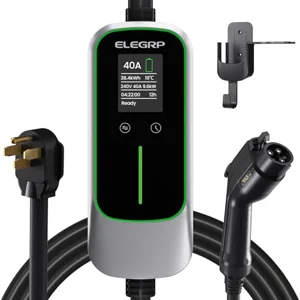 |
ELEGRP Level 2 EV Charger, 40 Amp – $209.99 The federal purchase credit is gone, but the separate 30C federal credit for home EV charging equipment is still active through mid-2026, and a Level 2 charger like this one cuts charging time from a full day to a few hours.
|
Which EVs Used to Qualify for the $7,500 Credit
Before it expired, the new-vehicle credit came with several eligibility rules that determined whether a car qualified at all, and whether it qualified for the full $7,500 or a reduced $3,750:
- Final assembly in North America. The vehicle had to be assembled in the United States, Canada, or Mexico. This alone disqualified many imported EVs.
- Price caps. $80,000 MSRP or less for vans, SUVs, and pickup trucks; $55,000 MSRP or less for cars and everything else.
- Income limits. Modified adjusted gross income capped at $300,000 for joint filers, $225,000 for heads of household, and $150,000 for single filers (using either the current or prior tax year, whichever was lower).
- Battery sourcing requirements. A rising percentage of battery critical minerals had to come from the U.S. or a free-trade partner, and a rising percentage of battery components had to be manufactured or assembled in North America. Meeting only one of the two requirements cut the credit to $3,750; meeting neither meant $0.
Those sourcing rules changed every year and sometimes every quarter, which is why the exact credit amount for a given trim could shift without the car itself changing. As a general reference, these were the kinds of vehicles that typically qualified for some level of credit during 2025, before the program ended:
| Vehicle (2025 model year) | Typical credit before expiration | Notes |
|---|---|---|
| Tesla Model 3 and Model Y | Up to $7,500 | Domestic battery assembly kept most trims at the full amount |
| Chevrolet Bolt EV / EUV, Equinox EV, Blazer EV | Up to $7,500 | GM built these EVs and their battery packs in North America |
| Ford F-150 Lightning | Up to $7,500 | Mustang Mach-E trims sometimes qualified for less due to battery sourcing |
| Cadillac Lyriq, Chevrolet Silverado EV | Up to $7,500 | Same GM North American assembly and battery sourcing |
| Volkswagen ID.4 | Up to $7,500 | Assembled at Volkswagen’s Chattanooga, Tennessee plant |
| Rivian R1S / R1T | Up to $3,750 | Partial credit due to battery component sourcing |
| Hyundai Ioniq 5, Kia EV6 / EV9 | Varied, up to $7,500 | Only after Hyundai’s Georgia (Metaplant) production ramped up in 2025; earlier Korean-built units did not qualify |
This list is a historical reference, not a current one. If you bought one of these vehicles before September 30, 2025, and never claimed the credit, talk to a tax professional about whether you can still file or amend a return for that tax year. If you are shopping now, none of this applies to your purchase.
What About the Used EV Tax Credit?
The used clean vehicle credit under Section 25E worked differently, but it is gone for the same reason. Before it expired, a used EV could qualify for a credit equal to 30% of the sale price, capped at $4,000, if the vehicle was at least two model years old, sold by a licensed dealer for $25,000 or less, and it was the first resale of that vehicle since the original owner qualified for a clean vehicle credit. Income limits applied too, capped lower than the new-vehicle credit at $150,000 joint, $112,500 head of household, and $75,000 single.
Like the new-vehicle credit, Section 25E ended for any used EV acquired after September 30, 2025. A used electric car bought today does not qualify for any version of this credit, no matter how old it is or how little it costs.
Is There Any Way to Still Claim the Credit?
There is one narrow exception. If you signed a binding written purchase agreement and made a payment, even a small deposit, on or before September 30, 2025, the IRS allows you to still claim the credit for that vehicle once it is placed in service, even if delivery happened weeks or months later. This mainly helps buyers who ordered a car that was on backorder or in production when the credit ended.
- The contract has to have been legally binding under state law, not just a reservation deposit that either side could cancel penalty-free.
- A nominal down payment is generally enough to satisfy the payment requirement.
- You still file IRS Form 8936 (Clean Vehicle Credit) with your tax return for the year the vehicle was placed in service, not necessarily the year you signed the contract.
- If you are unsure whether your specific purchase agreement qualifies, a tax professional or the dealer’s finance office can usually confirm it against your paperwork.
Outside of this exception, there is currently no legislative path back to the credit. Congress would need to pass a new law to reinstate any version of Section 30D or 25E, and no such bill has been signed as of this writing.
What EV Savings Are Still Available in 2026
The federal purchase credit is gone, but it was never the only way to save money on an EV. A few programs are still active in 2026:
| Program | What it covers | Status in 2026 |
|---|---|---|
| Section 30C federal charger credit | 30% of the cost to buy and install home EV charging equipment, up to $1,000 for individuals | Still active for equipment installed through June 30, 2026, in eligible census tracts |
| New car loan interest deduction | Up to $10,000 per year in interest on a loan for a new, U.S.-assembled vehicle (gas or electric) | Available for loans originated 2025 through 2028; phases out above $100,000 MAGI single / $200,000 joint |
| State and utility EV incentives | Rebates, tax credits, or reduced electricity rates that vary by state and utility provider | Vary widely; several states still have income-qualified programs running |
The car loan interest deduction is worth a second look even though it is not EV-specific. It applies to any new vehicle assembled in the United States, with a gross vehicle weight rating under 14,000 pounds, as long as the VIN is reported on your return. For a buyer financing a U.S.-built EV, that deduction can meaningfully offset part of what the purchase credit used to cover, though it works differently since it reduces taxable income rather than your tax bill directly.
EVs also still cost less to live with day to day than gas cars in most cases, from cheaper electricity than gasoline to less frequent routine servicing, since there is no oil to change and far fewer moving parts to wear out. That ongoing savings gap is smaller now that the upfront credit is gone, which is exactly what our guide on whether electric cars are still expensive in 2026 breaks down in more detail.
State EV Incentives That Are Still Active
With the federal credit gone, state-level programs are now the main source of EV purchase help, and most of the ones still funded are income-qualified rather than open to every buyer. Two examples of what is currently active:
- California: The Driving Clean Assistance Program and Clean Cars 4 All offer grants, in some cases up to $14,000, to income-qualified buyers who scrap an older, high-polluting vehicle for an EV or plug-in hybrid. Separately, the state’s MyFirstEV program, launched in mid-2026, gives first-time EV buyers an instant $3,500 rebate on a new EV priced under $50,000 (or $1,750 on a qualifying used EV), applied at the point of sale through participating automakers. California’s older Clean Vehicle Rebate Project stopped accepting new applications back in November 2023 and has not reopened.
- Colorado: The state’s Innovative Motor Vehicle Credit offers a base credit of $750 on qualifying new EVs, plug-in hybrids, or hydrogen fuel-cell vehicles under $80,000 MSRP, with an extra $2,500 available on vehicles priced under $35,000. Colorado also runs Vehicle Exchange Colorado, a point-of-sale rebate up to $6,000 for income-qualified residents trading an older vehicle for a used EV.
These programs change funding levels and rules frequently, and many other states run their own versions. Check your state energy office’s website and your local electric utility before assuming an incentive is still funded or that you qualify.
Frequently Asked Questions
Is there still a federal EV tax credit in 2026?
No. The $7,500 credit for new EVs and the $4,000 credit for used EVs both ended for any vehicle acquired after September 30, 2025, under the One Big Beautiful Bill Act. No new or used electric vehicle purchased today qualifies for either credit.
What cars used to qualify for the $7,500 EV tax credit?
Vehicles assembled in North America that met price caps ($55,000 for cars, $80,000 for trucks, SUVs, and vans), income limits, and battery sourcing rules typically qualified for some level of credit before September 30, 2025. Examples included the Tesla Model 3 and Model Y, Chevrolet Bolt, Equinox EV, and Blazer EV, the Ford F-150 Lightning, and the Volkswagen ID.4, among others. Exact amounts varied by trim and changed as battery sourcing rules were updated.
Can I still get the used EV tax credit?
No. Section 25E, the used clean vehicle credit worth up to $4,000, ended for any used EV acquired after September 30, 2025, the same date as the new-vehicle credit.
Is there any way to still claim the EV tax credit?
Only if you signed a binding written purchase contract and made a payment on or before September 30, 2025, even if the vehicle was delivered afterward. You would still file IRS Form 8936 for the year the vehicle was placed in service. Outside of this exception, the credit is not available.
What replaced the EV tax credit?
Nothing replaced it directly. A new deduction lets buyers of any new, U.S.-assembled vehicle, not just EVs, deduct up to $10,000 per year in loan interest through 2028, subject to income limits. A separate federal credit for home EV charging equipment is still active through June 30, 2026, and some state and utility incentives remain, but there is no direct federal purchase credit replacing the old $7,500 and $4,000 amounts.
Are state EV incentives still available in 2026?
Yes, in many states, though most current programs are income-qualified rather than open to every buyer. California and Colorado both still run active programs as of 2026; other states vary. Check your state energy office and local utility for current details, since funding and rules change frequently.
Conclusion
No car qualifies for the federal EV tax credit in 2026. The $7,500 new-vehicle credit and $4,000 used-vehicle credit both ended for purchases after September 30, 2025, and only a narrow binding-contract exception lets a small number of late-2025 buyers still claim it. If you are shopping for an EV now, plan on the sticker price being the real price, then look at what is still available: a federal credit for home charging equipment through mid-2026, a new car loan interest deduction for U.S.-assembled vehicles, and whatever state or utility programs your area still funds.
Products related to this article
Sponsored / affiliate links. As an Amazon Associate I earn from qualifying purchases. I may earn additional commission from eligible campaigns.