Transmission Cooler Review: Is It Worth the Upgrade?
A transmission cooler pays off if you tow a camper trailer, crawl off-road, or sit in hot traffic; a stacked-plate cooler with a thermostat is the safest all-around choice, while heavy towing at low speed often needs a plate-and-fin cooler with fan support. Heat drives fluid oxidation, sloppy shifts, and faster clutch wear.
Verdict

For most owners, the choice is not “cooler or no cooler.” It is which cooler matches the duty cycle. The Dbsheep 40K unit is the best starting point here because it fits the common towing-upgrade brief: add capacity, keep plumbing simple, and avoid a universal one-size-fits-all install that can be too small or too airflow-dependent.
Specs at a glance
| Product | Cooler type | Capacity / rating | Fittings / hardware | Price |
|---|---|---|---|---|
| Dbsheep 40K Transmission Cooler – Replacement for Tru-Cool LPD47391 | Low Pressure Drop stacked-plate | 40,000 GVW cooling efficiency | Complete installation hardware kit | $64.97 |
| Ucreative 30 Row AN10 Stacked Plate Aluminum Engine Transmission Oil Cooler | 30 row stacked plate | High cooling efficiency | Multiple AN fittings | $89.99 |
| WIT 677 Rapid-Cool Transmission Oil Cooler | Plate & fin | Up to 14,000 GVW | 3/8-inch push-on fittings, hardware, hose, clamps | $51.58 |
Who it is for
This guide fits owners of automatic vehicles who tow a camper trailer, move slowly on trails, or live where ambient heat stays high for long stretches. It also suits drivers who want to confirm whether the factory radiator cooler is enough before adding more plumbing.
It is less useful for light commuter use with no load, no heat soak, and no extended low-speed operation. In that case, temperature monitoring may be the better first step.
What a transmission cooler does
An automatic transmission cooler removes heat from fluid after load raises temperature. That matters because transmission heat climbs quickly under torque converter slip, climbing grades, stop-and-go towing, and crawling in soft terrain. When fluid runs hot for long periods, oxidation accelerates and friction materials age faster.
Normal operating range varies by transmission design, but the broad goal is steady, controlled temperature rather than swings into the danger zone. A cooler does not fix worn clutches or bad fluid. It simply reduces heat load so the transmission is not forced to shed as much of it through the radiator alone.
How an external cooler changes the system
An external air-to-oil cooler sits inline with the transmission fluid path, often after the factory radiator cooler or in a combined loop. That extra heat exchanger adds cooling capacity without changing internal transmission parts. The tradeoff is more hose, more fittings, and more chances to route plumbing poorly.
Pros and cons
- Pros: lower heat under load, better fit for towing, and optional fan support where vehicle speed is low.
- Pros: can be added to a factory radiator cooler path.
- Cons: extra plumbing, possible overcooling in mild use, and more installation complexity.
- Cons: poor placement or restrictive hose routing can erase much of the benefit.
What size transmission cooler do you need?
Size should follow the vehicle’s real duty cycle, not a generic “bigger is better” rule. A light daily driver may only need monitoring or a modest auxiliary cooler, while a trailer tow rig in hot weather needs more core area, better airflow, and sometimes a fan-assisted package.
Plate count, core size, fitting size, and BTU per hour rating all matter. Davies Craig lists a 30-plate transmission cooler and a 21-plate cooler rated at 13,934 BTU per hour, with the 21-plate core measuring 213mm tall and 281mm wide and using 3/8-inch inlet fittings. Those are the kinds of details that tell you whether a cooler is likely to fit and flow well.
Thermostat strategy matters
A thermostatic switch prevents a cooler from running all the time when ambient temperatures are mild. Davies Craig’s setup includes an inline thermo switch costing $40, which is a useful pattern for owners worried about overcooling in winter or in unloaded commuting.
Decision table: choose the right setup
| Use case | Ambient temperature | Tow weight / load | Driving speed | Recommended setup |
|---|---|---|---|---|
| Daily commuting, no towing | Mild | None | Mostly steady road speed | No cooler yet; monitor transmission fluid temperature first |
| Camper trailer towing | Warm to hot | Moderate | Mixed road, some hill work | Stacked-plate external cooler, inline with factory radiator cooler, thermostat preferred |
| Heavy towing in traffic | Hot | High | Low speed or stop-start | Fan-assisted transmission cooler with thermostatic switching |
| Off-road crawling | Warm or hot | Moderate to high load | Low speed | Fan-assisted cooler with careful mounting and protected hose routing |
| Hot-climate daily driver with occasional load | Very hot | Light to moderate | Mostly highway | Moderate stacked-plate cooler; add monitoring before going large |
Checklist to confirm whether the factory cooler is enough
- Check whether the vehicle tows a camper trailer, carries heavy payload, or spends time off-road.
- Watch transmission fluid temperature with an OBD2 reader.
- Note whether heat climbs mainly at low speed, on grades, or in traffic.
- Inspect whether the factory radiator cooler is already part of a combined loop.
- Confirm there is enough space for airflow, not just physical fit.
- If temperatures stay controlled under load, postpone the upgrade.
What works and what does not
Good mounting puts the cooler in real airflow and keeps it away from blocked grille sections, heat-soaked exhaust parts, and flimsy brackets. Hose routing should be short, smooth, and secure. Push-on fittings and a quick-fit kit make installation cleaner, but only if the lines do not kink under engine movement.
Thermostatic switching is a smart default. So is monitoring. An OBD2 reader or inline thermo switch gives you installation decision support instead of guessing. A common first-timer mistake is mounting a cooler where it looks convenient, then discovering that low-speed airflow never reaches the core.
Another failure mode is restrictive plumbing. Too many tight bends, undersized hose, or a poorly chosen fitting size can choke flow and reduce the benefit of a larger core. Overcooling is the other risk. A cooler that is too large for mild use can keep fluid below the range the transmission wants for efficient operation.
What the mounting location should solve
Where should a transmission cooler be mounted? As high as practical for protection, but still in a spot that gets direct airflow. Fan-assisted coolers relax that requirement because the fan creates forced airflow at low speed, which helps on trails, in traffic, and when the vehicle is crawling under load.
Alternatives

The WIT 677 Rapid-Cool is the simplest budget fit if you want a universal plate-and-fin cooler with 3/8-inch push-on fittings and included hardware. It suits full-size vehicles up to 14,000 GVW, but it depends more on vehicle speed and clean airflow than a fan-assisted option.
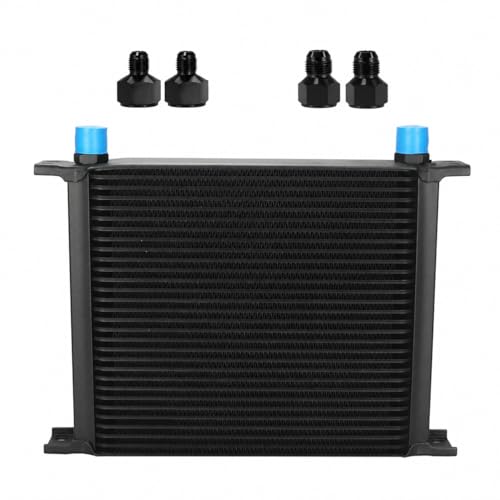
The Ucreative 30 Row AN10 stacked-plate cooler is the better pick when you want more connection flexibility through AN fittings and a sturdier stacked-plate layout. The drawback is cost, and the 30-row format can be more than a mild commuter needs.
For fan-assisted cooling, Davies Craig’s lineup is the reference point. The company offers a 30-plate transmission cooler with a 10-inch fan combo, a 21-plate cooler with an 8-inch fan combo, a 12V 30-plate fan combo, and a 24V version of the 30-plate fan combo. Davies Craig also lists a 30-plate Hydra-Cool transmission cooler and says the coolers are pressure tested. That kind of setup is strongest where speed is low and heat is persistent.
Should you buy it
Buy an external cooler if your automatic sees real heat load: towing, slow trail work, high ambient temperatures, or long uphill pulls. Buy a fan-assisted cooler when the vehicle spends time below useful ram-air speed. Skip the upgrade for ordinary commuting unless temperature monitoring shows the factory system is running near its limit.
For most shoppers, the Dbsheep 40K stacked-plate cooler is the best balance of capacity, price, and install simplicity. If your use pattern is more demanding at low speed, step up to a fan-assisted solution rather than oversizing a passive cooler and hoping airflow will be enough.
Frequently asked questions
is a transmission cooler worth it
Yes, if your automatic regularly sees towing, hill climbs, crawling, or hot-weather traffic. It is usually not worth adding one for a lightly loaded commuter that never approaches thermal stress. The right answer depends on measured heat, not habit or mileage alone.
will a transmission cooler help towing
Yes. Towing raises load-based heat generation because the transmission and torque converter work harder, especially on grades and in stop-start traffic. A cooler helps keep fluid temperature steadier, which is the point. It does not increase tow rating or fix poor towing technique.
what size transmission cooler do I need
Start with use case, then match core capacity to ambient heat, tow weight, and speed. Light towing in moderate weather can use a compact stacked-plate unit. Heavy towing in hot traffic usually calls for a larger core or a fan-assisted setup with thermostatic control.
should I use a fan-assisted transmission cooler
Use one if the vehicle sees low-speed operation, off-road crawling, or traffic where ram air is weak. A 12V or 24V fan adds forced airflow, which helps when vehicle speed cannot. Thermostatic switching is the better choice because it avoids unnecessary fan cycling.
where should a transmission cooler be mounted
Mount it where it receives real airflow, clear of obstructions and away from heat sources. The best location is often in front of the radiator or condenser, but fan-assisted units have more flexibility. Poor placement is a common reason a cooler underperforms.
which transmission cooler brands are worth buying
Based on the spec sheet and common use cases, the useful names here are Davies Craig for fan-assisted setups, Dbsheep for a budget stacked-plate option, Ucreative for AN-fitting flexibility, and WIT for a simple universal plate-and-fin cooler. Choose by fitment and duty cycle, not branding alone.
Products related to this article
Sponsored / affiliate links. As an Amazon Associate I earn from qualifying purchases. I may earn additional commission from eligible campaigns.