What Is Diminished Value and How Do You Claim It?
Diminished value is the drop in a car’s market value after repairs, and a claim is usually worth filing when you’re not at fault and the car is newer, higher-value, or had structural damage. File it carelessly, and you can lose real resale money while the insurer treats the loss like an ordinary repair issue. This guide shows how to judge the claim’s value and which records, photos, repair documents, and valuation evidence to send.
This guide is part of our Car Dealer Money Guide: Negotiating, Financing, Leasing, Trading In and Selling series.
What diminished value means
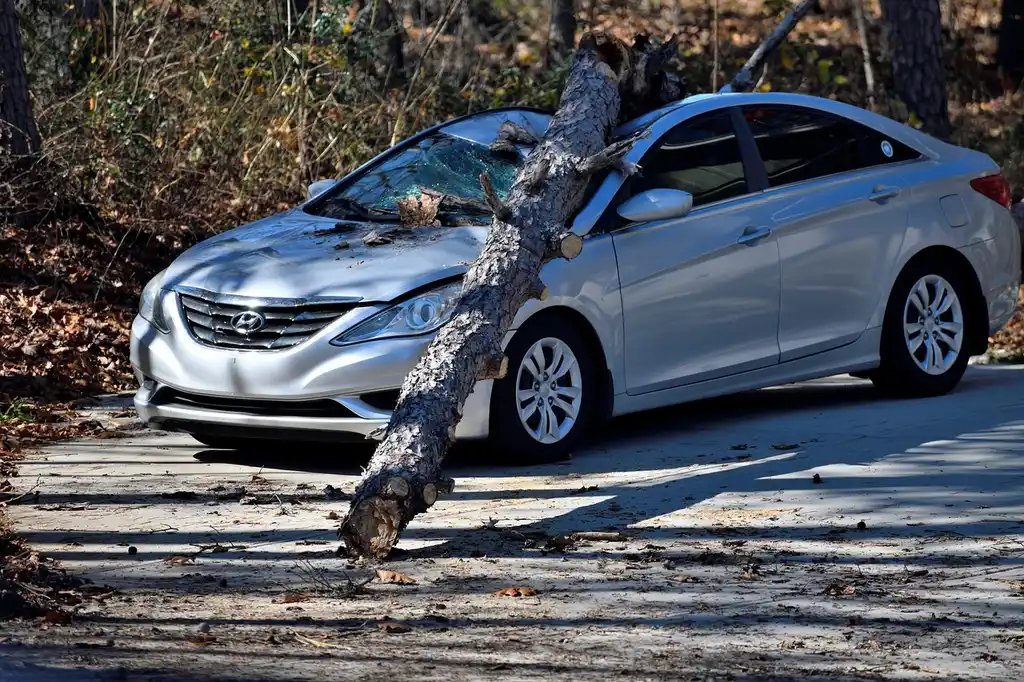
Diminished value is the post-repair drop in resale or trade-in value after an accident. Even when the body shop fixes the car correctly, buyers and dealers may still discount it because the vehicle now has accident history, and that history can follow it through a vehicle report and market check.
The key point is that the loss is tied to the market’s reaction, not just visible damage. A repaired car with prior structural damage often faces a bigger value hit than a car with a small bumper repair, because the first case changes buyer confidence more sharply.
Inherent diminished value versus repair-related loss
Inherent diminished value is the loss that remains after quality repairs simply because the car was damaged. Repair-related diminished value comes from imperfect repair work, such as mismatched paint, panel gaps, warning lights, wind noise, or other defects that should be fixed under the repair claim or a supplemental claim.
That split matters because the evidence changes. Inherent diminished value usually relies on market data, repair severity, and history reports. Repair-related loss needs workmanship proof, repair invoices, and photos that show what still is not right.
Can you claim diminished value?
Yes, but only when the facts and the policy line up. Third-party claims against the at-fault driver’s insurer are more common. First-party claims against your own insurer depend on state law and policy language, and many policies limit or exclude this coverage entirely.
Third-party claims
If another driver caused the crash, you can usually make the claim with that driver’s insurer after liability is accepted or reasonably clear. That carrier may still dispute the amount, but the legal footing is often stronger because you are seeking payment for loss caused by someone else’s negligence.
First-party claims
A first-party diminished value claim is filed with your own insurer. Some states allow it, some do not, and some policies narrow it through exclusions or claim language. Read the policy closely, because a routine collision claim does not automatically include post-repair market loss.
Lease status, prior damage, and branded titles
Leased cars can create extra friction because the leasing company may control the vehicle and the eventual disposition of the claim. Prior accident history, a salvage or rebuilt title, and other branding can weaken the case fast. If the market already discounts the car, the new loss may be smaller and harder to prove.
When a claim is worth filing
A claim is worth filing when the expected loss is large enough to justify the time, paperwork, and possible pushback. Newer cars, higher-value cars, and repairs involving structural damage or air bags usually create more room for a claim than an older car with light cosmetic damage. Mileage and prior damage can shrink that room quickly.
| Factor | Claim viability | Why it matters |
|---|---|---|
| Vehicle age under 5 years | Stronger | Buyers and dealers often discount newer cars more after an accident. |
| Vehicle age over 10 years | Weaker | Market value is already lower, so the post-accident drop is harder to prove. |
| Mileage under 60,000 | Stronger | Lower-mileage cars tend to carry more resale sensitivity to accident history. |
| Mileage over 100,000 | Weaker | High mileage gives the insurer an easy argument that value was already depressed. |
| Damage severity: structural, air bag, frame, or suspension | Stronger | Serious damage increases the chance of a real market discount. |
| Damage severity: minor paint or bumper repair | Weaker | Small claims often fail because the market discount is modest or disputed. |
| Prior accident history | Weaker | Previous losses make it harder to prove the new crash caused a fresh value drop. |
| No prior accident history | Stronger | A clean history report gives the claim more credibility. |
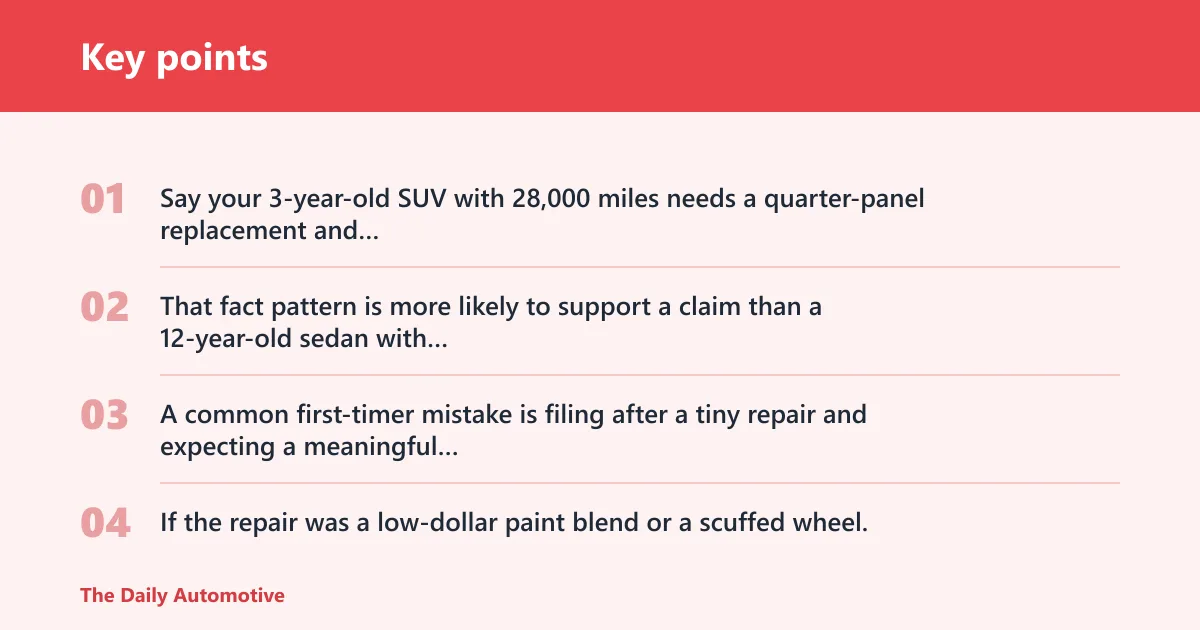
Say your 3-year-old SUV with 28,000 miles needs a quarter-panel replacement and suspension work after a left-front impact. That fact pattern is more likely to support a claim than a 12-year-old sedan with 132,000 miles and a scratched rear bumper.
A common first-timer mistake is filing after a tiny repair and expecting a meaningful payout. If the repair was a low-dollar paint blend or a scuffed wheel, the insurer may argue the loss is too small to matter in the market.
Claim packet checklist
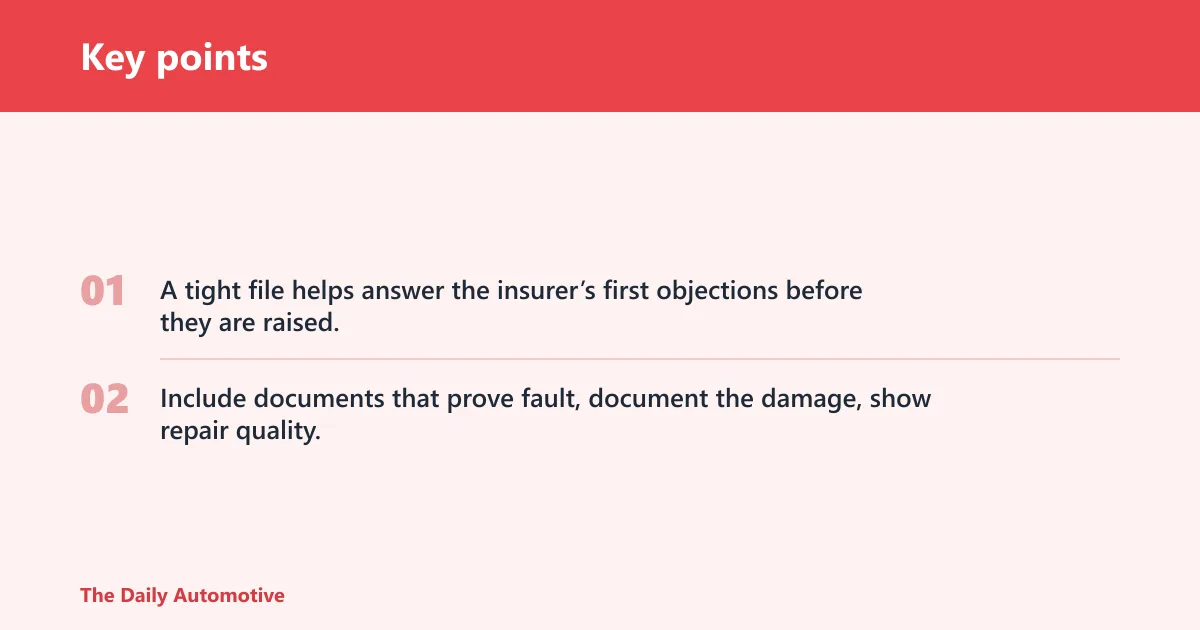
This packet is the part many claimants miss. A tight file helps answer the insurer’s first objections before they are raised. Include documents that prove fault, document the damage, show repair quality, and support the market loss with independent evidence.
| Document | Why it matters | What objection it defeats |
|---|---|---|
| Accident report or liability summary | Shows who caused the loss and who should pay. | “We have not accepted liability.” |
| Repair invoice | Lists the actual work completed and the repair categories. | “The damage was too minor to affect value.” |
| Parts list | Shows which components were replaced or repaired. | “There was no structural or major replacement work.” |
| Paint and labor records | Helps show the scope and quality of the repair. | “You have no proof of the repair extent.” |
| Before-and-after photos | Document damage and the finished repair, when available. | “The file lacks visual proof.” |
| Vehicle history report | Shows the accident entry that buyers may see later. | “The market will not know about this crash.” |
| Odometer record | Anchors mileage at the time of loss. | “The car has too many miles for a meaningful claim.” |
| Diminished value appraisal | Gives a written valuation that supports the amount claimed. | “Your number is speculative.” |
| Comparable sales or dealer quotes | Shows how similar repaired or accident-damaged cars are priced. | “There is no market evidence of loss.” |
| Claim letter with a specific demand | Sets out the amount sought and the basis for it. | “We never received a proper request.” |
Start by confirming liability and identifying the correct insurer. For a third-party claim, that is the at-fault driver’s carrier. For a first-party claim, it is your own insurer, if the policy and state law allow it. Then put the claim in writing, send it to the adjuster, and track response dates.
- Confirm fault and open the claim with the right carrier.
- Collect repair records, photos, and the vehicle history report.
- Order a diminished value appraisal if the case has real value.
- Prepare a written demand that states the amount and the basis.
- Submit the packet to the adjuster and save proof of delivery.
- Track the response window and any request for more documents.
How to request diminished value claim review
Your written request should be direct. State that you are seeking compensation for post-repair market loss, identify the accident date, list the claim number, and attach the supporting packet. Ask the adjuster to review the file and confirm the next step in writing.
If the insurer says it needs more time, ask for the specific document or valuation item it wants. Vague delays can drag the claim toward a deadline problem, especially if the statute of limitations is shorter than expected for property claims in your state.
How insurers price loss
Insurers often use their own formula, a staff appraiser, or a market comparison to set the number. Some formulas place heavy weight on vehicle age, mileage, and repair cost. Others focus on comparable sales for similar cars with accident history. The result is often lower than the amount a claimant first expects.
A diminished value appraisal can help because it puts the estimate in writing and explains the market method used. Good appraisals point to comparable vehicles, repaired damage scope, and the likely discount a buyer would expect. They do not guarantee payment, but they give the adjuster something harder to dismiss.
Suppose a 2022 crossover needed a front-end repair with hood, bumper, grille, and radiator support work. If the insurer values the loss by a low internal formula, a written appraisal that compares similar vehicles with and without accident history can challenge that assumption with specific market evidence.
If the insurer pushes back
Pushback usually comes as a low offer, a denial, or a claim that the repair restored full value. Respond with better proof, not general complaints. Use the appraisal, the repair records, the vehicle history report, and any comparable sales that show the market still discounts the car.
Low offers and denials
If the offer is low, ask the adjuster to explain which part of the valuation it disputes: mileage, repair severity, prior history, or market comparison. That tells you what evidence to improve. If the insurer ignores the claim or relies on a weak formula, request a supervisor review in writing.
Independent appraisal and complaints
If the file still goes nowhere, an independent appraisal may help separate market loss from the insurer’s internal estimate. A complaint to the state insurance department can also make sense when the carrier refuses to explain the basis for the denial or misses response deadlines. Use that step after the packet is complete, not before.
Frequently asked questions
What is diminished value and how does it work?
Diminished value is the post-repair market loss a car can suffer after an accident. The car may be fixed correctly and still sell for less because buyers see the crash history. Claims usually work by proving liability, documenting repairs, and showing the market discount with an appraisal or comparable sales.
Who can claim diminished value from an insurance company?
Usually, the strongest claim belongs to the vehicle owner against the at-fault driver’s insurer. In some states and policies, a first-party claim against your own insurer may also be possible, but that coverage is often limited or excluded. Lease status and title branding can weaken the case.
How is diminished value calculated on a car?
There is no single universal formula. Insurers and appraisers may consider vehicle age, mileage, repair severity, prior accident history, and market comparisons. The best evidence usually pairs a written diminished value appraisal with repair records and examples of similar cars that sell for less after damage.
What documents do I need to support a diminished value claim?
At a minimum, gather the repair invoice, parts list, paint and labor records, before-and-after photos if available, and a vehicle history report. Add a written demand and, if possible, an independent diminished value appraisal. Those records help defeat the usual objection that the loss is speculative.
How long do I have to file a diminished value claim?
The deadline depends on state law and, sometimes, on the type of claim and policy language. Do not assume the deadline matches a bodily injury or full property damage deadline. File early enough to leave room for appraisal review, supervisor review, and any insurer delay.
What if the insurance company denies my diminished value claim?
Request the reason in writing and ask which fact it disputes: liability, repair severity, mileage, prior history, or valuation method. Then respond with better evidence, such as an appraisal, repair records, and comparable sales. If the carrier still refuses to address the file, a supervisor review or state complaint may be the next step.
Products related to this article
Sponsored / affiliate links. As an Amazon Associate I earn from qualifying purchases. I may earn additional commission from eligible campaigns.