
How to Dispute a Low Total Loss Offer From Your Insurer
Dispute a low total loss offer by demanding the ACV breakdown, then challenging missing options, wrong mileage, weak comparables, or unsupported deductions with better local comps and repair records. A weak challenge can leave you short by hundreds or thousands, and stuck taking the first number. This guide shows you how to audit the valuation, build a line-item counteroffer, and decide when to escalate to a manager, appraisal clause, or regulator.
What a low total loss offer really means
A low offer usually means the insurer’s ACV number does not fully match the vehicle’s pre-loss market value. ACV should track the actual market for your exact trim, mileage, condition, and equipment, then reflect only deductions the carrier can document.
ACV is the payout basis
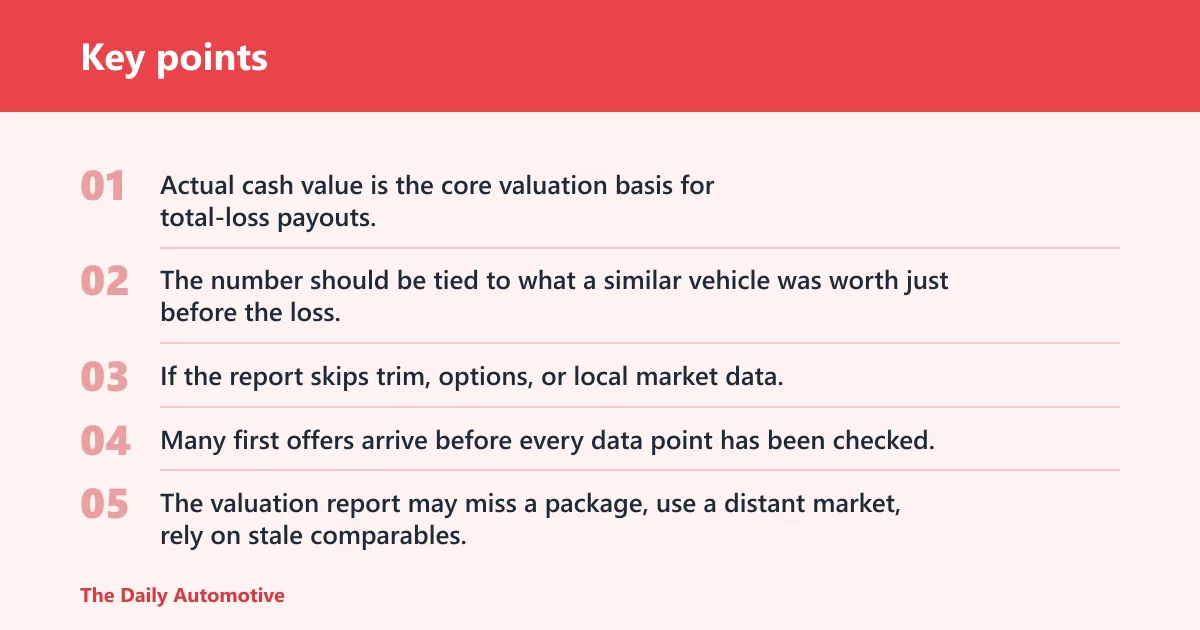
Actual cash value is the core valuation basis for total-loss payouts. The number should be tied to what a similar vehicle was worth just before the loss, not to a generic model average or a vague internal estimate. If the report skips trim, options, or local market data, the payout is easier to challenge.
Why the first offer is often incomplete
Many first offers arrive before every data point has been checked. The valuation report may miss a package, use a distant market, rely on stale comparables, or apply deductions without enough support. Treat the first number like a draft, not a final answer.
What the insurer has to justify
Ask what supports each line of the total loss settlement valuation report. A defensible offer should show the comparable vehicles used, the adjustments made, and the reason for every deduction. If the carrier cannot explain the math, focus the dispute on the weak line items, not the headline total.
Get the valuation report and comparables
Request the insurer’s total loss settlement valuation report, the full list of comparable vehicles, and any adjustment sheet that explains the final ACV. You need the data behind the number before you can attack it. A summary page alone is not enough to review the offer properly.
What to request from the adjuster
Ask for the complete valuation packet: the comp list, photos used in the file, condition adjustments, mileage basis, options list, salvage deduction, fee entries, and any market-area notes. If the insurer refuses full methodology and only gives a summary number, that refusal itself is a warning sign.
How to read the comp list
Comparable vehicles should be same or substantially similar year, make, model, trim, drivetrain, mileage, and options. They should also be local and recently sold or listed. A comp from another region, a different drivetrain, or a vehicle with major missing equipment is weaker evidence than a close local match.
What missing data signals a weak offer
If the report omits photos, trims, sold dates, mileage, or clear adjustment logic, press harder. Missing data does not prove fraud, but it does show the valuation may be incomplete. That is the point where a line-by-line counteroffer becomes more effective than a general complaint.
Total loss dispute audit checklist
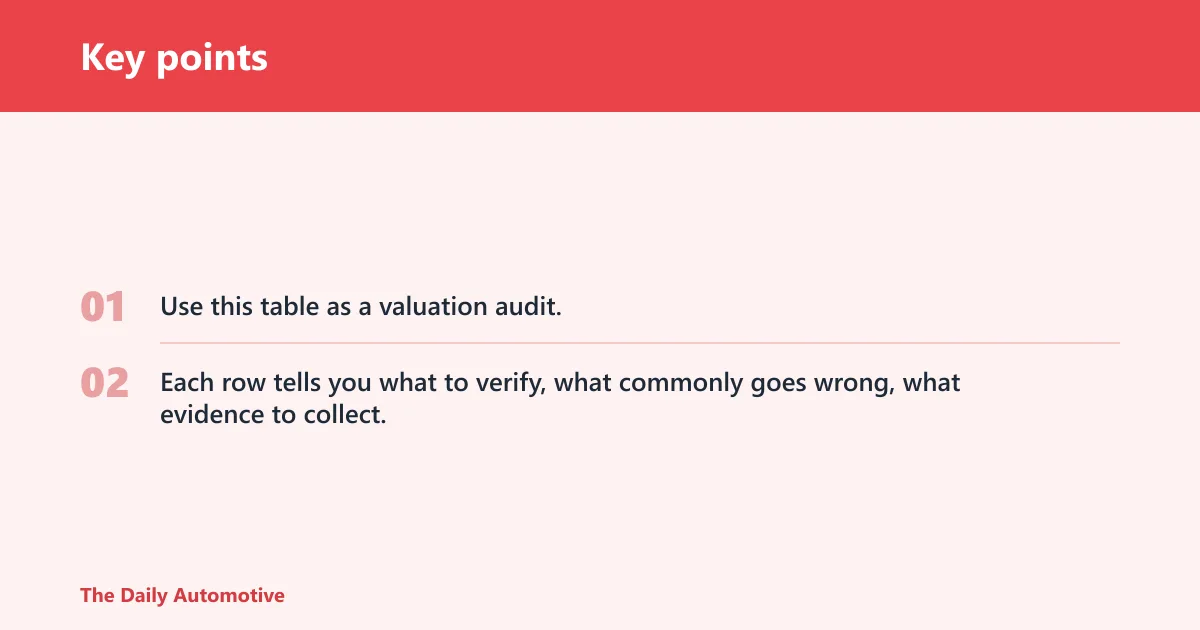
Use this table as a valuation audit. Each row tells you what to verify, what commonly goes wrong, what evidence to collect, and when the issue is serious enough to escalate.
| Insurer line item | What to verify | Common error | Evidence to collect | Escalate? |
|---|---|---|---|---|
| Trim | Exact trim level and package codes | Base trim used for a higher trim vehicle | Window sticker, VIN decoder output, build sheet | Yes, if the trim changes market value |
| Mileage | Actual odometer reading at loss date | Wrong reading or exaggerated mileage adjustment | Photos of odometer, repair order, inspection sheet | Yes, if the report uses the wrong figure |
| Options | Factory equipment and installed packages | Missing convenience, safety, or tech options | Build sheet, sticker, dealer record, photos | Yes, if options were omitted |
| Condition | Whether wear is normal pre-loss condition | Overstated wear deduction without proof | Pre-loss photos, service records, inspection reports | Yes, if the deduction is vague |
| Local comparables | Same market area and recent transaction timing | Distant or stale comps used to lower ACV | Local listings, dealer quotes, sold ads, printouts | Yes, if comps are not local |
| Prior damage | Any pre-existing damage that can be measured | Unsupported prior-damage adjustment | Photos, estimates, prior repair invoices | Yes, if no measurable basis exists |
| Salvage value | Whether the deduction is documented | Flat salvage deduction with no market support | Salvage bid, auction data, title record | Yes, if support is weak or absent |
| Fees | Title, transfer, and processing charges allowed by policy or state practice | Fees omitted when the policy or claim practice allows them | Policy declarations, fee schedule, title documents | Yes, if allowed fees were left out |
| Taxes | Whether sales tax applies to the settlement amount | Tax omitted or calculated on the wrong base | Policy language, invoice, state tax treatment | Yes, if the settlement math is off |
| Policy appraisal-clause triggers | Whether the policy allows a formal value dispute process | Carrier ignores appraisal rights or stalls on value | Policy copy, declarations page, claim correspondence | Yes, if the insurer will not move on value |
Did they use the right trim, mileage, and options?
Yes, this is one of the fastest ways to find a lowball offer. Wrong trim, wrong mileage, or missing options can move ACV enough to matter. A valuation built around the wrong vehicle configuration is easy to attack because the market data no longer matches your car.
Wrong trim or drivetrain
If your vehicle is an all-wheel-drive higher trim and the insurer valued it like a lower front-wheel-drive version, the comp set is suspect. Trim and drivetrain affect the market directly. Check the VIN, window sticker, build sheet, and the comp list line by line.
Missing factory options
Factory packages often change value more than casual buyers expect. Safety suites, premium audio, towing packages, sunroofs, and upgraded wheels can all matter. If the report leaves out installed factory equipment, the ACV can drift below the local market for that exact build.
Aftermarket equipment and upgrades
Aftermarket equipment is trickier. Some additions add little or no value, while others can support a higher number if they are documented and standard for the vehicle type. Receipts, photos, and installation records help, but the strongest argument is still market-based evidence showing buyers actually pay more for the same setup.
Say your pickup has a factory towing package, 4×4, and upgraded wheels, but the report prices a base 2WD truck with steel wheels. That is not a minor clerical issue. It is a different market vehicle, and the adjustment should be challenged immediately.
Recent maintenance and service records
Recent maintenance does not usually create a dollar-for-dollar refund, but it can support a stronger condition rating and help rebut wear deductions. Oil-change records, brake work, tires with remaining tread, and recent major repairs all help show the car was in better shape than the insurer assumed.
Can you challenge condition and prior damage deductions?
Yes. Prior damage and condition deductions are often disputed because they can be broad, subjective, or unsupported. The insurer should identify the exact issue, show how it affects value, and back it with photos or measurements. A vague deduction is weaker than a documented one.
Pre-loss wear versus actual damage
Normal wear is not the same as a value-reducing defect. Light seat wear, stone chips, or typical tire use may be part of ordinary ownership. A deduction becomes harder to defend when the insurer treats ordinary wear as if it were major pre-loss damage.
Photo proof and service history
Use dated photos, service records, and inspection documents to show what the car looked like before the loss. If the vehicle had new tires, a recent brake service, or clean panels before the crash, that information belongs in the counteroffer. The goal is to replace vague judgment with verifiable evidence.
When a deduction is too vague to stand
If the report says “condition adjustment” without explaining the defect, the mileage basis, or the actual impact on market value, push back. The same is true for prior damage that is not tied to a photo set or estimate. An unsupported deduction should not survive a line-by-line review.
Suppose a sedan has a scratch on one rear quarter panel, but the insurer applies a broad condition deduction that treats the whole car as neglected. That is the sort of unsupported reduction that should be singled out and countered with photos and service records.
When salvage value or fees need a second look
Salvage value, title fees, taxes, and towing can change the final check, even after ACV is settled. These items should be reviewed separately from the base vehicle value. A correct ACV with wrong deductions or missing payments still leaves you underpaid.
How salvage value is set
Salvage value is a deduction only if the insurer can support it. It should be tied to documentation, not a guess. The amount can vary by vehicle condition and market, so a flat unexplained figure deserves a challenge if the basis is thin.
Taxes, title fees, and towing
Check whether the offer includes taxes or title-related charges that your policy or state practice may require. Towing and storage handling also matter if they were part of the covered loss. These items are easy to miss because they sit below the headline ACV.
Lienholder checks and payment splits
If there is a lienholder, the insurer may name it on the check or send payment splits directly to the lender and the owner. That does not change the valuation issue, but it affects settlement logistics. You also may need to complete title transfer or endorse the title before the payout closes.
What to do if the insurer will not move
Do not jump straight to a legal threat. Start with a line-by-line counteroffer that identifies the exact errors in the report, attaches the better evidence, and asks for a revised ACV. If the carrier still will not move, escalate in a defined order so the file shows a real dispute.
Write a line-by-line counteroffer
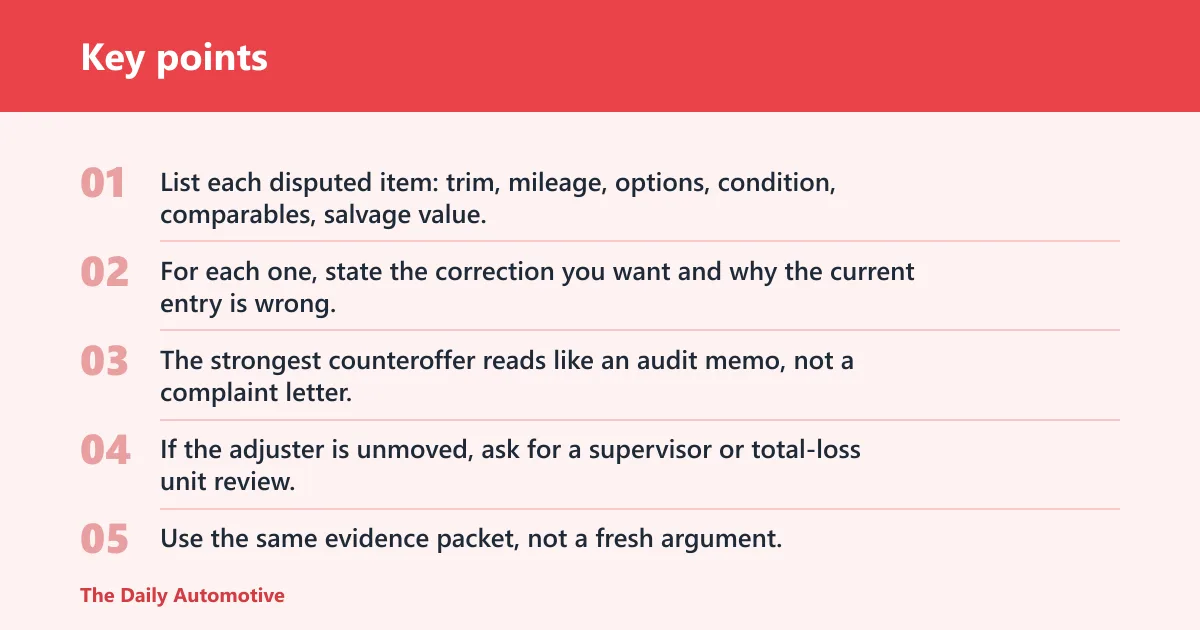
List each disputed item: trim, mileage, options, condition, comparables, salvage value, fees, and taxes. For each one, state the correction you want and why the current entry is wrong. Keep the tone factual. The strongest counteroffer reads like an audit memo, not a complaint letter.
Ask for a supervisor review
If the adjuster is unmoved, ask for a supervisor or total-loss unit review. Use the same evidence packet, not a fresh argument. A second set of eyes can correct an obvious comp error or approve an adjustment the first adjuster would not.
Use the appraisal clause if your policy allows it
Appraisal clauses matter when the fight is over value, not coverage. Under this process, each side may hire an appraiser, and a neutral umpire can resolve the difference if the two numbers stay far apart. South Carolina does not have a statute requiring auto policies to include an appraisal clause, so you have to read the policy itself. That is also why the policy copy matters so much.
In South Carolina, the 75% rule controls salvage title branding, not the insurer’s total-loss decision, and insurers are governed by the Unfair Claims Practices Act, S.C. Code § 38-59-20. South Carolina auto policies are not required by statute to include an appraisal clause. If the policy does include one, follow that process before the file hardens.
Escalate to the regulator or counsel when needed
If the insurer refuses to share the valuation basis, ignores documented errors, or will not honor the policy dispute process, a regulator complaint or legal advice may be the next step. That is especially true when the file includes clear market evidence and the carrier still will not correct the math.
New Jersey’s total-loss settlements must be based on documented, verifiable data, and the state allows the average of two Commissioner-approved valuation guides for a substantially similar vehicle. New Jersey insurers may also use a dealer quotation for a comparable vehicle within 25 miles. Those details matter because they define what “market-based” support can look like.
Mississippi law sets no fixed percentage for a total loss, but it does require a salvage certificate of title after a total-loss payout. Mississippi also gives 15 days to forward an endorsed title after receiving settlement funds. New York’s 75% figure applies to salvage-branding for vehicles eight model years or newer, and New York requires a “REBUILT SALVAGE” brand when an insurer declares a total loss. Those rules affect title handling, not the first valuation check you should dispute. (Cornell)
Should you hire an independent appraiser for a total loss claim?
An independent appraisal can be strong evidence when the insurer’s report is thin or the comp set is poor. It should be documented and market-based, not a guess. A paid appraisal is one tool, not the only tool, and it works best after you have already audited the insurer’s math.
Premier DV advertises a flat-fee South Carolina appraisal of $449, and Premier DV advertises a flat-fee appraisal price of $449 across its state pages. A fee like that may make sense when the file is close to deadlocked and the value gap justifies another documented opinion. The key is whether the appraisal is grounded in local market data and supported line by line.
Frequently asked questions
How do I dispute a low total loss offer from my insurer?
Start by requesting the valuation report, then compare every line item against your VIN, photos, service records, and local market comps. Send a written counteroffer that corrects the trim, mileage, options, condition, or deduction errors. If the insurer still will not adjust value, move to a supervisor review or appraisal clause.
What evidence do I need to challenge a total loss valuation?
Collect the total loss settlement valuation report, photos of the vehicle, the odometer reading, build sheet or window sticker, repair invoices, service records, and recent local comparable listings. The best evidence ties directly to the disputed line item. Market-based proof usually beats general complaints.
Can I ask for the insurer’s valuation report and comparables?
Yes. You should ask for the full report, the comp list, and any adjustment sheet. Without those documents, you cannot verify whether the insurer used the right trim, mileage, options, or market area. If the company only gives a summary number, press for the underlying data.
What if my insurer used the wrong trim, mileage, or options?
That is a direct valuation error. Correct it with the VIN, build sheet, odometer photos, and matching listings for the proper configuration. If the wrong equipment materially changes market value, ask for a revised ACV and point out exactly which comp entries no longer fit.
Can I negotiate salvage value or deductions on a total loss offer?
Yes, if the insurer’s support is weak. Salvage value should be documented, and prior damage or condition deductions should be measurable and explained. Ask for the basis of each reduction, then counter with your own market data or title records if the deduction is overstated.
Does my policy have an appraisal clause for a total loss dispute?
Only the policy can answer that. If an appraisal clause exists, it can be the right path when both sides agree the car is a total loss but disagree on value. Read the policy language carefully, because the clause may set deadlines, appraiser selection rules, and an umpire process.
How long do I have to challenge a total loss offer?
The deadline depends on the claim file, the policy language, and any state-specific rules that affect contract or complaint timing. Do not wait for the check to clear before reviewing the report. Raise valuation errors as soon as you spot them so the dispute is on record early.
What if the insurer says the car is totaled but the payout is too low?
That is a valuation dispute, not a question about whether the vehicle was declared a total loss. Treat the offer as an ACV audit: check comps, trim, mileage, options, and deductions. The total-loss decision can be right while the payout number is still wrong.
Products related to this article
Sponsored / affiliate links. As an Amazon Associate I earn from qualifying purchases. I may earn additional commission from eligible campaigns.