What Is a Market Adjustment on a Car and Can You Negotiate It?
A market adjustment is a dealer-added markup above MSRP. You can often negotiate it down, offset it with rebates or trade value, or walk away if the deal no longer makes sense. Ignore it, and you can overpay by thousands on a car that may already carry fees, financing add-ons, or a weak trade offer. This guide shows how to spot a real scarcity premium, spot padding, and decide when to push, counter, or leave.
What a market adjustment
A market adjustment is an extra amount the dealer adds above the manufacturer suggested retail price. It can appear as a line item labeled “market adjustment,” “ADM,” “dealer markup,” or a similar fee on the buyer’s worksheet. It is not the same as tax, title, or registration. (Consumerfinance)
That matters because the worksheet can make the charge look ordinary when it is really a dealer pricing choice. MSRP is the baseline sticker price. A market adjustment sits above it. Out-the-door price is the number that shows what you actually pay after the vehicle price, dealer fees, and required government charges are added.
How it appears on the worksheet
Look for the line items in this order: vehicle price, adjustment or markup, dealer fees, add-ons, then taxes, title, and registration. If the adjustment is buried inside another fee, ask the salesperson to itemize every charge. A clean worksheet is easier to compare across stores.
Sometimes the dealer will quote a low vehicle price and make up the difference elsewhere. Other times the markup appears plainly above MSRP. Either way, the number to challenge is the total, not the label.
Why it sits above MSRP
CFPB says market adjustments can increase the price over MSRP. Dealers use them when supply is tight, demand is strong, or a specific trim is hard to find. High-interest models, limited editions, and some EVs are common examples.
The charge is a pricing signal, not a fixed rule. That is why the same car can carry a markup at one store and none at another, sometimes within the same metro area.
Why it is not the same as taxes or registration
Taxes, title, and registration are separate from dealer pricing, and CFPB says they are not negotiable. A market adjustment is different. It is a dealer-added amount, so negotiation depends on market conditions and how much bargaining power the dealer has over that vehicle.
MSRP vs. out-the-door price
MSRP is the manufacturer’s suggested retail price before dealer markups. It does not include every charge you may see at signing. Out-the-door price is the cleanest comparison number because it includes the full purchase cost, including taxes, title, registration, and fees.
That is why a deal that looks good at MSRP can still cost more than a rival quote. Dealer fees, a market adjustment, and add-ons can turn a close-to-sticker offer into a much higher final number.
What MSRP does and does not include
MSRP gives you a starting point. It is useful for comparing vehicles, trims, and model years. It is not a final price, and it is not a promise that the dealer will sell at sticker.
Freight, prep, document fees, and optional products can change the total. The same source says dealer preparation fees may be part of vehicle pricing, document fees may be charged by the dealer, and delivery charges may be among negotiable dealer fees.
Why out-the-door price is the number to compare
Out-the-door price lets you compare one dealer’s offer against another on the same basis. It captures the full amount due before you decide whether the deal is worth taking. Monthly payment alone does not do that, because it can hide a higher price inside a longer loan.
The same source says a shorter loan term reduces total loan cost, while longer loans can increase total interest paid. That is why the payment is a financing result, not the purchase price.
How dealer fees change the final amount
Dealer doc fees are separate charges and are often hard to negotiate. Optional add-ons can add even more cost. The same source says optional add-on products are not required, and it lists extended warranties and GAP insurance as optional add-on products.
Suppose a compact SUV is quoted at MSRP with a modest adjustment removed, but the desk adds a document fee, prep fee, wheel locks, and nitrogen fill. The sticker may look fixed. The total has moved.
Why do dealers add market adjustments?
Dealers add market adjustments when they think demand is stronger than supply. That can happen on new-model launches, popular trims, low-volume performance cars, and EVs with short inventory. The charge is often a way to manage profit when buyers are competing for the same unit.
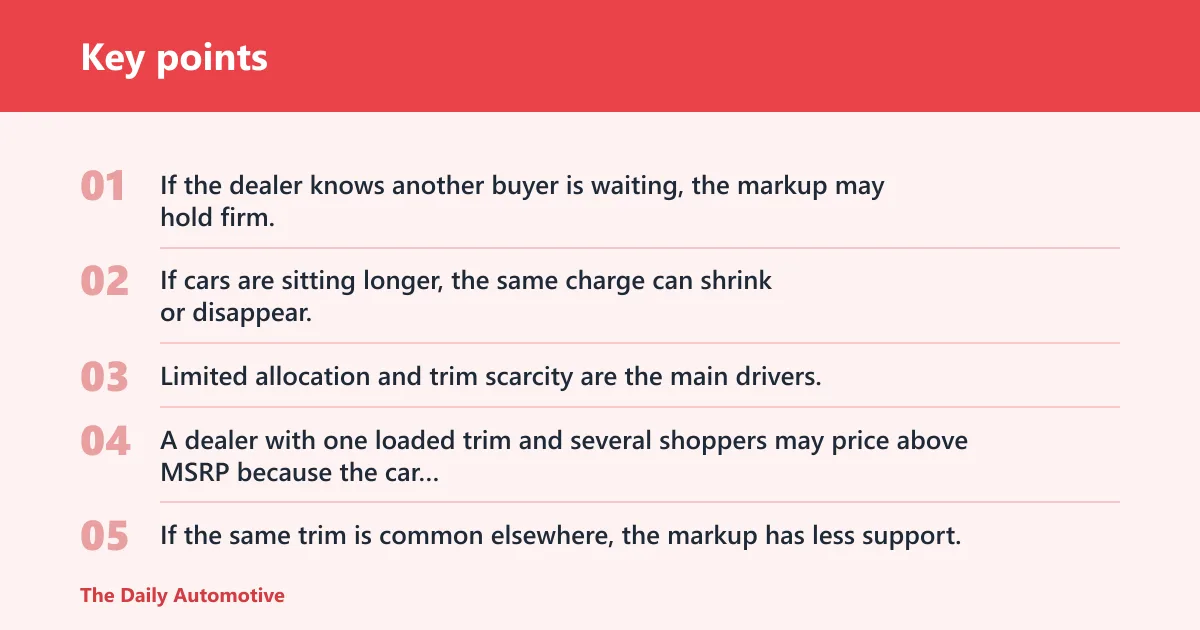
Bargaining power changes by market. If the dealer knows another buyer is waiting, the markup may hold firm. If cars are sitting longer, the same charge can shrink or disappear.
Supply shortages and high-demand trims
Limited allocation and trim scarcity are the main drivers. A dealer with one loaded trim and several shoppers may price above MSRP because the car is easy to move. If the same trim is common elsewhere, the markup has less support.
Hot colors, performance packages, and first-year redesigns often bring the strongest pricing pressure. Buyers chasing a specific build usually face less room to bargain on the vehicle itself, so the rest of the deal matters more.
Scarcity on hot models and EVs
Some EVs have seen markups on certain trims because inventory can be uneven across regions. The same is true for limited-run SUVs, trucks with popular tow packages, and specialty models with low build counts. Scarcity does not make the markup permanent, but it can make it harder to remove.
A common first-timer mistake is assuming every dealer will quote the same amount because the vehicle is identical. It is not. Two stores may have different floorplan pressure, different stock levels, and different willingness to trade price for volume.
How dealer bargaining power changes by market
End-of-month and end-of-quarter periods can help, but only if the dealer needs one more sale to hit a target. That is not a guarantee. A store with limited supply may hold its number even near a deadline.
The dealer’s bargaining power is strongest when the car is scarce and the buyer is attached to one exact unit. Your bargaining power rises when you can compare several stores, several trims, or several colors and walk away from the most expensive offer.
Can you negotiate a market adjustment at a dealership?
Yes, often you can negotiate it, but not always. The markup is most flexible when the car has been on the lot for a while, another dealer has a lower quote, or the store wants to move you into financing, protection products, or a trade deal. It is least flexible when inventory is thin and the model is in demand.
When the markup is most flexible
The best opening is a direct request for the adjustment to be removed from the worksheet. If the salesperson says no, ask whether the dealer can match another store’s out-the-door quote or convert the markup into a rebate, rate discount, or other concession.
The same source says APR and interest rate are negotiable on auto loans. CFPB also says preapproval can help you compare and negotiate rates. That gives you another lever if the dealer will not move much on vehicle price.
When the dealer may hold firm
A dealer may stand firm when the car is a hot model, a limited trim, or the only unit in a wide radius. That can also happen if the store believes another buyer will pay the markup quickly. In those cases, the price may not move, but the rest of the structure still can.
Ask whether the markup is tied to the car itself or to a package of dealer offers. Sometimes the price will not drop, but the dealer will improve the financing rate, add a rebate, or reduce another charge to keep the deal alive.
What to ask for if the price will not move
- Remove the market adjustment and hold the rest of the deal flat.
- Match the competitor’s out-the-door price.
- Apply a manufacturer incentive or rebate to offset the markup.
- Improve the APR or loan term without changing the vehicle price.
- Remove add-ons you did not request.
Watch for failure cases. A dealer can “remove” the markup and then reduce trade-in value, cut a rebate, or add a fee elsewhere. A deal is only better if the out-the-door number is actually lower.
How to lower the total cost
Start with preapproval before you visit. That separates the car price from financing and gives you a rate benchmark. Then compare written quotes on the same trim, same equipment, and same delivery terms. Finally, keep the trade-in out of the price negotiation until the vehicle price is settled.
Use preapproval before you visit
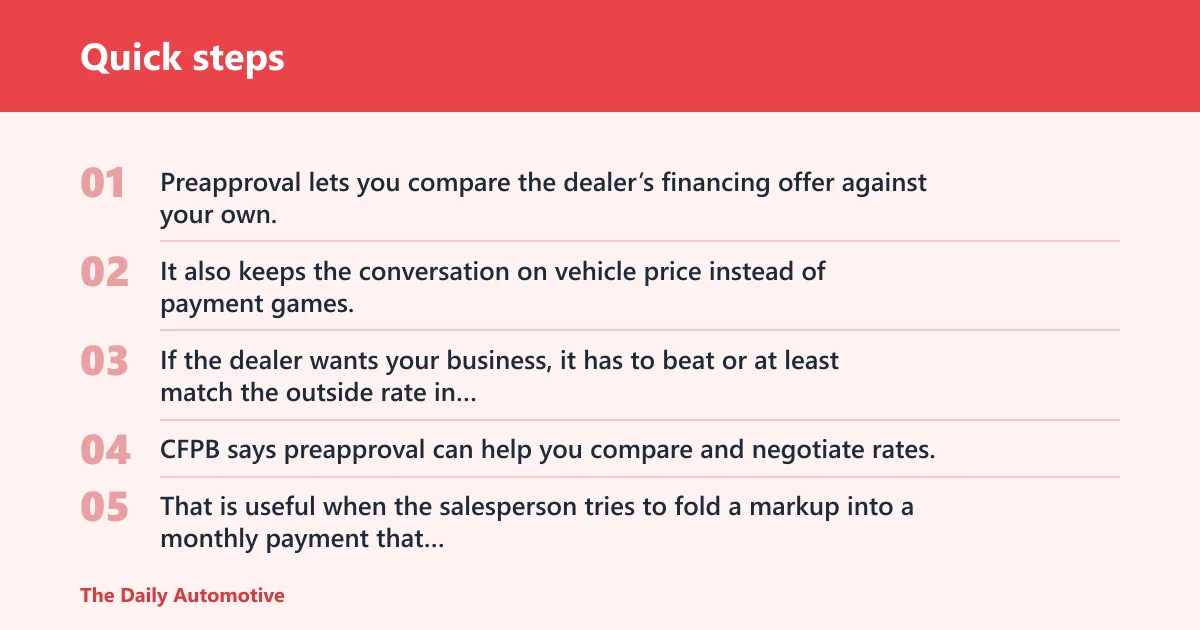
Preapproval lets you compare the dealer’s financing offer against your own. It also keeps the conversation on vehicle price instead of payment games. If the dealer wants your business, it has to beat or at least match the outside rate in a way you can verify.
The same source says preapproval can help you compare and negotiate rates. That is useful when the salesperson tries to fold a markup into a monthly payment that looks harmless at first glance.
Compare dealer quotes on the same vehicle
Ask for the same trim, drivetrain, options, and fees on every quote. A lower sticker with a higher adjustment is not a better deal. Use out-the-door price as the main comparison, not the advertised payment.
Say your first quote may show MSRP plus about a $3,000 market adjustment and a $799 doc fee. A second dealer shows MSRP with no adjustment but adds a higher finance rate. The second quote may still cost less, but only if the full out-the-door and loan totals are lower.
Use trade-in value without blending it into the sticker price
Trade-in value can reduce the taxable or financed amount in some states, which can help the deal. But keep it separate from the vehicle price discussion. A dealer can raise your trade offer while also holding the markup, and the net result may still be worse than a cleaner purchase quote.
If the dealer is strong on the trade but weak on the car, ask for both numbers in writing. That lets you see whether the store is giving on one side and taking on the other.
Check rebates and special financing
Manufacturer incentives can offset a markup. They may include rebates or special financing, but availability varies by model and buyer. A dealer may also trade a markup reduction for the loss of an incentive, so compare the whole package before saying yes.
The same source says optional add-on products are not required, and GAP insurance is optional. That matters because a dealer may try to pair a markup with a warranty or protection package. Refuse the extras unless they are part of your plan.
Market adjustment calculator
This table shows how the same vehicle can end up with different out-the-door costs depending on what happens to the markup. The example uses the same asking price and dealer fees, then changes only the concession path so you can compare the total.
| Scenario | Asking price | Market adjustment | Dealer fees | Out-the-door price |
|---|---|---|---|---|
| Markup removed | $42,000 | $0 | $1,095 | $43,095 |
| Markup reduced | $42,000 | $1,500 | $1,095 | $44,595 |
| Markup offset by rebate or finance concession | $42,000 | $2,500 | $1,095 | $45,595 before rebate or APR savings |
Use the third path only if the rebate or finance concession is real and documented. If the dealer says it will “make up” the markup through a lower rate, ask for the exact APR, term, and total finance charge in writing. A lower payment is not enough.
To compare offers, subtract any rebate from the vehicle price first, then add dealer fees, then add taxes, title, and registration. If the dealer rolls the markup into a finance package, compute the total cost over the full term instead of focusing on the monthly number.
When to walk away
Walk away when the dealer will not explain the worksheet clearly, when the markup is paired with weak incentives, or when the store keeps moving the target by changing trade value or adding fees. If the out-the-door number is still high after you have asked for a clean quote, the next dealer may be the better deal.
Signs the dealer is padding profit elsewhere
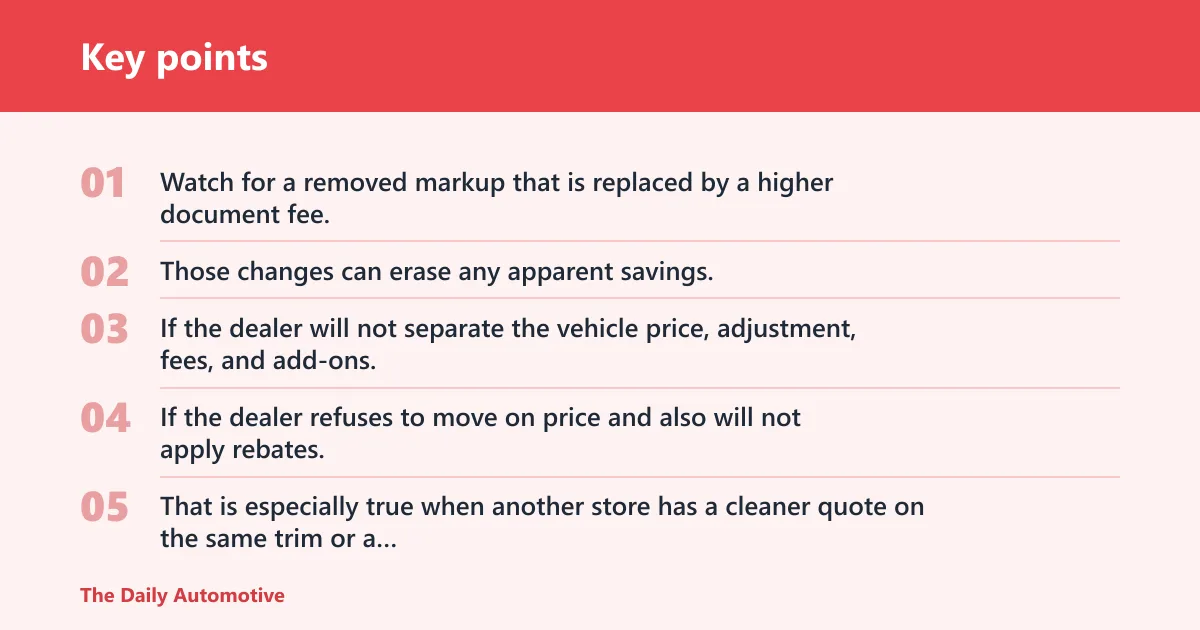
Watch for a removed markup that is replaced by a higher document fee, a lower trade offer, a bundled protection product, or a financing rate that is worse than your preapproval. Those changes can erase any apparent savings.
Also watch for vague worksheet labels. If the dealer will not separate the vehicle price, adjustment, fees, and add-ons, the structure is working in the store’s favor, not yours.
When the markup is paired with weak incentives
If the dealer refuses to move on price and also will not apply rebates, the deal may be too expensive. That is especially true when another store has a cleaner quote on the same trim or a close substitute. The shortage premium should be compared against the cost of waiting.
A second quote can beat a hard sell. Even a modest difference in out-the-door price can outweigh the pressure to buy the first car in front of you.
Why a second quote can beat a hard sell
One store may be counting on urgency. Another may be willing to sell volume. Getting both quotes in writing keeps the conversation focused on numbers instead of time pressure. That is the simplest way to test whether the markup is real market pricing or just extra profit.
Frequently asked questions
What is a market adjustment on a car?
A market adjustment is a dealer-added charge above MSRP. It can appear as a markup or separate fee on the buyer’s worksheet. Dealers tend to use it on high-demand or low-supply vehicles, and the amount can change with market conditions and dealer bargaining power.
Is a market adjustment the same as MSRP?
No. MSRP is the manufacturer suggested retail price, which is the baseline sticker price before dealer markups. A market adjustment sits above it. The out-the-door price is what matters most because it includes fees and required government charges too.
How do I avoid paying a market adjustment on a car?
Shop several dealers, request out-the-door quotes, and use preapproval before you visit. Compare the same trim and equipment, not just the same model name. If the dealer will not move the markup, a second quote or a different trim can be the better answer.
Should I walk away if a dealer adds a market adjustment?
Walk away if the markup makes the deal uncompetitive or if the dealer will not explain the full worksheet. If the store offsets the markup with a real rebate or better financing, it may still work. The key is the total cost, not the label on one line.
Can a market adjustment be removed if I finance through the dealer?
Sometimes, but financing through the dealer does not guarantee a better deal. The same source says APR and interest rate are negotiable, so compare the dealer’s rate with your preapproval. If the markup disappears only because the rate worsens or add-ons appear, the deal may cost more overall.
Are market adjustments negotiable on new cars only?
They are most common on new cars, especially scarce or high-demand models. That said, dealers can price used vehicles above expected market levels too, just under different labels. The same rule applies: compare the full out-the-door price and do not treat the first quote as fixed.
Products related to this article
Sponsored / affiliate links. As an Amazon Associate I earn from qualifying purchases. I may earn additional commission from eligible campaigns.