How Does an Insurance Company Decide a Car Is Totaled?
An insurer may total a car when repair costs, salvage value, and related fees reach the insurer’s total-loss threshold or when the car cannot be repaired safely. Thresholds and formulas vary by state and by carrier. Miss that decision and you can lose payout dollars or get stuck disputing a low offer. Here’s how total-loss decisions work and how to challenge the repair estimate, value, and repairability with documents.
How insurers decide a car is totaled
Many total-loss decisions involve repair cost, market value, and repairability, but the exact method can differ by state law, policy language, and insurer practice. An insurer may total a car when repair costs exceed the vehicle’s value, or when the estimate crosses the company’s total-loss threshold. State law and insurer rules can change that threshold and the settlement path.
The three-part test
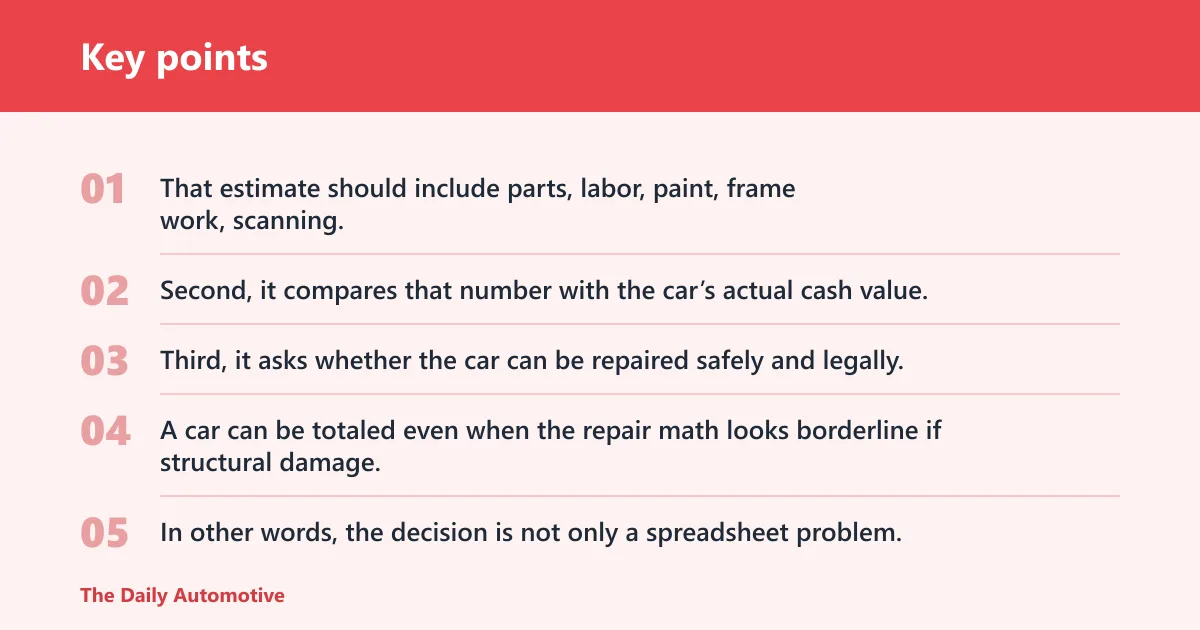
First, the insurer prices the repair. That estimate should include parts, labor, paint, frame work, scanning, and any required safety operations. Second, it compares that number with the car’s actual cash value, which is the pre-loss fair market value. Third, it asks whether the car can be repaired safely and legally.
That last step matters. A car can be totaled even when the repair math looks borderline if structural damage, airbag deployment, or hidden frame issues make a safe repair impractical. In other words, the decision is not only a spreadsheet problem.
When safety can total a car before the math does
Suppose a late-model crossover has front-end damage, a bent unibody rail, and deployed airbags. The visible damage may seem limited, but the repair plan can require structural work, restraint-system replacement, and checks that push the car past the insurer’s repair threshold. In some cases, repair standards, OEM procedures, or state rules can affect whether the vehicle is repairable.
That is why the claim file should be read for more than the final number. Look for notes about frame measurements, diagnostic scans, calibrations, and whether the body shop believes the car can return to pre-loss condition.
Why the threshold matters
Some insurers use a fixed percentage threshold to decide total loss. States may set total-loss thresholds, but those rules vary widely and are not a payout cap. That means the same repair estimate can lead to different outcomes depending on state law, the policy, and carrier guidelines.
If your state uses a lower threshold, the insurer may total a car sooner. If the policy or state allows a higher threshold, you may have room to challenge the estimate before the car is declared a total loss.
What value does the insurer use?
The insurer usually pays actual cash value, not replacement cost value and not what you paid for the car. Actual cash value is the pre-loss market value used to set the total-loss payout, and the deductible is subtracted on a first-party claim. Comprehensive and collision are the coverages most often used for this kind of claim; liability works differently in a third-party claim.
Actual cash value versus replacement cost value
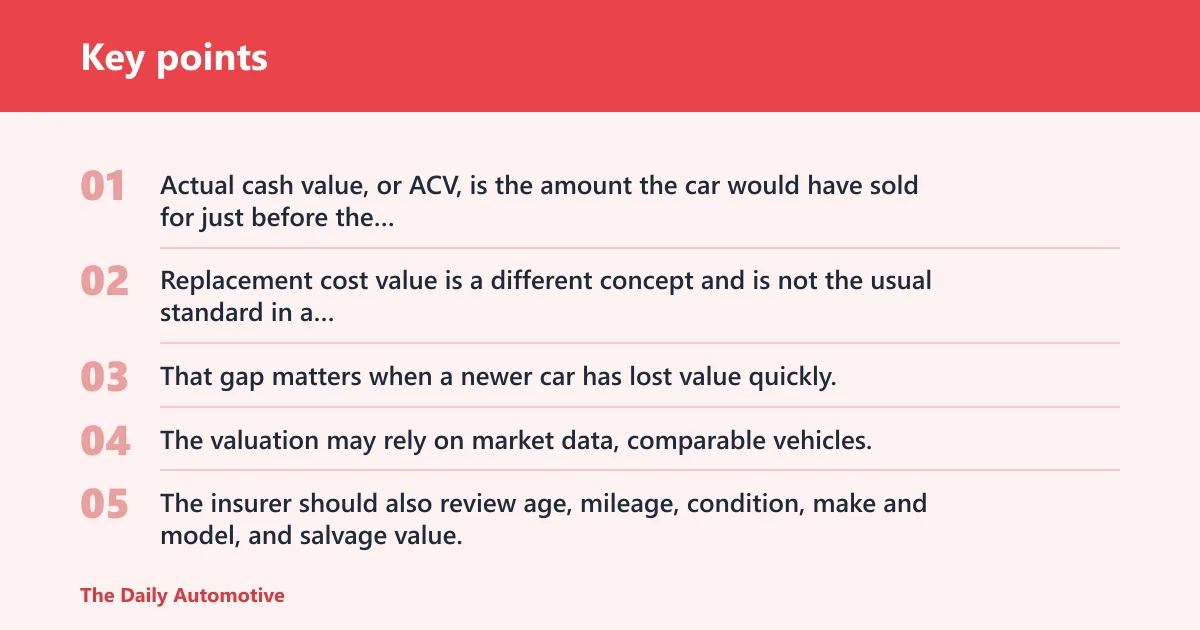
Actual cash value, or ACV, is the amount the car would have sold for just before the crash. Replacement cost value is a different concept and is not the usual standard in a total-loss claim. That gap matters when a newer car has lost value quickly, or when a well-kept older car is undervalued by a generic pricing tool.
The valuation may rely on market data, comparable vehicles, and third-party valuation vendors, and may also consider source data such as Kelley Blue Book. The insurer should also review age, mileage, condition, make and model, and salvage value.
What the valuation report should show
The valuation report, or appraisal report, is the insurer’s written basis for the offer. It should include the options the car had, its mileage, its condition, and the comparable vehicles used to support the number. Oregon says insurers must provide written notice explaining the total-loss and value determination, and it says they generally use evaluation services to value the vehicle. (Oregon)
Oregon also says you are owed what the vehicle would have sold for before the accident. That is a market question, not a book-entry guess.
Why local comparable vehicles matter
Comparable vehicles should be local market examples with the same make, model, mileage, and options, and similar condition. If the insurer uses cars from a different region, trims with fewer features, or vehicles with much higher miles, the offer can come in low. Comparable vehicles are the easiest place to spot a bad valuation.
Picture a 2019 sedan with 42,000 miles, leather seats, a backup camera, and a factory towing package. If the report compares it to bare-bones cars with 70,000 miles, the valuation is not a clean match. The differences should be adjusted, not ignored.
Total-loss challenge checklist
This checklist shows the most common claim issues, the insurer’s usual proof, and the document or argument that can move the number. Use it against the repair estimate, the valuation, and the payout terms.
| Claim issue | What the insurer will use | What evidence you should gather | What to say in the dispute |
|---|---|---|---|
| Repair estimate errors | Body-shop estimate, labor rate, part prices, diagnostic charges | Second estimate, line-by-line photos, supplement notes, scan report | “The estimate missed required operations, so the repair cost is understated.” |
| Missing options | Decoded VIN, trim sheet, equipment database | Window sticker, build sheet, dealer record, photo of installed equipment | “The valuation omits factory options that raise ACV.” |
| Mileage mistakes | Odometer reading in the file | Photo of the odometer, service record, inspection sheet | “The report uses the wrong mileage, so the value needs correction.” |
| Condition disputes | Condition grade, prior wear notes, interior photos | Pre-loss photos, service records, tire tread notes, maintenance log | “The condition rating is too low for this car’s documented state.” |
| Comparable vehicle gap | Valuation report comparables | Local listings, dealer ads, comparable VINs, mileage and option notes | “The comps are not local, not similar, or not adjusted correctly.” |
| Prior damage | Prior claim notes, Carfax-type history, prior repairs | Repair invoices, pre-loss photos, disclosure of unrelated damage | “The report penalizes damage that was already repaired or unrelated to this loss.” |
| Aftermarket parts | OEM-only assumptions or depreciation on parts | Receipts for upgraded parts, supplier invoices, installation records | “The car had documented aftermarket parts that should be considered in value.” |
| Salvage deduction | Salvage bid or salvage-buyback figure | Salvage quotes, written request to retain the car, title records | “If I keep the car, the salvage deduction must be shown clearly.” |
| Lienholder issues | Payoff statement, lien release rules, lender name on title | Current payoff letter, loan contract, lender contact details | “Confirm the payment order and whether the lender must approve retention.” |
| Rental-loss timing | Claim diary, inspection date, repairability review date | Rental receipts, claim notes, emails showing delay, coverage page | “The loss-of-use period should cover reasonable claim handling time.” |
How can you tell the offer is too low?
Start with the report line by line. If the insurer missed options, used the wrong mileage, downgraded condition, or picked weak comparable vehicles, the offer may be too low. Then compare the report to nearby listings for the same make, model, mileage, and options. That is where most errors show up.
Check the repair estimate line by line
Repair-estimate mistakes often hide in small entries. Look for omitted operations such as wheel alignment, calibration, blend time, diagnostic scans, frame measurements, and corrosion protection. If the estimate omits a required step, the repair total can be understated and the insurer can reach a total-loss decision on bad math.
A common first-timer mistake is to challenge only the final number and ignore the line items that produced it. The stronger move is to mark the missing operations and ask the shop to supplement the estimate in writing.
Compare the report to nearby listings
Use local market listings that match the report’s key points. The most useful matches are the same year or close, the same trim, similar mileage, and similar equipment. If the insurer’s comps are out of market or stripped of options, the valuation report is vulnerable.
Do not compare against the highest asking price on the internet without context. Compare the valuation report to actual local examples and note the exact differences in mileage, condition, and equipment.
Look for prior damage or aftermarket-parts penalties
If the insurer lowers value because of prior damage, ask for the basis. If the damage was repaired before the crash, or if it was unrelated, the report should not treat it as current loss. The same goes for aftermarket parts: if they were documented and installed before the accident, they should not disappear from the valuation.
Keep invoices, pre-loss photos, and service records together. Those documents can change the condition grade and the market value at the same time.
What if you still owe money?
What you owe on the loan does not control the ACV payout. The insurer pays the actual cash value, minus the deductible on a first-party claim, then sends payment according to the lienholder’s rights. If the loan balance is higher than the settlement, GAP insurance may matter.
How the insurer pays the lienholder
When a lender has a lien, the check may be issued to the policyholder, the lender, or both. The lienholder can be named on the check and may control whether the owner can keep the car. The lender usually wants the loan paid off or its interest protected before it releases the title.
If the settlement does not cover the full payoff, the borrower can still owe the difference. That is why the payoff letter matters as much as the valuation report.
When GAP insurance matters
GAP insurance can help if the loan balance is higher than the settlement. It is meant to cover the difference between what the insurer pays and what the lender is still owed, subject to the policy terms. It does not replace the total-loss valuation fight, and it does not raise ACV by itself.
If you have GAP coverage, send the settlement figures and the lender payoff statement as soon as both are available. Delays can affect when the loan is closed and when title questions are resolved.
Can you keep the car after a total loss?
Yes, sometimes. If you keep the totaled car, the insurer subtracts the salvage value from the check. The payout equals pre-loss value minus salvage value, and the title and registration rules can change after owner retention. A lienholder can also affect the decision.
How salvage value changes the payout
Salvage value is the amount a salvage buyer would pay for the damaged car. If you keep the vehicle, the insurer subtracts that value from the settlement. That means the check is lower, because the insurer is no longer taking possession of the damaged car.
This is where the written math should be very clear. Ask for the salvage bid or the salvage deduction that was used, then compare it with the insurer’s estimate of the car’s pre-loss value.
Title and registration issues after owner retention
Keeping the car usually means the title status changes. Many states require a salvage or rebuilt title process before the car can be registered again, insured again, or sold normally. Those steps can carry inspection and paperwork requirements, so the retention decision should be made with the title rules in mind.
If the car is only worth a little more than the salvage bid, the reduced payout may not justify the title hassle. Ask for the net numbers before agreeing.
When the lienholder can affect the decision
If a lender still has a lien, it may refuse owner retention or require the loan to be resolved first. That is because the lender’s interest sits on the title. If you want to keep the car, get the lender’s position in writing before you accept the retention option.
How do you dispute the valuation?
Dispute the valuation in writing and attach documents that attack the weakest parts of the report. The most effective challenges are a corrected VIN build, proof of options, proof of mileage, condition photos, and local comparable vehicles. If the dispute stays open, use the appraisal provision if your policy and state law provide one and require it.
What to send with a written challenge
- A copy of the valuation report with the bad entries marked.
- Photos of the vehicle before the loss, if available.
- Odometer proof, service records, and registration history.
- Window sticker, build sheet, or dealer printout showing options.
- Three to five local comparable vehicles with mileage and price.
- Repair estimates or supplements that show missing work.
- Proof of prior repairs, if the insurer is discounting the car unfairly.
Be specific. Do not say the offer feels low. Say which line item is wrong and what document corrects it.
How the appraisal provision works
An appraisal provision is a policy dispute mechanism. Each side gets an appraiser, and an umpire may break ties if the appraisers disagree. Procedures and rights vary by policy and state law, and the provision may not be available in every claim.
That process is useful when the carrier will not move after a document-based dispute. It is best used after you have already corrected the obvious report errors.
When to ask for a reinspection
Ask for a reinspection when the insurer missed visible damage, used the wrong trim, or failed to count required repairs. If the valuation is wrong because the car was misidentified, a reinspection may solve the problem faster than a formal appraisal. If the dispute is about market value, you may need the appraisal path.
Separate first-party and third-party claims here. On your own collision or comprehensive claim, the insurer pays under your policy terms. On a third-party claim, bargaining power often depends on proving the other driver’s fault and the value of the loss, so the negotiation path can look different.
Frequently asked questions
How does an insurance company decide if a car is totaled?
An insurer usually totals a car when the repair cost, plus related fees and salvage considerations, reaches the vehicle’s actual cash value or the carrier’s total-loss threshold. Safety and repairability also matter, so a car can be totaled even if the math is close.
How does the insurance company determine the value of a totaled car?
The insurer usually relies on a valuation report built from market data, vehicle age, mileage, condition, options, and comparable vehicles. Book value sources such as Kelley Blue Book may be part of the process, but the report should reflect the local market, not just a generic average.
How can I tell if the insurer’s total-loss value is too low?
Compare the report to nearby listings for the same make, model, mileage, options, and condition. Then check whether the report missed equipment, used the wrong mileage, or discounted the car for prior damage that was already repaired. Those are the most common pressure points.
What happens if I still owe money on a totaled car?
The insurer pays the settlement, usually to you and the lienholder, based on the loan and title terms. If the payoff is higher than the settlement, you may still owe the difference. GAP insurance may cover that gap if your policy includes it.
Can I keep my car if the insurance company totals it?
Sometimes. If you keep the car, the insurer subtracts salvage value from the payout, and the title may need to be branded or rebuilt before the car can be driven or sold normally. A lienholder may also have a say if there is still a loan on the car.
How do I dispute a totaled car valuation?
Send a written challenge with the valuation report marked up, proof of options, mileage proof, condition photos, and local comparable vehicles. If the insurer still will not move, ask about the appraisal provision. That gives each side a formal way to reset the number.
Products related to this article
Sponsored / affiliate links. As an Amazon Associate I earn from qualifying purchases. I may earn additional commission from eligible campaigns.