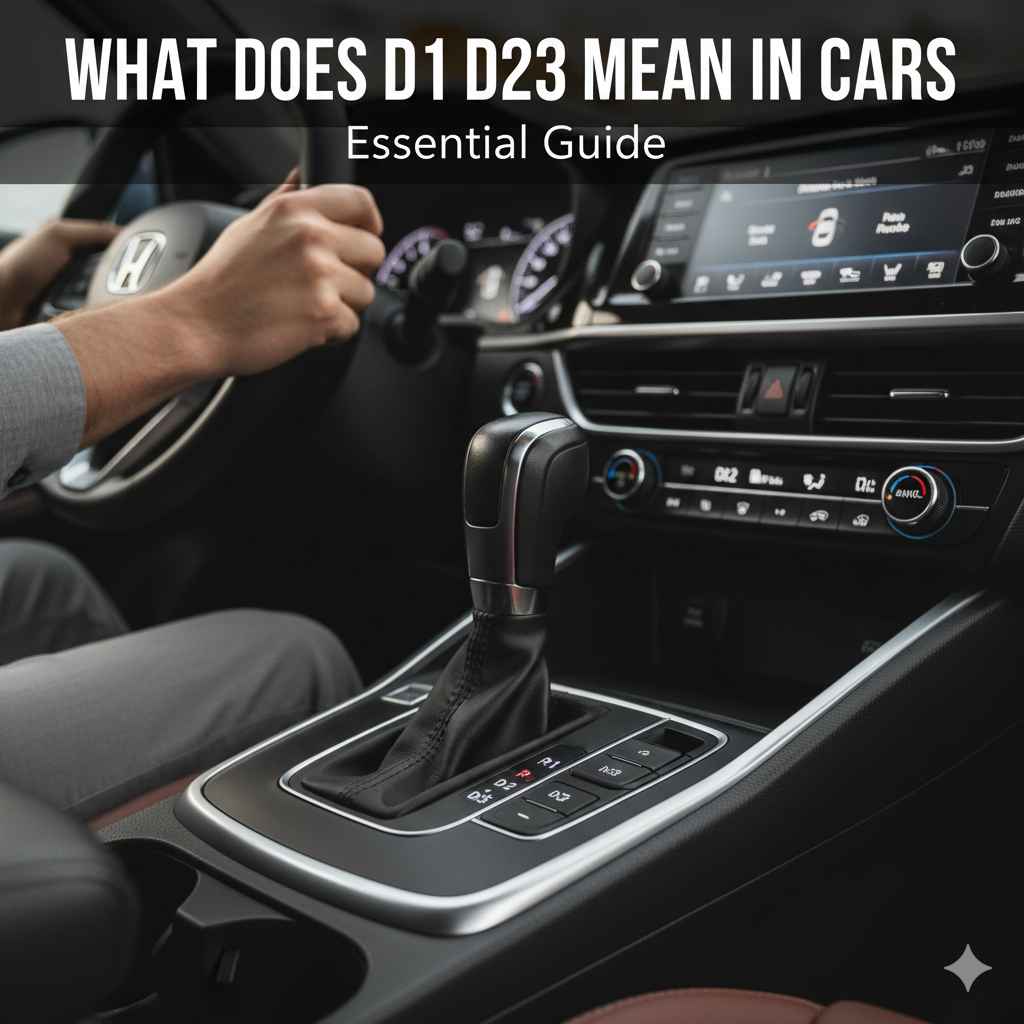
What Does D1 D2 D3 Mean In Cars: Essential Guide
In cars, D1, D2, and D3 usually refer to different forward gear selections in an automatic transmission. D1 is the lowest gear for maximum power, D2 offers more speed, and D3 provides higher speeds. They help optimize performance and fuel economy depending on driving conditions.
Ever glanced at your car’s gear shifter only to see letters and numbers like “D1,” “D2,” or “D3” and wondered what on earth they mean? You’re not alone! Many drivers see these options and stick to the familiar “D” for drive, missing out on potentially better performance and efficiency. But don’t worry, understanding these settings is simpler than you think, and it can make a real difference in how your car handles. Think of it as unlocking a secret level of control for your vehicle. This guide will break down exactly what D1, D2, and D3 mean in cars, why they’re there, and when to use them. Let’s make your car’s automatic transmission less mysterious and more manageable!
Understanding Automatic Transmission Gear Selections
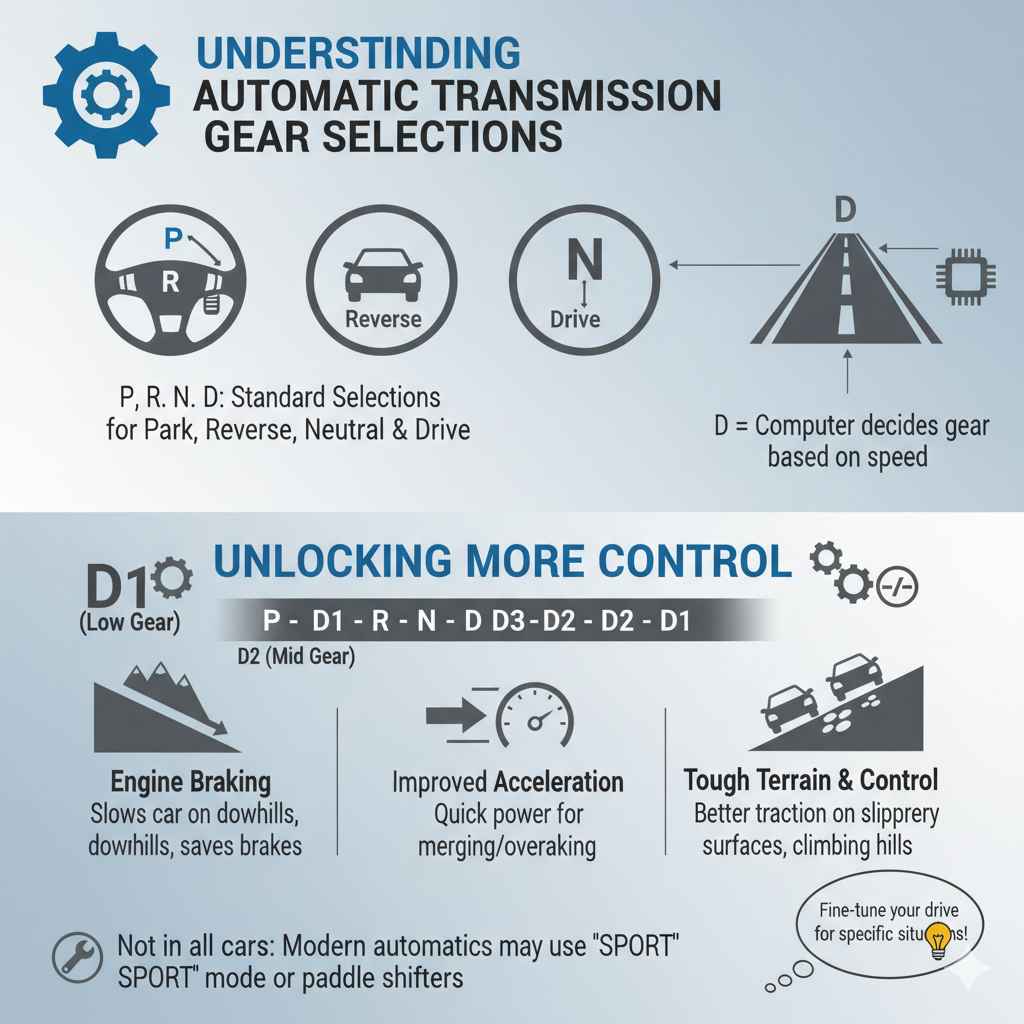
Automatic transmissions are designed to shift gears for you, making driving easier. Normally, you’ll see “P” (Park), “R” (Reverse), “N” (Neutral), and “D” (Drive). When you select “D,” the car’s computer decides which gear is best for the current speed and acceleration. Simple enough, right? However, some cars offer more specific control within the “D” range itself. These additional selections, often labeled D1, D2, D3, or similar variations like L (Low), 2, or 3, allow you, the driver, to influence which gears the transmission uses.
These options are not present in every car. Most modern cars with advanced automatic transmissions or continuously variable transmissions (CVTs) might not have these distinct D1, D2, D3 markings. Instead, they might offer a “Sport” mode or manual shifting options (like paddle shifters or a +/- gate) to achieve similar results. But if you do see D1, D2, D3 on your shifter or in your car’s manual, it’s helpful to know what they do. It’s like having a few extra tools in your car’s toolkit, ready to be used when needed.
Why Are There Extra Gear Options?
The primary reason for these extra gear selections is to give you more control over your car’s power delivery and its speed capabilities. By limiting the transmission to a specific gear or range of gears, you can:
- Increase Engine Braking: This is very useful when driving downhill. By staying in a lower gear, the engine’s resistance helps slow the car down, reducing the strain on your brakes and preventing them from overheating.
- Improve Acceleration: For quick bursts of speed, like merging onto a highway or overtaking, selecting a lower gear can keep the engine in its power band for maximum performance.
- Handle Tough Terrain: Driving on slippery surfaces like snow, ice, or mud, or climbing steep hills, can be made easier by manually selecting a lower gear for better traction and control.
- Optimize for Specific Conditions: Whether you need more power or want to manage your speed more deliberately, these options offer flexibility that the standard “D” mode might not provide.
Think of it this way: If “D” is like an automatic setting that’s generally good, D1, D2, and D3 are like fine-tuning options for specific situations. They allow you to tell your car, “Hey, I need a bit more grunt here,” or “Let’s slow this descent gracefully.”
Decoding D1, D2, and D3
Let’s break down what each of these common gear selections typically means. While the exact behavior can vary slightly between car manufacturers, the general principles are consistent. These designations usually refer to limiting the automatic transmission to at most a certain gear.
D1 (First Gear)
When you select D1, you are telling your car’s transmission to use only the first gear. This is the lowest possible forward gear. What does this mean for driving?
- Maximum Torque and Power: First gear provides the most leverage (torque) from the engine to the wheels. This is why it’s used for starting from a complete stop.
- Slowest Speed: You won’t be able to reach high speeds in D1. The engine will rev much higher for a given speed compared to higher gears.
- Engine Braking: It offers the strongest engine braking effect.
When to use D1:
- Starting from a standstill on a steep incline.
- Driving very slowly on slippery surfaces where maximum control is needed (like thick snow or mud).
- Going down very steep hills to help control your descent.
- When you need the absolute most pulling power.
D2 (Second Gear)
Selecting D2 typically means the transmission will use either first or second gear, but it will not shift into third or any higher gears. Second gear offers a balance between power and speed, suitable for moderate acceleration and slower speeds.
- More Speed than D1: You can reach higher speeds in D2 than in D1 before the engine reaches its redline.
- Less Torque than D1: While still providing good pulling power, it’s not as much as first gear.
- Moderate Engine Braking: Offers more engine braking than higher gears but less than D1.
When to use D2:
- Climbing moderate hills.
- Driving in snowy or icy conditions where you need more control than you’d get in ‘D’ but more speed than ‘D1’ allows.
- Going down moderately steep hills.
- When you need to accelerate moderately but want to prevent the transmission from shifting into higher gears too quickly (e.g., in a construction zone with intermittent stops).
D3 (Third Gear)
Choosing D3 usually restricts the transmission to using first, second, or third gear. It allows for higher speeds than D1 or D2, but still limits the highest gear the transmission will engage. This is often the highest numerical gear limitation you’ll find in these types of selectors.
- Higher Speeds Possible: You can achieve respectable road speeds in D3.
- Less Power than D1/D2: It offers the least torque and engine braking among these lower gear selections.
- Good for Uphill Cruising: Allows the engine to reach higher speeds while climbing hills or maintaining momentum.
When to use D3:
- Driving on hilly terrain where you want the transmission to avoid shifting into very high gears, maintaining better power for inclines.
- When driving on highways in certain conditions where you want to limit gear shifts, perhaps to prevent the transmission from downshifting unnecessarily.
- Slowing down from higher speeds without heavy reliance on the brakes, as it provides a modest amount of engine braking.
Common Gear Shifter Markings and Their Meanings
Car manufacturers use different symbols and terminology. While D1, D2, D3 are common, you might see other markings that serve a similar purpose. Understanding these variations can prevent confusion.
Table: Common Gear Shifter Markings
| Marking | Typical Meaning | When to Use |
|---|---|---|
| D | Drive (Full automatic operation) | Everyday driving on normal roads. |
| D1, 1, L | First Gear Only | Steep hills (uphill/downhill), very slippery conditions, maximum towing power. |
| D2, 2 | First and Second Gears | Moderate hills, moderate slippery conditions, slower speeds. |
| D3, 3 | First, Second, and Third Gears | Hilly terrain, highway driving to prevent unnecessary shifts, moderate downhill slopes. |
| OD (Overdrive) | Highest gear ratio (usually 4th, 5th, 6th, or higher). Often engaged by default in ‘D’. | Cruising at highway speeds for fuel efficiency. |
| M, S, Manual Mode, +/- | Manual control over gear selection (using paddle shifters or shifter gate). Allows driver to select any gear typically within a safe range. | Performance driving, engine braking on descents, precise control. |
It’s always a good idea to check your car’s owner’s manual. It will tell you precisely what each marking on your specific shifter means and provide manufacturer-recommended usage. For example, Toyota manuals, like many others, detail such functions for their models.
Overdrive (OD) Explained
The “OD” marking, often found on shifters or as a button, stands for “Overdrive.” When OD is engaged (usually the default state when “D” is selected), the transmission can shift into its highest gear(s). These gears have a lower numerical ratio, allowing the engine to run at a lower RPM for a given road speed, significantly improving fuel efficiency on the highway. If you see a button that says “O/D OFF,” pressing it will disengage overdrive, preventing the transmission from shifting into the highest gear(s). This can be useful for towing or going up hills, where you might want the engine to work a bit harder in a lower gear.
When and Why to Use D1, D2, or D3
Now that we know what these gears are, let’s dive into practical scenarios where using them makes sense. This is where you start to feel like a pro driver!
1. Driving Downhill (Engine Braking)
This is perhaps the most common and important use for D1, D2, and D3. When you’re going down a long, steep hill, relying solely on your brakes can cause them to overheat and fade, a dangerous situation. By selecting a lower gear, you use the engine’s internal friction to help slow the car. This is called engine braking.
- Very Steep Hills: Use D1. The engine will actively resist the car’s forward motion.
- Moderately Steep Hills: Use D2 or D3. These offer a gentler but still effective slowing effect.
The key is to select the gear that allows you to maintain a safe, controlled speed without touching the brakes much, if at all. Imagine your car is gently grabbing the road instead of just rolling downhill.
2. Driving in Slippery Conditions (Snow, Ice, Mud)
In low-traction situations, smooth and predictable power delivery is crucial. The standard “D” mode might cause the wheels to spin excessively when you accelerate, leading to a loss of control. Lower gears help here.
- Deep Snow or Mud: D1 is often best. It provides the slowest wheel speed and maximum torque application, reducing the chance of spinning and getting stuck.
- Icy Roads or Light Snow: D2 can be a good compromise. It allows for a bit more speed than D1 but still offers more controlled acceleration than typical ‘D’ mode.
The goal is to apply power gently and steadily. By limiting the transmission gears, you prevent sudden shifts or excessive wheel spin. For more information on driving safely in adverse weather, the Florida Department of Transportation offers excellent general advice.
3. Climbing Steep Hills
When going uphill, especially with a heavy load or towing, you want the engine to have enough power. Sometimes, in ‘D’ mode, the transmission might be hesitant to downshift, or it might shift into a higher gear that strains the engine.
- Steep, Power-Hungry Climbs: Use D3 or D2. This keeps the transmission in a lower gear, ensuring the engine stays in its power band and doesn’t struggle.
- Very Slow, But Steep Climb: D1 might be necessary if you’re moving at a crawl and need maximum torque.
By selecting D3 or D2, you essentially tell the car, “Don’t shift up too soon; I need sustained power.”
4. Towing or Carrying Heavy Loads
Towing a trailer or hauling a significant amount of weight puts extra strain on your transmission and engine. Using lower gears can help manage this strain.
- Starting and Accelerating: Use D1 or D2 to get the load moving smoothly.
- Maintaining Speed (Especially Uphill): D3 can prevent the transmission from constantly shifting up and down, which can overheat the fluid.
- Downhill: D1 or D2 for engine braking, as mentioned earlier.
Consult your vehicle’s owner’s manual for specific recommendations regarding towing and transmission usage.
5. Performance Driving or Specific Situations
While not for everyday commuting, some drivers use these modes for spirited driving on twisty roads or in specific competitive events (like autocross) where they want to keep the engine in a particular RPM range without the automatic transmission interfering.
If your car has a “Sport” mode or manual shifting (like +/-), these are often better suited and more sophisticated for performance driving than older D1/D2/D3 systems. However, the principle of restricting gear selection to optimize engine power and response remains the same.
How to Select D1, D2, or D3
The process is generally straightforward and very similar to selecting “D” for Drive. You’ll typically find these markings on the same gear shifter assembly as P, R, N, and D.
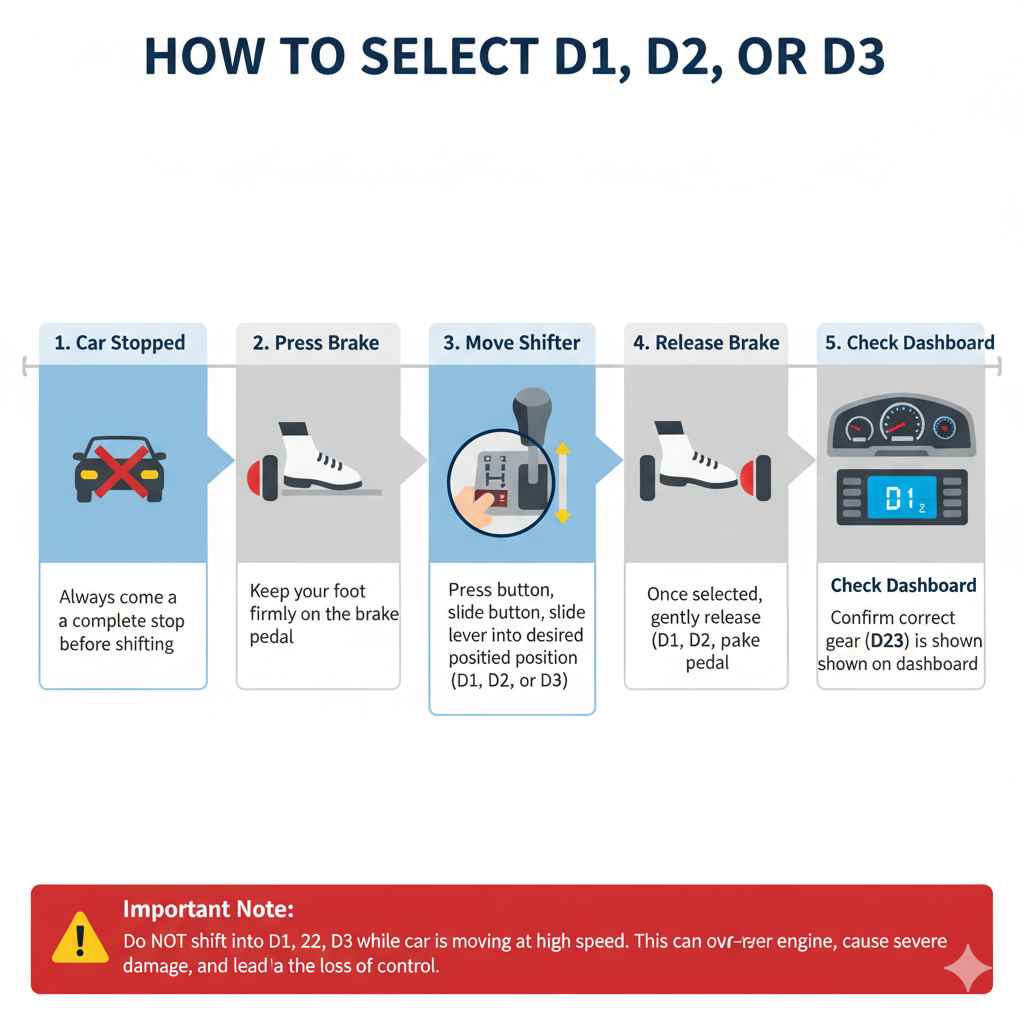
- Ensure the Car is Stopped: Always come to a complete stop before shifting between gears, especially when moving from D to a lower gear or vice-versa.
- Press the Brake Pedal: Keep your foot firmly on the brake pedal.
- Move the Shifter: On most shifters, you’ll need to press a button (often near the shift lever’s grip) to move the lever out of Park or Neutral. Then, slide the lever into the desired position (D1, D2, D3). Some shifters might require a side-to-side ‘gate’ motion to access these lower gears from ‘D’.
- Release the Brake: Once the desired gear is selected and displayed on your dashboard, you can gently release the brake pedal.
- Check Your Dashboard: Always confirm that the correct gear selection (D1, D2, or D3) is shown on your instrument cluster.
Important Note: Do NOT try to shift into D1, D2, or D3 while your car is moving at speed, especially from a higher gear towards a lower one. For example, trying to force your car into D1 when you are already traveling at 40 mph is extremely dangerous. It can over-rev the engine, potentially causing severe damage, and could also lead to a loss of control. Stick to using these lower gear selections when the car is stopped or moving below the speed appropriate for that gear.
Troubleshooting and Common Questions
Even with clear explanations, some questions might pop up. Let’s address a few common ones.
Frequently Asked Questions (FAQ)
Q1: My car only has “D,” “L,” or “2” marks. What do they mean?
Answer: “L” (Low) typically functions like D1, meaning it will only use first gear. “2” (Second) usually functions like D2, restricting the transmission to first and second gears. These are older designations but serve a similar purpose of limiting gear selection.
Q2: Can I damage my transmission by using D1, D2, or D3?
Answer: Generally, no, if used correctly. These are engineered features. The main risk is trying to shift into a lower gear (like D1) while going too fast, which can over-rev the engine and potentially damage it or the transmission. Always use them within the appropriate speed ranges indicated by your car’s manual or common sense.
Q3: Will using D1, D2, or D3 help my fuel economy?
Answer: Not usually. These lower gears require the engine to work harder and spin at higher RPMs for a given speed, which typically uses more fuel. The exception might be on long downhill stretches where engine braking prevents you from needing to accelerate to maintain speed, thus saving fuel compared to constant braking and accelerating. Their primary benefits are control and performance, not fuel saving.