What Happens When AC Is Overcharged in a Car? Full Breakdown
What happens when AC is overcharged in a car is more damaging than most drivers realize, and understanding the consequences can save you from costly repairs. This post explains the symptoms, causes, dangers, and solutions for an overcharged car AC system.
Simply put, an overcharged AC system has too much refrigerant in the loop, which raises pressures beyond safe limits. This leads to poor cooling, potential compressor damage, and even system failure if not corrected. The fix involves recovering excess refrigerant and recharging to the proper level.
Key Takeaways
- Overcharged AC causes warm air, high pressure readings, and compressor strain that can lead to failure.
- Excess refrigerant reduces cooling efficiency by flooding the condenser and preventing proper heat exchange.
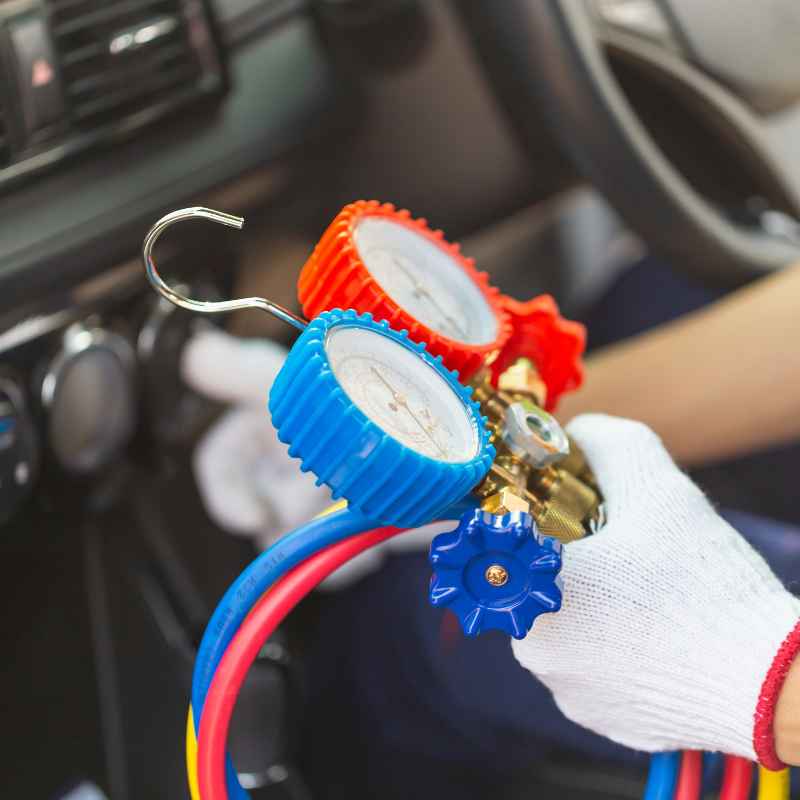
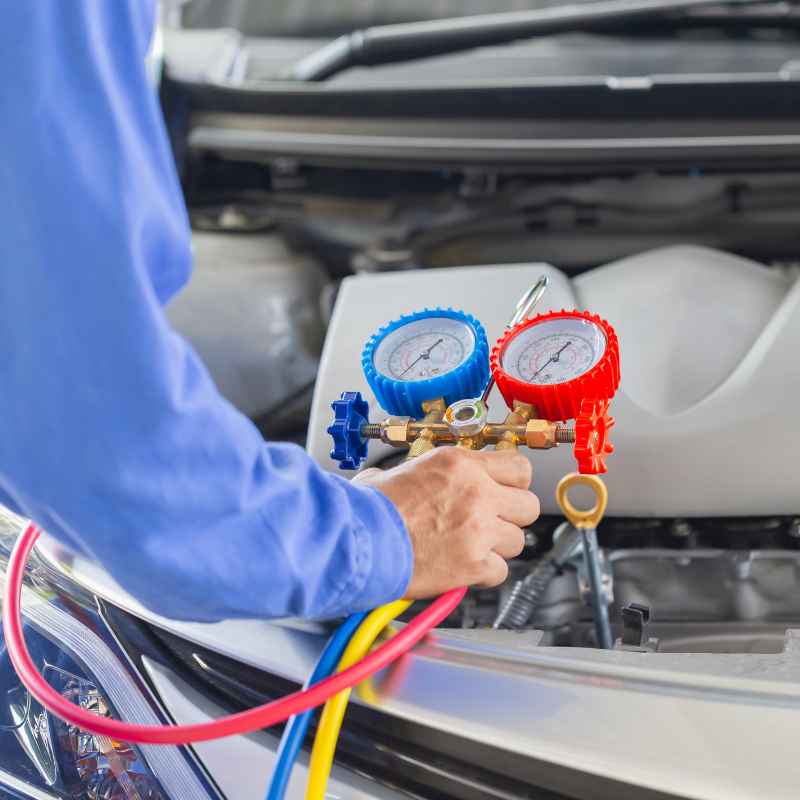
- Diagnosing an overcharged system requires a manifold gauge set and knowledge of manufacturer pressure specs.
- Fixing the issue involves recovering refrigerant and recharging to exact specifications, not just guessing.
- Proper charging depends on ambient temperature, humidity, and vehicle-specific requirements.
What Is an Overcharged Car AC System?
An overcharged car AC system contains more refrigerant than the manufacturer specifies for optimal operation. Every vehicle has a precise refrigerant capacity measured in ounces or pounds. When you add too much, the system cannot function as designed.
The AC circuit works in a closed loop. The compressor pushes refrigerant through the condenser, where it cools and changes from gas to liquid. Then it passes through the expansion device and evaporator, absorbing heat from the cabin.
Each component is sized for a specific refrigerant volume. Exceeding that volume throws everything out of balance.
Think of it like filling a blood pressure cuff. Too little air gives a false reading. Too much air risks bursting the cuff or damaging the pump.
Your car AC works the same way. The compressor, hoses, and seals are rated for certain pressures. Overcharging pushes those pressures well above design limits.
Warning: Overcharging can cause liquid refrigerant to reach the compressor, which cannot compress liquid. This is called liquid slugging and it destroys compressor valves internally.
The automotive industry considers proper refrigerant charge a critical service parameter. According to the U.S. Department of Energy, an improperly charged AC system can reduce fuel economy by up to 25 percent under certain driving conditions because the compressor works harder than necessary.
The Environmental Protection Agency also reports that improper refrigerant handling is a leading cause of premature AC system failures.
| Parameter | Proper Charge | Overcharged System |
|---|---|---|
| Low side pressure | 25-45 psi | 50-70+ psi |
| High side pressure | 150-250 psi | 275-400+ psi |
| Vent temperature | 38-45 degrees F | 55-70 degrees F or warmer |
| Compressor amp draw | 5-8 amps | 10-15+ amps |
These numbers illustrate the dramatic difference between a properly charged system and an overloaded one. High side pressure above 300 psi puts every seal and hose at risk of sudden failure.
What Are the Symptoms of an Overcharged AC?
An overcharged AC system telegraphs its condition through several clear symptoms. Recognizing these early can prevent major component damage. Here are the most common signs you will notice.
- Warm air from vents: The most obvious symptom. Instead of cold air, you get air that feels barely cool or even warm at idle.
- Frequent compressor cycling: The compressor turns on and off rapidly, sometimes every few seconds, because high pressure triggers the safety cutoff switch.
- Hissing or gurgling sounds: Excess refrigerant can cause abnormal noises from the condenser or expansion valve as liquid struggles to pass through.
- Frost or ice on lines: In some cases, you may see frost forming on the low side lines or accumulator because the system is confused by the excess charge.
- Engine strain at idle: The compressor drag increases noticeably. You may feel the engine struggle or hear a belt squeal when the AC engages.
- Visible oil leaks: High internal pressure forces refrigerant oil past seals and o-rings, leaving oily residue around connections.
- High side pressure above 300 psi: A manifold gauge confirms this. Anything above 275 psi on a typical 80 degree day signals a problem.
Studies show that overcharging by just 10 percent can reduce cooling efficiency by 20 to 30 percent according to data from SAE International research on AC system performance. That means you are burning more fuel and getting worse cooling at the same time.
Not all symptoms appear at once. You might notice warm air first, then hear strange sounds weeks later. The system degrades gradually until something fails outright.
Catching it early matters because a compressor replacement can cost 800 to 1500 dollars depending on the vehicle.
Important: Never rely on feel alone to diagnose overcharge. Use a manifold gauge set to verify pressure readings. Guessing leads to misdiagnosis and wasted refrigerant.
How Does an AC System Become Overcharged?
The most common cause of overcharging is do-it-yourself AC recharge kits. These canned refrigerant cans sold at auto parts stores seem simple. You attach a hose, squeeze a trigger, and the system fills.
But they lack precision. Most kits do not include a gauge that reads high side pressure, and the low side gauge they provide is often inaccurate.
A typical can contains 12 to 20 ounces of refrigerant. A car may need only 24 to 30 ounces total. Adding one full can to a system that already has some charge left pushes it over the limit.
The instructions usually say to charge until the gauge reads in the green zone. But that green zone is a generic range that does not account for ambient temperature, humidity, or your specific vehicle.
Professional shops can overcharge too, though less commonly. A technician might misread manufacturer specifications or fail to account for different refrigerant types. R134a and R1234yf systems require different charge weights and pressures.
Using the wrong specification leads to an improper charge.
Another cause is topping off a system with a slow leak. Someone notices cooling has weakened, assumes refrigerant is low, and adds a can. But the leak may be small, and the system actually has near-normal charge.
Adding more pushes it over the top. The Automotive Service Association reports that refrigerant overcharge is responsible for approximately 15 percent of all AC repair visits annually.
System contamination can mimic overcharge symptoms too. Air or moisture in the system raises pressure readings even if refrigerant volume is correct. That is why proper vacuuming and evacuation matter before charging any system.
| Cause | Frequency | Prevention |
|---|---|---|
| DIY recharge kits | Very common | Use professional gauges and weigh refrigerant |
| Technician error | Moderate | Follow vehicle-specific specs |
| Topping off without diagnosis | Common | Leak test before adding refrigerant |
| System contamination | Less common | Vacuum system for 30-45 minutes |
Prevention starts with knowing your vehicle specific capacity. Check the underhood sticker or service manual before adding any refrigerant. That number is your target.
Why Is Overcharging Dangerous for Your AC System?
An overcharged AC system creates a cascade of problems that start small and end with component failure. The compressor is the most expensive part in the system, often costing between 500 and 1200 dollars for parts and labor. Overcharging directly threatens it.
High pressure forces the compressor to work against greater resistance. The clutch engages and disengages more frequently, wearing out the clutch plate and bearing. Eventually the clutch fails completely, and the compressor stops turning.
On many vehicles, the clutch cannot be replaced separately, requiring a full compressor replacement.
Liquid slugging occurs when liquid refrigerant enters the compressor. Compressors are designed to compress gas, not liquid. Liquid does not compress.
The piston or scroll meets incompressible fluid, causing immediate damage to reed valves, pistons, or scroll plates. This damage is often permanent and requires compressor replacement.
Seals and o-rings throughout the system degrade faster under sustained high pressure. Refrigerant oil carries the oil through the system to lubricate seals. Overcharging forces oil out of seals, leaving them dry and brittle.
Leaks develop at the compressor shaft seal, condenser fittings, and evaporator connections.
The condenser can rupture in extreme cases. Condensers are aluminum with thin wall construction. High side pressure above 400 psi can cause the condenser to split or crack at weld seams.
This releases all refrigerant instantly and can spray oily refrigerant into the engine bay.
Overcharged AC also reduces system lifespan significantly. ASHRAE guidelines indicate that proper refrigerant charge can improve system efficiency by 15 to 20 percent and extend component life. Running overcharged cuts that lifespan by half or more in many cases.
Tip: If your AC stops blowing cold suddenly, turn it off immediately. Running an overcharged system even for a few minutes can cause internal compressor damage that is not immediately obvious.
How to Diagnose an Overcharged Car AC
Diagnosing an overcharged system requires proper tools and a systematic approach. You cannot tell by feel or sound alone. Here is the step by step process professionals use.
- Connect a manifold gauge set to the low and high side service ports. Make sure the valves are closed before connecting.
- Run the engine at 1500 to 2000 RPM and set the AC to maximum cool, recirculation mode, with blower on high.
- Read both gauges after the system stabilizes. This usually takes 3 to 5 minutes.
- Compare your readings to the manufacturer pressure chart for the current ambient temperature.
- Check for excessive high side pressure. Over 275 psi on a mild 80 degree day indicates overcharge.
- Observe compressor cycling. Rapid on-off cycles of less than 10 seconds each confirm high pressure cutoff activation.
- Measure vent temperature with a digital thermometer. Above 50 degrees F when ambient is below 90 degrees F suggests a problem.
A clear diagnostic sign is when both low and high side pressures read high simultaneously. A properly charged system shows low side around 25 to 35 psi and high side around 180 to 220 psi on a moderate day. Overcharged systems show numbers far above these ranges on both sides.
You should also check for sight glass indicators on older R12 systems. Bubbles mean low charge. Clear with no bubbles could mean proper charge or overcharge.
A completely clear sight glass with high gauge readings points to overcharge.
Air in the system mimics overcharge symptoms too. If pressures are high but vent temperature is not cold, suspect air contamination. The fix is the same as overcharge recovery, evacuation, and recharge.
Important: Never open the high side service port while the system is running. High side pressure can exceed 300 psi and refrigerant oil spray can cause severe frostbite or eye injury.
How to Fix an Overcharged Car AC System
Fixing an overcharged system is not a simple bleed-off operation. You cannot just vent refrigerant into the atmosphere. That is illegal under EPA regulations for all refrigerants including R134a and R1234yf.
Venting carries fines of up to 37,500 dollars per day under the Clean Air Act.
The correct fix requires a refrigerant recovery machine. These machines pull the entire charge out of the system, filter it, and store it in an internal tank. Here is the proper procedure.
- Connect the recovery machine to the AC system service ports. Follow the machine instructions carefully.
- Run the recovery cycle until the machine indicates the system is empty. This typically takes 5 to 10 minutes.
- Weigh the recovered refrigerant to confirm how much was in the system. Compare to the manufacturer specification.
- Evacuate the system using a vacuum pump for 30 to 45 minutes to remove moisture and air.
- Recharge the system with the exact weight of refrigerant specified for your vehicle. Use a refrigerant scale for accuracy.
- Test system operation with gauges and vent thermometer to verify proper pressures and cooling.
If you do not have access to a recovery machine, the only legal option is to take the vehicle to a professional repair shop. Most shops charge 100 to 200 dollars for recovery and recharge service. That is far cheaper than replacing a compressor.
Some people attempt to bleed small amounts of refrigerant from the low side to reduce pressure. This is not recommended because you cannot control how much comes out. You may end up undercharged.
Plus, refrigerant escapes as gas which also carries lubricating oil with it. Removing too much oil damages the compressor.
After fixing the overcharge, always check for the root cause. If the system had a leak that prompted the overcharge in the first place, that leak still exists. Perform a leak test using UV dye or an electronic leak detector before completing the repair.
What Does Proper AC Charging Look Like?
Properly charging a car AC system is a precise process that requires the right tools and knowledge. It is not a guess or a feel. Here is what correct charging involves.
First, you need the exact refrigerant capacity for your vehicle. This is listed on the underhood sticker and in the service manual. It is measured in ounces.
A Honda Civic might require 21 ounces of R134a. A Ford F150 might need 36 ounces. There is no universal amount.
Second, you need a refrigerant scale. Charging by weight is the only accurate method. Charging by pressure or sight glass is less reliable.
Set the scale to zero with the tank connected, then open the valve and add exactly the required weight.
Temperatures affect charging too. Most manufacturer specifications assume an ambient temperature around 70 to 90 degrees F. If you charge when it is 95 degrees outside, you may need to adjust target pressures upward slightly.
If it is 60 degrees, you target lower pressures.
| Ambient Temp | Low Side Target | High Side Target | Vent Temp Target |
|---|---|---|---|
| 70 degrees F | 25-30 psi | 160-190 psi | 38-42 degrees F |
| 80 degrees F | 28-35 psi | 190-220 psi | 40-45 degrees F |
| 90 degrees F | 32-40 psi | 220-250 psi | 42-48 degrees F |
| 100 degrees F | 35-45 psi | 240-275 psi | 45-52 degrees F |
These are general ranges. Always defer to your vehicle manufacturer specifications first. The numbers vary by vehicle design, condenser size, and compressor type.
A proper charge also includes the right amount of PAG oil. When you replace components like the compressor, accumulator, or condenser, you must add oil to compensate for what was lost. Too little oil damages the compressor.
Too much oil reduces cooling efficiency and can cause poor performance similar to overcharge.
Common Mistakes When Charging Car AC
Most AC charging mistakes come from inexperience or rushing. Here are the errors that lead to overcharged systems and other problems.
- Charging without a scale: Adding refrigerant by can count instead of weight is the number one cause of overcharge. A can is not a precise measurement.
- Ignoring ambient temperature: Charging on a hot day without adjusting target pressures leads to undercharge or overcharge depending on how you interpret the gauge.
- Skipping the vacuum step: Not evacuating the system leaves air and moisture inside. Moisture freezes in the expansion valve and blocks refrigerant flow. Air raises system pressure.
- Mixing refrigerant types: Adding R134a to an R12 system or vice versa creates chemical reactions that damage seals and reduce cooling. R1234yf systems use different fittings, but adapters allow dangerous mixing.
- Charging liquid into the low side: Liquid refrigerant entering the low side can reach the compressor and cause liquid slugging. Always charge as vapor on the low side.
- Using stop leak products: These contain sealants that clog the expansion valve, condenser, and receiver drier. They cause more damage than the leak they pretend to fix.
- Assuming a full system needs no check: Even new AC systems can be overcharged from the factory or after component replacement. Always verify with gauges.
The National Institute for Automotive Service Excellence recommends that all AC service be performed by certified technicians using approved equipment. Their ASE certification program tests knowledge of proper charging procedures, refrigerant handling laws, and diagnostic methods.
One more mistake worth mentioning is overestimating how much refrigerant a system holds. Many owners think their large SUV needs four or five cans of refrigerant. In reality, most vehicles take between 20 and 36 ounces.
That is roughly one to three cans maximum. Adding more than that guarantees overcharge.
Frequently Asked Questions
Can overcharged AC damage the compressor?
Yes, overcharging is one of the most common causes of compressor failure. High pressure forces the compressor to work harder, causes rapid clutch cycling, and can lead to liquid slugging which destroys internal components. Compressor replacement typically costs 800 to 1500 dollars.
How do I know if my car AC is overcharged?
The main signs are warm air from vents, high gauge readings on both low and high sides, rapid compressor cycling, and hissing sounds from the engine bay. A manifold gauge set showing low side above 50 psi and high side above 275 psi on a mild day confirms overcharge.
Can I remove refrigerant from my car AC myself?
Technically you can use a recovery machine if you own one. But venting refrigerant to the atmosphere is illegal under EPA regulations. Most DIYers do not have recovery equipment.
The safest legal option is to take the vehicle to a professional shop for proper recovery and recharge.
What happens if you put too much refrigerant in a car?
The system pressures rise above safe limits, cooling efficiency drops, the compressor works harder and wears faster, seals leak, and in extreme cases the condenser can rupture. Overcharging by just 10 percent can cut cooling performance by 20 to 30 percent.
How much does it cost to fix an overcharged AC system?
Professional recovery and recharge typically costs 100 to 200 dollars. If the compressor has already been damaged, replacement adds 500 to 1500 dollars. Early diagnosis saves money.
A simple recovery is far cheaper than replacing major components.
Final Thoughts
What happens when AC is overcharged in a car is a sequence of high pressure damage, reduced cooling, and expensive repairs. Recognizing the symptoms early and fixing the charge level correctly keeps your AC running efficiently for years. Always use manufacturer specifications, proper tools, and legal refrigerant handling practices.
Your compressor and your wallet will thank you.
Products related to this article
Sponsored / affiliate links. As an Amazon Associate I earn from qualifying purchases. I may earn additional commission from eligible campaigns.