
What Is a Bagged Car? Simple Explanation
Ever heard someone talk about a “bagged car” and felt a little lost? You’re not alone! It sounds like it might involve a grocery bag or something equally strange, but it’s actually a really cool automotive modification. Many people find it a bit confusing at first, but learning about it is much simpler than you might think. This post will break down What Is a Bagged Car? Simple Explanation, step by step, so you can understand this popular car feature. We’ll cover what it is, how it works, and why people choose to do it.
What Is a Bagged Car And How Does It Work
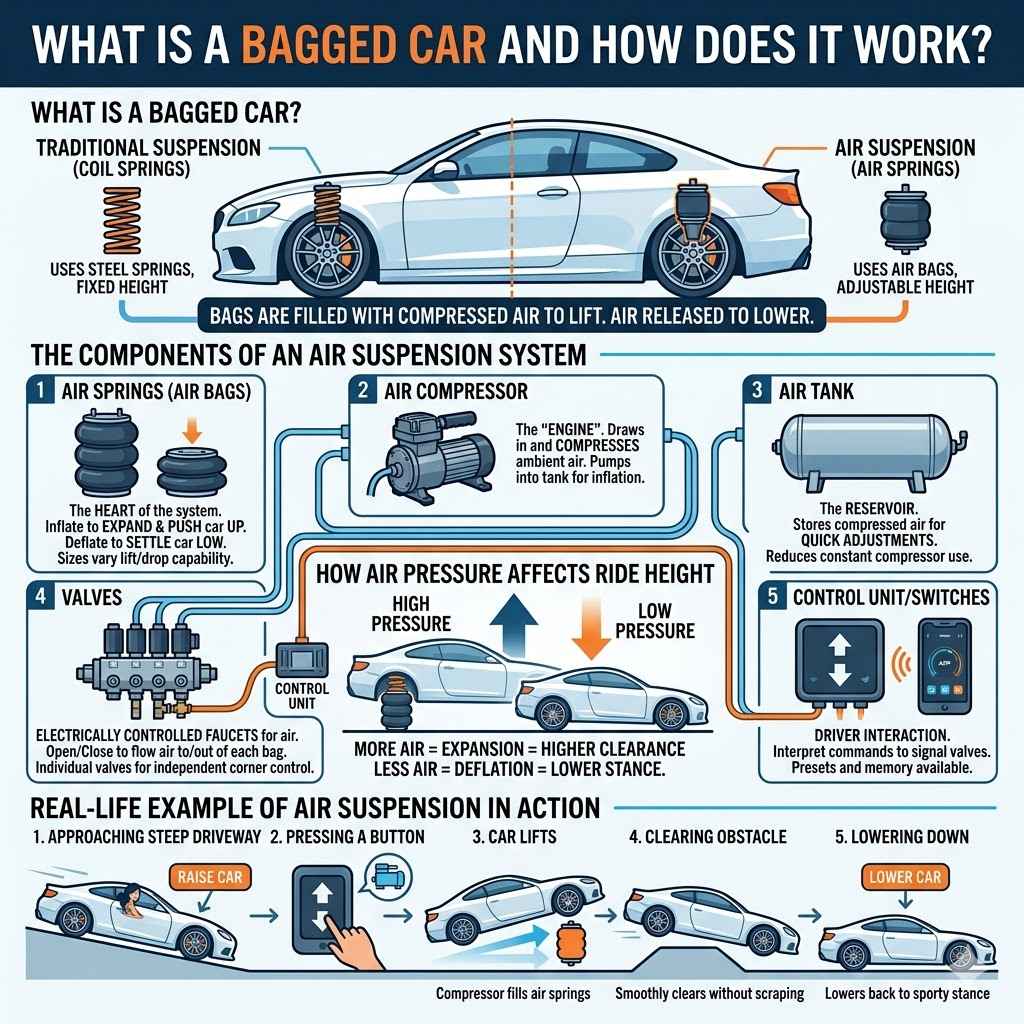
A bagged car is a vehicle that has been modified with an air suspension system. This means instead of traditional coil springs or leaf springs, the car uses air springs, often called air bags, to support its weight and control its ride height. These air springs are essentially durable rubber bags that are filled with compressed air. When the air pressure inside the bags increases, the car is lifted. When the air pressure is released, the car lowers.
This system gives the driver the ability to adjust the car’s height on the fly, making it possible to raise the car for clearing obstacles or lower it for a more aggressive look or improved handling. The entire system is controlled by a compressor and a set of valves, allowing for precise adjustments.
The Components of an Air Suspension System
Understanding the parts of an air suspension system is key to grasping what makes a bagged car unique. Each component plays a vital role in the system’s operation.
Air Springs (Air Bags)
These are the heart of the system. They are typically made of heavy-duty rubber or polyurethane and are shaped like bellows or cylinders. When air is pumped into them, they expand, pushing the car’s chassis upwards. Conversely, when air is released, they deflate, allowing the car to sit lower. The size and type of air spring can influence how much lift or drop a car can achieve. For example, larger diameter springs can often provide more lift.
Air Compressor
This is the “engine” of the air suspension. The compressor draws in ambient air and compresses it, storing it in a tank. This pressurized air is then used to inflate the air springs. The compressor’s power and efficiency can affect how quickly the suspension can be raised or lowered. High-quality compressors are designed to operate quietly and efficiently, ensuring a smooth experience.
Air Tank
The air tank acts as a reservoir for the compressed air. It stores enough air to allow for multiple adjustments to the suspension height without needing to run the compressor constantly. The size of the tank is important; a larger tank means more air is available for quick adjustments, reducing the need for the compressor to cycle frequently.
Valves
These electrically controlled valves are like faucets for the air. They open and close to allow compressed air to flow into or out of the air springs, controlling the ride height. A sophisticated system will have individual valves for each air spring, allowing for independent control of different corners of the car. This enables advanced features like leveling the car automatically.
Control Unit/Switches
This is how the driver interacts with the system. It can range from simple up/down switches to advanced digital controllers with memory presets for different ride heights. Some systems are even integrated with smartphone apps for remote control. The control unit interprets the driver’s commands and signals the valves to adjust the air pressure accordingly.
How Air Pressure Affects Ride Height
The relationship between air pressure and ride height is fundamental to how air suspension works. Think of it like a balloon. The more air you put into a balloon, the bigger it gets and the more force it exerts. Similarly, as the air compressor pumps more air into the air springs, they expand. This expansion pushes the car upwards, increasing the ground clearance. When the driver wants to lower the car, the control unit signals the valves to open, releasing air from the springs.
As the air escapes, the springs deflate, and the car settles lower to the ground. This adjustability is the primary appeal of air suspension.
Real-Life Example of Air Suspension in Action
Imagine Sarah driving her lowered sports car. She approaches a steep driveway that she normally can’t clear without scraping the bottom. With her bagged car, she simply presses a button on her controller. The air compressor kicks in, and within seconds, the air springs inflate, raising the car’s ride height significantly.
She smoothly drives up the driveway without any issue. Once she’s on level ground, she lowers the car back down to its aggressive, sporty stance. This flexibility is a major advantage of air suspension.
Benefits Of Having A Bagged Car
People choose to bag their cars for a variety of reasons, all centered around the unique advantages this system offers. It’s not just about looks; it’s also about functionality and adaptability.
Enhanced Aesthetics and Style
One of the most visible benefits of a bagged car is its striking appearance. The ability to drastically lower a vehicle allows for an aggressive, “stanced” look that many enthusiasts admire. This low-slung profile can make a car look more dynamic and stylish.
Achieving the “Stance” Look
The term “stance” in car culture refers to the way a car sits, particularly its relationship with the wheels and fenders. Bagging allows enthusiasts to achieve an extreme stance by lowering the car so the fenders are very close to or even resting on the tire sidewalls. This ultra-low look is a significant aesthetic goal for many who modify their vehicles.
Customization and Personalization
Air suspension offers a level of customization that traditional suspension cannot match. Drivers can change their car’s appearance to suit different occasions or moods. Want a show car look for an event? Lower it to the ground. Need to drive comfortably on a daily basis? Raise it to a more practical height. This versatility makes each bagged car truly unique.
Improved Aerodynamics (Potentially)
While not the primary reason for most, lowering a car can sometimes lead to slight improvements in aerodynamics. A lower profile reduces the amount of air that flows underneath the vehicle, which can decrease drag. This effect is more pronounced on race cars, but it can be a subtle bonus for street vehicles as well.
Improved Ride Comfort and Quality
Contrary to what some might think, air suspension can actually improve ride comfort compared to stiff, lowered coil springs. The air springs act as a cushion, absorbing bumps and imperfections in the road more effectively.
Absorbing Road Imperfections
The compressible nature of air allows the suspension to soak up bumps, potholes, and rough surfaces much better than a traditional spring. Instead of a jarring impact, the air cushion absorbs the shock, leading to a smoother, more comfortable ride. This is especially noticeable on longer drives or on roads that are not perfectly maintained.
Adjustable Ride Stiffness
With advanced control systems, drivers can often adjust not just the height but also the stiffness of the ride by altering the air pressure. This means you can have a softer, more comfortable ride for cruising and a firmer, more responsive ride for spirited driving, all from the same system.
Reduced Fatigue on Long Drives
The enhanced comfort provided by air suspension can significantly reduce driver and passenger fatigue on long journeys. Less road vibration and impact means a more relaxed experience, making road trips much more enjoyable.
Practicality and Functionality
Beyond looks and comfort, air suspension offers genuine practical benefits that can make owning and driving a modified car much easier.
Clearing Obstacles and Steep Driveways
This is perhaps the most significant practical advantage. Many custom cars are lowered so much that they cannot safely navigate speed bumps, steep driveways, or rough terrain. With an air suspension system, the driver can simply raise the vehicle to gain the necessary clearance, avoiding costly damage to the car’s undercarriage.
Easier Entry and Exit
For extremely lowered vehicles, getting in and out can be a challenge. Being able to raise the car makes entry and exit much more accessible, especially for passengers. This adds a layer of everyday usability to vehicles that might otherwise be difficult to use regularly.
Loading and Unloading Cargo
In some cases, air suspension can be used to lower the rear of a vehicle to make loading and unloading heavy items easier. This is particularly useful for vehicles used for hauling or for those with trailers.
Case Study: The Daily Driver’s Dilemma
Mark loves the aggressive look of a lowered car, but his old suspension made it impossible to drive over speed bumps without fear. He decided to install an air suspension system. Now, he can lower his car for car shows to achieve that perfect stance. But when he needs to drive to work or run errands, he simply raises the suspension to a comfortable height, easily clearing all obstacles. This transformation made his passion project a practical daily driver.
How To Install An Air Suspension System On A Car
Installing an air suspension system is a significant undertaking that requires specific tools and knowledge. It involves modifying the vehicle’s existing suspension components and integrating new electrical and pneumatic systems.
Step-by-Step Installation Process
The process generally involves several key stages, from preparation to final testing. It’s important to follow manufacturer instructions precisely.
Preparation and Planning
Before starting, ensure you have all the necessary components and tools. This includes the air springs, compressor, tank, valves, control unit, wiring, and plumbing. It’s also crucial to plan where each component will be mounted, considering factors like accessibility for maintenance and electrical connections. Safety is paramount; disconnect the battery before beginning any electrical work.
Removing Stock Suspension Components
The original suspension parts, such as springs, shocks, and sometimes control arms, need to be removed. This typically involves unbolting and carefully lowering the existing suspension. Depending on the kit, some modifications to the chassis or suspension mounts might be necessary.
Mounting the Air Springs and Shocks
The new air springs and often new performance shocks are installed. These are designed to work together, and proper alignment is critical. The air springs are usually attached to the vehicle’s chassis and the suspension components that connect to the wheels.
Installing the Compressor, Tank, and Valves
The compressor, air tank, and solenoid valves are mounted in suitable locations. These are often placed in the trunk, under the vehicle, or in other discreet yet accessible areas. The tank needs to be securely mounted to prevent vibration damage.
Running Air Lines and Electrical Wiring
Air lines are routed from the valves to the air springs, and electrical wires connect the control unit, valves, compressor, and power source. Careful routing of these lines prevents them from being damaged by moving parts or road debris. Proper wire gauge and connections are essential for reliable operation.
Connecting the Control Unit and Testing
The control unit is wired and mounted in a convenient location inside the cabin. Once all connections are made, the system is tested. This involves powering up the compressor and checking for leaks in the air lines. The control unit is then used to cycle the suspension through its full range of height adjustment.
Tools and Equipment Needed
A successful installation relies on having the right tools. This isn’t a DIY job for the average car owner without specialized equipment.
General Mechanic’s Tools
This includes a comprehensive set of wrenches, sockets, screwdrivers, pliers, and a torque wrench. A good jack and sturdy jack stands are essential for safely lifting and supporting the vehicle.
Specialized Tools
Specific tools like a pipe cutter for air lines, a crimper for electrical connectors, and possibly a drill and grinder for mounting components are often required. A multimeter is crucial for electrical diagnostics.
Leak Detection Tools
A spray bottle with soapy water is often used to detect air leaks. Some professional systems might use electronic leak detectors.
Sample Installation Scenario
Consider a scenario where a shop is installing a complete air suspension kit on a classic muscle car. The team first meticulously removes the old leaf spring suspension. They then fabricate custom mounts for the new air springs and shocks, ensuring they are perfectly aligned. The air tank is secured under the chassis, and air lines are run neatly through the car’s frame rails.
The compressor is placed in the trunk, and the digital controller is installed discreetly below the dashboard. Finally, the system is pressurized, and every connection is checked for leaks using soapy water.
Understanding The Technical Terms
To truly understand bagged cars, some technical terms need clarification. These terms explain the mechanics and engineering behind the system.
Air Spring
An air spring, often referred to as an air bag or air bellows, is a flexible, pressurized cylinder made of rubber or polyurethane. Its primary function is to replace the traditional metal coil or leaf spring in a vehicle’s suspension. When compressed air is pumped into the air spring, it expands, pushing upwards against the vehicle’s chassis. The amount of air inside determines the spring’s stiffness and the vehicle’s ride height.
Different designs exist, including double-bellows, convoluted, and sleeve-style air springs, each offering varying degrees of lift, travel, and load capacity. The durability of the air spring is critical, as they are constantly subjected to pressure and movement.
Solenoid Valve
A solenoid valve is an electromechanically operated valve used to control the flow of air (or other fluids) into or out of the air springs. It consists of an electric solenoid, which is an electromagnetic coil, and a valve body. When an electric current is passed through the solenoid coil, it creates a magnetic field that pulls on a plunger or armature. This movement opens or closes the valve, allowing or blocking the passage of compressed air.
In an air suspension system, multiple solenoid valves are typically used, often one for each air spring or pair of springs, allowing for precise control over the pressure in each corner of the vehicle. This enables independent adjustment of ride height and leveling.
Air Compressor
The air compressor is the device responsible for generating and supplying the compressed air needed to operate the air suspension system. It works by drawing in ambient air and compressing it to a high pressure, which is then stored in the air tank. Compressors can vary in size, power, and efficiency.
Some are compact and designed for quieter operation, while others are more powerful for quicker inflation. The compressor often features an automatic shut-off when the air tank reaches its maximum pressure to prevent damage. It’s a critical component that directly impacts how quickly the suspension can be adjusted.
Air Tank
The air tank, also known as an air reservoir or pressure tank, serves as a storage vessel for the compressed air generated by the compressor. Having an air tank allows the system to have a readily available supply of compressed air, meaning the compressor doesn’t need to run every time the suspension is adjusted. This provides for quicker height adjustments and reduces wear on the compressor.
The size of the tank is important; larger tanks can support more frequent or larger adjustments before the compressor needs to refill them. The tank is typically made of metal and designed to withstand high pressures.
Control Unit
The control unit, often referred to as the management system or controller, is the brain of the air suspension. It receives input from the driver (via switches, remotes, or smartphone apps) and commands the solenoid valves and compressor accordingly. More advanced control units can also monitor the pressure in each air spring and automatically adjust them to maintain a level ride height, even when the vehicle’s load changes.
Some systems allow for programmable ride height presets, enabling the driver to quickly switch between different settings, such as a lowered setting for shows and a raised setting for driving.
Popular Air Suspension Kits and Brands
The aftermarket for air suspension is diverse, offering various solutions for different car makes and models. Choosing the right kit depends on budget, desired features, and vehicle type.
Leading Brands in Air Suspension
Several reputable brands are known for their quality and innovation in the air suspension market. These brands often provide comprehensive kits designed for specific vehicles.
Air Lift Performance
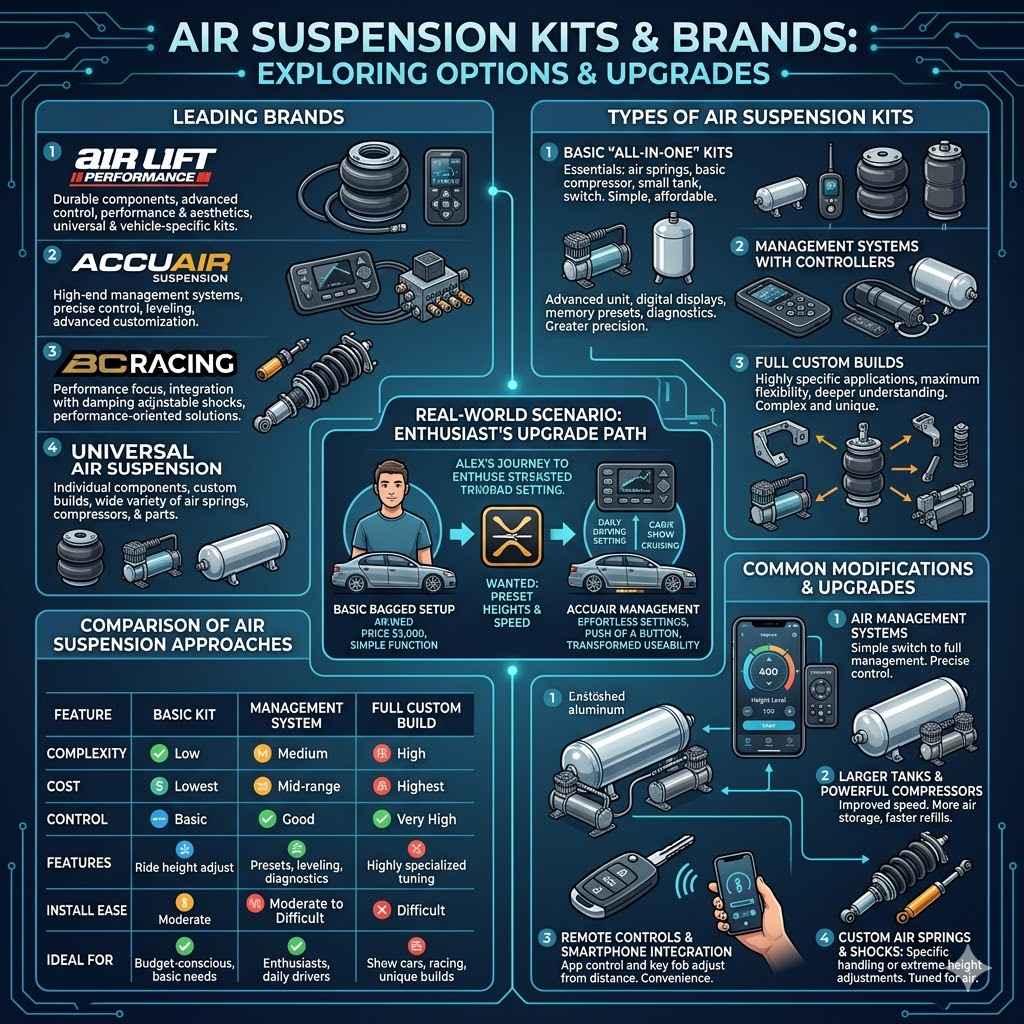
This is one of the most well-known brands, offering a wide range of kits for many popular vehicles. They are known for their durable components, advanced control systems, and focus on performance and aesthetics. Air Lift offers both universal and vehicle-specific kits.
AccuAir Suspension
AccuAir is recognized for its high-end, sophisticated air management systems. They offer advanced controllers and integrated systems that provide precise control over ride height, leveling, and suspension tuning. Their products are often favored by those seeking the ultimate in customization and performance.
BC Racing
While primarily known for coilovers, BC Racing also offers air suspension components and kits. They focus on providing performance-oriented air suspension solutions that can be integrated with their damping adjustable shocks.
Universal Air Suspension
This brand offers a wide variety of individual air suspension components, allowing for custom builds or replacement parts. They provide options for springs, shocks, compressors, and management systems, catering to those who want to build a unique system from the ground up.
Types of Air Suspension Kits
Air suspension kits can be broadly categorized based on their complexity and features.
Basic “All-In-One” Kits
These kits typically include the essentials: air springs, a compressor, a small tank, and a basic control switch. They are usually the most affordable option and provide a straightforward way to add adjustable ride height. They are great for those who want the core functionality without advanced features.
Management Systems with Controllers
These kits go a step further, incorporating a more advanced control unit. This might include digital displays, memory presets for different ride heights, and sometimes diagnostics. They offer greater precision and convenience.
Full Custom Builds
For highly specific applications or unique vehicle builds, custom air suspension systems can be designed and assembled using individual components from various manufacturers. This allows for maximum flexibility in tuning and aesthetics but requires a deeper understanding of the system.
Comparison of Air Suspension Systems
Here’s a simplified comparison of different approaches to air suspension:
| Feature | Basic Kit | Management System | Full Custom Build |
|---|---|---|---|
| Complexity | Low | Medium | High |
| Cost | Lowest | Mid-range | Highest |
| Control Precision | Basic | Good | Very High |
| Features | Ride height adjust | Presets, leveling, diagnostics | Highly specialized tuning |
| Installation Ease | Moderate | Moderate to Difficult | Difficult |
| Ideal For | Budget-conscious, basic needs | Enthusiasts, daily drivers | Show cars, racing, unique builds |
Common Modifications and Upgrades
Once a basic air suspension system is installed, many owners look to upgrade or modify it further. These upgrades can enhance performance, aesthetics, or functionality.
Air Management Systems
Upgrading from a simple switch to a full air management system with digital controllers and multiple presets is a common modification. This allows for easier and more precise control over the vehicle’s stance.
Larger Air Tanks and More Powerful Compressors
These upgrades can improve the speed at which the suspension can be raised or lowered. A larger tank holds more air, reducing the frequency of compressor cycles, while a more powerful compressor can refill the tank faster.
Remote Controls and Smartphone Integration
Modern systems often allow for remote control via key fobs or smartphone apps, offering convenience and the ability to adjust the car’s height from a distance.
Custom Air Spring and Shock Combinations
For specific handling characteristics or extreme ride height adjustments, enthusiasts may opt for different types of air springs or performance shocks that are tuned for their air suspension setup.
Real-World Scenario: The Enthusiast’s Upgrade Path
Alex started with a basic bagged setup on his sedan to achieve a lowered look. After enjoying the initial benefits, he found himself wishing for quicker adjustments and the ability to set specific ride heights for different situations. He upgraded his system to an AccuAir management system with an e-Level controller.
This allowed him to program his preferred heights for daily driving, cruising, and car shows. He could now effortlessly switch between settings with the push of a button, transforming his car’s appearance and usability.
Frequently Asked Questions
What is a bagged car?
A bagged car is a vehicle that has been modified with an air suspension system instead of traditional springs, allowing its ride height to be adjusted using compressed air.
Why would someone want a bagged car?
People bag their cars for improved aesthetics, achieving a low “stanced” look, enhanced ride comfort, and the practical ability to raise the car to clear obstacles like speed bumps or steep driveways.
Is air suspension reliable?
Modern air suspension systems are generally reliable when properly installed and maintained. However, like any mechanical system, they can experience issues such as leaks or component failures over time.
Can any car be bagged?
While most cars can technically be fitted with an air suspension system, the complexity and cost can vary significantly depending on the vehicle’s make, model, and existing suspension design.
How long does it take to install an air suspension system?
Installation time can range from a full weekend for a basic kit done by an experienced DIYer to several days or more for complex systems or professional installations.
Conclusion
Understanding What Is a Bagged Car? Simple Explanation is now within your reach. It’s a car with adjustable air springs that let you change its height. This offers cool looks, a smoother ride, and the practical advantage of clearing obstacles. With the right components and installation, a bagged car provides a unique blend of style and function. You can explore different kits to find the perfect setup for your needs and enjoy the benefits of adjustable suspension.