Who Pays More Than CarMax? Find the Best Car Selling Price
Private buyers usually pay the most, but dealer bids, specialist buyers, and some auctions can beat CarMax when your private-sale net falls after repairs, ads, title work, and time. If a competing offer is close to that net, it may be the better deal. Ignoring those costs can leave hundreds or thousands on the table. This guide compares who can actually pay more than CarMax and when each route wins.
Who can beat CarMax on price?
Private buyers often pay the highest gross price, yet they also bring the most friction. Dealer-bid networks, specialist buyers, local franchise dealers, and some auctions can beat a CarMax-style instant offer when the car is clean, desirable, or unusual enough to pull competing bids. The key is net payout, not the headline number.
CarMax is the benchmark because it gives a quick, low-hassle used-car buying offer. That makes it a useful baseline, especially when you want a fast sale and a simple handoff. But a buyer that pays slightly less upfront can still leave you with more cash once fees, transport, repairs, and time are counted.
What “more than CarMax” really means
Compare the amount you keep after deductions. A private sale may show the highest sticker price, but ads, cleaning, minor fixes, title work, and your time can cut the result down. A dealer network can post a lower gross offer and still net more if it avoids those same costs.
Say your car needs tires, has a small paint scrape, and would take two weekends to sell privately. A private buyer might pay more on paper, but a dealer bid that closes in one day can leave you ahead once those costs are removed.
CarMax payout comparison table
This table compares the routes sellers usually weigh against CarMax. The gross offer matters, but the deductions and hassle often decide the real winner.
| Buyer type | Typical gross offer | Common fees/deductions | Speed of sale | Risk level | Best for | When CarMax still wins |
|---|---|---|---|---|---|---|
| Dealer network | Often near market price, sometimes higher when multiple dealers bid | Possible transport, admin, and reconditioning deductions | Fast | Low to medium | Clean, standard cars with good demand | When you want a guaranteed quick sale and bids are close |
| Private sale | Usually the highest gross price | Ads, cleaning, test-drive time, negotiation, title work, and repair risk | Slowest | High | Popular models in good condition | When the private-sale premium is small after costs |
| Specialist buyer | Can beat CarMax for niche, damaged, modified, or unusual cars | Inspection-based deductions, transport, or repair allowance | Fast | Medium | Luxury, classic, EV, or problem cars with a buyer who wants that exact vehicle | When the specialist buyer narrows value sharply for repairs or wear |
| Auction | Can be strong on the right car, weak on rough inventory | Seller fees, transport, listing charges, and uncertain hammer price | Variable | High | Cars with broad dealer appeal and enough condition to compete | When certainty matters more than chasing a higher but unstable result |
| Trade-in | Often lower gross price, sometimes offset by tax treatment where applicable | Less visible friction, but dealer margin is built into the deal | Fast | Low | One-stop replacement buyers | When a separate sale would pay more net, or you are not buying another car |
Which buyers usually beat CarMax after deductions?
Dealer-bid networks can often be a strong way to beat CarMax without taking on the full hassle of a private sale. Private buyers usually win on gross price, but only if the car is easy to sell and you can absorb the extra time. Specialist buyers and auctions are mixed, with gains strongest on the right vehicle.
Dealer bidding networks
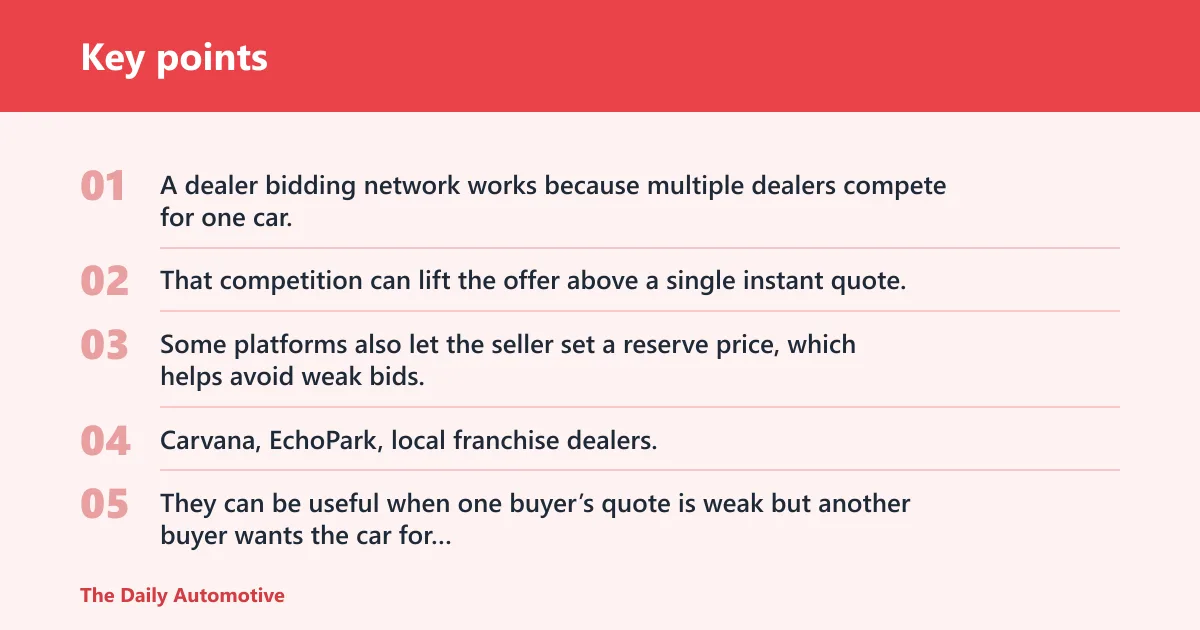
A dealer bidding network works because multiple dealers compete for one car. That competition can lift the offer above a single instant quote, especially if the car fits current retail demand. Some platforms also let the seller set a reserve price, which helps avoid weak bids.
Carvana, EchoPark, local franchise dealers, and instant-cash-offer aggregators are common U.S. options to compare against CarMax. They can be useful when one buyer’s quote is weak but another buyer wants the car for retail inventory.
Private sale
Private sale usually gives the highest headline number because the buyer is paying retail money, not wholesale. The catch is the drag on net proceeds. Fees for ads, paperwork, and time, plus the chance of price haggling or a no-show, can shrink the gap against CarMax fast.
A common first-timer mistake is to count the asking price as the payout. If a car is listed for more, but needs $800 in cosmetic work and two weeks of messaging, the final net may land below a dealer offer that closes the same day.
Specialist buyers, auctions, and trade-ins
Specialist buyers can beat CarMax on vehicles that fall outside normal retail demand. That includes some luxury cars, modified cars, older cars, and electric vehicles with market sensitivity. They may value the exact trim, battery condition, or parts availability more than a generalist buyer would. Sellers can usually find these buyers through niche dealers, specialty used-car lots, enthusiast marketplaces, or auction channels focused on that vehicle type.
Auctions can beat CarMax when competition is strong and the car is ready to move. They can also disappoint when demand is thin, because fees and transport can eat into a higher hammer price. Trade-ins are often the easiest route, but the value is often folded into the dealer’s own profit model. Trade-in tax benefits also depend on state law, so the same allowance can be more valuable in one state than another.
How do fees and deductions change net payout?
Fees and deductions are where a winning-looking offer loses its edge. Transport, admin, reconditioning, and repair allowances can all come out of the gross figure. A higher bid can still net less if the buyer assumes costly work or charges for moving the car.
Which deductions matter most?
On rougher cars, repair deductions matter most. Tires, brakes, warning lights, paint damage, and missing service records can all drag the bid down. On cleaner cars, transport and admin costs tend to matter more because there is less obvious work to price out.
Damage and mechanical issues are a common way to shrink offers. Modified cars can also draw softer bids because the buyer may need to reverse the changes or wait longer for the right retail customer. Financed cars add another layer of friction because the payoff process must clear the lender first.
What makes one car worth more than another?
Market demand, mileage, age, service history, condition, and powertrain all affect the result. Premium brands often hold value better than mainstream cars, but that advantage can fade if the car has high mileage, visible damage, or weak documentation. The right buyer type depends on the car’s profile.
Mileage and age
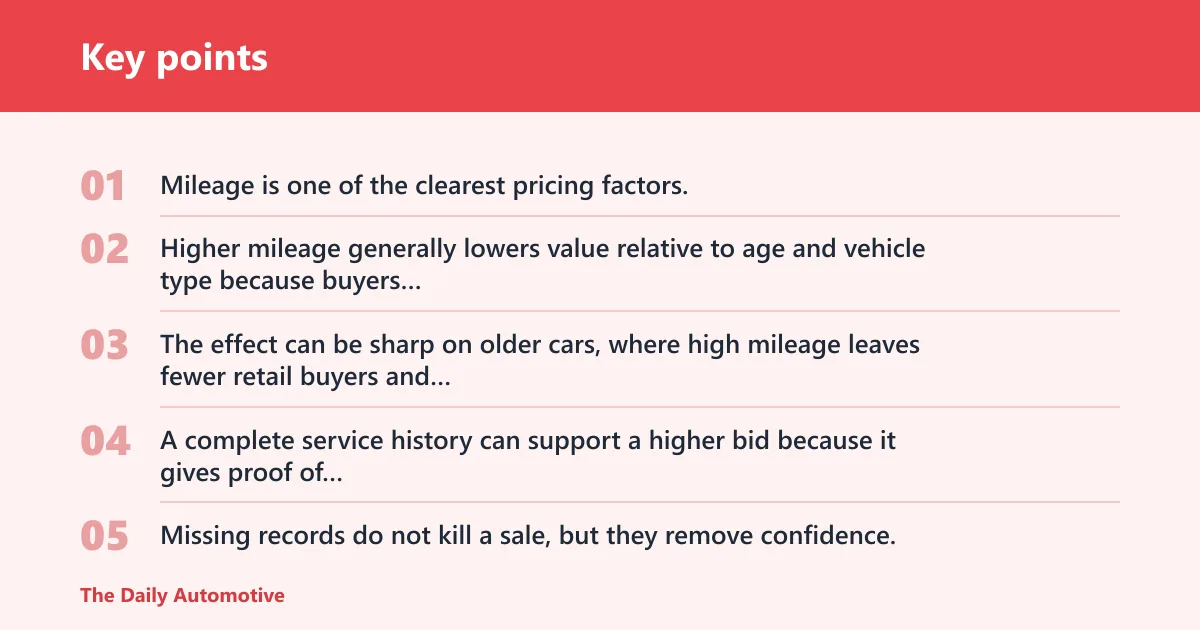
Mileage is one of the clearest pricing factors. Higher mileage generally lowers value relative to age and vehicle type because buyers expect more wear and shorter remaining life. The effect can be sharp on older cars, where high mileage leaves fewer retail buyers and a smaller margin for dealers.
Service history
A complete service history can support a higher bid because it gives proof of maintenance to manufacturer standards. Missing records do not kill a sale, but they remove confidence. That matters most when the car is near the top of its segment and buyers are comparing several similar examples.
Condition and presentation
Condition and presentation matter more than many sellers expect. A clean car with tidy paint, fresh mats, and no obvious warning lights tends to draw better interest than an untidy car with the same mileage. Cosmetic prep can help; mechanical and body damage can reduce offers quickly.
Electric vehicles
Electric vehicles can swing harder in the used market because technology changes fast and pricing is sensitive to range, battery health, and demand shifts. That can create larger discounts than sellers expect. A dealer network or specialist buyer may understand a specific EV better than a general instant offer buyer.
Choose CarMax if… / Choose a dealer bidding network if…
Choose CarMax if speed, certainty, and low hassle matter more than chasing the last dollar. Choose a dealer bidding network if your car is clean, standard, and likely to attract multiple dealers. The right choice depends on whether the extra effort produces enough net gain to justify it.
Choose CarMax if…
- You want a fast sale with little negotiation.
- Your car is fairly standard and the competing bids are close.
- The vehicle is financed and you want a simple payoff process.
- You do not want to spend time on ads, meetups, or price haggling.
Choose a dealer bidding network if…
- Your car is clean, well-documented, and in demand.
- You want competition among dealers rather than one fixed buyer.
- You are selling a luxury car, EV, or another vehicle with a narrower buyer pool.
- Your offer gap versus CarMax is wide enough to justify a short wait.
What should you do before accepting any offer?
Start with the easiest gains: clean the car, gather the paperwork, and check whether small repairs are worth doing. A polished car with service records usually looks stronger than the same car with clutter and missing documents. But do not spend heavily on repairs unless the likely price lift is bigger than the cost.
- Wash the car and remove personal items.
- Collect service records, title or payoff details, and registration documents.
- Check tires, lights, and warning indicators before listing or bidding.
- Get more than one offer and compare the net payout, not just the headline price.
- Skip expensive repairs unless they clearly raise the likely sale price.
Suppose a 7-year-old sedan has complete service records, but the front bumper has scuffs and the cabin needs a deep clean. A small cosmetic fix may help the bid more than a larger mechanical repair if the mechanical systems are sound. The reverse is true when a warning light points to a costly fault.
Frequently asked questions
Who pays more than CarMax for a used car?
Private buyers usually pay more on paper, but dealer networks, specialist buyers, and some auctions can beat CarMax on net payout. The winner depends on deductions, speed, and how easy the car is to resell. Clean, desirable cars usually attract the strongest competition.
Is selling to a dealer better than trading it in?
Selling to a dealer network is often better if you want a direct cash offer and are not buying another car. A trade-in can still make sense when the tax or convenience benefit offsets a lower gross price. Compare the final net, not the listed allowance, and check how your state treats trade-in tax savings.
How do I get the best car selling price online?
Get multiple offers, clean the car, gather records, and compare the payout after any deductions. Dealer-bid networks can help because several dealers compete for the same car. A strong online result usually comes from good presentation, accurate details, and a vehicle with broad dealer appeal and enough condition to compete.
Which car buying service gives the highest offer?
There is no single winner for every car. Private buyers usually offer the most gross money, while dealer networks, local franchise dealers, and instant-cash-offer aggregators can sometimes beat CarMax on net proceeds with less hassle. The highest true offer is the one that stays highest after repairs, fees, transport, and your time are counted.
What should I do before selling my car for more money?
Clean it thoroughly, fix low-cost cosmetic issues, and collect service records. Then compare several offers and ask how each buyer handles deductions for tires, brakes, paint, warning lights, or missing documents. If a repair is expensive, check whether it will pay for itself before spending the money.
Does mileage reduce my car’s value a lot?
Usually yes, especially when mileage is high for the car’s age. Buyers expect more wear, more maintenance, and less remaining life. The effect is strongest on older cars and weaker on models that are known to hold up well, but it still matters in nearly every appraisal.
Are online dealer networks better than a single instant offer?
Often yes, because competition can push the offer above what one buyer will pay. That is especially useful for clean cars, luxury models, EVs, and vehicles with good service history. A single instant offer is still useful when you want certainty, speed, and a simple handoff.
Products related to this article
Sponsored / affiliate links. As an Amazon Associate I earn from qualifying purchases. I may earn additional commission from eligible campaigns.