Why Does My Car AC Turn On and Off: Essential Fixes
Your car’s AC cycling on and off frequently is often due to low refrigerant, a faulty compressor clutch, a dirty condenser, or an issue with the blower motor or electrical system. These common problems can usually be diagnosed and fixed with simple steps, helping you enjoy cool, consistent air again.
That sudden blast of warm air when your car’s air conditioning suddenly cuts out can be incredibly frustrating, especially on a hot day. It’s a common problem: your car AC turns on and off intermittently. You might be driving along, enjoying a cool cabin, and then, poof, the cool air disappears, only for it to kick back in a few minutes later. This on-again, off-again behavior isn’t just annoying; it can signal a problem that needs attention. But don’t worry! Many of these issues are more common than you think, and with a little understanding, you can figure out what’s happening and get your car’s AC blowing nice and cold again. We’ll guide you through the most likely culprits and the fixes you can try, making car care feel a lot less daunting.
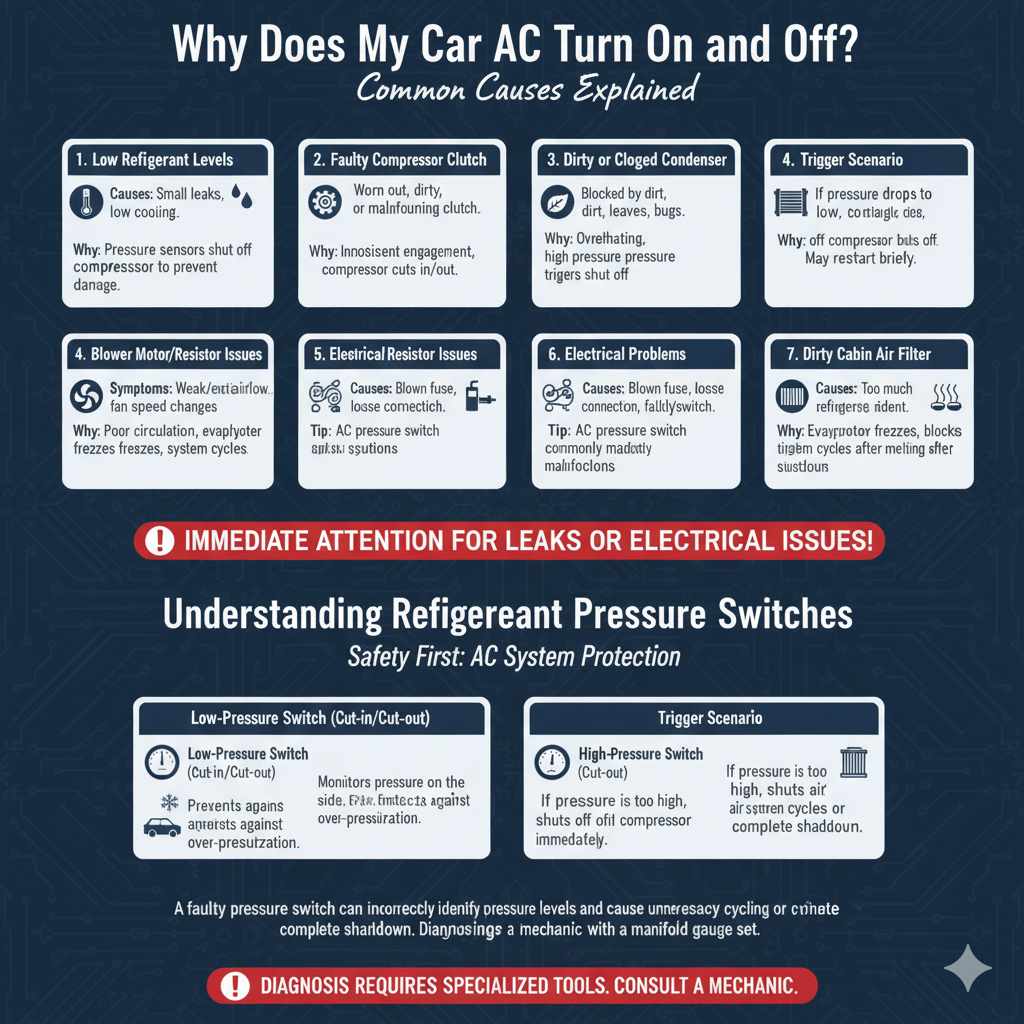
Why Does My Car AC Turn On and Off? Common Causes Explained
It can be puzzling when your car’s air conditioning system doesn’t work as expected. The on-again, off-again nature of your AC often points to specific components struggling to do their job. Understanding these reasons is the first step to finding a solution. Let’s break down the most common reasons why your car AC might be cycling unexpectedly, turning off and then back on.
1. Low Refrigerant Levels
Refrigerant is the lifeblood of your car’s AC system. It’s the substance that absorbs heat from your cabin and releases it outside. If the refrigerant level is too low, the system can’t cool effectively. This often triggers a safety mechanism that causes the compressor to cycle off temporarily. Over time, small leaks can cause refrigerant levels to drop. You might also notice that the AC doesn’t blow as cold as it used to, even when it’s running.
Why it causes on/off cycling: Modern AC systems have pressure sensors. When the refrigerant is too low, the pressure drops, and these sensors tell the compressor to shut off to prevent damage. Once the pressure stabilizes slightly, it might turn back on for a short while before the cycle repeats.
2. Faulty Compressor Clutch
The AC compressor is the heart of your AC system, circulating the refrigerant. The compressor clutch is what engages the compressor when you turn on the AC. If this clutch is worn out, dirty, or malfunctioning, it might not engage properly or consistently. This can lead to the compressor cutting in and out, causing your AC to turn on and off randomly.
Why it causes on/off cycling: A weak or faulty clutch might engage for a while, allowing the system to cool, but then disengage due to insufficient magnetic force or internal wear. It can also overheat and disengage as a protective measure.
3. Dirty or Clogged Condenser
The condenser is like your AC’s radiator. It’s usually located at the front of your car, in front of the main radiator. Its job is to release heat from the refrigerant. If the condenser fins are blocked by dirt, leaves, bugs, or debris, it can’t dissipate heat effectively. This causes the refrigerant to overheat, leading to high system pressure. To protect itself, the AC system will shut off the compressor.
Why it causes on/off cycling: When the condenser is clogged, the system overheats, the pressure builds too high, and a high-pressure switch shuts off the compressor. Once the system cools down a bit, the pressure drops, and the compressor might try to re-engage, leading to the on/off cycle.
4. Issues with the Blower Motor or Resistor
The blower motor is responsible for pushing the cooled air through your car’s vents and into the cabin. If the blower motor is failing or its resistor (which controls fan speed) is faulty, it can cause erratic behavior. While this usually manifests as the fan not working at all or only working on certain speeds, it can sometimes affect the overall AC cycle if the system’s airflow sensors are affected or if overheating occurs due to poor air circulation.
Symptom alert: Listen for unusual noises from the fan, or notice that the fan speed changes on its own or doesn’t work on all settings.
5. Electrical Problems
Like any complex system in your car, the AC relies on a network of electrical components. This includes fuses, relays, wiring, pressure switches, and sensors. A blown fuse, a loose connection, a faulty relay, or a malfunctioning pressure switch can all cause the AC compressor to cut off unexpectedly. Sometimes, these electrical issues can be intermittent, leading to the cycling behavior you’re experiencing.
Tip: A common electrical gremlin is a faulty AC pressure switch. These switches monitor the pressure within the AC system and can signal the compressor to shut off if the pressure is too high or too low, protecting the system from damage.
6. Overcharged Refrigerant
While low refrigerant is common, having too much refrigerant can also be a problem. An overcharged system creates excessively high pressure, which, similar to a clogged condenser, can trigger pressure switches to shut down the compressor to prevent damage. This is less common for DIYers to cause unless they’ve recently had the AC serviced and it was overfilled.
7. Dirty Cabin Air Filter
A clogged cabin air filter restricts airflow into your car’s cabin. While this primarily affects how much air comes out of your vents, severe blockage can sometimes lead to poor circulation within the AC system itself. This can cause the evaporator coil to freeze up, which then prevents air from flowing at all. Once the ice melts, the system might restart, leading to an on-off cycle.
Common AC System Components and Their Roles
To better understand why your AC might be acting up, it helps to know the main players in the cooling game. Here’s a quick rundown of the essential parts:
| Component | Function | How it Falters |
|---|---|---|
| Compressor | The ‘pump’ that circulates refrigerant and creates the cooling effect. | Worn out parts, electrical issues with the clutch, internal failure. |
| Condenser | Located at the front of the car, it releases heat from the refrigerant to the outside air. | Clogged fins (dirt, debris), bent fins restricting airflow. |
| Evaporator | Located inside the dashboard, it absorbs heat from the cabin air, making the air cold. | Can freeze up from low refrigerant or airflow issues. |
| Refrigerant | The chemical that absorbs and releases heat, enabling cooling. | Low levels due to leaks, or too much refrigerant (overcharged). |
| Expansion Valve/Orifice Tube | Controls the flow of refrigerant into the evaporator. | Can become clogged or fail to regulate flow. |
| Pressure Switches | Sensors that monitor refrigerant pressure and protect the system by shutting off the compressor if pressure is too high or too low. | Faulty switches can trigger shutdowns incorrectly. |
| Blower Motor | Pushes the cooled air through the vents into the cabin. | Failing motor, faulty resistor causing speed issues or complete failure. |
DIY Fixes: What You Can Do Yourself
When your car AC starts its on-and-off routine, some fixes are within reach for the home mechanic. These steps can help you identify the issue and often resolve it without a costly trip to the shop. Always prioritize safety and consult your vehicle’s manual if you’re unsure.
Step 1: Visual Inspection – The Obvious Clues
Before diving into complex diagnostics, take a moment to look around.
- Check the Condenser: Go to the front of your car and look at the AC condenser (it’s usually a thin, radiator-like component). Is it packed with dirt, leaves, or debris? If so, carefully clean it. You can use a garden hose with a gentle spray (avoid high pressure that can bend the fins) or a soft brush. Ensure the engine is off and cool.
- Inspect Belts: With the engine off, check the serpentine belt that drives the AC compressor. Is it tight and in good condition? A loose or worn belt can slip and cause the compressor to disengage intermittently.
- Look for Leaks: While difficult to spot without specialized equipment, sometimes you can see oily residue around AC system connections or hoses. This residue often indicates a refrigerant leak.
Step 2: Clean the Condenser
This is often the easiest and most effective DIY fix for AC problems related to overheating. A clean condenser allows heat to escape efficiently.
- Get your car parked on a level surface. Ensure the engine is off and cool.
- Locate the AC condenser. It’s usually in front of the engine’s main radiator.
- Gently spray it with water from a hose. A low-pressure setting is best to avoid damaging the delicate fins.
- Use a soft brush or compressed air to remove stubborn debris.
- Allow it to dry.
Step 3: Check the Cabin Air Filter
A restricted airflow can sometimes play a role and is an easy component to check and replace.
- Refer to your owner’s manual to find the cabin air filter location. It’s often behind the glove box or under the dashboard.
- Remove the old filter.
- Hold it up to a light. If you can’t see much light through it, or if it’s visibly dirty and clogged, it needs replacing.
- Install the new filter, ensuring it’s oriented correctly (there’s usually an airflow direction arrow).
Step 4: Check Fuses and Relays
Electrical issues can be a culprit, and checking fuses is a straightforward diagnostic step.
- Consult your owner’s manual to find the fuse box locations (usually under the dashboard and/or in the engine bay) and the specific fuses/relays related to the AC system.
- Turn off the ignition.
- Locate the AC fuse and relay.
- Pull out the fuse using a fuse puller (sometimes included in the fuse box lid or as a separate tool). Inspect it for a broken or melted wire element. If it’s blown, replace it with a fuse of the exact same amperage rating.
- Relays are a bit trickier to test without tools, but sometimes you can swap a suspect relay with an identical one from a non-critical system (like the horn) to see if the AC starts working.
Safety Note: Always use the correct amperage fuse. Using a higher-rated fuse can damage the electrical system and cause a fire hazard.
Step 5: Topping Up Refrigerant (Use with Caution!)
If you suspect low refrigerant, refilling it might seem like the simplest solution. Many auto parts stores sell AC recharge kits that contain refrigerant and a sealant. However, this should be approached with caution.
- Identify the correct refrigerant type: Check your owner’s manual or the label under the hood for the specific type of refrigerant your car uses (e.g., R-134a or R-1234yf).
- Connect the can: Follow the instructions on the recharge kit, which typically involves connecting the can to the low-pressure port of your AC system.
- Monitor pressure: Most kits have a gauge to help you fill to the correct pressure. Overfilling can cause system damage, just like low levels.
Important Considerations:
- This is a temporary fix if there’s a leak. The refrigerant will escape again.
- Refrigerant is a potent chemical. Wear safety glasses and gloves.
- If you’re unsure, it’s best to let a professional handle refrigerant. Handling refrigerant can have environmental implications. For more on refrigerant handling, check out the EPA’s Section 609 regulations.
When to Call a Professional Mechanic
While DIY fixes can be rewarding and cost-effective, some AC problems require the expertise and specialized tools of a professional. If you’ve tried the basic steps or are uncomfortable with any part of the process, it’s time to seek help.
- Suspected Refrigerant Leaks: Professionals have special tools to detect and repair leaks, and the equipment to evacuate the old refrigerant safely before adding new R-134a or R-1234yf and recharging the system with the precise amount.
- Compressor Issues: Diagnosing and replacing an AC compressor is a complex job that often requires specialized tools to depressurize and recover refrigerant, and to properly install and vacuum the system.
- Electrical System Diagnosis: If you’ve checked fuses and relays and the problem persists, a mechanic can use diagnostic tools to trace electrical faults in sensors, the control module, or wiring harnesses.
- Internal System Blockages: Problems with the expansion valve, orifice tube, or blockages within the AC lines are difficult to diagnose and fix without professional expertise.
- Lack of Confidence or Tools: If you don’t have the right tools, feel unsure about a repair, or simply prefer to have it done right the first time, a mechanic is your best bet.
Understanding Refrigerant Pressure Switches
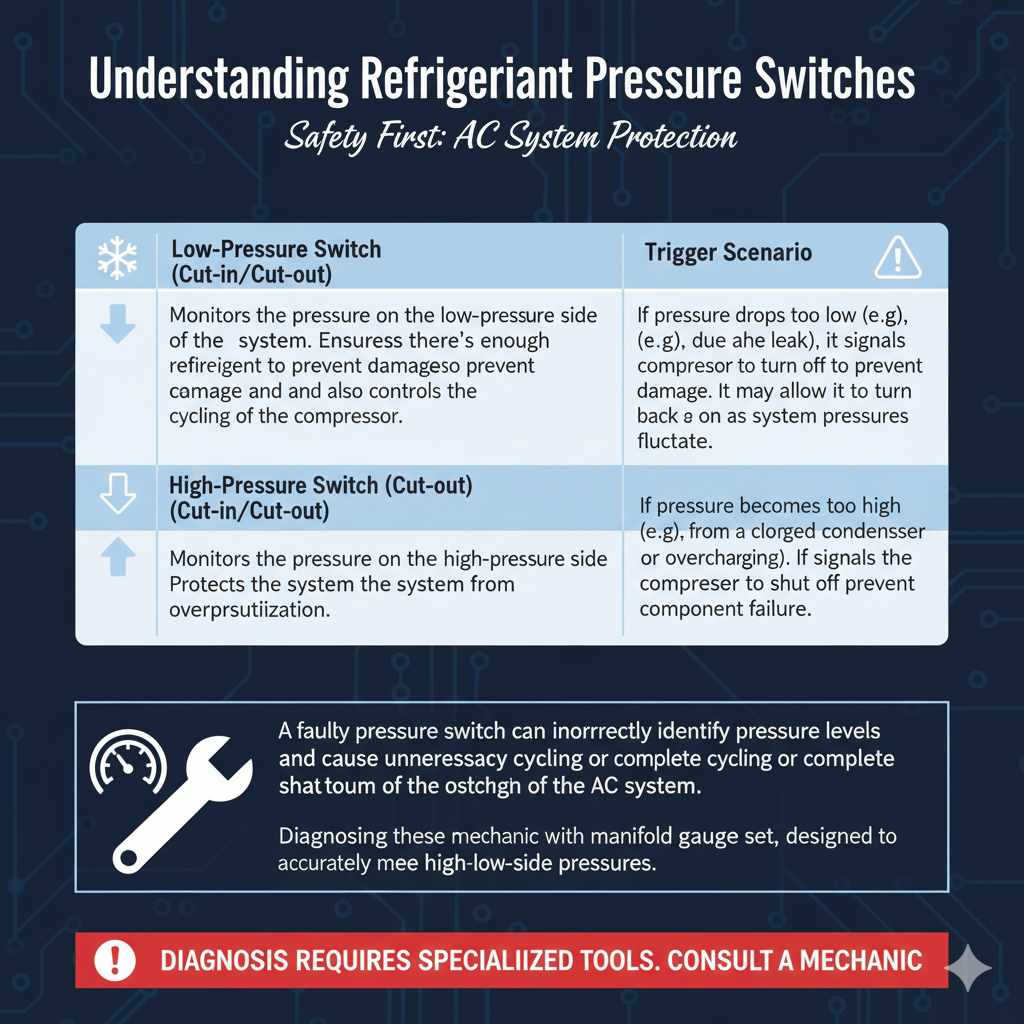
Pressure switches are unsung heroes in your AC system. They are safety devices designed to protect your AC components from damage caused by incorrect refrigerant pressure. When your car AC turns on and off, these switches are often involved.
There are typically two main types of pressure switches:
| Switch Type | Function | Trigger Scenario |
|---|---|---|
| Low-Pressure Switch (Cut-in/Cut-out) | Monitors the pressure on the low-pressure side of the system. Ensures there’s enough refrigerant to prevent compressor damage and also controls the cycling of the compressor. | If pressure drops too low (e.g., due to a leak), it signals the compressor to turn off to prevent damage. It may allow it to turn back on briefly as system pressures fluctuate. |
| High-Pressure Switch (Cut-out) | Monitors the pressure on the high-pressure side of the system. Protects the system from over-pressurization. | If pressure becomes too high (e.g., from a clogged condenser or overcharging), it signals the compressor to shut off immediately to prevent component failure. |
A faulty pressure switch can incorrectly identify pressure levels and cause unnecessary cycling or complete shutdown of the AC system. Diagnosing these requires a mechanic with a manifold gauge set, designed to accurately measure the high and low-side pressures.
FAQ: Your Burning AC Questions Answered
Here are some common questions drivers have about their AC system’s unpredictable behavior.
Q1: Why does my car AC blow cold for a bit, then hot, then cold again?
A1: This classic on-and-off cycling is usually due to the system’s safety controls. Low refrigerant, a clogged condenser preventing heat dissipation, or a faulty compressor clutch can cause the system to overheat or lose pressure, forcing the compressor to shut off. Once pressures stabilize, it may turn back on, repeating the cycle.
Q2: Can I just add more refrigerant myself?
A2: You can, using an AC recharge kit, but it’s often a temporary fix if there’s a leak. It’s crucial to use the correct type of refrigerant for your car and to avoid overcharging, which can damage components. If your AC is blowing warm, it’s often low because of a leak that needs professional attention.
Q3: My AC just stopped working completely. What should I check first?
A3: Start with the simplest things: check the AC fuse and relay in your fuse box. Then, inspect your cabin air filter for blockages. If those are fine, the issue could be more complex, such as low refrigerant, a faulty fan, or a problem with the compressor itself.
Q4: Is it expensive to fix an AC that turns on and off?
A4: The cost varies greatly depending on the cause. simple fixes like cleaning the condenser or replacing a fuse are very inexpensive. However, a refrigerant leak requiring a professional flush and recharge, or a faulty compressor, can be more costly. Getting a proper diagnosis is key to estimating repair costs.