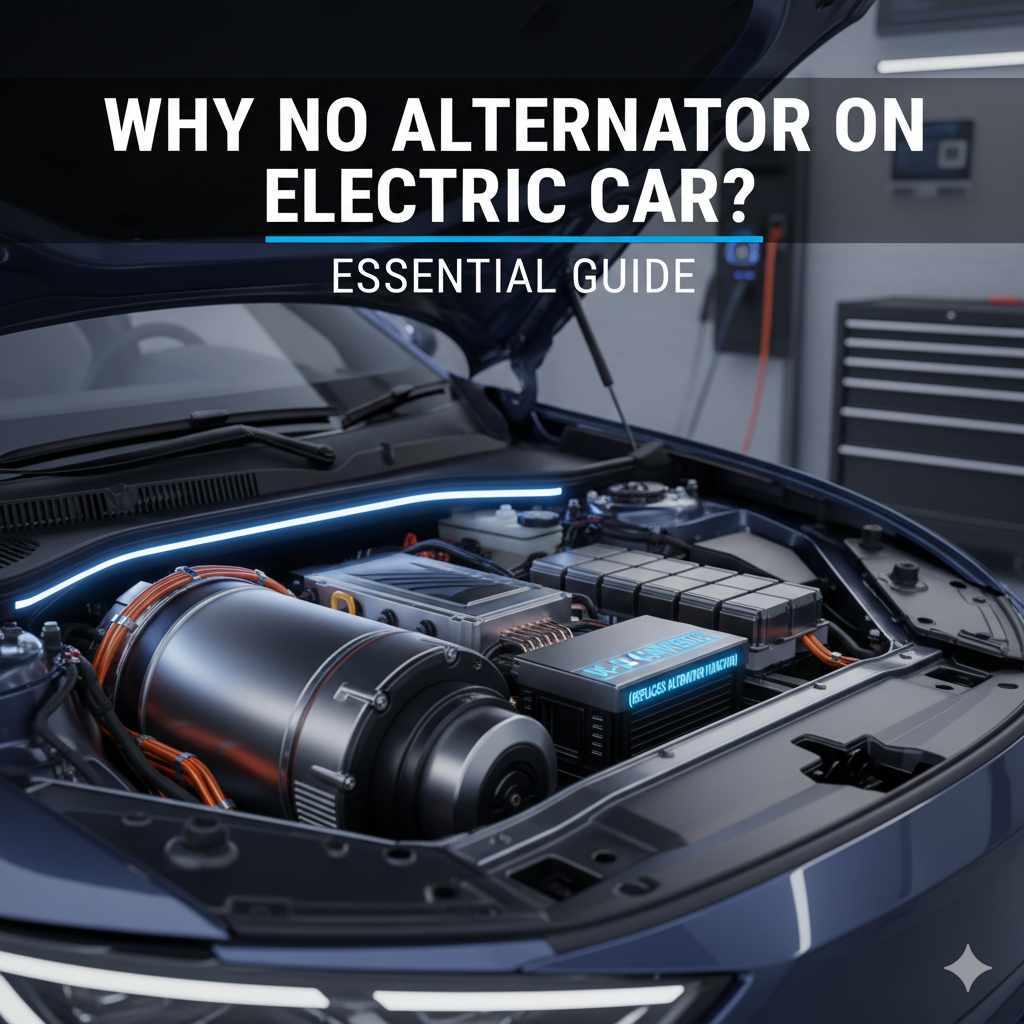
Why No Alternator On Electric Car? Essential Guide
Electric cars don’t need an alternator because they don’t have an internal combustion engine to power it. Instead, they use a large battery pack and electric motors. The battery stores energy and powers the motor, while regenerative braking captures energy to recharge the battery, eliminating the need for an alternator.
Have you ever wondered why electric cars (EVs) seem so quiet and different from the cars we’re used to? One big difference you might not immediately notice is the absence of a common part under the hood: the alternator. It’s a crucial component in gasoline cars, but in EVs, it’s simply not present. This can be confusing, especially if you’re used to how traditional cars work. But don’t worry! Understanding this difference actually makes EVs easier to grasp. We’re here to break down exactly why electric cars skip the alternator and how they manage their power instead. Get ready to learn the simple, straightforward reasons behind this change!
The Mystery of the Missing Alternator: What’s Going On?
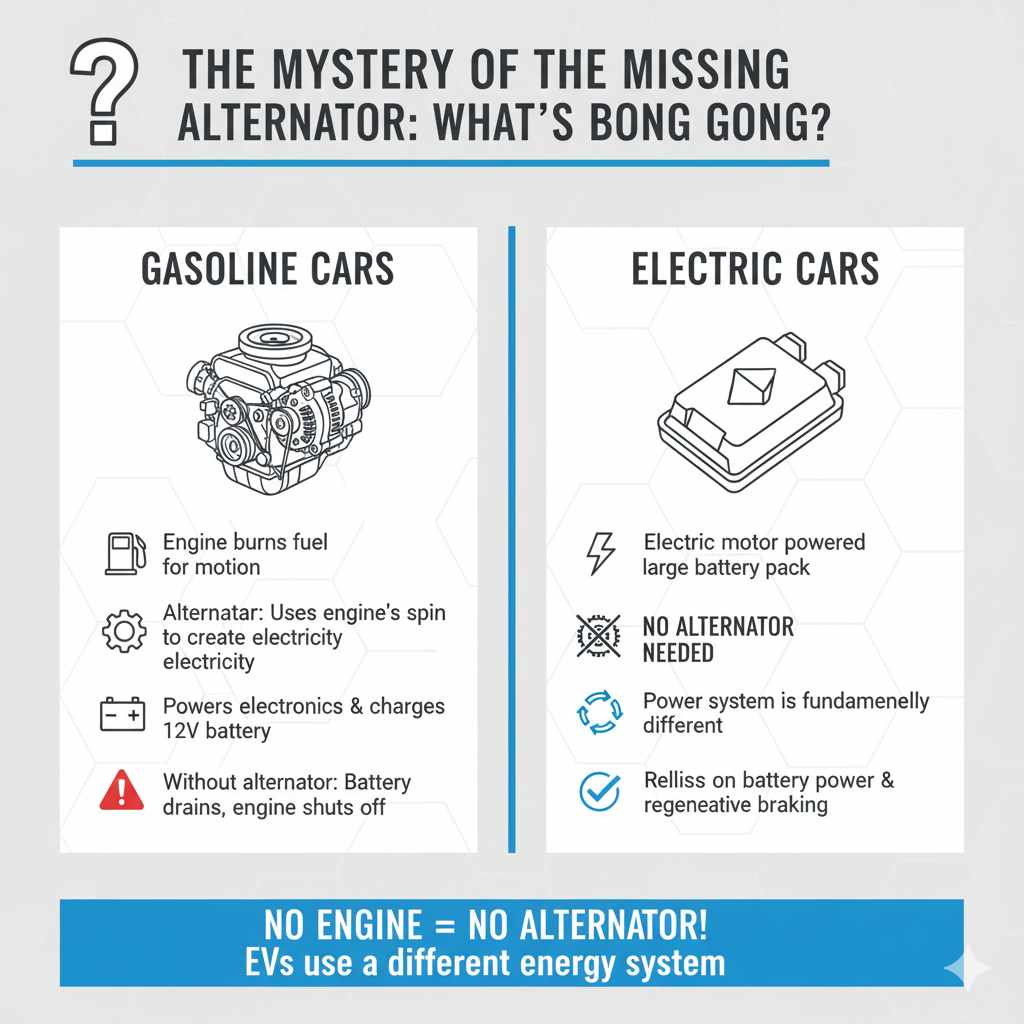
When you pop the hood of a gasoline-powered car, you’ll find an alternator. Its job is simple: it uses the spinning motion from the engine to create electricity. This electricity then powers your car’s electronics, like the radio, lights, and the ignition system. It also tops up the car battery. Without an alternator, a gasoline car’s battery would quickly drain, and the engine would eventually shut off.
Electric cars, however, work on a fundamentally different principle. They don’t have an engine that burns fuel to create motion. Instead, they have an electric motor powered by a large battery pack. This basic difference means the entire system for generating and managing electricity is different. The need for an alternator, which directly relies on engine power, vanishes.
Understanding the Core Components of an Electric Car
To really get why an alternator isn’t needed, let’s look at the key players in an EV’s powertrain:
- The Battery Pack: This is the “fuel tank” of an EV. It’s a large, high-voltage battery, usually made up of many smaller lithium-ion cells, that stores the electrical energy needed to power the car. Think of it as the main power source for everything.
- The Electric Motor: This is what makes the car move. It takes the electrical energy from the battery pack and converts it into mechanical energy (rotation) to turn the wheels. It’s incredibly efficient and provides instant torque, which is why EVs can feel so responsive.
- The Power Electronics Controller (Inverter): This is the “brain” that manages the flow of electricity. It converts the direct current (DC) from the battery into alternating current (AC) that the motor uses, and it also controls the motor’s speed and power output.
- On-Board Charger: When you plug your EV in to charge, this component takes the AC power from the charging station and converts it into DC power that the battery pack can store.
Notice anything missing from that list? That’s right – no mention of an engine or anything that needs to be mechanically driven at high speeds to generate electricity constantly. The battery is the primary energy source and storage, and the motor is what uses that energy to move the car. It’s a much simpler, direct system.
How Electric Cars Handle Power Without an Alternator
Since there’s no engine spinning an alternator, how do EVs keep their batteries charged and power all their systems? The answer lies in their unique design and technology:
1. The Battery Pack is King (and Queen!)
The main battery pack in an electric car is designed to do two things: store a large amount of energy and deliver that energy reliably to the electric motor. It’s like a giant, rechargeable power bank for your car. When you’re driving, the motor draws power from this battery. When you’re parked and plugged in, the on-board charger replenishes the battery from the grid.
These battery packs are sophisticated systems that manage their own charge levels, temperature, and health. They don’t rely on an external mechanical component like an alternator to stay topped up during operation. Their charging happens either when plugged into an external power source or through the car’s own regenerative braking system.
2. Regenerative Braking: The Clever Energy Saver
This is one of the most brilliant aspects of electric cars and a key reason they can be so efficient. When you take your foot off the accelerator pedal or press the brake pedal lightly, the electric motor works in reverse. Instead of using electricity to create motion, it uses the car’s motion to generate electricity.
Think of it like this: the spinning wheels turn the motor, and this spinning action makes the motor act like a generator. The electricity produced by this “generator” action is then sent back to recharge the battery pack. This process not only helps slow the car down, reducing wear on the traditional brakes, but it also recovers energy that would otherwise be lost as heat.
According to a report by the U.S. Department of Energy’s National Renewable Energy Laboratory (NREL), regenerative braking can recover a significant amount of energy, sometimes up to 10-20% of the total energy used for driving. This energy recovery is vital for extending the driving range of EVs.
This ability to generate electricity directly from vehicle motion completely bypasses the need for a belt-driven alternator. The motor itself performs the function when needed.
3. The “12-Volt” System in EVs: Still Needs Power!
Now, you might be thinking, “If the big battery powers the motor, what powers the lights, the infotainment system, the power windows, and all the other standard car gadgets that usually run on a 12-volt system?” This is a great question, and EVs do have a smaller, 12-volt battery, similar to what you find in a gasoline car.
However, in an EV, this 12-volt battery isn’t recharged by an alternator. Instead, there’s a special device called a DC-to-DC converter. This converter takes high-voltage power from the main battery pack (which can be anywhere from 300 to 800 volts or more) and converts it down to the 12 volts needed to charge the smaller battery and power those auxiliary systems. The 12-volt battery then acts as a buffer and a source of stable power for these lower-voltage components, just like in a conventional car.
This DC-to-DC converter is essentially the EV’s version of an alternator, but it’s not a mechanical belt-driven device. It’s an electronic component that efficiently steps down voltage. So, while there’s no alternator, the dual electrical system (high-voltage for drive, low-voltage for accessories) is very much present, just powered differently.
Alternator vs. EV Power System: A Simple Comparison
Let’s put it side-by-side to see the core differences clearly:
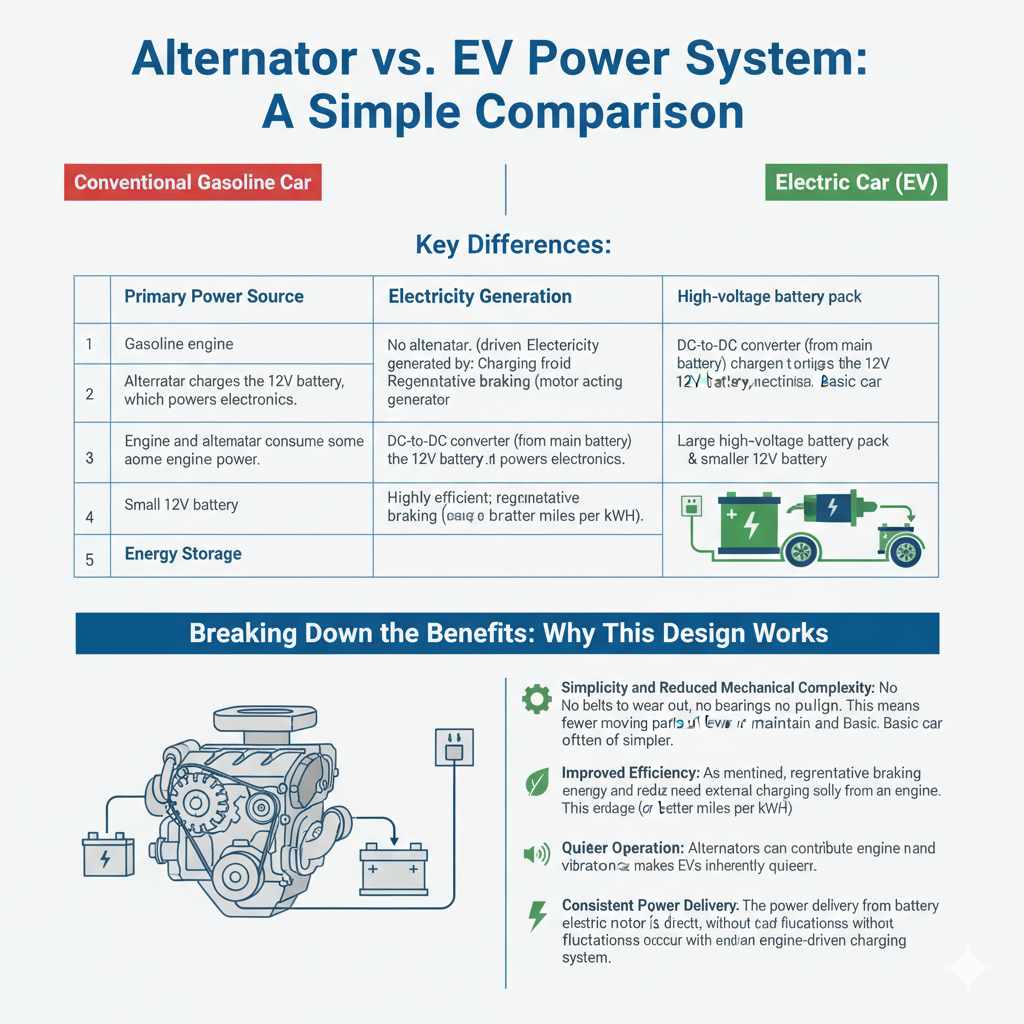
| Feature | Conventional Gasoline Car | Electric Car (EV) |
|---|---|---|
| Primary Power Source | Gasoline engine | High-voltage battery pack |
| Electricity Generation | Alternator (driven by engine belt) | No alternator. Electricity generated by: – Charging from the grid – Regenerative braking (motor acting as generator) |
| Powering Electronics | Alternator charges the 12V battery, which powers electronics. | DC-to-DC converter (from main battery) charges the 12V battery, which powers electronics. |
| Energy Storage | Small 12V battery | Large high-voltage battery pack & smaller 12V battery |
| Efficiency | Engine and alternator consume some engine power. | Highly efficient; regenerative braking recovers energy. |
Breaking Down the Benefits: Why This Design Works
The absence of an alternator and the reliance on battery power and regenerative braking offer several advantages for electric car owners:
- Simplicity and Reduced Mechanical Complexity: No belts to wear out, no bearings to fail, no pulleys to align. This means fewer moving parts to maintain and fewer potential points of failure. Basic car maintenance on an EV can often be simpler.
- Improved Efficiency: As mentioned, regenerative braking recovers energy and reduces the need for constant external charging solely from an engine. This leads to better mileage (or rather, miles per kWh).
- Quieter Operation: Alternators can contribute to engine noise and vibrations. Their absence makes EVs inherently quieter.
- Consistent Power Delivery: The power delivery from a battery and electric motor is direct and responsive, without the fluctuations that can sometimes occur with an engine-driven charging system.
Frequently Asked Questions (FAQs)
Q1: So, my electric car has no battery at all?
Answer: Electric cars have two types of batteries! They have a large, high-voltage battery pack that powers the drive motor and a smaller, standard 12-volt battery that powers accessories like your lights, radio, and dashboard. This 12-volt battery is charged by the main battery via a DC-to-DC converter, not an alternator.
Q2: How does my EV charge its battery?
Answer: EV batteries are primarily charged by plugging the car into an external power source (like a home charger or a public charging station). Additionally, the regenerative braking system helps to recharge the battery somewhat as you drive by converting the car’s momentum into electrical energy.
Q3: What happens if my EV’s 12-volt battery dies?
Answer: If the 12-volt battery dies, your EV might not be able to start or power essential systems, even if the main high-voltage battery is fully charged. This is because the 12-volt system controls critical functions, including the systems that enable the car to “wake up” and draw power from the main battery. You would typically need to jump-start it using an external 12-volt power source (like another car’s battery or a jump pack), or have it serviced.
Q4: Is regenerative braking the same as using the brakes?
Answer: Regenerative braking is a form of braking, but it’s handled by the electric motor. It primarily slows the car down by turning the motor into a generator. Traditional friction brakes (using brake pads and rotors) are still present and are used for stronger braking, emergency stops, or when the battery is full and cannot accept more charge.
Q5: Are electric cars more reliable because they have fewer parts?
Answer: Generally, yes. With fewer moving parts compared to a gasoline engine and its associated systems (like exhaust, fuel injection, and the alternator), EVs often have a lower potential for mechanical failures. This can lead to reduced maintenance needs and potentially greater long-term reliability.
Q6: Does an electric car have an engine?
Answer: No, an electric car does not have an internal combustion engine. It uses one or more electric motors to propel the vehicle, powered by a large battery pack.
Q7: Can I install an alternator on my electric car?
Answer: No, you cannot and should not install an alternator on an electric car. The entire electrical and propulsion system of an EV is designed without one. Attempting to do so would be incompatible with the car’s design and would likely cause significant damage.
Conclusion: A Simpler, Smarter Power System
So, there you have it! The absence of an alternator in an electric car isn’t a sign of something missing; it’s a deliberate design choice that leverages the core advantages of electric propulsion. Instead of an engine-driven alternator, EVs use their large battery pack as the primary energy store, their electric motor to drive the wheels, and clever regenerative braking to recapture energy. For the everyday electronics, a DC-to-DC converter handles the voltage conversion, ensuring everything from your headlights to your infotainment system hums along smoothly.
This fundamental difference makes EVs simpler mechanically, more efficient, and quieter to operate. While the tech might seem complex at first, understanding these core differences demystifies the EV experience and highlights the innovative engineering that powers our increasingly electrified future. You’re now equipped with the knowledge to understand one of the most significant distinctions between electric and gasoline vehicles!