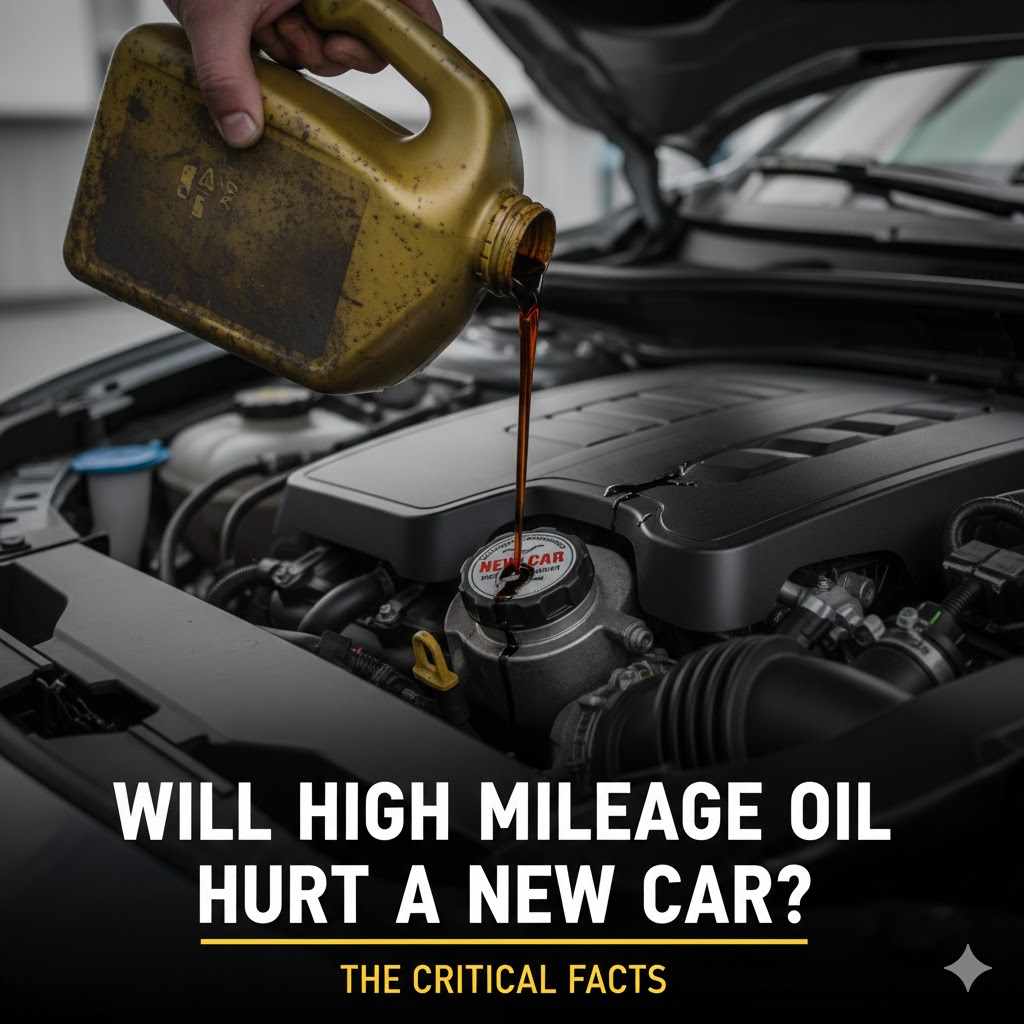
Will High Mileage Oil Hurt a New Car? The Critical Facts
Using high mileage oil in a new car for one oil change is unlikely to cause immediate harm, but it’s not recommended. Its special additives are designed for older engines and can potentially cause premature wear on new seals over time. Always use the oil specified in your car’s owner’s manual to protect your engine and warranty.
Walking down the oil aisle at the auto parts store can feel overwhelming. You see dozens of bottles labeled “Full Synthetic,” “Conventional,” “Synthetic Blend,” and then you spot it: “High Mileage.” It sounds impressive, right? More protection, better for your engine. So you might wonder, “If it’s good for an old car, it must be great for my new car, too!” It’s a common thought, but the answer isn’t so simple.
This question is one I hear all the time. Maybe you grabbed the wrong bottle by mistake or got some well-meaning but incorrect advice. Don’t worry. We’re going to clear up all the confusion. In this guide, I’ll explain exactly what high mileage oil is, what it does, and whether it’s a friend or foe to your new car’s engine. Let’s get you the right answers so you can feel confident about your car care.
Let’s dive right into the heart of the matter. To understand if high mileage oil is bad for a new car, we first need to understand what makes it special. It’s not just regular oil in a different bottle; it has a unique recipe designed for a specific job.
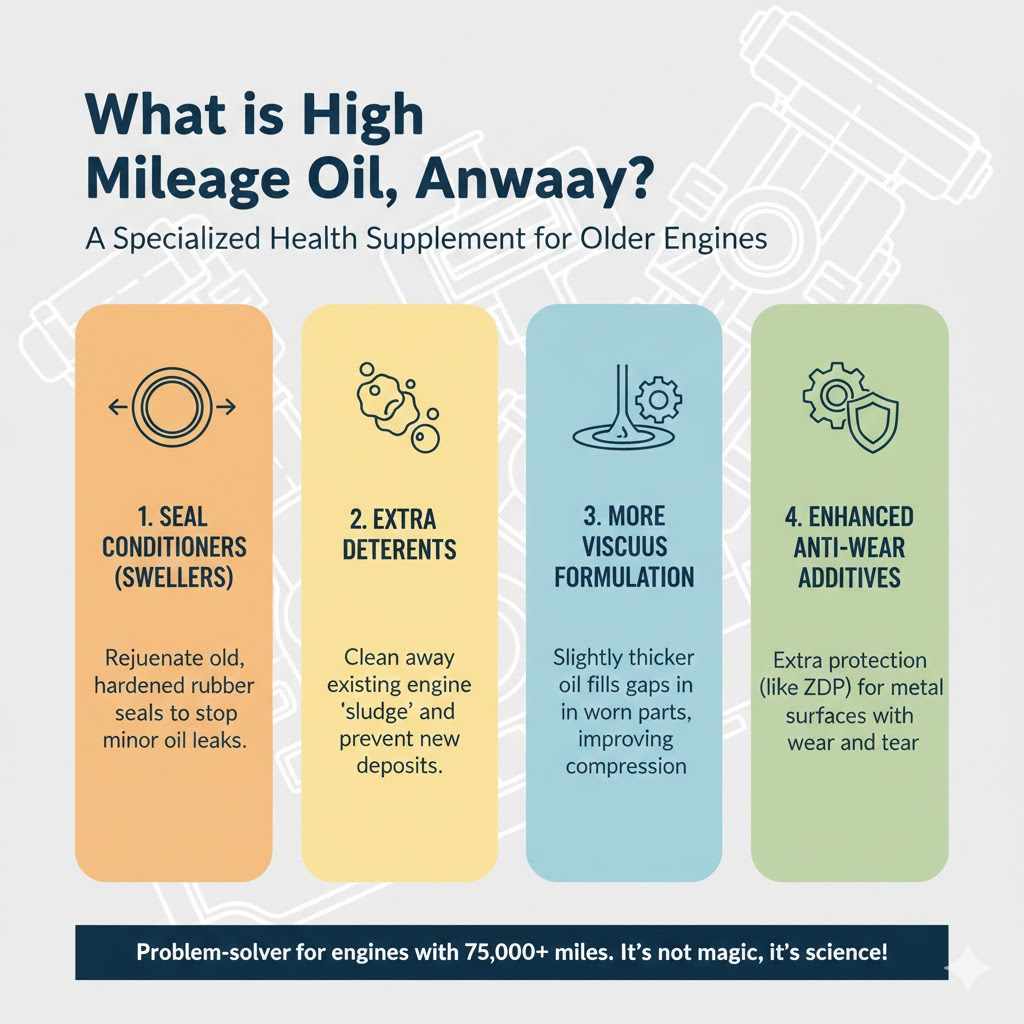
What is High Mileage Oil, Anyway?
Think of high mileage oil as a specialized health supplement for older engines, typically those with more than 75,000 miles. As cars age, their engine parts wear down. Gaskets and seals, which are often made of rubber, can become hard and brittle. This can lead to tiny oil leaks and a loss of engine compression, which means less power and efficiency.
High mileage oil is formulated with specific additives to combat these problems of aging. Here’s what’s inside:
- Seal Conditioners (Swellers): This is the most important ingredient. These are chemicals designed to soak into old, hardened rubber seals, making them swell up and become more pliable. This helps them seal gaps more effectively, which can slow or even stop minor oil leaks.
- Extra Detergents: Over tens of thousands of miles, engines can build up “sludge”—a thick, gunky deposit of old oil and contaminants. High mileage oils contain a higher concentration of detergents to help clean away this existing sludge and prevent new deposits from forming.
- More Viscous Formulation: These oils are often slightly thicker (at operating temperatures) than their standard counterparts. This thicker oil film helps fill in the microscopic gaps between worn engine parts, like bearings and piston rings, improving compression and reducing oil consumption (burning oil).
- Enhanced Anti-Wear Additives: They also include a robust package of anti-wear additives, like Zinc and Phosphorus (ZDDP), to provide an extra layer of protection on metal surfaces that have already experienced some wear and tear.
In short, high mileage oil is a problem-solver for engines that are starting to show their age.
Conventional Oil vs. High Mileage Oil: A Simple Breakdown
It’s helpful to see the differences side-by-side. While both oils lubricate your engine, their goals are quite different. Modern synthetic oils, which are required for most new cars, are focused on peak performance, fuel economy, and protection for new components with very tight tolerances.
Here’s a simple table to compare them:
| Feature | Standard Synthetic Oil (for New Cars) | High Mileage Oil |
|---|---|---|
| Primary Goal | Maximize performance, fuel efficiency, and protection in a new engine. | Recondition and protect an aging engine with over 75,000 miles. |
| Key Additives | Balanced detergents, friction modifiers for fuel economy, and anti-wear agents. | Seal conditioners, extra detergents, viscosity modifiers, and robust anti-wear agents. |
| Seal Interaction | Maintains the health and flexibility of new seals. | Causes old, brittle seals to swell to stop leaks. |
| Ideal Engine | New engines with low mileage and tight internal clearances. | Older engines with some wear, potential leaks, or sludge buildup. |
So, What Happens If You Put High Mileage Oil in a New Car?
Now we get to the main question. You’ve accidentally poured high mileage 5W-30 into your new car that calls for standard 5W-30. What’s going to happen?
The Short-Term Reality: Is It an Emergency?
Let’s get this out of the way first: No, it is not an emergency. If you’ve used high mileage oil for one oil change, your engine is not going to seize up or suffer immediate, catastrophic damage. The base oil and viscosity are likely similar to what your car requires, so it will still lubricate your engine parts just fine for a short period.
Think of it this way: you gave your healthy young car a dose of medicine meant for a senior citizen. It’s not the right medicine, and it won’t help, but a single dose is unlikely to cause a major problem. You don’t need to pull over and have your car towed. Just relax.
The Long-Term Risks: Why It’s Not a Good Idea
While one-time use isn’t a disaster, using high mileage oil consistently in a new car is a bad idea. The very additives that help an old engine can be harmful to a new one over time. Here’s why:
- Aggressive on New Seals: The seal conditioners are the biggest concern. New seals in your engine are soft, pliable, and perfectly sized. The “swelling” agents in high mileage oil can be too aggressive on these healthy seals. Over time, this can cause them to swell too much, soften, and break down prematurely. You could essentially be creating the very problem—leaks—that you were trying to avoid.
- Unnecessary Additives: A new engine is perfectly clean inside. It doesn’t have decades of sludge buildup. The extra-strong detergents in high mileage oil have nothing to clean, making them a wasted feature you’re paying for. While they won’t necessarily harm anything, they are not optimized for the pristine conditions of your new engine.
- Incorrect Formulation for Modern Engines: New engines, especially turbocharged and direct-injection models, run hotter and have incredibly tight tolerances. They require specific oils (usually full synthetics) that are designed to handle high heat, prevent deposits on turbochargers, and combat issues like Low-Speed Pre-Ignition (LSPI). High mileage oil is not formulated with these specific modern challenges in mind.
- Potential Warranty Issues: This is a big one. Every new car comes with an owner’s manual that specifies the exact type of oil you must use. This includes the viscosity grade (e.g., 0W-20) and the performance certification (e.g., API SP or ILSAC GF-6). High mileage oil may not always carry the latest certifications required by your manufacturer. Using an oil that doesn’t meet these specs could, according to the Magnuson-Moss Warranty Act, give the manufacturer grounds to deny an engine-related warranty claim. It’s a risk you don’t want to take.
What Oil Should You Use in a New Car?
The answer is wonderfully simple: use what the people who designed your engine tell you to use. Finding this information is easy and is the single most important thing you can do for your engine’s health.
Step 1: Always Check Your Owner’s Manual
Your car’s owner’s manual is your bible for maintenance. In the maintenance or specifications section, it will clearly state the required oil. Look for two key pieces of information:
- Viscosity Grade: This looks like “SAE 0W-20” or “SAE 5W-30.”
- Oil Specification/Certification: This will be an industry standard code, like “API Service SP” or “ILSAC GF-6.”
Many manufacturers also have their own specific approvals, such as GM’s dexos1™ or various European specs (VW, BMW, Mercedes-Benz). Your manual will list these if they are required. The oil cap on your engine often lists the viscosity grade as well.
Step 2: Understand Viscosity (The “W” Numbers)
Viscosity is simply a measure of an oil’s thickness or resistance to flow. The numbers can seem confusing, but the concept is straightforward.
- The First Number (e.g., 5W): The “W” stands for “Winter.” This number indicates how easily the oil flows when it’s cold. A lower number means it flows better in cold temperatures, which is crucial for protecting your engine during startup.
- The Second Number (e.g., 30): This indicates the oil’s thickness once the engine is at its full operating temperature.
Using the correct viscosity ensures your oil is thin enough to circulate quickly on a cold morning but thick enough to protect parts when the engine is hot.
Step 3: Choose the Right Type (Conventional, Synthetic Blend, Full Synthetic)
For almost any car made in the last decade, the manufacturer will require or strongly recommend full synthetic oil. Here’s a quick comparison:
| Oil Type | Description | Best For |
|---|---|---|
| Conventional | Refined from crude oil. Least expensive, offers basic protection. | Older, simpler engines with no special requirements. Rarely recommended for new cars. |
| Synthetic Blend | A mix of conventional and synthetic base oils. Offers better protection than conventional. | A budget-friendly step up from conventional, but full synthetic is often better. |
| Full Synthetic | Man-made and highly refined for purity and performance. Offers the best protection, stability at high temperatures, and longest life. | Most new cars, especially those with turbochargers or high-performance engines. |
Full synthetic oil provides superior protection, lasts longer between changes, and helps improve fuel economy. The extra cost is a worthwhile investment in the longevity of your new car.
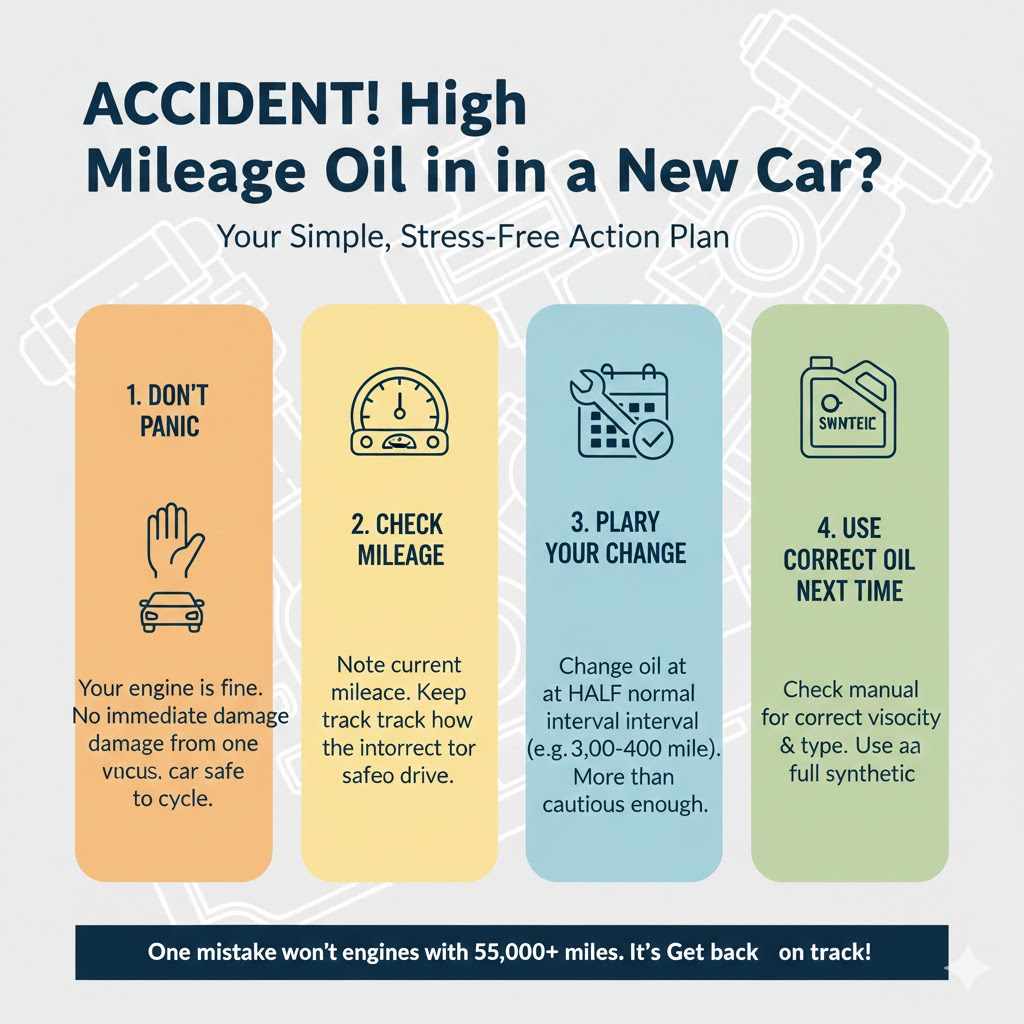
I Accidentally Used High Mileage Oil in My New Car! What Now?
Okay, so it happened. You’re reading this article after the fact. You just put high mileage oil in your car with 15,000 miles on it. Take a deep breath. Here’s your simple, stress-free action plan.
Step 1: Don’t Panic
As we covered, your engine is fine. It will not be damaged from one cycle of the wrong oil. You don’t need to drain it immediately in a panic. The car is perfectly safe to drive.
Step 2: Check Your Mileage
Note the mileage on your car when the oil was changed. This will help you keep track of how long the incorrect oil has been in the engine.
Step 3: Plan for an Early Oil Change
While you don’t need to drain it today, you shouldn’t run it for the full oil change interval either. A good rule of thumb is to change the oil at about half the manufacturer’s recommended interval. So, if your car’s oil change interval is 7,500 miles, plan to change it again in about 3,000-4,000 miles. This is more than cautious enough to ensure there are no ill effects.
Step 4: Use the Correct Oil Next Time
When you do the next oil change, make sure you get it right. Double-check your owner’s manual for the correct viscosity and specification, and buy a quality full synthetic oil that meets those requirements. This will get your car back on track for a long and healthy life.
Frequently Asked Questions (FAQ)
1. Can I mix high mileage oil with regular oil?
In a pinch, yes. If your oil is low and the only thing available is high mileage oil, it is much better to top it off than to run the engine with low oil. However, it’s not ideal for regular use as it dilutes the additive package of both oils. Try to use the correct oil for topping off whenever possible.
2. Is high mileage oil always synthetic?
No, high mileage oil comes in conventional, synthetic blend, and full synthetic varieties. The “high mileage” label refers to its special additive package (seal conditioners, extra detergents), not the type of base oil used.
3. What happens if I use a thicker oil than recommended, like 10W-40 instead of 5W-20?
Using a much thicker oil than specified can be harmful. Modern engines have very small oil passages. A thicker oil may struggle to flow through them, especially when cold, leading to oil starvation in critical parts of the engine. It can also reduce fuel economy and strain the oil pump.
4. At what mileage should I actually switch to high mileage oil?
The general industry consensus is to consider switching around 75,000 miles. However, this is just a guideline. If your car is not leaking or burning oil and is running well, you can continue using the standard synthetic oil specified by the manufacturer. There’s no harm in sticking with what works.
5. Will using the wrong oil definitely void my new car’s warranty?
It can. If you have an engine failure and the dealership discovers you have been consistently using an oil that does not meet the manufacturer’s required specifications, they can legally deny your warranty claim. It’s a risk that is not worth taking for the small price difference of an oil change.
6. Is high mileage oil more expensive?
Typically, yes. It usually costs a bit more than standard conventional or synthetic blend oil because of its advanced additive formula. Full synthetic high mileage oil is often priced similarly to standard full synthetic oil.
7. Can high mileage oil really fix an oil leak?
It can sometimes slow or stop very minor leaks from dried-out seals, like a rear main seal or valve cover gaskets. The seal conditioners help the rubber swell and seal better. However, it is not a magic fix for cracked gaskets, damaged seals, or significant leaks. It’s more of a stop-gap measure than a permanent repair.
Conclusion: Your Car Deserves the Right Care
So, will high mileage oil hurt a new car? The final answer is that while a single, accidental use is not a crisis, making it a habit is a bad idea. The special formula designed to help aging engines can be counterproductive and potentially harmful to the new, healthy components in your car.
The best and simplest rule for car maintenance is this: always trust your owner’s manual. The engineers who designed your engine know exactly what it needs to run reliably for hundreds of thousands of miles. Using the specified viscosity and certified synthetic oil is the most important investment you can make in your vehicle’s long-term health and in protecting your warranty.
Now you have the facts. You can walk into any auto parts store with confidence, knowing exactly what to look for and why. Taking care of your car doesn’t have to be complicated. With a little knowledge, you can make smart decisions that will keep your ride running smoothly for years to come. You’ve got this!