Wing Spoiler for Car: Wing vs. Spoiler and Legality
Choose a spoiler if you want low-profile rear downforce and fewer legality headaches; choose a wing only if the car sees repeated track-speed use, the mount is sturdy, visible, and legal where you live. Bad mounting can crack panels, block rear view, and fail inspection. This guide compares wing and spoiler packaging, visibility, mounting safety, and the main street-legality checks.
| Decision factor | Wing | Spoiler and Legality | Winner |
|---|---|---|---|
| Road-speed aero effect | Creates genuine downforce, but the effect matters most when speed is high enough to load the rear axle. | Helps reduce lift by stabilising airflow separation at the rear, with less drag and cleaner integration. | Spoiler and Legality |
| Drag and efficiency | Usually adds more drag because the airfoil is doing real work. | Usually introduces less drag than a full wing. | Spoiler and Legality |
| Visibility and packaging | More likely to bisect rear glass or sit near the center brake light and plate. | Lower-profile and easier to package around glass, plate, and lamp locations. | Spoiler and Legality |
| Mounting and reinforcement | Often needs backing plates or other reinforcement because the load path is real. | Usually simpler to mount, with less structural demand. | Spoiler and Legality |
| Best-fit use case | Track-oriented aero package with front-to-rear balance. | Daily driver, mixed use, and moderate road speeds. | Spoiler and Legality |
Wing vs. spoiler: the trade-off
A spoiler is the street-first part. It sits lower, stays closer to OEM-style packaging, and changes rear airflow without asking much from the trunk skin or hatch. A wing is the more aggressive tool. It is an airfoil on uprights that creates downforce by pressure difference, and that only pays off when the car is moving fast enough to need it.
What a rear spoiler does
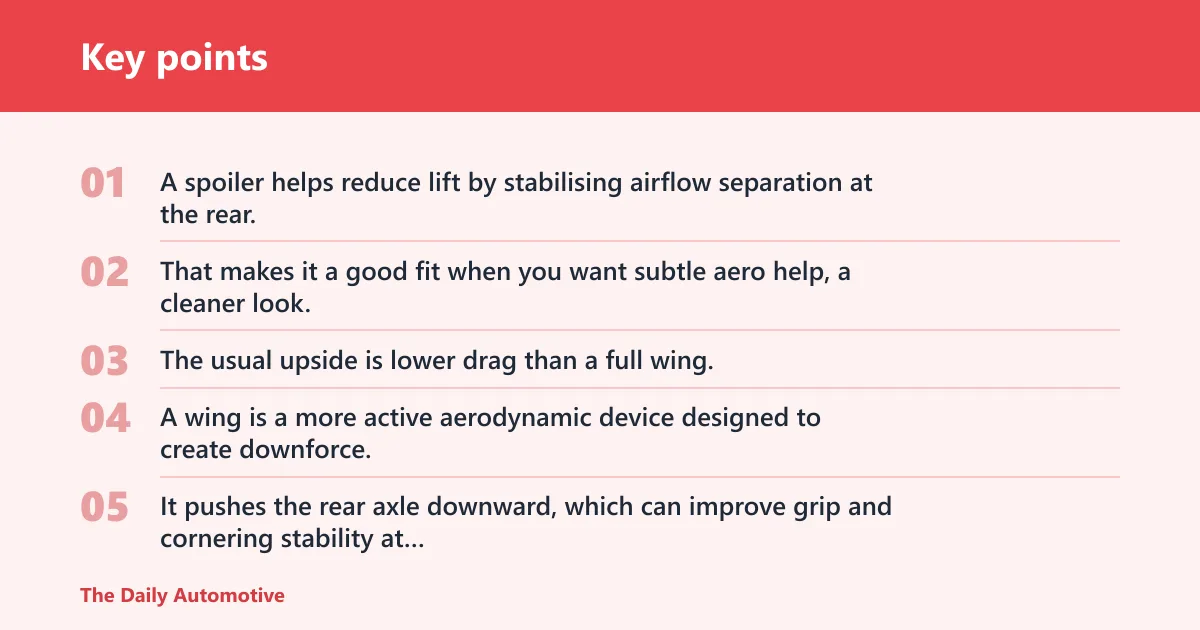
A spoiler helps reduce lift by stabilising airflow separation at the rear. That makes it a good fit when you want subtle aero help, a cleaner look, and fewer packaging problems around the rear glass, plate, or center brake light. The usual upside is lower drag than a full wing, which matters more on the street than many owners expect.
What a rear wing does
A wing is a more active aerodynamic device designed to create downforce. It pushes the rear axle downward, which can improve grip and cornering stability at speed, but that benefit usually comes with extra drag. A wing also needs a stronger mounting plan because the load path is not cosmetic, especially on a larger element or a tall set of uprights.
Why street speed changes the answer
At moderate road speeds, the aero gain from a wing is often limited compared with the added drag, noise, packaging impact, and possible inspection risk. That is why the street answer usually leans toward a spoiler, while a wing belongs on a car that sees frequent high-speed driving or very high-speed circuit use. The part should match the car’s use, not the owner’s wish for a more aggressive silhouette.
| Street aero comparison | Wing | Spoiler and Legality |
|---|---|---|
| Downforce | Higher, because the airfoil is built to make aerodynamic force. | Lower, because it mainly manages separation and lift. |
| Drag | Usually higher. | Usually lower. |
| Rear visibility risk | Higher on some coupes and hatches. | Lower on most cars. |
| Mounting complexity | Higher, often with reinforcement needs. | Lower, especially in OEM-style fitment. |
Downforce and drag
Downforce helps the tire work harder without sliding as early, but it is not free. More downforce usually means more drag, and that tradeoff is why wings matter more on track than as cosmetic aero. On the street, the extra drag can matter more than the grip unless the car is driven at sustained high speed.
Say your hatchback runs mostly at moderate road speeds, with the occasional freeway pull. A subtle spoiler can tidy the rear airflow without turning the car into a drag penalty, while a tall wing may add visual drama and little usable benefit in day-to-day driving.
Visibility and packaging
Rear visibility is a packaging issue as much as a legal one. A wing can bisect rear glass and still be legal if mirrors and other visibility rules are met, but it must not create a serious rearward-view problem where local rules care about that. Spoilers usually have an easier time clearing the rear window, the plate, and the center brake light.
Mounting and reinforcement
Mounting hardware must be secure, free of sharp edges, and able to carry load without cracking the trunk skin or hatch. Larger wings often need backing plates or similar reinforcement, with a clear load path so the sheet metal is not carrying all of the load. If the mount flexes, the part can rattle, leak, or fail inspection even if the shape itself looks harmless.
A common first-timer mistake is bolting a large wing to a thin trunk lid with no reinforcement. The first sign is often flex around the fasteners, then water intrusion or paint cracking, and finally a mount that no longer feels solid.
Does a wing make more downforce?
Yes. A wing gives more downforce than a spoiler because it is built as an airfoil rather than a low-profile flow manager. That extra downforce can improve rear grip and stability at speed, which is why wings show up more often on track-oriented cars and full aero packages.
How downforce helps at speed
Downforce pushes the rear axle downward, which can make the rear tires more willing to accept braking, turn-in, and throttle loads. On a road car, that is most relevant when speeds are high enough for the aero load to matter. On slower streets, the benefit may be hard to feel.
Why more drag comes with it
More downforce usually means more drag because the part is forcing the air to change direction and pressure. That is not a flaw; it is the price of the extra grip. For a street build, the penalty can outweigh the benefit unless the car spends real time at speed.
Why spoilers are often the street-first choice
The spoiler recommendation is tied to lower drag and cleaner integration. It is usually the better fit when the car’s use case is daily driving, mixed use, or moderate road speeds. The part still has a job, but it asks for less compromise from the body and the driver.
Is a rear wing legal?
Rear wings are legal in every state, but legality depends on fitment and inspection points, not on whether the part looks aggressive. Practical checks usually include rearward view, plate visibility, center brake light clearance, secure mounting, and the absence of sharp or dangerous edges. Local rules can still fail a bad installation.
Rearward view and mirror rules
A wing can block part of the rear window and still pass if the car retains adequate rearward visibility through mirrors and any other required view provisions. That means the legality question is less about the wing itself and more about whether it creates a real visibility problem for the driver or the inspector.
Plate visibility and center brake light clearance
License plate visibility must not be obscured by the wing or spoiler mounting. Low-mounted wings are more likely to shadow the plate, especially on cars with a short rear overhang. The center brake light also has to remain visible; if the aero part blocks it, that becomes an inspection problem fast.
Sharp edges, secure mounting, and local inspection checks
Mounting hardware must not leave exposed sharp edges, loose fasteners, or a part that can move under load. Inspectors can fail a car for dangerous edge hazards, insecure attachment, or obvious body damage around the mounting points. A wing that looks fine from ten feet away can still fail if the load path is sloppy.
Street legality checklist
Use this before you buy or drill. It catches the usual failure modes before the part goes on the car.
| Check | Legality risk | Pass/fail inspection points | Daily driver | Fast road | Track use |
|---|---|---|---|---|---|
| Plate visibility | Medium to high if the part shadows the plate. | Plate readable from behind; no wing blade, bracket, or trunk lip blocks it. | Yes | Yes | Yes |
| Center brake light clearance | Medium if the part sits high or close to glass. | Brake light remains visible from the rear; no direct obstruction from uprights or wing plane. | Yes | Yes | Yes |
| Rearward view | Medium on hatchbacks and coupes with tall mounts. | Driver can still see adequately with mirrors; view is not blocked in a way local rules reject. | Yes | Yes | Usually |
| Sharp edges | High if hardware or brackets are exposed. | No knife-like edges, protruding bolts, or unsafe corners. | Yes | Yes | Yes |
| Secure mounting | High for large wings on thin sheet metal. | No flex, rattle, or visible movement; fasteners and backing are sound. | Yes | Yes | Yes |
| Reinforcement needs | High when the wing is large or tall. | Backing plates or equivalent load spreading used where needed; trunk skin not doing the whole job. | No | Maybe | Yes |
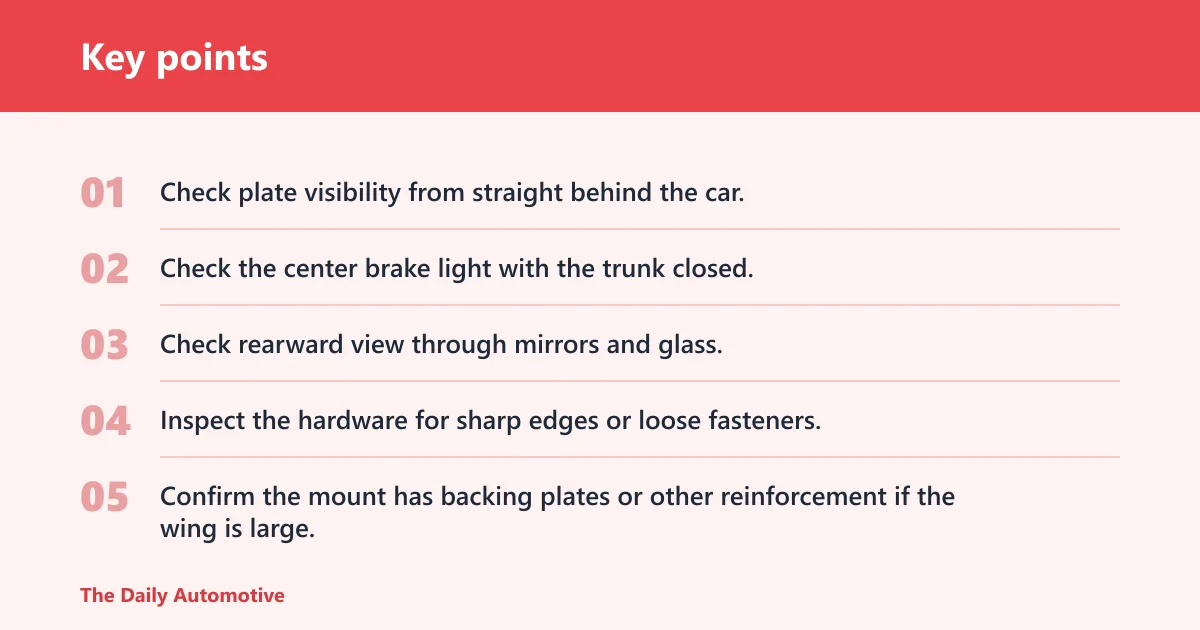
- Check plate visibility from straight behind the car.
- Check the center brake light with the trunk closed.
- Check rearward view through mirrors and glass.
- Inspect the hardware for sharp edges or loose fasteners.
- Confirm the mount has backing plates or other reinforcement if the wing is large.
- Verify local inspection rules before drilling the body.
Choose Wing if… / Choose Spoiler and Legality if…

Choose Wing if the car sees frequent high-speed driving, track days, or a full aero package that balances front and rear grip. Choose Spoiler and Legality if you drive mostly on the street, want lower drag, need cleaner packaging, or do not want to reinforce the trunk or hatch.
Choose Wing if…
Pick Wing if your car is a track build, a fast road car with sustained high-speed use, or a coupe or hatchback that can physically accept a reinforced mount without blocking legal lighting or plate placement. It also makes more sense when the rear wing is part of a track-oriented aero package that includes front-to-rear balance, such as a splitter or diffuser.
Choose Spoiler and Legality if…
Pick Spoiler and Legality if the car is a daily driver, a mixed-use street build, or a sedan or hatch where subtle rear aero fits the body better. It is the better answer when you want a lower-profile part with fewer inspection problems, less drag, and less risk of cracking the trunk skin or blocking the center brake light.
When a car shape changes the answer
Body style matters. A notchback sedan often gives you more room to package a spoiler cleanly, while a hatchback can run into rear-glass and brake-light issues sooner. On a coupe, a wing may fit physically, but fitment still has to clear the plate, the lamp, and the rearward view check.
Suppose a coupe owner wants a 140 mph circuit setup with a tall rear wing and no front aero. The wing may add rear grip, but the balance is wrong if the front axle is not addressed too, and the car may also run into mounting or visibility issues that a spoiler would avoid.


What can go wrong at install?
The common failures are structural, not cosmetic. Trunk-skin cracking, panel flex, leaks around fasteners, and loose hardware are all signs that the mount or load path is wrong. A wing that sits well on the bench can still cause problems once the car sees speed and vibration.
Trunk-skin cracking and flex
Thin sheet metal is a bad place to concentrate load. If the wing loads the skin without backing plates or a spreader, the metal can flex and crack around the holes. That is both a durability problem and a legality problem if the mount starts to shift.
Leaks, backing plates, and load paths
Any drilled installation needs sealing and a clear structural plan. Backing plates spread the load over more metal, which helps prevent deformation and water intrusion. The load path should run through hardware and reinforcement, not through paint and thin skin alone.
Why cheap hardware can become a problem
Low-grade brackets and undersized fasteners can loosen, bend, or corrode. Once that happens, the wing can rattle, lose alignment, or create a sharp edge at the mount. A legal-looking part becomes a problem when the hardware cannot hold it in place.
Frequently asked questions
What is the difference between a wing and a spoiler on a car?
A spoiler is a low-profile body-mounted part that helps reduce lift by managing rear airflow separation. A wing is an airfoil on uprights that creates downforce by pressure difference. The spoiler is usually subtler and easier to package; the wing is more functional at speed and usually adds more drag.
Is a rear wing legal in the US?
Yes, rear wings are legal in every state, but the installation still has to pass common checks. Rearward view, plate visibility, center brake light clearance, and safe mounting are the usual issues. A wing that blocks lighting or leaves sharp edges can fail even if the part itself is not banned.
Is a spoiler legal on a car?
Yes, a spoiler is generally legal, provided it does not obscure the plate, hide the center brake light, or create unsafe mounting hardware. Because spoilers are lower and closer to OEM-style packaging, they often clear those checks more easily than a large wing.
Does a wing give more downforce than a spoiler?
Yes. A wing is designed to create downforce, while a spoiler mainly manages separation and can reduce lift or drag. That extra downforce is useful at speed, but it usually comes with more drag and more mounting complexity, which is why the wing is the more track-focused choice.
Can a wing block the rear window or license plate?
Yes, it can. A wing may bisect the rear glass, and low-mounted setups can shadow the plate. That does not automatically make it illegal, but it can create inspection problems if rearward visibility is inadequate or if the plate and brake light are obscured.
When is a spoiler better than a wing for street driving?
A spoiler is better when the car spends most of its life at normal road speeds, when you want lower drag, or when rear visibility and clean packaging matter more than peak aero. It is also the safer choice if you do not want to reinforce the trunk or hatch.
Products related to this article
Sponsored / affiliate links. As an Amazon Associate I earn from qualifying purchases. I may earn additional commission from eligible campaigns.