What Do Spoilers on Cars Do? Spoiler vs Wing, Downforce, Drag
A car spoiler is a shaped panel on the body that disturbs the airflow so the car lifts less at speed, and on some cars it also presses the tires harder into the road. The catch is that the effect grows with speed and the price is often extra drag, so a spoiler that helps a sports car at 180 mph may do very little on a family sedan at 70 mph. This guide covers what each device does, what Porsche and Chevrolet say about their own numbers, what it means at street speeds, and how to judge an aftermarket spoiler.
What Is a Spoiler on a Car?
Best Road-Car Aero Read
|
Modifying the Aerodynamics of Your Road Car (SpeedPro) A book whose listing title is about changing the aerodynamics of a road car, which is exactly the question behind a spoiler purchase.
As an Amazon Associate we earn from qualifying purchases. Spec-based pick from the listing, not a hands-on test. |
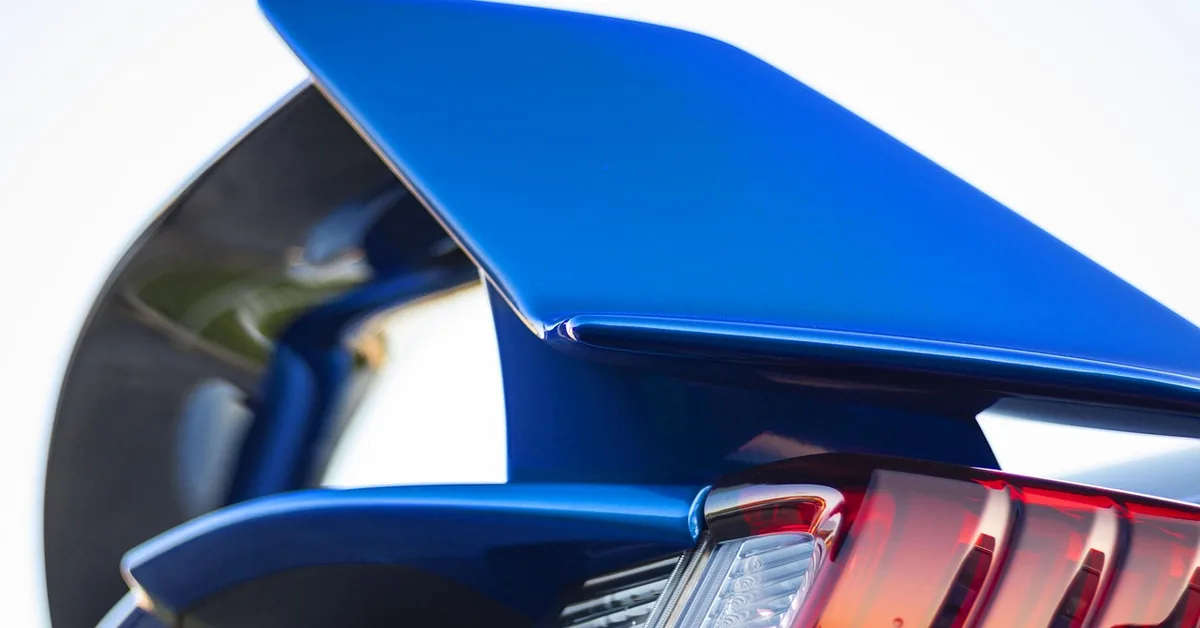
In everyday use, “spoiler” covers any add-on at the front, rear or roof that changes how air leaves or passes the body. The name describes the job: it “spoils” an airflow pattern that would otherwise lift the car or drag it back. Porsche’s engineering newsroom describes the problem plainly: a streamlined body can create lift at the front and rear axles, which an aircraft needs but a car does not.
That is the real answer to “what is the purpose of a spoiler on a car”: it is a countermeasure for lift and a tool for steering where the air goes. Whether it is worth having depends on how fast you drive and how the body is shaped, which is what the rest of this page sorts out.
What Do Spoilers Do on a Car? Lift, Drag and Downforce
Three words explain almost every spoiler claim. NASA Glenn’s beginner pages define lift as a force that acts perpendicular to the airflow, and drag as the force that acts in the direction opposing the motion. Lift occurs when a moving flow of gas is turned by a solid object, and the object is pushed the opposite way. On a car, the useful version of that push is downforce: a force that presses the car toward the road instead of lifting it.
NASA’s drag equation shows why speed dominates. Drag equals the drag coefficient times the air density times half the velocity squared times the reference area. Because velocity is squared, going twice as fast brings four times the air load. Porsche’s newsroom makes the same point for lift: doubling vehicle speed quadruples the force of aerodynamic lift, and from about 80 km/h air becomes the dominating force working against further acceleration.
Spoiler vs Wing: What Is the Difference?
The two words are used loosely, so treat this as a working rule rather than a standard. A spoiler usually sits close to the body and works by disturbing or cutting off a flow that would otherwise lift the car. A wing stands above the body on supports and works more like an upside-down aircraft wing, turning air upward so the car is pushed down. That second description is our plain-language reading of NASA’s “flow turned one way, force the other way” principle, not a quote from a maker.
Makers do not always keep to this split. Porsche’s 911 Turbo S has what the company calls a rear wing that extends and tilts, while Chevrolet describes the standard Corvette Z06 piece as a rear spoiler and the optional pedestal-mounted piece as a rear wing. The practical check is the shape: raised on supports means wing, flush with the trunk edge means spoiler or lip.
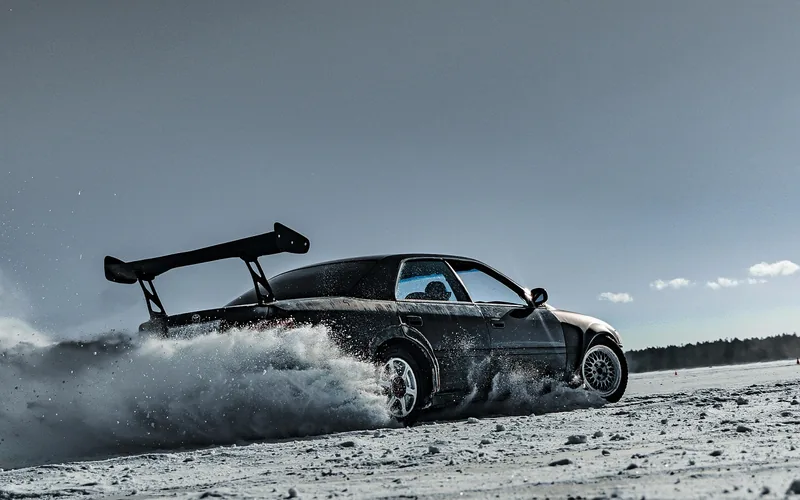
Spoiler, Wing, Lip, Splitter and Active Spoiler at a Glance
| Device | Where it sits | What it is meant to do | What a source in this article says |
|---|---|---|---|
| Rear spoiler | Trunk or tailgate edge | Reduce rear lift, steady the car at speed | Porsche 1972 Carrera RS 2.7 “ducktail” reduced aerodynamic lift and drag (Porsche Newsroom, 2014) |
| Rear wing | On supports above the body | Add rear downforce | Corvette Z07 package with carbon fiber high rear wing: 734 lb at 186 mph (Chevrolet, 2021) |
| Wickerbill (small tab) | Edge of a rear spoiler | Add downforce from a small vertical tab | Z06 fixed wickerbill: 365 lb more at 186 mph (Chevrolet, 2021) |
| Front spoiler or lip | Under the front bumper | Reduce front-axle lift by sending air around the body | First 911 S front spoiler, 1971: less front lift, better directional stability (Porsche Newsroom, 2014) |
| Front splitter | Front edge, flat extension | Front-end downforce | Standard Z06 includes a front splitter; the carbon package adds a larger one (Chevrolet, 2021) |
| Active spoiler or wing | Rear, moves with speed or mode | Switch between low drag and high downforce | 911 Turbo S: three active parts, eight configurations (Porsche Newsroom, 2020) |
What the Manufacturers Actually Say
Every figure below is quoted from a maker document we read in full, with the model and year.
| Source and car | Part | Stated result | Context given |
|---|---|---|---|
| Porsche Newsroom, 2014: 911 history | Front spoiler (1971, 911 S) | Reduced front-section lift; better directional stability and easier control | Historical account, no number |
| Porsche Newsroom, 2014: 911 history | Ducktail and front spoiler (1972, Carrera RS 2.7) | Reduced aerodynamic lift and drag | Car designed for motor sports |
| Porsche Newsroom, 2020: 911 Turbo S | Active front spoiler and rear wing | Downforce up 15 percent; maximum about 170 kg in Performance position | Sport Plus mode activated |
| Porsche Newsroom, 2020: 911 Turbo S | All retracted, flaps closed | Minimum drag coefficient 0.33 | Most efficient of the eight configurations |
| Chevrolet, 2023 Corvette Z06 launch | Fixed wickerbill on standard rear spoiler | 365 lb (165.6 kg) more downforce | At 186 mph (299.3 km/h) |
| Chevrolet, 2023 Corvette Z06 launch | Z07 package with carbon fiber high rear wing and ground effects | 734 lb of downforce | At 186 mph; Chevrolet called it more than any Corvette before |
Two details matter here. First, every large number is quoted at a very high speed, 186 mph for the Corvette. Second, Porsche’s head of aerodynamics describes a conflict: a low drag coefficient is desirable for maximum speed and low consumption, while high downforce is advantageous for driving dynamics, and the two characteristics contradict each other. Porsche’s answer is a wing that moves.
Do Spoilers Matter at Legal Highway Speeds?
This is the question most searchers actually have, and no maker document we read answers it directly. What we can do is show the arithmetic. NASA describes dynamic pressure as half the density times the velocity squared, and the drag equation uses it directly. If we assume the same car, the same setup and a force that scales with that term, a force quoted at 186 mph shrinks quickly at lower speeds.
| Speed | Share of the 186 mph force | Z06 wickerbill (365 lb at 186 mph) | Z07 package (734 lb at 186 mph) |
|---|---|---|---|
| 70 mph | about 14 percent | about 52 lb | about 104 lb |
| 100 mph | about 29 percent | about 106 lb | about 212 lb |
| 120 mph | about 42 percent | about 152 lb | about 305 lb |
| 186 mph | 100 percent | 365 lb | 734 lb |
These lower rows are our own scaling arithmetic, not measurements and not Chevrolet figures. Real cars also change with ride height, tire load and body shape, so treat the table as an order-of-magnitude picture: at ordinary highway speed the same wing produces a small fraction of its track-speed force. That fits Porsche’s description of its Eco position, where the wing stays retracted over a large speed range so the car can be driven with minimum drag.
Does a Spoiler Improve Fuel Economy?
Not by default. The older version of this page said rear spoilers reduce drag and improve fuel efficiency, and our sources do not support that as a general rule. Fueleconomy.gov explains that a vehicle spends energy moving air out of the way, less at low speeds and more as speed increases, and that this resistance is directly related to the vehicle’s shape and frontal area. A part that adds downforce usually adds some drag too.
Porsche shows both sides. Its 911 Turbo S reaches its minimum drag coefficient of 0.33 with the front and rear spoilers retracted, and its airbrake mode deliberately raises drag and downforce together, which Porsche says can reduce braking distance. Porsche says its 1972 ducktail and front spoiler reduced both lift and drag, so a spoiler can lower drag on some bodies, but it is not a fuel-saving device you can assume.
Fueleconomy.gov gives one useful comparison from a 2014 Oak Ridge National Laboratory study (SAE 2014-01-1614) using a small sedan and a standard SUV. A large, blunt roof-top cargo box reduced fuel economy by around 2 to 8 percent in city driving, 6 to 17 percent on the highway and 10 to 25 percent at 65 to 75 mph. Rear-mount boxes or trays cost much less, about 1 to 2 percent in the city and 1 to 5 percent on the highway. The lesson for spoiler buyers: a large object in the airstream can matter more to your fuel bill than a trunk-lid wing.
Spoiler Myths Checked Against Sources
| Common claim | What the sources support | Verdict |
|---|---|---|
| A spoiler always makes a car faster | Porsche says low drag and high downforce contradict each other; its wing raises drag in Performance and airbrake positions | Not as a rule |
| A spoiler always saves fuel | Fueleconomy.gov ties drag to shape and frontal area; Porsche’s lowest drag setting has the spoilers retracted | Not supported |
| Spoilers only matter at track speeds | Largest quoted numbers are at 186 mph, and force scales with speed squared; Porsche and Chevrolet also describe stability benefits at high speed | Mostly true for big wings, partly true for small ones |
| A bigger wing means more downforce | Size is one factor; Porsche made its Turbo wing lighter with a larger effective area, and angle and speed are also tuned | Oversimplified |
Buying and Fitting an Aftermarket Spoiler
If you want one mostly for looks, that is a legitimate reason, as long as you do not expect track-level results. Our separate pages on a wing spoiler for a car and a universal spoiler cover specific products, and the guide to adhesive for a car spoiler covers mounting options.
- Check the fit claim: a “universal” part is not shaped for your trunk lid, so look for how it mounts and what it touches.
- Look for published data: a maker that has measured downforce or drag will usually say so; silence is a signal.
- Think about visibility: a tall wing can sit in the rear window line. We did not find an official page in this research that states a rule on rear-view obstruction, so check your own state’s vehicle code and your insurer before fitting.
- Secure mounting matters: a part that works loose at speed is a hazard to the car behind you, so follow the maker’s instructions or use a qualified installer.
Where Spoilers Come From: Race Cars and Car Culture
Porsche’s documents trace the idea from racing: the 917 long-tail car for Le Mans, then the 1971 front spoiler, the 1972 ducktail, a large fixed rear spoiler on the first 911 Turbo in 1975, and the first electrically extending rear spoiler in 1989. For the racing side, see the different types of race cars. The styling side is part of car culture from hobby to lifestyle.
Frequently Asked Questions
What Is The Purpose Of Car Spoilers?
A spoiler manages airflow to reduce lift and, on some designs, add downforce. Porsche’s history shows its early front spoiler reduced front-end lift and improved directional stability. The benefit grows with speed, so it is most useful on fast cars.
How Do Spoilers Affect Car Performance?
Factory-engineered ones do, mainly at high speed. Because aerodynamic force rises with the square of speed, a part tuned for 186 mph produces a small fraction of that force at 70 mph. Aftermarket parts without published data may do little beyond changing the look.
Do spoilers reduce drag or save gas?
Not reliably. Downforce usually comes with extra drag, and Porsche’s lowest-drag setting keeps its spoilers retracted. Porsche says its 1972 ducktail and front spoiler reduced both lift and drag, but our sources do not support a general fuel-saving claim.
What does an active spoiler do?
An active spoiler moves with speed or driving mode. On the 2020 Porsche 911 Turbo S, the system offers eight aerodynamic configurations, from a low-drag retracted setting to a Performance setting with about 170 kg of maximum downforce, plus an airbrake function in hard braking.
What We Verified and What We Did Not
Facts in this article come from NASA Glenn Research Center beginner aeronautics pages, Fueleconomy.gov (driving efficiency and where the energy goes pages), the Porsche Newsroom (2014 aerodynamics history and 2020 911 Turbo S release) and the Chevrolet 2023 Corvette Z06 launch release. We did not test any spoiler ourselves, and the lower rows of the speed table are our own arithmetic. We did not verify state laws on spoilers or rear-view obstruction, or any figure for roof spoilers, so none are stated. This page is general information, not engineering or legal advice.
Products related to this article
Sponsored / affiliate links. As an Amazon Associate I earn from qualifying purchases. I may earn additional commission from eligible campaigns.