1955 Chevy One-Fifty American Graffiti Guide
Finding good information about the 1955 Chevrolet One-Fifty in American Graffiti Guide can feel a bit tricky sometimes. You might be wondering why this car from a classic movie is so popular and what makes it special for fans. It’s easy to get lost in all the details.
But don’t worry! We’re going to make it super simple, step by step. Get ready to learn all about this iconic car.
The 1955 Chevrolet One-Fifty In American Graffiti
This section is all about introducing the star of our show, the 1955 Chevrolet One-Fifty as it appears in the beloved film “American Graffiti.” We’ll explore its significance in the movie and why this particular model captured the hearts of so many. Understanding its role helps us appreciate its lasting appeal.
The Icon’s Role In The Film
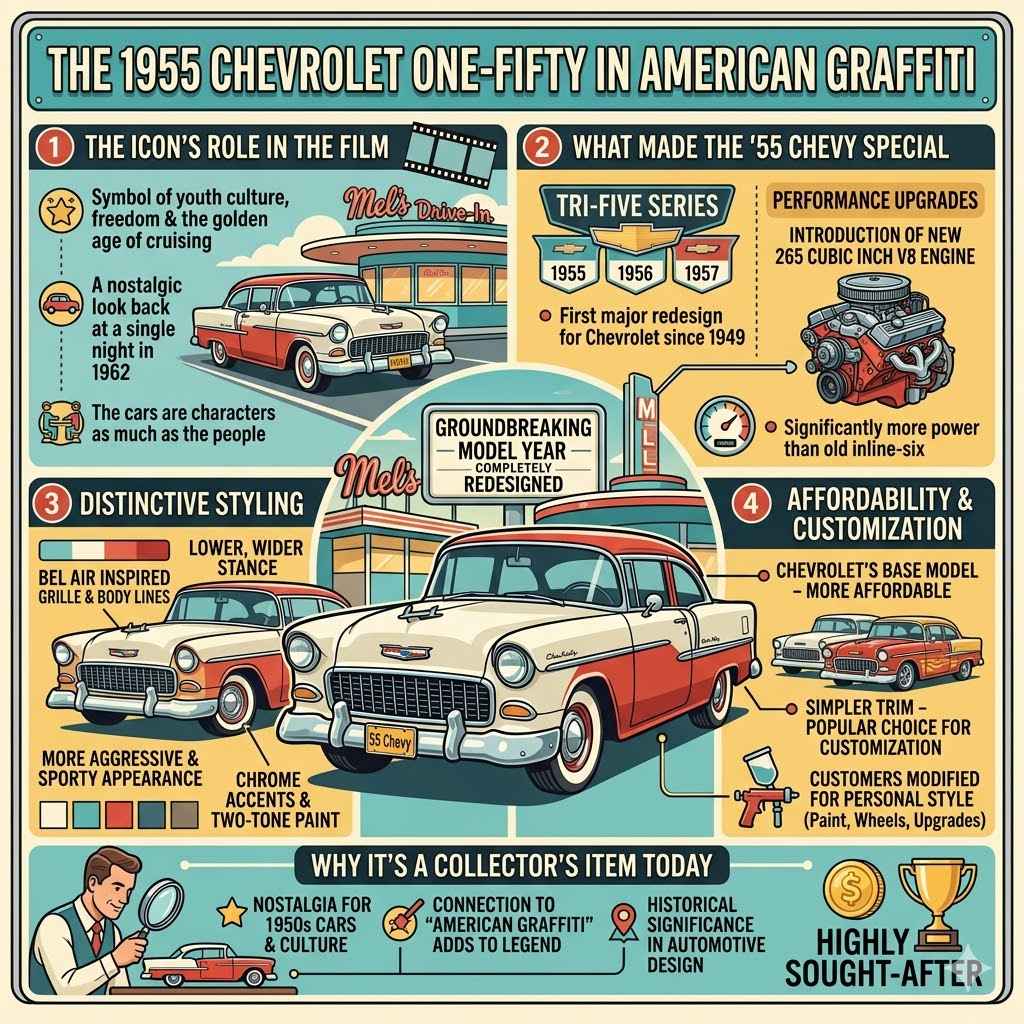
The 1955 Chevrolet One-Fifty, often called the “55 Chevy,” plays a crucial role in “American Graffiti.” It’s not just any car; it’s a symbol of youth culture, freedom, and the golden age of cruising. The movie itself is a nostalgic look back at a single night in 1962, and the cars are as much characters as the people.
This car represents a specific era of American automotive design. It embodies the dreams and aspirations of teenagers in the early 1960s. Its presence on screen makes it an unforgettable part of cinematic history.
What Made The ’55 Chevy Special
The 1955 Chevrolet was part of Chevy’s groundbreaking “Tri-Five” series, which included the 1955, 1956, and 1957 models. The 1955 model year was particularly significant because it marked a complete redesign for Chevrolet. It introduced a new V8 engine, which was a big deal for performance and popularity.
Its styling was also a step forward. The car featured a more modern, sleeker look compared to its predecessors. This made it highly desirable for young drivers who wanted a car that looked cool and performed well.
Distinctive Styling The 1955 Chevrolet One-Fifty featured a distinctive “Bel Air” inspired grille and body lines that set it apart. It had a lower, wider stance than previous models, giving it a more aggressive and sporty appearance. The chrome accents and two-tone paint options further enhanced its appeal. This design language became a hallmark of American cars in the mid-1950s.
Performance Upgrades The introduction of the new V8 engine, often referred to as the “265 cubic inch V8,” was a game-changer. This engine offered significantly more power and smoother operation compared to older inline-six engines. It allowed the ’55 Chevy to reach higher speeds and accelerate faster, which was very important for cruising and drag racing enthusiasts of the era.
Affordability and Customization The One-Fifty was Chevrolet’s base model, making it more affordable than the Bel Air. This affordability made it accessible to a wider range of buyers, including teenagers and young families. Its simpler trim also made it a popular choice for customization. People could easily modify it to suit their personal style, adding custom paint, wheels, and engine upgrades.
Why It’s A Collector’s Item
Today, the 1955 Chevrolet One-Fifty is a highly sought-after collector’s item. Its appeal stems from a combination of factors. Nostalgia plays a huge part, especially for those who grew up with or admired the cars of the 1950s.
The connection to “American Graffiti” also adds to its legendary status.
Many collectors value the car for its historical significance in automotive design and its place in popular culture. Finding one in good condition, or a well-restored example, can be challenging but rewarding.
Finding And Identifying Your 1955 Chevrolet One-Fifty
This part of our guide focuses on how you can identify a true 1955 Chevrolet One-Fifty and what to look for when considering purchasing one. We’ll cover identifying features and common areas to inspect. This will help you become a more informed enthusiast.
Decoding The VIN And Trim Levels
The Vehicle Identification Number (VIN) is key to confirming the year, make, and model of any classic car. For a 1955 Chevrolet, the VIN will start with a code that indicates the series. The One-Fifty was part of the 1500 series.
Chevrolet offered several trim levels in 1955. The One-Fifty was the most basic. It typically had fewer chrome accents and simpler interior appointments compared to the Two-Ten and the premium Bel Air models.
Identifying these differences is crucial for collectors.
The 150 series was marketed as the “Utility” model. It was designed to be functional and affordable. This meant less ornamentation.
For example, One-Fifties usually had simpler trim around the windows and lacked the distinctive chrome side moldings that were standard on the Bel Air.
Key Exterior Features To Look For
When you see a 1955 Chevrolet, several exterior clues can help you identify it as a One-Fifty. One of the most obvious is the lack of chrome. The One-Fifty models were often sold with minimal chrome trim.
Look at the side of the car. Bel Air models had a prominent stainless-steel trim piece that ran from the front fender all the way to the rear. The Two-Ten had a less elaborate chrome strip.
The One-Fifty typically had no side body trim at all, or at best, a very simple, unadorned strip.
The grille also offers clues. While all 1955 Chevys shared a similar grille design, the One-Fifty might have had less chrome treatment on the grille itself. Headlight bezels and bumpers were also often less ornate on the base model.
Side Trim The absence of extensive chrome side moldings is a strong indicator of a One-Fifty. While some owners might have added aftermarket trim, original One-Fifties were quite bare. The One-Fifty line focused on essential features and affordability over elaborate styling.
Window Trim Window stainless steel trim on the One-Fifty was typically simpler. The Bel Air featured a more complex, polished stainless steel trim around the windows, especially the rear quarter windows on two-door models. The One-Fifty had basic, often painted, or less polished trim.
Badge Identification While many badges might have been removed or replaced over the years, the original badges can be telling. The One-Fifty model typically had a simple “150” badge, often located on the rear quarter panel. This was distinct from the “Two-Ten” or “Bel Air” badging.
Interior Distinctions
The interior of the 1955 Chevrolet One-Fifty is where its economy-focused origins are most apparent. You’ll notice less plush materials and fewer amenities compared to higher trim levels. This simplicity is part of its charm for many enthusiasts.
The dashboard typically had a simpler design. While the basic layout was the same across models, the One-Fifty might have had a painted dash rather than a chrome-accented one. Upholstery was usually fabric or vinyl, designed for durability rather than luxury.
Features like power windows, power steering, and power brakes were often optional or not available at all on the One-Fifty, making it a true driver’s car where you had to do more of the work yourself.
Seat Upholstery The seating in a One-Fifty was designed for practicality. You’d typically find durable woven fabrics or vinyl in simple patterns. These materials were chosen for their longevity and ease of cleaning, reflecting the car’s utility-oriented purpose.
Dashboard Simplicity The dashboard often featured a painted metal finish instead of the chrome and polished accents found in more upscale models. Gauges might have been more basic, with fewer warning lights or secondary instruments. Radio options were also simpler.
Door Panels Door panels on the One-Fifty were usually made of vinyl or plain fabric, often with minimal trim. Higher-end models might have featured padded panels or contrasting inserts. The One-Fifty’s interior was functional and unadorned.
Restoring And Maintaining Your 1955 Chevrolet One-Fifty
Restoring a classic car like the 1955 Chevrolet One-Fifty can be a rewarding experience. This section will guide you through the common aspects of restoration and essential maintenance tips to keep your classic running smoothly for years to come.
Common Restoration Projects
When restoring a 1955 Chevrolet One-Fifty, several areas often require attention. The chassis and suspension are critical for safety and ride quality. Rust is a common enemy of classic cars, so inspecting the frame, floor pans, and body panels for corrosion is paramount.
The powertrain, including the engine and transmission, may need rebuilding or replacement. The original inline-six engines are reliable, but many owners opt for a V8 swap for more power. The braking system, steering components, and fuel system also require careful inspection and often refurbishment.
The electrical system can be a source of frustration. Old wiring can degrade, leading to shorts and electrical gremlins. Replacing or repairing the wiring harness is often necessary.
Even the smallest electrical issues can cause big problems.
Engine And Drivetrain Considerations
The 1955 Chevrolet could come with a 235 cubic inch inline-six engine or a 265 cubic inch V8. The V8 was a significant upgrade, offering much better performance. Many restorers choose to rebuild the original engine or opt for a more modern V8 from later Chevrolet models.
If you’re keeping the original engine, ensure it’s been properly inspected for wear. New gaskets, seals, and possibly new pistons or bearings might be needed. For V8 conversions, consider the transmission compatibility and drivetrain strength.
Engine Rebuilds A full engine rebuild involves disassembling the engine, cleaning all parts, inspecting for wear, and replacing worn components. This includes machining the cylinder block and crankshaft if necessary, and installing new pistons, rings, bearings, and seals. It’s a thorough process to ensure optimal performance and longevity.
Transmission Options The original transmission might have been a manual or an automatic Powerglide. Modern upgrades often include replacing the old transmission with a more efficient and smoother unit like a Turbo-Hydramatic 350 or 700R4. This can improve driving experience and fuel economy.
Cooling System A robust cooling system is vital, especially with older engines or if you’re planning on driving in warmer climates or in traffic. This involves cleaning or replacing the radiator, water pump, and hoses. Ensuring proper coolant flow prevents overheating, a common issue in classic cars.
Bodywork And Paint
The body of a 1955 Chevrolet One-Fifty requires careful attention, especially regarding rust. Common areas for rust include the lower fenders, rocker panels, door bottoms, and the trunk floor. Proper repair involves cutting out rusted metal and welding in new panels.
After bodywork, the car needs a quality paint job. Many owners choose to replicate the original color schemes or opt for custom colors. The goal is a smooth, glossy finish that protects the metal and enhances the car’s appearance.
Rust Repair Identifying and repairing rust is a fundamental part of restoring any classic car. This often involves using specialized tools like angle grinders and plasma cutters to remove corroded metal. New sheet metal is then cut, shaped, and welded into place to restore the original body lines.
Paint Preparation Proper preparation is key to a great paint job. This includes sanding down to bare metal, applying primers, and using body fillers to smooth out imperfections. The more time spent on preparation, the better the final finish will look and last.
Choosing a Color Original colors can be researched through Chevrolet color charts from 1955. Popular choices included various shades of blue, green, red, and black, often with contrasting roofs. Custom paint jobs can range from simple solid colors to elaborate multi-stage finishes.
Interior Restoration
The interior of your 1955 One-Fifty can be restored to a factory-correct appearance or customized to your liking. This might involve reupholstering seats, replacing the headliner, carpeting, and door panels. The dashboard instruments and controls can also be restored or upgraded.
Modern materials are often used for durability and comfort. For instance, foam padding in seats can be improved for better ride quality. Sound deadening material can also be added to reduce road noise and improve the cabin experience.
Seat Upholstery Reupholstering involves stripping down the old seats, repairing or replacing the frame and springs, and then installing new foam and fabric or vinyl covers. Kits are often available, or you can have a professional automotive upholsterer do the work.
Headliner Replacement The headliner is the fabric lining the roof of the car. Replacing it can make a huge difference in the car’s interior appearance. This often involves removing the old material, cleaning the roof structure, and carefully applying the new headliner fabric.
Carpet And Floor Mats Replacing old, worn-out carpet with new, properly fitted carpeting enhances the interior’s look and feel. It also helps protect the floor pans from wear and tear. Custom floor mats can add a personal touch.
The 1955 Chevrolet One-Fifty in American Graffiti A Deep Dive
This section provides a more detailed look at the 1955 Chevrolet One-Fifty specifically within the context of “American Graffiti.” We’ll analyze its on-screen presence, its symbolic meaning, and why it remains so memorable to fans of the film and classic cars.
Symbolism Of The ’55 Chevy In The Movie
In “American Graffiti,” the ’55 Chevy represents more than just transportation; it embodies freedom, youth, and the transition into adulthood. It’s a vehicle of dreams for the characters, especially John Milner, who treats his souped-up ’55 as an extension of himself. Its power and iconic look make it a standout.
The car is a symbol of the idealized American teenager’s life in the early 1960s. It represents the thrill of driving, the pursuit of girls, and the camaraderie among friends. Its presence is deeply tied to the movie’s themes of nostalgia and the end of an era.
Milner’s Famous ’55 Chevy
John Milner’s 1955 Chevrolet One-Fifty is perhaps the most famous on-screen representation of this car. It’s depicted as a highly customized hot rod, painted a distinctive yellow, and equipped with a powerful engine. It’s a symbol of Milner’s pride and his identity as a “cruising king.”
The movie shows Milner constantly caring for and driving his ’55 Chevy, highlighting its importance to his character. Its speed and distinctive rumble are memorable elements of the film. The car is more than a prop; it’s central to Milner’s narrative arc.
Customization Details Milner’s ’55 Chevy features significant modifications that were popular in the early 1960s hot rod culture. These include a lowered stance, custom wheels, and likely engine upgrades that give it a distinctive performance edge. The yellow paint job is iconic and instantly recognizable.
On-Screen Appearances The car is featured in several key scenes, including drag races and cruising sequences. Its roar and visual presence are used to emphasize Milner’s character and his place in the social hierarchy of the film’s high school world.
Cultural Impact The iconic status of Milner’s ’55 Chevy in “American Graffiti” has inspired countless model replicas, artwork, and even real-life restorations that aim to replicate the movie car. It solidified the ’55 Chevy’s place in automotive pop culture history.
The 1955 Chevrolet One-Fifty in American Graffiti Guide For Enthusiasts
For enthusiasts looking to understand the 1955 Chevrolet One-Fifty in “American Graffiti,” it’s about appreciating the car’s historical context and its cinematic legacy. This guide aims to provide that insight, helping you connect with the car on a deeper level.
Whether you’re interested in owning a similar car, building a replica, or simply enjoying the movie more, knowing the details about the ’55 Chevy enhances the experience. It’s a car that bridges the gap between automotive history and popular culture.
Finding A Replica If you’re interested in owning a car similar to Milner’s, research the specific modifications seen on screen. Many builders specialize in creating faithful movie replicas. This often involves sourcing period-correct parts and executing custom paint and engine work.
Appreciating The Original The original 1955 Chevrolet One-Fifty is a piece of automotive history. Its robust build and classic styling make it a desirable car for collectors. Even a stock version has an undeniable charm that evokes the era depicted in the film.
Movie Memorabilia Related To The Car Collecting memorabilia associated with the movie and the car, such as movie posters, model kits, or even production stills featuring the ’55 Chevy, can be a way for fans to connect with this icon.
Technical Specifications And Modifications
Understanding the technical details of the 1955 Chevrolet One-Fifty, especially as seen in “American Graffiti,” is key for enthusiasts. This section will break down its original specifications and common modifications that enthusiasts undertake.
Original Factory Specifications
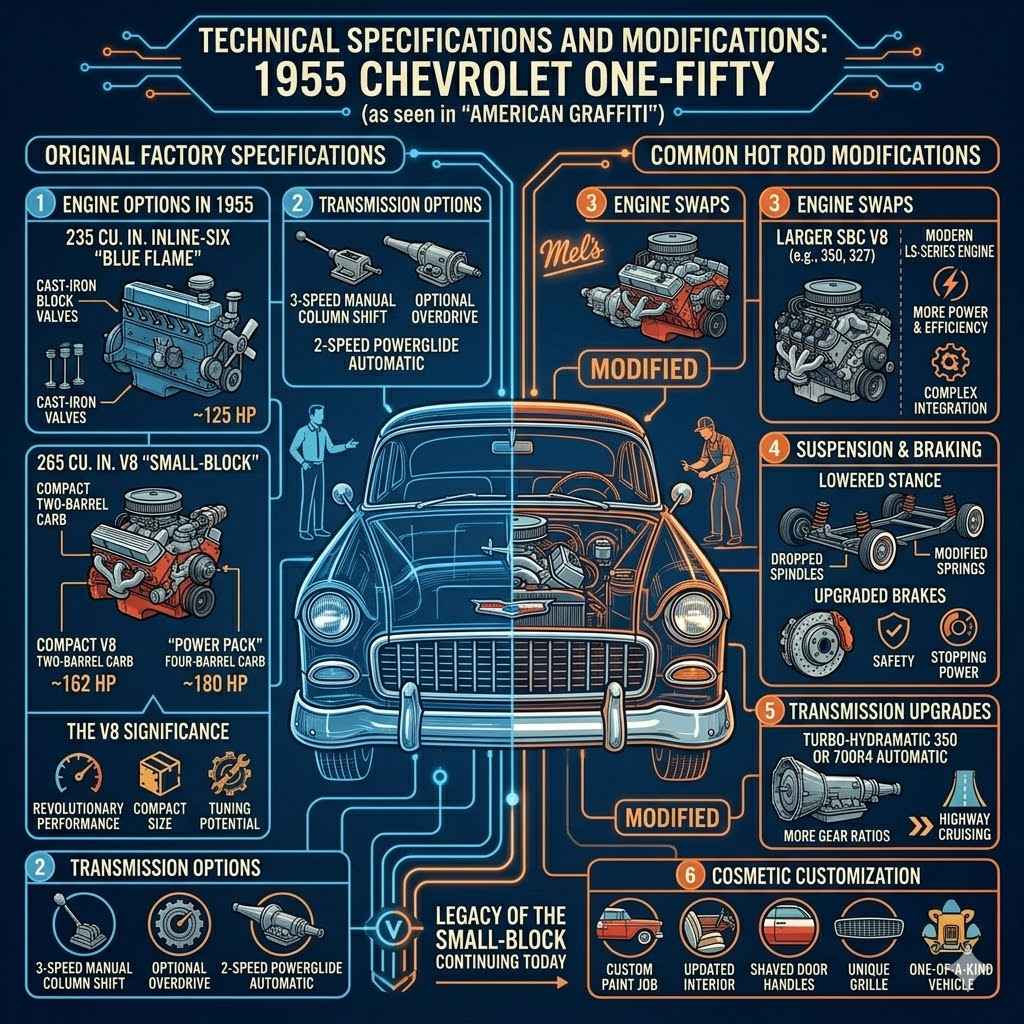
The 1955 Chevrolet One-Fifty was offered with two main engine options. The standard engine was the 235 cubic inch “Blue Flame” inline-six. This engine produced around 125 horsepower.
It was known for its reliability and fuel efficiency for the time.
The more performance-oriented option was the 265 cubic inch “Power Pack” V8. This engine came in different tunes, with the most potent version producing about 180 horsepower. This V8 was a significant step forward for Chevrolet and was a major factor in the car’s popularity.
Transmission options included a 3-speed manual column shift, an optional overdrive for the manual transmission, and the 2-speed Powerglide automatic transmission. These were standard for the era and offered basic functionality.
Engine Options In 1955
Chevrolet’s lineup for 1955 was revolutionary. The One-Fifty was available with the reliable 235 cubic inch “Thrift-Line” inline-six engine. This engine was a workhorse, known for its durability.
It was the economical choice for many buyers.
The real excitement came with the introduction of the new 265 cubic inch V8 engine. This compact V8 was a powerhouse. It offered a substantial increase in performance over the inline-six.
It was available in several configurations, including a two-barrel carburetor version and a four-barrel carburetor version.
235 Cubic Inch Inline-Six The “Blue Flame” engine was a staple of Chevrolet production for many years. It featured overhead valves and a robust cast-iron block. While not a performance king by today’s standards, it provided dependable transportation for the average driver of the 1950s.
265 Cubic Inch V8 “The Small-Block” The 265 V8 was a groundbreaking engine. It was lighter, more powerful, and more compact than many other V8s of the time. Its design laid the foundation for Chevrolet’s legendary small-block V8 lineage that continues to this day.
Horsepower Ratings The base 235 inline-six produced around 125 horsepower. The 265 V8 with a two-barrel carburetor made about 162 horsepower. The most powerful version, the “Power Pack” with a four-barrel carburetor and dual exhaust, churned out approximately 180 horsepower.
Common Hot Rod Modifications
“American Graffiti” showcased the trend of customizing these cars into hot rods. Common modifications include engine swaps, suspension upgrades, and cosmetic changes. The goal is usually to increase performance and achieve a distinctive look.
Engine swaps often involve replacing the original inline-six or even the 265 V8 with more powerful engines. Popular choices include larger displacement small-block Chevrolet V8s (like the 350 or 327) or even modern LS-series engines. These swaps require modifications to the engine mounts, transmission, and exhaust systems.
Suspension modifications aim to improve handling and achieve the desired stance. This can include lowering the front end with dropped spindles or modified springs, and upgrading to disc brakes for better stopping power. Rear suspension upgrades might involve stronger leaf springs or coilover setups.
Engine Swaps The most common engine swap for a ’55 Chevy is to a larger Chevrolet small-block V8, such as the 350 cubic inch engine. This provides a significant power increase. Modern LS engines offer even more power and efficiency but require more complex integration.
Suspension And Braking Upgrades Lowering the car is a signature hot rod modification. This can be achieved through dropping spindles, cutting springs, or using adjustable coilovers. Upgrading to front disc brakes is crucial for safety, as the original drum brakes are less effective, especially with increased speed.
Transmission Upgrades Swapping out the original Powerglide or 3-speed manual for a more modern and robust transmission, like a Turbo-Hydramatic 350 or 700R4 automatic, is common. These transmissions offer more gear ratios for better acceleration and highway cruising.
Cosmetic Customization Beyond performance upgrades, many hot rods feature custom paint jobs, updated interiors, and unique exterior details like custom grilles or shaved door handles. The aim is to create a one-of-a-kind vehicle that reflects the owner’s personality and style.
The Significance Of The V8 Engine
The V8 engine was a pivotal development for Chevrolet and for the American automotive industry. Its introduction in the 1955 models, especially the 265 cubic inch small-block, revolutionized performance and customization. This engine’s compact size and power potential made it ideal for hot rodding.
This V8 engine offered a dramatic increase in power and torque over the older inline-six engines. It provided the speed and acceleration that young drivers craved for cruising and street racing. The V8’s sound and feel were also a big part of its appeal.
Power And Acceleration The V8 engine provided the horsepower and torque necessary for spirited driving. This was crucial for the car’s popularity in a culture that increasingly valued speed and performance. The feeling of raw power was exhilarating.
Customization Potential The small-block V8’s design was highly adaptable. It was relatively easy to modify for even more power. This made it the perfect engine for enthusiasts who wanted to tune their cars and push the limits of performance.
Legacy Of The Small-Block The design of the 1955 265 V8 was so successful that it formed the basis for nearly all subsequent Chevrolet small-block V8s. This engine’s DNA is present in many iconic American performance cars.
Frequently Asked Questions
Question: What makes the 1955 Chevrolet One-Fifty special in American Graffiti
Answer: The 1955 Chevrolet One-Fifty in “American Graffiti” is special because it represents freedom, youth, and the iconic cruising culture of the early 1960s. John Milner’s customized yellow ’55 Chevy is a central character, symbolizing pride and performance.
Question: How can I identify a 1955 Chevrolet One-Fifty
Answer: Look for minimal chrome trim, especially on the sides and windows, compared to Bel Air or Two-Ten models. The One-Fifty was the base model, featuring simpler interior appointments and a more utilitarian design. A specific “150” badge might also be present.
Question: What were the engine options for the 1955 Chevrolet One-Fifty
Answer: The 1955 Chevrolet One-Fifty was available with the 235 cubic inch “Blue Flame” inline-six engine, and importantly, the new 265 cubic inch “Power Pack” V8 engine, which was a significant performance upgrade.
Question: Is it hard to find a 1955 Chevrolet One-Fifty for sale
Answer: Finding one can be challenging as they are popular collector cars. However, with patience and by searching specialized classic car sites, auctions, and enthusiast forums, you can find them. Restored models are more common than original unrestored examples.
Question: Can I modify my 1955 Chevrolet One-Fifty like in the movie
Answer: Yes, many enthusiasts modify their 1955 Chevys to resemble movie cars or to improve performance. Common modifications include engine swaps, suspension upgrades, brake conversions, and custom paint jobs, similar to what was seen in “American Graffiti.”
Final Thoughts
The 1955 Chevrolet One-Fifty in “American Graffiti” is more than just a car; it’s a cultural icon. This guide explored its significance in the film, how to identify and restore it, and its technical details. Owning or appreciating this classic brings a piece of automotive history to life.