Bully Dog Tire Pressure Monitoring System Review
Bully Dog TPMS is worth buying only if the exact listing solves a fitment gap that your factory system cannot cover, or if you need monitoring on a trailer, RV, or extra wheels that the vehicle’s built-in system ignores. Otherwise, a cheaper universal kit or the factory TPMS is usually the cleaner buy.
Verdict
That call depends on the exact Bully Dog kit, because the model details matter more than the brand name. Check the manufacturer’s listing for sensor style, tire count, pressure range, display type, and whether the system needs metal valve stems, adapters, or a separate receiver before you buy.
Pros and cons
- Useful when factory TPMS does not cover towed tires, trailers, or a nonstandard wheel setup.
- Wireless TPMS can give real-time pressure and temperature alerts.
- External cap sensors are often easier to add later than internal sensors.
- Exact fitment, display, and pairing details vary by listing, so you have to verify them carefully.
- Some setups add valve-stem hardware and service friction compared with factory TPMS.
- Cheaper kits often make more sense for a basic sedan with only one set of four tires.
- External sensors can be more exposed to damage or loss than internal sensors.
- Battery replacement, relearn steps, and false alerts can add ownership hassle.
- If the listing does not clearly support your tire count or valve type, skip it.
Specs at a glance
| Monitor type | Display and receiver | Sensor style | Tire count and fitment | Alerts | Install and pairing |
|---|---|---|---|---|---|
| Wireless TPMS monitor, exact Bully Dog model varies by listing | Check the manufacturer’s listing for screen size, visibility, mounting location, and power source | Check whether the kit uses external cap sensors or internal valve-stem sensors | Verify tire count, vehicle type, trailer support, and wheel-count limits before purchase | Real-time pressure and temperature monitoring; low-pressure and high-temperature alerts are core features | Pairing typically uses sensor ID setup and vehicle lookup; relearn may be needed after tire service |
Who it
This is for a buyer who needs more than factory TPMS can offer. A tow vehicle owner, RV buyer, or trailer owner may want pressure and temperature data on tires the dash does not monitor. If the car already covers all tires you care about, the value drops fast.
It is less attractive for a commuter sedan with a standard four-tire layout and no towing use. In that case, a basic aftermarket kit or the factory system is often enough, especially if you do not need extra-wheel monitoring or special valve hardware.
A common first-timer mistake is buying by brand name alone and finding out later that the kit does not match the valve stem type on the vehicle or trailer. Another common miss is assuming a receiver can clearly identify which wheel is low without checking the display logic first.
What works
The main appeal is practical monitoring. A TPMS watches tire pressure live, and temperature readings matter because heat often rises before a tire failure becomes obvious. For towing, that extra warning can be more useful than the factory dash icon that only covers the tow vehicle.
Bully Dog can make sense when you need a system that fits a specific monitoring problem better than the default setup. That includes trailer wheels, dual-axle setups, or a vehicle where the factory system is limited by tire count or pairing rules.
Pressure and temperature alerts
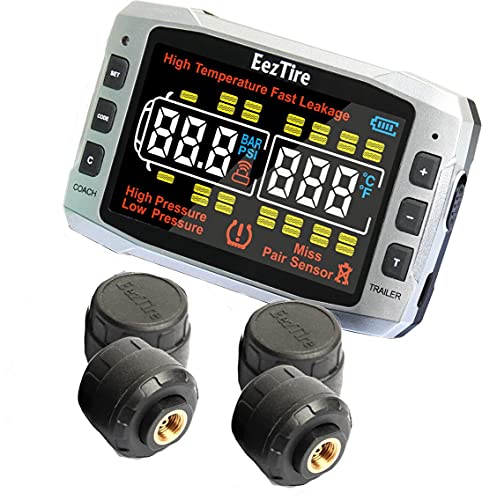
Good aftermarket TPMS kits usually watch for low pressure, high pressure, fast leaks, and high temperature. Expect the display to alert as soon as pressure drops or heat climbs, then identify the tire location so you can inspect the correct wheel instead of guessing.
That location detail is where many cheaper systems fall short. If the monitor only shows a generic warning, the driver has to walk around and check each tire. If the display shows individual wheel positions, the fault is easier to isolate.
Setup and pairing path
Most wireless TPMS systems rely on sensor ID pairing and a vehicle lookup. Some also need a relearn after tire rotation or replacement. If the listing says the system requires a tool or a programmed setup, expect more time at install and more friction after service.
Suppose you rotate a tow vehicle’s tires and the monitor still points to the old front-left sensor. That is a relearn problem, not necessarily a bad sensor. The better systems make the refresh straightforward; the weaker ones make every service visit slower.
What does not?
Fitment is the first risk. External cap sensors can require compatible valve stems, and some systems depend on metal valve hardware or T-valve adapters. Internal sensors avoid some external exposure, but they are usually more involved to install and service. If your wheel or stem setup is unusual, confirm compatibility before ordering.
Battery and service friction are the other weak spots. External sensors can lose batteries, be damaged, or throw false warnings. Internal sensors reduce that exposure but make tire service more involved. Either way, a TPMS adds another part to maintain.
Failure cases and ownership friction
Broken sensors happen. So do false warnings, especially after tire work or when a sensor is near the end of its battery life. The driver also needs to know which wheel is actually low, because a vague warning is less helpful than a wheel-specific one.
Bartec notes that some vehicle manufacturers say valve stem components are replaced every tire service. That matters because a TPMS purchase may carry replacement costs beyond the initial kit price. Check the manufacturer’s listing and your service shop’s policy before assuming a simple rotation will stay simple.
Privacy and signal transmission
Wireless TPMS sends sensor data by radio, often on license-free bands such as 315 MHz. RTL-SDR coverage says modern vehicles have wireless tire pressure sensors that communicate with the vehicle’s computer and transmit a unique identifier. That is a signal-transmission issue, not usually a location-tracking feature by itself.
The privacy risk rises only if the system also pairs to an app or connected receiver that stores vehicle data. For a normal standalone monitor, the bigger concern is interference, compatibility, and false readings, not vehicle surveillance.
How does the Bully Dog TPMS compare with other aftermarket TPMS kits?
Compared with other aftermarket kits, Bully Dog only makes sense if its exact listing gives you the right fitment, sensor type, or display setup at a better total cost. External cap sensors are easier to add and service, while internal valve-stem sensors are cleaner once installed but harder to live with during tire work.
Factory TPMS is enough when it already covers the tires you care about and you do not need trailer monitoring. Aftermarket systems win when you need more tire positions, a different wheel setup, or a display that gives you clearer wheel-by-wheel pressure data. Cheaper kits win when you just want basic alerts and do not need premium mounting or extra service parts.
External cap sensors versus internal sensors
External cap sensors thread onto the valve stem and are usually the easier route for retrofits. They can be more vulnerable to theft, damage, or leaks if the stem hardware is poor. Internal sensors sit inside the tire and are less exposed, but they tend to raise install and tire-service complexity.
For RVs and trailers, external systems often appeal because they are easier to move between setups. That convenience matters if the same monitor must handle a tow vehicle today and a different trailer later.
Factory TPMS versus aftermarket
Factory TPMS is the simplest option when it already covers every tire you care about. It is built into the vehicle logic, so you avoid a separate display and extra sensors for the car itself.
Aftermarket TPMS earns its place when you need a longer vehicle chain, a trailer, or a second display you can mount where it is easier to see. For towing, that flexibility is often the whole reason to buy one.
Bully dog tire pressure decision table
| Product | Badge | Best for | Price | ||
|---|---|---|---|---|---|
 |
Tymate TM7 RV Tire Pressure Monitoring SystemTymate | Our pick | 4 sensors · wireless · color LCD | $33.99
Price as of 3 Nov 2026
|
View |
 |
TST 507 Series TPMS – RV Tire Pressure Monitoring SystemTRUCK SYSTMS | Upgrade pick | 4 cap sensors · color display · RV system | $368.00
Price as of 3 Nov 2026
|
View |
|
EEZTire-TPMS Pro (518C) Tire Pressure and TemperatureEEZ RV Products | Also great | 4 sensors · 3.5" color display · AT sensors | $249.00
Price as of 3 Nov 2026
|
View |
| Tire count | Valve type | Pressure range | Display type | Install difficulty | Best-use case |
|---|---|---|---|---|---|
| 4 tires | Standard stems only, confirm cap fitment | Check the listing for your model | Small in-cab color display or dash-mounted monitor | Low if pairing is automatic; medium if sensor ID setup is manual | Sedan or small crossover when factory TPMS is missing or unreliable |
| 6 to 8 tires | May need metal valves or adapters for external sensors | Check the listing for trailer or tow-vehicle pressure limits | Readable color display with clear wheel position labels | Medium, because pairing and placement matter more | Tow vehicle with trailer or dual-axle monitoring |
| More than 8 tires | Verify internal or external sensor support before buying | Check the listing for high-pressure tire support | Large display with strong visibility in daylight | High; setup and service checks matter | RV or large trailer use where wheel count is the main issue |
Sedan recommendation
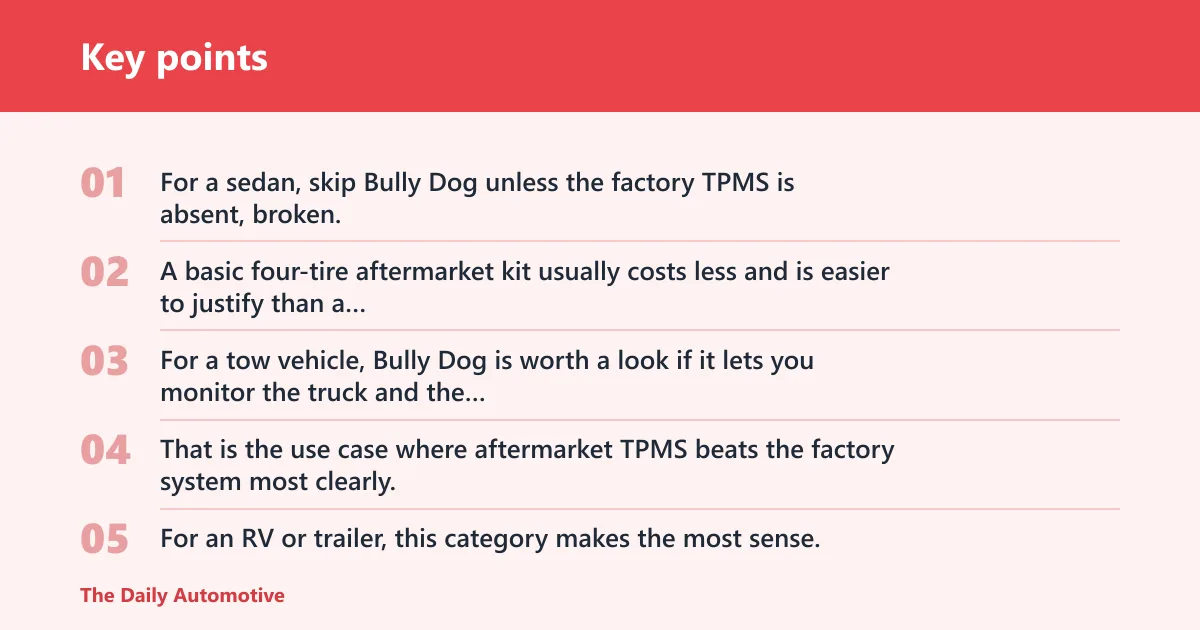
For a sedan, skip Bully Dog unless the factory TPMS is absent, broken, or too limited for your needs. A basic four-tire aftermarket kit usually costs less and is easier to justify than a specialized setup with extra sensors and service parts.
Tow vehicle recommendation
For a tow vehicle, Bully Dog is worth a look if it lets you monitor the truck and the trailer in one display. That is the use case where aftermarket TPMS beats the factory system most clearly, especially when the trailer tires run hotter or at higher pressure than the truck tires.
RV or trailer recommendation
For an RV or trailer, this category makes the most sense. HawksHead says aftermarket TPMS kits are sold for RVs, trailers, semi trucks, motorcycles, and industrial vehicles, which matches the kind of fitment problem these systems are built to solve. Higher wheel count support and readable alerts matter more here than on a normal car.
Should you buy it?
Buy Bully Dog TPMS if the exact listing matches your tire count, valve type, and display needs, and if factory TPMS will not cover the wheels you care about. Skip it if you are shopping for a plain four-tire sedan setup and do not need trailer or RV monitoring. Before checkout, verify sensor style, pairing method, replacement parts, and whether the monitor can clearly show the wheel that is low.
For pricing context, aftermarket TPMS spans a wide range. The same source lists a wireless TPMS system at $109.00, a solar TPMS system for 4-wheel monitoring at $259.99, and a Talon 22 TPMS kit with 4 through sensors at $420.99. HawksHead also says its Talon X-Treme system can monitor up to 38 wheels, which shows how far the category stretches once the tire count climbs.
That spread is why Bully Dog should be judged by the problem it solves, not by a generic price target. If the listing gives you the right fitment and the right wheel coverage, it can be a sensible safety buy. If not, the cheaper option is usually the better one.
How to check before you buy
- Confirm your tire count and whether the monitor supports all of those positions.
- Check whether the kit uses external cap sensors or internal valve-stem sensors.
- Verify valve stem compatibility, including metal valves or adapter needs.
- Read the install notes for sensor ID pairing and any required relearn after tire service.
- Make sure the display is easy to mount without blocking the driver’s view or airbag zones.
Follow the vehicle and product manual, never work under a vehicle held only by a jack, never exceed the vehicle’s rated roof, hitch, tow, or payload limit, keep items out of airbag zones and the driver’s view, and check local laws.
Frequently asked questions
Is the Bully Dog tire pressure monitoring system worth it?
It is worth it only when the exact kit solves a fitment or monitoring problem your factory system does not cover. That usually means trailer, RV, or extra-wheel monitoring. For a standard sedan with one set of four tires, a cheaper kit often delivers the same basic pressure alerts for less money.
What sensors does the Bully Dog TPMS use, external cap or internal valve-stem?
Do not assume either style without checking the exact listing. External cap sensors are common in retrofit systems, while internal valve-stem sensors are used when a cleaner install matters more than easy access. The wrong choice can create fitment problems or extra service cost later.
Can Bully Dog TPMS work on RVs or trailers?
It can, if the specific kit supports the wheel count and pressure range your RV or trailer needs. RV and trailer buyers should check for dual-axle support, display visibility, and higher-pressure tire coverage. A trailer-friendly system is one of the few places aftermarket TPMS can beat factory equipment clearly.
How hard is it to install and pair a Bully Dog TPMS?
It can be simple or annoying, depending on whether the kit needs sensor ID pairing, a vehicle lookup, or a relearn after service. External sensors are usually easier to fit, but pairing and wheel-position setup still matter. If the listing mentions a tool or programming step, expect more setup time.
Are TPMS sensors a privacy risk or only a safety feature?
For most standalone systems, TPMS is mainly a safety feature. The sensors transmit radio signals, often on license-free bands, and the data usually goes only to the receiver or vehicle computer. Privacy risk rises only if the monitor connects to an app or cloud-linked receiver that stores vehicle data.
Products related to this article
Sponsored / affiliate links. As an Amazon Associate I earn from qualifying purchases. I may earn additional commission from eligible campaigns.