Best Car Window Cleaning Brushes for Cars (2026): We Compared
The best car window cleaning brushes are a microfiber glass brush for inside windshields, a soft detailing brush for vents and trim, and a dual-purpose kit brush if you want one tool for mixed interior jobs. Cheap or stiff bristles can leave lint, scratch trim, or push dust onto clean glass. Here’s how those three brush styles compare, what each does well, and which one fits your detailing routine.
Quick comparison
| Product | Badge | Best for | Price | ||
|---|---|---|---|---|---|
 |
Coktaseleg Window Squeegee Kit with Pole and Scrubber, (12"Coktaseleg | Our pick | 12 & 16 in · Coktaseleg · Squeegee Kit | $24.99
Price as of 19 Oct 2026
|
View |
 |
Beieverluck 15 Pieces Windshield Cleaner Tool, Inside CarBeieverluck | Budget pick | 15 Pieces · Beieverluck · Windshield Cleaner Kit | $16.99
Price as of 19 Oct 2026
|
View |
The split is straightforward: one tool reaches corners, one dusts delicate trim, and one covers broader glass. Pick the wrong one, and you usually get lint on the glass, missed edge grime, or a brush that fits the job but not the vehicle.
How we chose
This comparison favors glass-first use, not generic car-detailing language. The key filters were corner reach, streak control, metal-free construction, replacement pad value, and whether the tool makes sense in a sedan, SUV, or truck.
We also separated three jobs that get blurred on many roundup pages: cleaning inside windshields, dusting interior trim, and cleaning larger exterior glass. Those are different problems, and the brush shape that solves one can be awkward for another.
Value matters, but not only in the purchase price. A brush with washable microfiber pads can be the better buy than a cheaper tool that sheds lint or needs frequent replacement heads.
Beieverluck windshield cleaner kit: best for tight corners
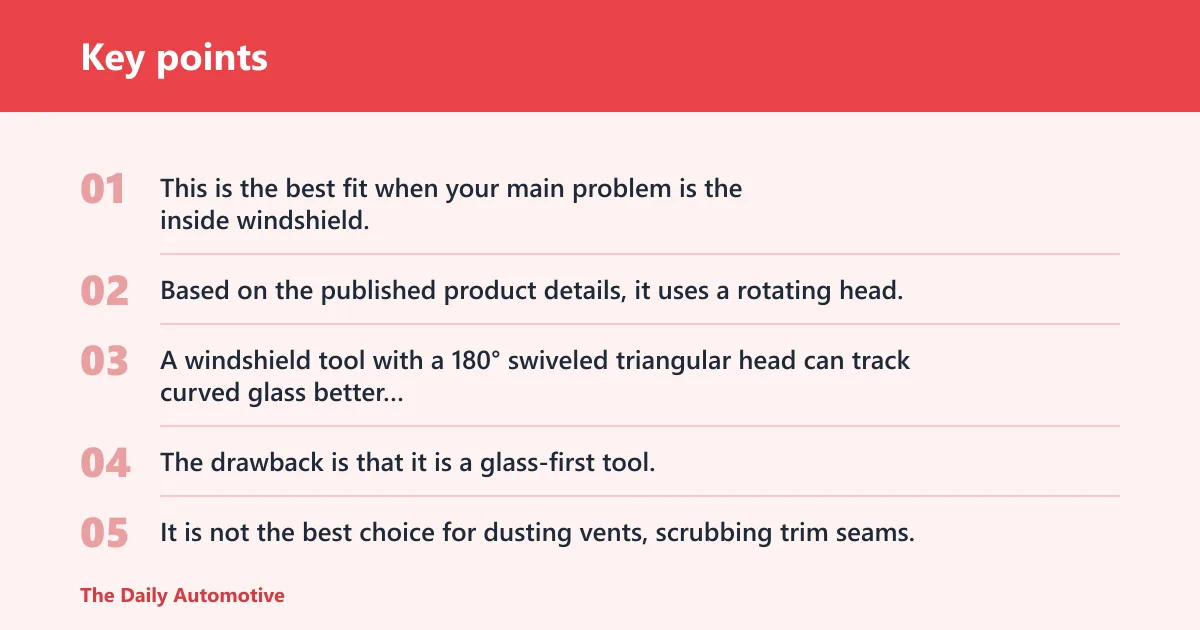
This is the best fit when your main problem is the inside windshield, especially the corners near the A-pillars and lower edge. Based on the published product details, it uses a rotating head, comes with 9 reusable microfiber pads, and has an extendable handle that helps reach both sides of the glass.
The main strength is access. A windshield tool with a 180° swiveled triangular head can track curved glass better than a stiff fixed brush, and the 9-inch to 15-inch handle range gives enough reach for many passenger cars without making the tool bulky in the cabin.
The drawback is that it is a glass-first tool. It is not the best choice for dusting vents, scrubbing trim seams, or handling wheel grime, so buyers who want one brush for everything should look elsewhere or pair it with a detail brush.
A common first-timer mistake is using a long, rigid brush on the lower passenger-side corner of a curved windshield. It reaches the spot, but the angle is wrong, so the pad drags dirt back across the same edge and leaves a faint line.
For this style, washable microfiber or coral-fleece pads are the right match for glass. The pad face is what touches the window, so lint control and edge coverage matter more than bristle stiffness. If the pad gets saturated or dirty, the streaks usually come back fast.
Coktaseleg squeegee kit: best for mixed glass work
This is the better pick for buyers who want one kit that can move from interior glass to larger exterior panes. Based on the listed specs, it includes 12-inch and 16-inch squeegee heads, an extendable aluminum pole, and washable microfiber scrubbers for reusable cleaning.
The advantage is coverage. A squeegee-style glass tool can be the cleaner choice when the goal is to remove solution quickly from broader glass areas, especially on tall side glass or rear glass that is easy to streak if you overwork it.
The drawback is that squeegee kits are less precise in tight interior corners than a smaller windshield-specific tool. If your biggest annoyance is the hard-to-reach lower windshield edge, this is helpful, but it is not as focused as a pivoting inside-glass brush.
For exterior glass or larger panels, this kind of kit can make sense when you want fewer passes and less residue. It is also the more practical option for households that clean multiple glass surfaces, because the dual-head setup covers small and large panes better than a single narrow pad.
Boar hair detailing brush: best for delicate trim dusting
Natural boar hair bristles are better for dusting vents, buttons, seams, and textured trim than for scrubbing glass. The bristles are soft enough for delicate interior surfaces, and many kits use graduated sizes so you can match a small brush to tight seams and a larger one to broader trim panels.
The strength of a boar hair brush is control, not cleaning power on glass. It loosens dust without the harsher feel of a stiffer synthetic brush, which is why detailers often keep it for the areas around the glass rather than for the glass itself.
The drawback is also clear: boar hair is not the best answer for fingerprints on glass or heavy film on a windshield. It can move debris around if you try to use it as a windshield scrubber, and that often means more follow-up wiping.
Do boar hair brushes scratch car interiors? They are generally considered safer for delicate interior surfaces than harder brushes or metal-edged tools, especially when the brush has no exposed ferrule. The bigger risk comes from trapped grit, so the brush should be kept clean and used lightly on trim and seams.
Brush decision matrix
| Brush style | Corner reach | Streak risk | Pad replacement cost | Handle length | Interior safety | Multi-surface usefulness |
|---|---|---|---|---|---|---|
| Windshield cleaning brush | 5/5 | 2/5 | 3/5 | 4/5 | 4/5 | 2/5 |
| Boar hair detailing brush | 2/5 | 4/5 | 5/5 | 2/5 | 5/5 | 4/5 |
| Mixed detailing kit brush | 4/5 | 3/5 | 4/5 | 4/5 | 4/5 | 5/5 |
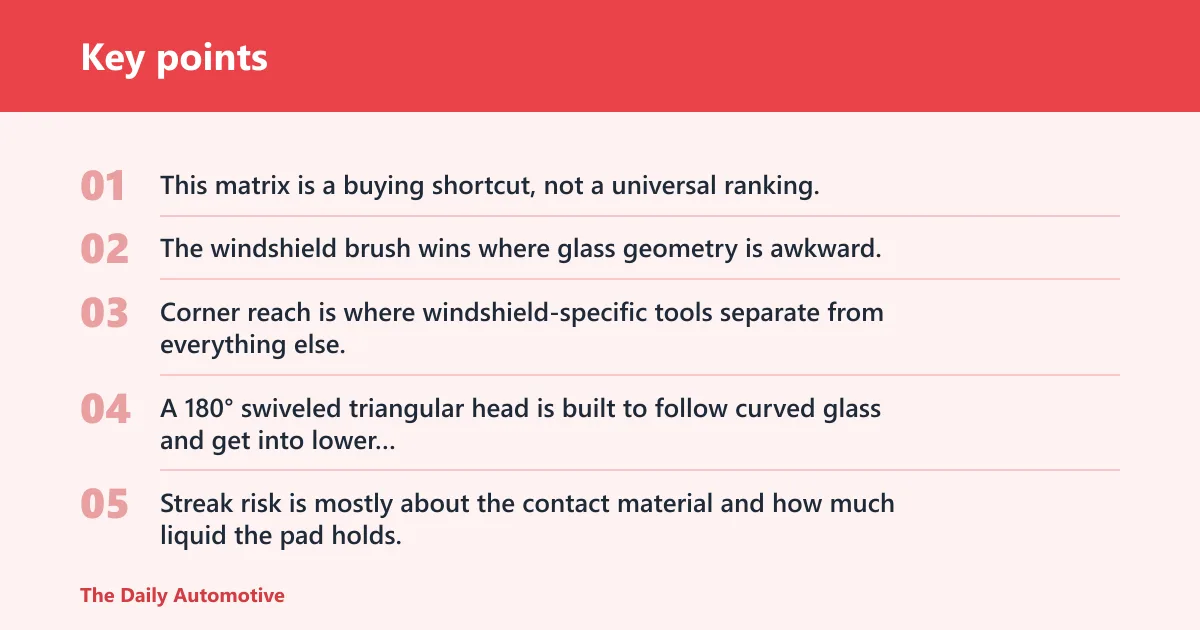
This matrix is a buying shortcut, not a universal ranking. The windshield brush wins where glass geometry is awkward, the boar hair brush wins for trim safety, and the mixed kit wins when the buyer needs one box for several jobs.
Corner reach
Corner reach is where windshield-specific tools separate from everything else. A 180° swiveled triangular head is built to follow curved glass and get into lower corners that a straight brush misses, while a boar hair brush is designed more for dusting than for edge scraping.
Streak control
Streak risk is mostly about the contact material and how much liquid the pad holds. Microfiber glass pads and coral-fleece pads are built for wiping film cleanly, while a soft brush used on glass can leave fibers behind if the pad is old, overloaded, or dirty.
Replacement pad cost
Replacement heads matter because glass tools wear differently from trim brushes. The Beieverluck kit includes 9 reusable microfiber pads, which lowers ongoing cost if you keep the pads clean; a detail brush with natural bristles usually does not rely on swap-in heads the same way.
Handle length and vehicle fit
Handle length should match the cabin, not just the product listing. One listed windshield tool uses an extendable 9-inch to 15-inch handle, which is useful in sedans and compact SUVs, while larger vehicles often benefit from a longer reach or a kit built around a pole.
Interior safety
Metal-free construction matters because exposed ferrules can scratch glass edges, trim, and painted surfaces. On interior work, the safest tools are the ones with soft contact points and no hard metal edge that can catch when you angle the brush into a seam.
Multi-surface usefulness
A mixed detailing kit is the most flexible choice when one case needs to handle glass, trim, light dust, and sometimes wheels. That flexibility is useful, but it also means the tool is not as specialized as a dedicated windshield brush or a dedicated trim brush.
Which one should you buy?
Choose the windshield brush first if your main complaint is the inside windshield corner that keeps collecting haze. Choose the boar hair brush if your interior issue is dust on vents, seams, and textured trim. Choose the mixed kit if you want one purchase that covers glass plus a wider set of detailing tasks.
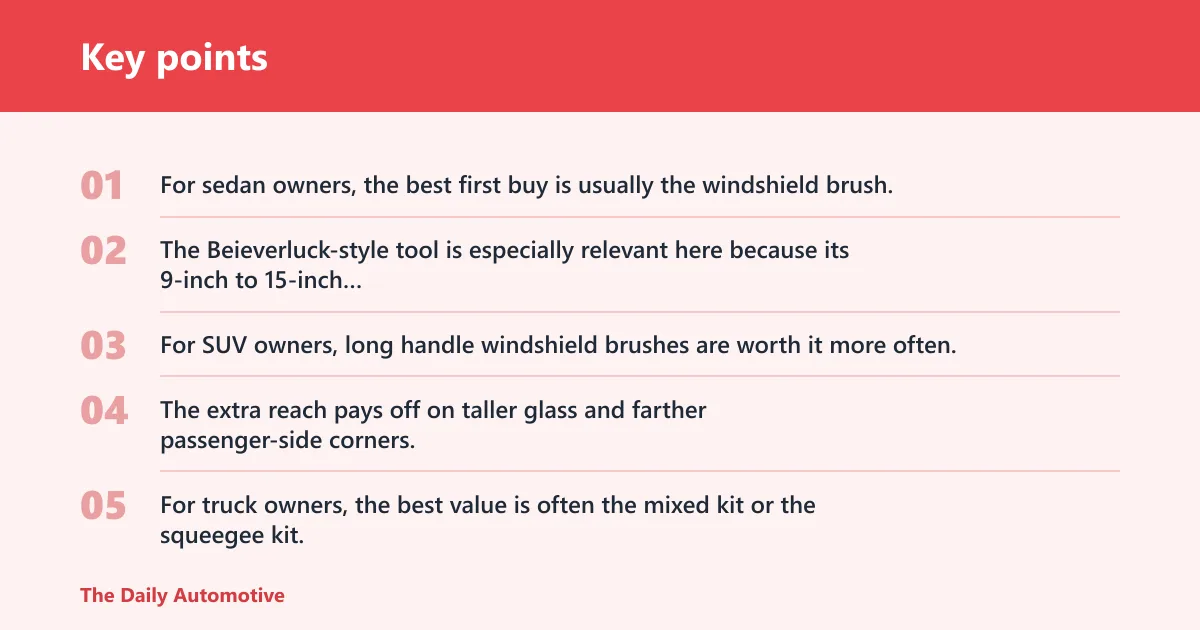
For sedan owners, the best first buy is usually the windshield brush, because short cabins still leave awkward corner angles near the dash and A-pillar. The Beieverluck-style tool is especially relevant here because its 9-inch to 15-inch extendable handle helps without making the tool awkward in small cabins.
For SUV owners, long handle windshield brushes are worth it more often. The extra reach pays off on taller glass and farther passenger-side corners, and a 180° swiveled head is more useful when the seating position puts the windshield farther away.
For truck owners, the best value is often the mixed kit or the squeegee kit. The taller cab and larger glass area make broader reach more useful, and a 43-inch long-handle mop or similar extended tool becomes practical when you clean both the windshield and larger exterior panes. One 15-piece kit includes a 43-inch long-handle mop and a windshield squeegee, which is the kind of setup that makes sense for bigger vehicles.
If budget matters most, the decision is not just the sticker price. A cheaper windshield brush with poor pads can cost more over time than a better kit with washable microfiber heads or reusable towels.
Picture a compact SUV with a curved windshield and a dusty dash. A small pivoting glass brush handles the lower corners, then a boar hair detail brush clears the vent grilles and the seam where dust usually collects. That split-tool approach is often cleaner than trying to force one brush into every job.
Use a squeegee-style glass tool when your priority is broad, repeatable glass cleaning and you want faster drying on larger panes. It is the better fit when the problem is coverage, not corner access.
Frequently asked questions
What is the best car window cleaning brush for inside windshields?
The best choice for inside windshields is a microfiber glass brush with a pivoting or swiveled head. It is built for curved glass, tight corners, and the low passenger-side edge that many fixed brushes miss. Washable microfiber pads are the key feature to look for.
Are long handle windshield cleaning brushes worth it?
Yes, if you drive an SUV or truck, or if the windshield is hard to reach from the seat. A long handle helps you get to the far corners without stretching awkwardly. For small sedans, a shorter extendable tool is often easier to control.
What brush material is safest for car glass and trim?
Soft microfiber is the safest choice for glass, and natural boar hair is the safer choice for delicate trim dusting. Metal-free construction matters in both cases because exposed ferrules can catch on edges or scratch nearby surfaces. The safest tool is the one matched to the job.
Can I use the same brush on windows and wheels?
You can, but it is a bad habit unless the brush is dedicated to heavy-duty exterior work only. Wheel and tire cleaning brushes often use soft synthetic or medium-firm bristles for brake dust and grime, and that residue should not go back onto interior glass or trim.
How do I avoid streaks when cleaning car windows with a brush?
Use a clean microfiber pad, keep the pad lightly damp rather than soaked, and change it once it picks up film. Streaks usually come from dirty pads, too much solution, or repeated passes over the same section. Finish with a dry microfiber towel if needed.
What size brush works best for tight windshield corners?
A smaller, pivoting head works best for tight corners, especially on curved glass. One listed windshield tool uses an extendable 9-inch to 15-inch handle, which is enough for many interior corners without making the tool hard to steer. Bigger heads are better for broader panes.
Which car cleaning brush set includes a squeegee or extra pads?
The Beieverluck windshield cleaner kit includes 9 microfiber pads and 3 spray bottles, while the Coktaseleg kit includes 12-inch and 16-inch squeegee heads plus washable microfiber scrubbers. If you want more replacement material or a squeegee-style setup, those are the clearer options.
Do boar hair brushes scratch car interiors?
Natural boar hair brushes are generally safe for delicate interior surfaces when used on dust, seams, and vents. The main risk comes from trapped grit or a brush with exposed metal parts. Keep the brush clean and use light pressure, and it is a better trim tool than a harsh bristle brush.
Products related to this article
Sponsored / affiliate links. As an Amazon Associate I earn from qualifying purchases. I may earn additional commission from eligible campaigns.