Best Car Organizers for Small Cars (2026): research shows
For small cars, the best organizer is usually a slim collapsible trunk bin with anchors and 2 to 4 compartments, unless cabin access matters more than cargo storage. I have seen poor fit steal legroom, block seat travel, and turn a quick cleanup into a daily chore. The right organizer keeps the cabin usable while still holding groceries, commuter gear, or an emergency kit.
This guide is part of our Car exterior accessories guide series.
Quick comparison
| Product | Badge | Best for | Price | ||
|---|---|---|---|---|---|
 |
Femuar Car Trunk Organizer-Collapsible Car Storage forFemuar | Our pick | Collapsible trunk organizer with non-slip bottom | $12.99
Price as of 29 Sep 2026
|
View |
 |
Givifive Car Seat Gap Filler Organizer 2Pack Soft Foam 3IN1Givifive | Also great | 2-pack 3-in-1 foam seat gap filler | $19.68
Price as of 29 Sep 2026
|
View |
In compact cars, fit matters more than feature count. The main tradeoff is plain: trunk bins save cabin space, seat-gap fillers save dropped items, and backseat or console organizers save access time.
The table below should be read as a space-first guide, not a storage-capacity contest. A small organizer that stays clear of seat rails and hatch edges is often the better buy.
According to We Drove Like Maniacs to Test Trunk Organizers. Here’s the One to Buy. — Car and Driver tested trunk organizers in January 2026. (source)
How we chose
Selection focused on small-car fit first. I compared where each organizer mounts, how much legroom or cargo access it takes, and which failure mode is most likely in a tight cabin.
I also weighed attachment strength, cleanup, compartment layout, and whether the design folds flat or stays slim when empty. Value mattered, but only after space cost and access stayed acceptable.
For product claims, this guide uses the published details from the listings and general range knowledge. It does not assume every small car will accept the same organizer in the same way.
Femuar Car Trunk Organizer-Collapsible Car Storage for Suv/Jeep/Sedan: best for groceries and emergency kits
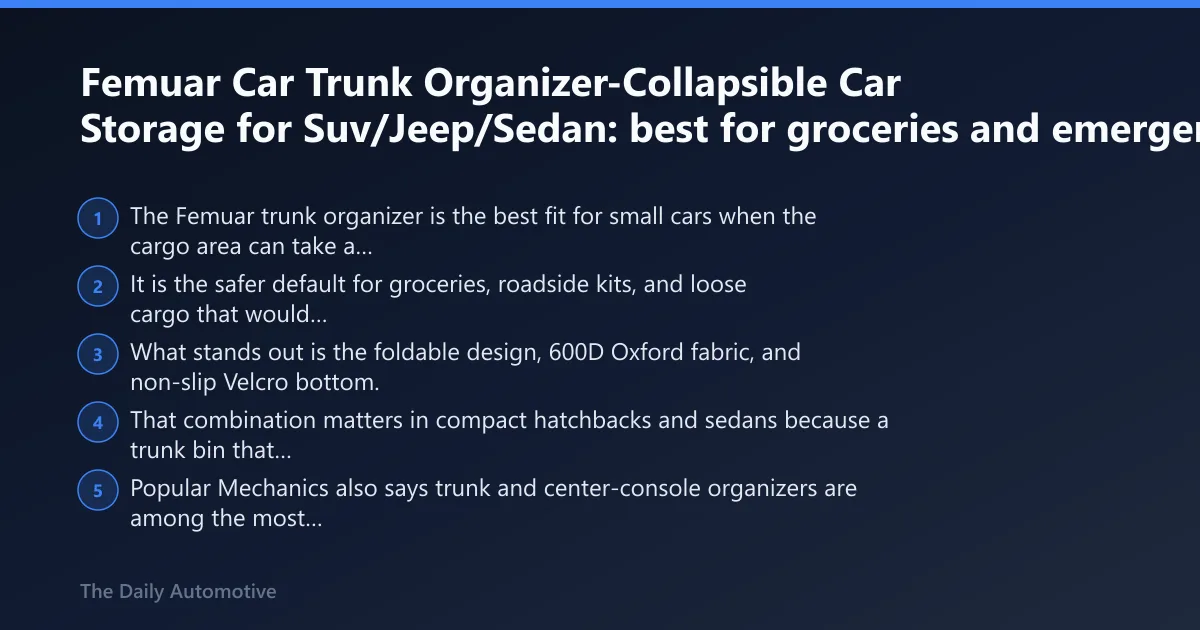
The Femuar trunk organizer is the best fit for small cars when the cargo area can take a floor piece without crowding the hatch. It is the safer default for groceries, roadside kits, and loose cargo that would otherwise slide around in the back.
What stands out is the foldable design, 600D Oxford fabric, and non-slip Velcro bottom. That combination matters in compact hatchbacks and sedans because a trunk bin that shifts under braking or acceleration is more nuisance than help. Popular Mechanics also says trunk and center-console organizers are among the most versatile layouts, and this style fits that pattern well.
The drawback is the same one that makes trunk organizers useful: they still occupy cargo depth. In a short trunk, a bin can block access to the rear wall, crowd a spare tire access panel, or sit too tall for the hatch opening if you choose the wrong dimensions.
What it fits in a small car
This is the right type for groceries, jumper cables, tire inflators, wash supplies, and a compact roadside kit. It works best when the cargo floor is flat and there is enough depth for a box that stays under the hatch line.
Popular Mechanics says many organizers work with a wide range of vehicle sizes and types, though bulky boxes can be a poor fit in small cars. In practice, a trunk bin should preserve rear visibility and not force bags to stack above the parcel shelf line.
Anchor and attachment options
Look for hooks, handles, or elastic bands if the organizer offers them, but the key control point is the anti-slip base. Velcro grips help most when the trunk floor has carpet and the organizer needs to stay put during cornering or sudden stops.
If a trunk organizer has no attachment path at all, it can still work, but the failure risk rises. Sliding is the common problem in compact cars, especially when the box is partially filled.
When it fails in compact cargo areas
It fails when cargo depth is short, the hatch opening is low, or the box gets too tall for the available height. Tipping and sliding are the big risks. If the trunk floor is shallow, a collapsible bin can still eat too much usable space once loaded.
A small-car trunk organizer should not block fold-down seat access unless the car is used almost entirely for cargo. If rear-seat folding is part of daily life, choose a lower-profile bin or move to a seat-gap or console solution.
Givifive Car Seat Gap Filler Organizer 2Pack Soft Foam 3IN1 Multifunctional: best for very tight cabins
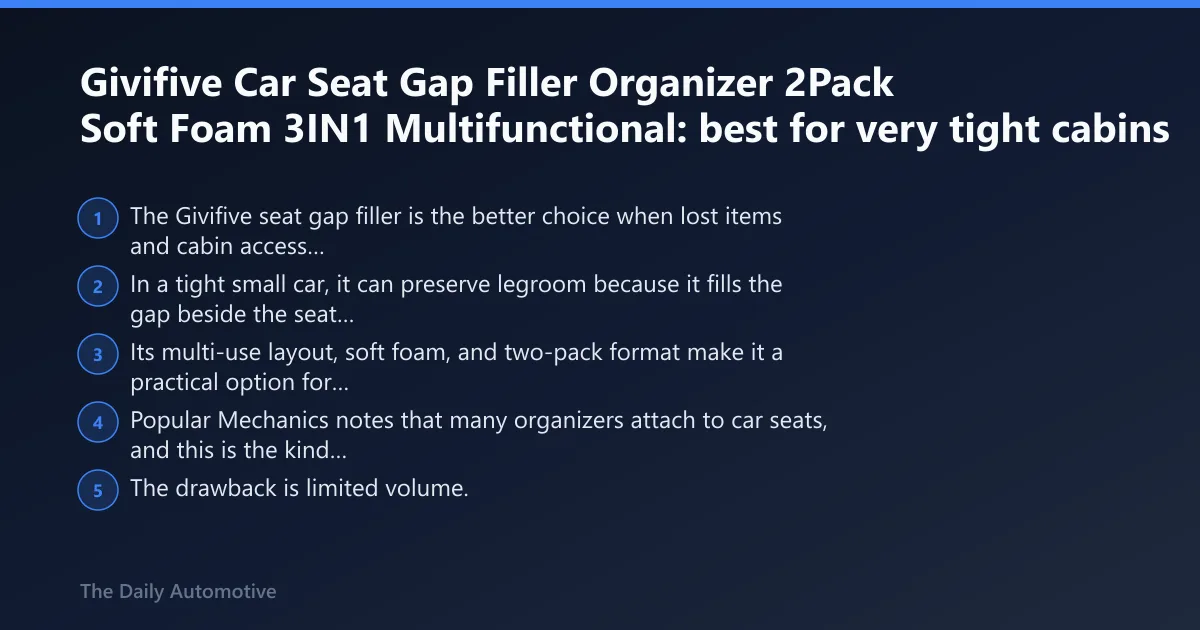
The Givifive seat gap filler is the better choice when lost items and cabin access matter more than cargo storage. In a tight small car, it can preserve legroom because it fills the gap beside the seat instead of taking floor space in the trunk.
Its multi-use layout, soft foam, and two-pack format make it a practical option for keeping phones, cards, keys, and similar items from slipping between the seat and console. Popular Mechanics notes that many organizers attach to car seats, and this is the kind of accessory that works where a bigger box would feel intrusive.
The drawback is limited volume. It does not replace trunk storage, and if the seat rails, buckle hardware, or console shape are unusual, fit can be imperfect. It is a helper, not a cargo system.
Legroom and drop-item tradeoffs
A good seat gap filler should stop drop-through without pushing the seat outward in a way that reduces pedal comfort or hip room. In a compact car, even a small intrusion can matter on a longer drive.
If the filler is too thick, it can interfere with seat travel or make the belt buckle harder to reach. That is the failure mode to watch, especially on cars with narrow console spacing.
When it wins over a trunk organizer
It wins when the complaint is daily clutter in the front row rather than cargo in the back. A commuter who keeps a phone, toll card, and charging cable at hand usually gets more value from this type than from a rear cargo bin.
For very tight cabins, it is often the better first purchase. It leaves the hatch area untouched and improves access without adding visible bulk.
What is the best car organizer for a small car?
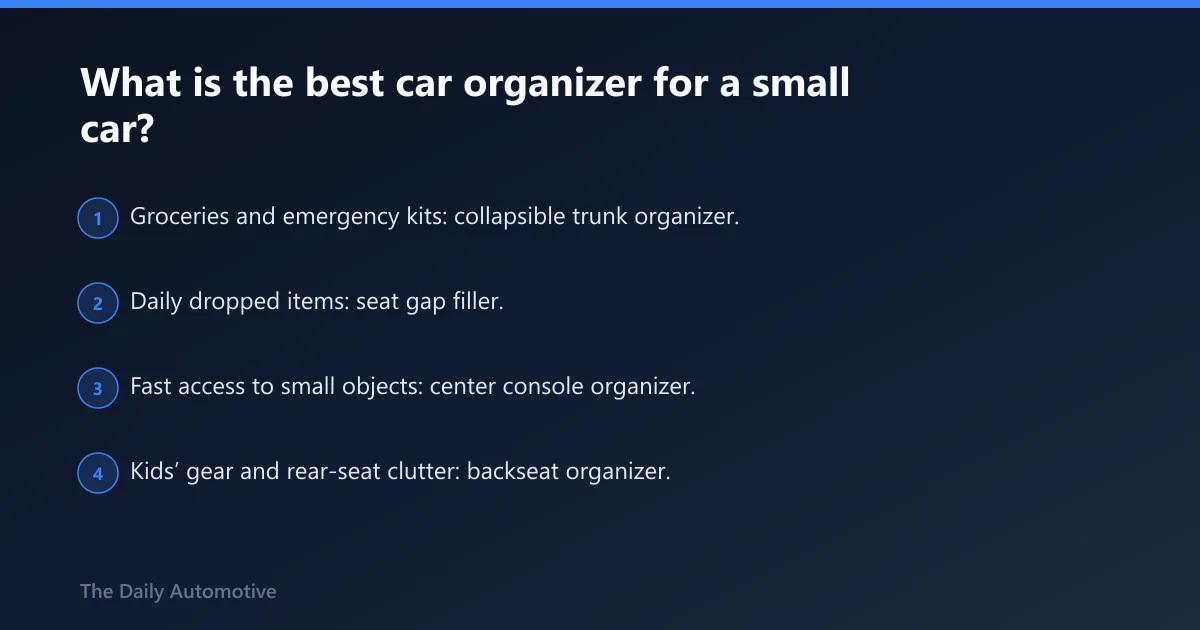
The best car organizer for a small car is usually a collapsible trunk organizer with anchors if cargo clutter is the main problem. If dropped items and front-row access are the bigger issue, a seat gap filler is the better fit because it uses dead space and leaves legroom more intact.
Popular Mechanics says the most versatile options usually fit inside the trunk or center console, and that matches small-car priorities. The right answer depends on where the clutter starts and what space you can afford to lose.
Best fit by use case
- Groceries and emergency kits: collapsible trunk organizer.
- Daily dropped items: seat gap filler.
- Fast access to small objects: center console organizer.
- Kids’ gear and rear-seat clutter: backseat organizer.
That ranking is about fit, not feature count. In a small car, the organizer that solves the problem with the least cabin intrusion is usually the right one.
How do I choose a car organizer that fits a small car?
Choose by install location first, then by dimensions, then by failure mode. In a compact cabin, a great organizer on paper can still be the wrong pick if it steals seat travel, blocks the hatch, or makes access awkward.
Start with the space you can spare. Then match the organizer type to that space and to the type of clutter you need to contain.
Fit criteria that matter most
- Placement: trunk, seat gap, console, or seatback.
- Dimensions: length, width, height, and fold-flat storage.
- Attachment: hooks, Velcro grips, handles, or elastic bands.
- Material: water-resistant, spill-resistant, wipe-clean surfaces.
- Layout: 2 to 4 main compartments, side pockets, adjustable dividers.
If a product does not clearly fit your cabin geometry, skip it. Small cars do not reward optimism.
Center console organizer: best for daily small-item access
A center console organizer is the best choice when the main goal is quick access to small items without adding floor clutter. It belongs in the glovebox or console area, where trays and dividers keep items visible and easy to reach.
This type works well for coins, cards, pens, sunglasses, and charging gear. The limitation is obvious: it stores small things well, but it does not handle bulk cargo and can feel cramped if the console opening is already narrow.
Tray and divider layouts
Look for a tray-and-divider layout rather than one deep bucket. A divided organizer reduces rummaging and makes it easier to keep a few everyday items from mixing into one noisy pile.
Popular Mechanics says some organizers attach to gloveboxes or sun visors. For compact cars, console fit is usually the cleaner choice because it keeps the cabin from looking cluttered.
What to store here and what to leave out
Store light, frequently used items here. Leave out heavy tools, large bottles, and anything that could rattle or jam the lid.
Console organizers work best when they do not interfere with shifter movement, lid closure, or USB access. If any of those are compromised, the fit is wrong.
Backseat organizer: best for kids’ gear and commute clutter
A backseat organizer is the best option when rear-seat passengers create the mess. It hangs behind the front seats and gives tablets, phones, chargers, snacks, and water bottles a fixed place without filling the front footwell.
Its weakness is front-seat interference. If it sags or hangs too low, it can touch knees, reduce seatback recline comfort, or make entry and exit awkward in a small car.
Pocket layout for tablets, chargers, and bottles
Choose a layout with pockets sized for the items you actually carry, not just a long list of pockets. A good backseat organizer uses the upper area for tablets and phones, then places lower pockets where bottles or toys are easy to grab.
Compartment count matters here too. Two to four main pockets plus side pockets is usually enough; more pockets can create bulk without making the organizer more useful.
How it affects front-seat space
The key risk is sagging into the front row. If the organizer hangs loose, it can rub knees or force the driver and passenger to give up seatback angle.
Mounting points need to be snug. Straps or elastic bands should hold the panel flat against the seatback, not let it bow outward under load.
Small-car fit matrix and measuring checklist
The matrix below turns the buying decision into a space problem. Use it before choosing by price or pocket count.
| Organizer type | Exact use case | Space cost | Main failure risk | Best fit note |
|---|---|---|---|---|
| Collapsible trunk organizer | Groceries, roadside kits, cleaning supplies | Uses cargo floor space; can reduce hatch depth | Tipping, sliding, blocking rear cargo access | Best when it folds flat and has a non-slip base |
| Seat gap filler | Phones, cards, keys, receipts | Uses dead space between seat and console | Seat interference or reduced legroom | Best when cabin width is tight and drops are frequent |
| Center console organizer | Daily small-item access | Uses console or glovebox volume only | Blocking lid movement or shifter access | Best for drivers who want fast reach, not bulk storage |
| Backseat organizer | Kids’ gear, tablets, chargers, bottles | Uses front seatbacks; can reduce rear comfort if oversized | Sagging, knee contact, seatback interference | Best when straps keep the panel flat and low |
Before buying, measure four points. Trunk depth tells you whether a floor bin will fit without stealing rear access. Hatch height tells you whether the organizer clears the opening. Rear-seat legroom clearance tells you whether a backseat panel or seat-gap piece will block movement. Console width tells you whether a tray or divider can sit without binding the lid.
- Measure trunk depth from the rear seatbacks to the hatch threshold.
- Measure hatch opening height at the narrowest point.
- Measure rear-seat clearance at the front seat rail and knee area.
- Measure console width and lid travel before ordering a tray.
- Check whether the organizer folds flat for storage when empty.
- Confirm attachment type: hooks, Velcro grips, handles, or elastic bands.
The most common small-car failure is not lack of storage. It is a piece that fits on paper but blocks access in practice. A low, fold-flat organizer usually beats a large one that looks more capable.
Are trunk organizers too big for compact cars?
Trunk organizers are not too big by default, but they become too big fast in compact cars if the cargo floor is shallow or the hatch opening is short. The right one stays low, folds flat, and leaves enough depth for bags to stand without tipping.
Popular Mechanics listed the Drive Auto Products Trunk Organizer as best overall, which fits the general idea that a trunk bin can be the most versatile setup. Car and Driver tested trunk organizers in January 2026 with grocery runs, sudden stops, and rapid acceleration, which is exactly the kind of use that exposes sliding and tipping.
What to look for in a trunk bin
- Collapsible sides for fold-flat storage.
- 2 to 4 main compartments for separating groceries or kit items.
- Side pockets for flat tools or cleanup gear.
- Anchors, Velcro, or other attachment help.
- Water-resistant material for spills and cleanup.
Car and Driver named the Thule Go Box best overall and said it comes in large and medium sizes, flattens when not in use, and uses a 24.0/18.0/12.0-inch size with a 7.2-pound weight and no anchor type. That combination is useful, but in a small car the lack of an anchor path may matter more than the storage volume.
What car organizer works best for groceries in a small car?
A collapsible trunk organizer is usually best for groceries because it keeps bags upright and stops them from rolling in the cargo area. In a small car, the key is not sheer volume but a stable base that does not tip when you turn or brake.
If grocery runs are short and frequent, a bin with two or three compartments is often enough. Separate produce, cold items, and household goods so one bag does not crush another.
Groceries and spill control
Water-resistant material helps here because leaked produce bags and condensation happen. Popular Mechanics notes some organizers include integrated cooler bags, which can be useful if perishables ride home in the same bin.
Look for wipe-clean surfaces and a bottom that grips the trunk floor. A bin that slides half an inch on every stop becomes irritating quickly.
Should I get a seat gap organizer or trunk organizer?
Get a seat gap organizer if the problem is daily front-row clutter and dropped items. Get a trunk organizer if the problem is cargo rolling around in back. The better choice depends on where the mess starts and whether you can spare legroom or cargo floor space.
In very tight cabins, the seat gap filler often wins because it uses space that would otherwise be wasted. In cars used for shopping or tool carrying, the trunk organizer usually wins because it contains more and keeps heavy items out of the cabin.
Which one wins in very tight cabins
If the car is so small that any rear cargo box cuts into the usable trunk, the seat gap filler is the safer first buy. If the front row is already crowded and access matters less than secure cargo, choose the trunk bin instead.
Many owners eventually use both, but only one should be bought first. The wrong first purchase is the one that removes the most usable space for the least benefit.
How do I keep my car organized without losing legroom?
Use dead space first and floor space last. Seat-gap fillers, console trays, and slim backseat panels preserve legroom better than floor bins, especially in compact sedans and hatchbacks where knee room is already limited.
If a floor organizer is necessary, keep it under about 4 inches tall and place it where it does not touch seat rails or block rear-seat folding. That keeps the cabin usable instead of turning storage into a nuisance.
Low-bulk habits that help
- Keep only one floor organizer in the cabin.
- Choose fold-flat designs when the organizer will sit empty often.
- Use compartment count only as needed, not as a goal.
- Match attachment type to the surface you actually have.
A small car stays comfortable when storage is doing work quietly. The best organizer is the one passengers stop noticing.
Which one should you buy?
If budget is tight, the seat gap filler is the value play because it fixes a common problem without consuming cargo space. If groceries and emergency gear matter most, buy the collapsible trunk organizer. If daily access is the main issue, the center console organizer is the cleaner answer. For families, the backseat organizer usually earns its keep fastest.
Popular Mechanics listed the Skyward Automotive Seat Gap Filler as best value, which fits the role of a low-cost, low-space solution. The Femuar trunk organizer is the stronger all-around cargo choice for a compact car. If the vehicle is especially cramped, choose by space cost first and price second.
Price tier matters only after fit. Budget options are fine when the organizer stays slim and stable. Midrange products usually bring better materials and attachment control. Premium choices make sense when you need the shape, anchors, or fold-flat behavior to be exact.
Frequently asked questions
What should I measure before buying a car organizer?
Measure trunk depth, hatch opening height, rear-seat legroom clearance, and console width. Those four numbers tell you whether the organizer will fit without blocking access or reducing comfort. Also check fold-flat storage depth, because a compact car is less forgiving when the organizer is not in use.
Products related to this article
Sponsored / affiliate links. As an Amazon Associate I earn from qualifying purchases. I may earn additional commission from eligible campaigns.
 Coverado Car Seat Covers, Front Covers for Cars, Car Seat Cover Front Seats, Automotive Seat Cover, Waterproof, Leather Car Seat Cushion, Universal Interior Covers Seat Protectors for Most Cars
 PartsTo Adjustable Kids Travel Car Seat Headrest Pillow with Lean Support Cushion Sleeping Travel Neck Safeguard Cushion Suitable for Kids Children Teenagers and Adults