Car Loans, Leasing and Dealer Tactics: What to Know
Before you sign, compare every offer using four numbers: out-the-door price, APR or money factor, term, and total cost. If the payment stays close but total paid rises, the deal is worse. Miss one padded fee or rate markup, and you can overpay by thousands or end up in a contract that is expensive to escape. This guide gives you a signing-day checklist for loans, leases, trade-ins, dealer add-ons, and the contract pages that deserve a second read.
Get the out-the-door quote in writing first. Then compare financing options, then inspect each line on the buyer’s order, loan contract, or lease agreement for markups, fees, and optional products. That sequence matters because a dealer can keep the payment looking familiar while changing the term, rate, down payment, and add-ons behind it.
Start with the out-the-door price, not the payment
The FTC says to get an out-the-door price in writing before financing, and the FTC says that number should include taxes and fees. It is the cleanest comparison point between dealers because it combines the vehicle price, taxes, title, registration, and dealer fees into one total.
What belongs in an out-the-door quote
Ask for an itemized quote that lists the selling price, sales tax, title fee, registration fee, documentation fee, and any dealer-installed accessories already on the car. If there is a trade-in, keep that number separate at first so it does not blur the purchase price.
Apples-to-apples comparisons break down when one store quotes only the sale price and another includes mandatory charges. A lower advertised price can still become a higher contract once dealer fees and accessories appear in the paperwork.
How to request the quote in writing before you visit
- Ask for the vehicle stock number or VIN.
- Request the full out-the-door total in writing.
- Ask for each fee listed separately.
- Ask whether accessories are already installed.
- Ask whether the quote assumes financing, leasing, or cash.
If a store replies with only a monthly payment, the quote is incomplete. Payment is easy to reshape by changing the term, down payment, or rate.
The documents that should match the quoted number
The written quote, the buyer’s order or purchase agreement, and the final loan or lease contract should show the same selling price and the same required fees. Taxes can shift slightly if registration details change, but dealer-added charges should not appear for the first time in the finance office.
Suppose a dealer emails a clean quote, then the buyer’s order adds wheel locks, nitrogen, and a paint package. Those are not title or registration charges. They should be removed or priced as optional products, not folded into the agreed deal.
Should you get pre-approved before you shop?
Yes. Get pre-approved before you shop because it gives you a rate, term, and amount to beat before the dealer starts shifting numbers. It also exposes dealer reserve, because the finance office has less room to pad the contract rate when you already have outside funding in hand.
What a bank or credit union pre-approval tells you
A car loan APR depends on credit score, term, lender, and the vehicle. Excellent-credit buyers can see 4.5-6.5% APR on new car loans in 2026. Good credit buyers typically see 6-8% APR, fair-credit buyers typically see 8-12% APR, and below 660 credit can mean 12-15% rates.
Credit unions typically offer rates 1-2% lower than dealer financing. That does not mean the dealer cannot beat the offer, but it gives you a clean baseline.
How pre-approval limits rate markup
Consumer Reports says dealers can mark up the interest rate from a bank loan. The lender may approve a lower buy rate, then the dealer writes a higher contract rate and keeps the spread as dealer reserve.
With a pre-approval, you can ask a direct question: “Is this contract rate the lender’s buy rate, or has it been marked up?” If the dealer can beat the outside offer with the same term and no added products, that is worth considering. If the dealer only beats it by extending the term or bundling products, it is not the same deal.
What to bring so the dealer can match the offer cleanly
Bring the pre-approval letter, maximum amount, rate, lender name, any vehicle restrictions, and the expiration date. Bring the exact term you want too. A dealer quote that beats your outside rate only by adding twelve more months is not a better financing offer.
What is the real difference between financing and leasing?
Financing usually fits buyers who plan to keep the vehicle past the loan term or drive more miles each year. Leasing can lower the payment, but the math depends on money factor, residual value, mileage limits, and end-of-lease charges that matter as much as the monthly bill.
Ownership horizon, miles, and wear tolerance
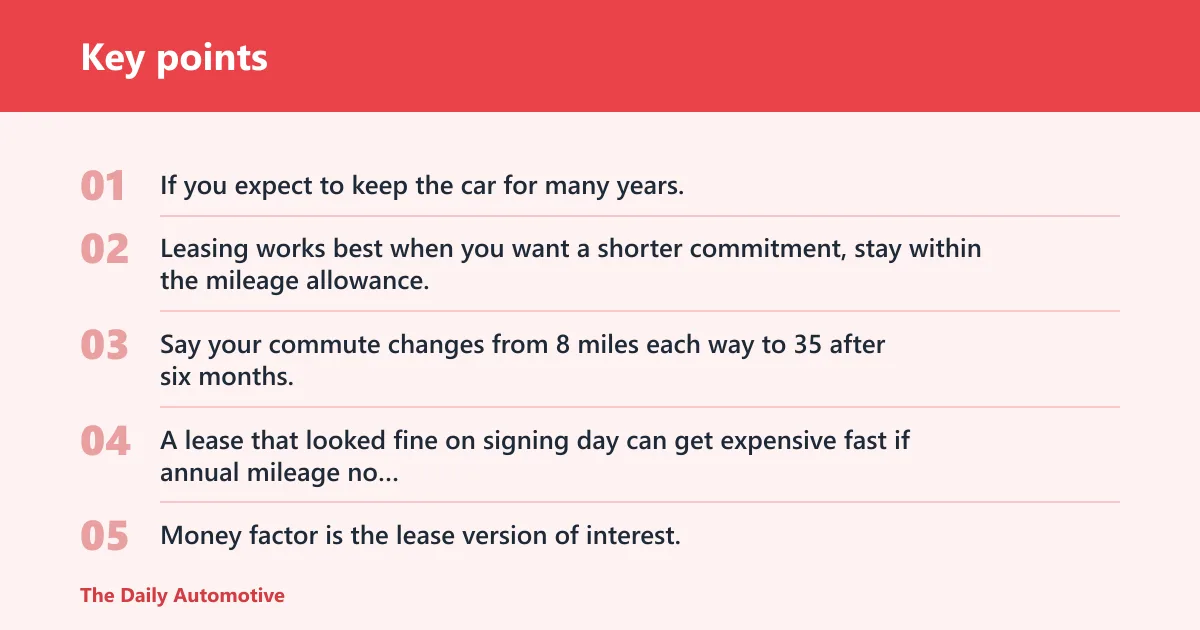
If you expect to keep the car for many years, financing usually gives you a clearer path to lower total cost once the loan is gone. Leasing works best when you want a shorter commitment, stay within the mileage allowance, and accept condition rules at return time.
Say your commute changes from 8 miles each way to 35 after six months. A lease that looked fine on signing day can get expensive fast if annual mileage no longer fits the contract.
Loan APR versus lease money factor
APR is the interest rate on a loan. Money factor is the lease version of interest, and you can convert it to an APR equivalent for comparison by multiplying it by 2400. A money factor of 0.00250 works out to an APR equivalent of 6.0%.
That conversion matters because a low lease payment can hide an expensive money factor if the residual value is strong or the term is short. Ask for the money factor in decimal form, not just the payment.
Residual value and the lease math
Residual value is the predicted value at lease end. Higher residuals usually lower the lease payment because you are financing less depreciation. They also shape the buyout number if you want to keep the vehicle later.
A lease with a high residual can look appealing month to month but make less sense if you already expect to buy the car at the end. Read the residual and compare it with your ownership plan before signing.
End-of-term costs buyers miss
Lease contracts need a separate check for mileage limits, wear standards, disposition fee, purchase-option fee, and any charges tied to tires, keys, or excess damage. These items rarely matter in a purchase contract, but they can change the full lease cost quickly.
How do dealer rate markups work on a car loan?
Dealer rate markups happen when a lender approves one rate and the dealer writes a higher one into the contract. The payment may still look acceptable, especially if the term is stretched, but the extra spread raises finance charges and creates profit inside the finance office.
Buy rate, contract rate, and dealer reserve
The buy rate is the lender-approved rate. The contract rate is the APR on the retail installment contract you sign. The difference can become dealer reserve.
This is why a monthly payment alone is weak. Two contracts can show nearly the same payment while one carries a higher APR and a longer term.
How term length changes payment and total interest
Car loans typically run 36-72 months, and the sweet spot for financing is 48-60 months. Longer terms reduce the monthly payment, but they usually raise total interest and slow your equity build. Dealers may still quote 72 or 84 months because the lower payment is easier to sell.
Picture a financed amount of $30,000. At 6% APR for 60 months, the payment is about $580 and total paid is around $34,800. Stretch that same amount to 84 months at 8%, and the payment falls to about $467, while total paid rises to around $39,200. The lower payment costs around $4,400 more overall.
Questions to ask before you sign
- What is the lender’s buy rate?
- What APR is on the contract?
- What is the exact term?
- What is the amount financed?
- Which products are included in the payment?
Consumer Reports identifies the four square as a dealership tactic. If the conversation keeps bouncing between price, payment, trade-in, and down payment on one worksheet, ask for each number separately and in writing.
Which fees are mandatory, optional, or state-limited?
Taxes, title, and registration are usually mandatory government charges. Documentation fees are dealer-added and state-dependent, with caps in some states and no caps in others. Accessories, protection packages, service contracts, and most finance-office products are usually optional unless a lender or lease program requires a specific item.
Taxes, title, and registration versus dealer-added charges
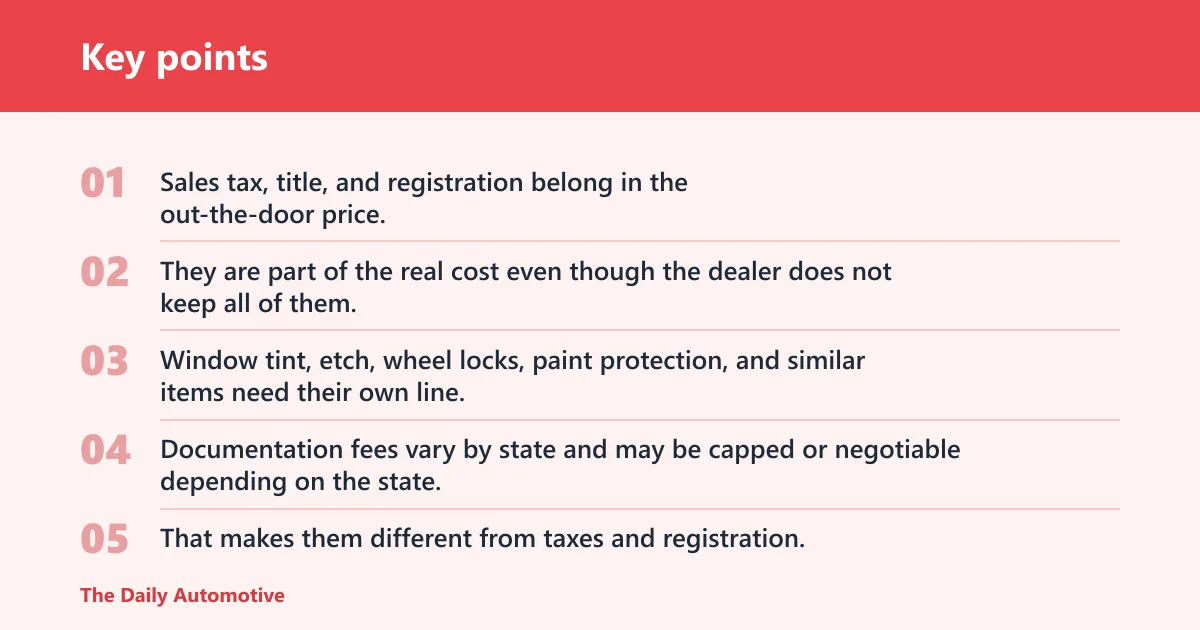
Sales tax, title, and registration belong in the out-the-door price. They are part of the real cost even though the dealer does not keep all of them. Dealer-added charges are different. Window tint, etch, wheel locks, paint protection, and similar items need their own line, with a clear yes or no from you.
Documentation fee rules and why state caps matter
Documentation fees vary by state and may be capped or negotiable depending on the state. That makes them different from taxes and registration. A doc fee can still be part of an apples-to-apples comparison even if a store refuses to change it. If one dealer charges more, the sale price should be lower to offset it.
Dealer-installed accessories and F&I products
Common finance-office products include service contracts, GAP coverage, tire and wheel coverage, prepaid maintenance, key replacement, theft recovery products, and appearance packages. Many are optional and may be overpriced at the dealer.
Consumer Reports warns dealers may add pricey extras after advertising a low price. Do not treat the menu as a required step. Ask which items are mandatory for the lender or lease company, and which are optional for the buyer.
How to ask for an itemized fee breakdown
Ask for an itemized quote before signing, ideally a one-page list that shows every fee and product on its own line. Then sort each line into one of five buckets: mandatory, optional, negotiable, conditional, or state-limited. That keeps title and tax from being lumped together with dealer profit.
Should you negotiate the trade-in, price, and financing separately?
Yes. Combining all three lets the dealer give ground on one number while taking it back on another. Separate negotiation makes hidden profit easier to spot in the sale price, trade allowance, APR, and add-ons before those figures are collapsed into one payment.
Why mixing numbers hides profit
A generous trade figure can distract from a padded sale price. A low APR can distract from a weak trade allowance. A low payment can hide both.
Set the out-the-door purchase price without the trade first. Then get the trade-in value. Then compare financing or leasing. Only after those numbers are clear should they be combined into one final contract.
How trade-in value affects taxes in some states
Trade-in value can affect the taxable amount in some states. That makes the trade relevant to total cost, but it still should not be used to mask the vehicle price. Keep a written line for the trade allowance, another for payoff if there is one, and another for net equity.
Using the trade as cash down
The standard down payment advice is 20% on a new car and 10% on a used car. Down payment reduces the amount financed or leased, lowers the monthly payment, and lowers interest cost. It also helps avoid negative equity.
If the trade has positive equity, it can work like cash down. If the trade is upside down, the shortage may be rolled into the next loan or lease, which raises the amount financed and can keep you underwater longer.
The worksheet numbers to isolate
- Agreed selling price
- Out-the-door total before trade
- Trade allowance
- Trade payoff and net equity
- Cash down
- APR or money factor
- Term
- Optional products
Why separating the trade-in can protect your deal
Yes—treat the new-car price and the trade-in as two separate negotiations if you want the cleanest read on the deal. The key is to lock in the out-the-door price first, then compare the dealer’s trade offer against what your car is worth elsewhere. That approach makes it harder for a dealer to bury an inflated car price inside a generous-looking allowance and keeps the total cost transparent.
The supporting guide on trade-in negotiation shows how the split works, when bundling is still reasonable, and which math checks help you spot a misleading offer. It matters because the wrong order can make a weak deal look stronger than it really is.
How to time a trade-in
Trade-in timing matters because it can change how much money you actually carry into your next car. The key question is whether your car still has positive equity and whether waiting would cost you more in repairs, depreciation, or warranty coverage than you might gain by holding on a little longer. The best trade-in timing guide breaks down when to act now and when waiting makes more sense.
That article also shows how mileage, loan payoff, and seasonal demand affect your offer, so you can compare the trade-in value against what you still owe and what the car may need soon. Use it to decide whether to trade, keep driving, or plan a few months ahead with a clearer exit point.
How do you read the contract line by line before signing?
Read the buyer’s order, then the financing or lease contract, then any separate product forms. Match the selling price, fees, trade figures, APR or money factor, term, and total cost across all pages. If a charge appears only in the finance office packet, stop and ask why.
Buyer’s order or purchase agreement
This page usually shows the selling price, rebates, fees, taxes, trade credit, and down payment. Check for dealer-installed accessories, protection packages, and document fees. The out-the-door total here should match the quoted deal unless you knowingly changed something.
Retail installment contract key fields
On a finance contract, focus on APR, amount financed, finance charge, total of payments, number of payments, payment due date, and any optional products financed into the deal. The amount financed should not quietly include products you declined.
If the term reads 72 or 84 months when you expected 60, that is not a small paperwork detail. It changes your total cost and your equity position.
Lease agreement fields that change total cost
On a lease, check the gross capitalized cost, cap cost reductions, money factor, residual value, mileage allowance, acquisition fee, disposition fee, and purchase-option price. These fields, not the payment alone, decide whether the lease is competitive.
Spot-delivery, arbitration, and cancellation language
Review any spot-delivery or conditional-delivery language if you are taking the car before funding is final. Also review cancellation terms on optional products and any arbitration clause so you know what happens if there is a dispute or you later remove a product.
Signing review checklist
| Line item | Mandatory or optional? | Where it appears | What to ask | Common inflation tactic |
|---|---|---|---|---|
| Selling price | Negotiable | Quote, buyer’s order | Is this the agreed sale price before fees and products? | Advertise low, add accessories later |
| Sales tax | Mandatory | Buyer’s order | What taxable amount is being used? | Mix tax with dealer fees to hide markup |
| Title and registration | Mandatory | Buyer’s order | Are these government charges or estimates? | Bundle with dealer charges as one fee block |
| Documentation fee | State-limited or negotiable | Buyer’s order | Is this capped by state, and can sale price offset it? | Call it non-negotiable while keeping sale price high |
| Accessories | Usually optional | Window sticker addendum, buyer’s order | Were these installed already, and can they be removed from the deal? | Present preloaded items as mandatory |
| Trade allowance | Negotiable | Worksheet, buyer’s order | What is the trade value before payoff? | Raise trade number while raising car price |
| Trade payoff | Conditional | Worksheet, buyer’s order | What is the exact payoff today? | Roll negative equity into new deal quietly |
| Cash down | Optional | Worksheet, contract | How much is cash, and how much is trade equity? | Use extra cash down to mask high rate |
| APR | Conditional | Retail installment contract | What is the lender buy rate, and is this marked up? | Increase contract rate above approval |
| Loan term | Conditional | Retail installment contract | Is this the term requested, and what is total paid? | Stretch term to lower payment |
| Money factor | Conditional | Lease agreement | What is the exact decimal and APR equivalent? | Quote payment without disclosing factor |
| Residual value | Conditional | Lease agreement | What residual and mileage allowance are assumed? | Use a favorable residual to distract from fees |
| Service contract | Optional | F&I menu, separate form | Can it be declined, and what is the cancellation policy? | Bundle into payment without naming it |
| GAP coverage | Optional or lender-required | F&I menu, contract | Is it required here, and what does it cost separately? | Present as mandatory for every buyer |
| Tire and wheel or maintenance plans | Optional | F&I menu | What events are covered, and can it be removed? | Add several small products to keep payment similar |
| Disposition fee and wear terms | Conditional | Lease agreement | What happens at return if the car is not bought? | Skip end-of-lease charges during sales pitch |
A bad deal, rebuilt step by step
Base quote before financing changes
Suppose the written out-the-door price is $33,200 on the same vehicle at two stores. Dealer A offers financing at 6% for 60 months with no added products. Dealer B offers a lower payment but does not start with the APR, term, or product list.
How term extension drops payment but raises total cost
Dealer B moves the term from 60 months to 84 months. That cuts the payment even before any rate discussion. For many shoppers, the lower payment feels like proof of a better deal even though the contract now runs for two more years.
How APR markup and add-ons stack up
Now add a contract-rate markup from 6% to 8%, plus a $1,895 service contract and $995 tire-and-wheel plan financed into the deal. The buyer sees a payment that still looks manageable. The contract now carries a larger amount financed, a higher rate, and a longer term.
Using the same $30,000 financed example, the 60-month 6% structure totals about $34,800 paid. Shift to 84 months at 8% and total paid is about $39,228 before those optional products. Add $2,890 in products to the financed balance, and the gap grows further. That is how a “comfortable” payment turns into a costly contract.
What the cleaned-up deal looks like
Strip the optional products, return to the shorter term, and compare the dealer APR with a credit union pre-approval. If Dealer B cannot match the outside approval without stretching the term or keeping add-ons, Dealer A’s higher payment may be the cheaper deal by a wide margin.
Frequently asked questions
What out-the-door price should I ask for before talking financing?
Ask for the full out-the-door price in writing, including the vehicle selling price, sales tax, title, registration, and dealer fees. That gives you one number to compare across stores before loan terms, lease terms, trade credit, or add-ons start changing the payment.
What add-ons and fees can I refuse at signing?
You can usually refuse service contracts, GAP if not lender-required, tire and wheel plans, maintenance plans, key coverage, appearance packages, and many dealer-installed accessories. Taxes, title, and registration are different. Documentation fees depend on state rules, so treat them as state-limited rather than automatically removable.
How do I avoid getting tricked by a low monthly payment?
Match every offer by out-the-door price, APR or money factor, term, and total cost. A low payment often comes from a longer term, more cash down, a higher residual, or products buried in the contract. If one variable changes, compare the whole deal again from the top.
Should I negotiate the trade-in and financing separately?
Yes. Separate the purchase price, trade allowance, trade payoff, and financing terms so profit cannot hide between them. Once each number is clear, combine them into one final structure. That is the simplest way to spot weak trade credit, rate markup, or negative equity being carried forward.
What is the difference between financing and leasing a car?
Financing is usually better for long ownership, higher mileage, and fewer end-of-term restrictions. Leasing can lower the payment, but it depends on money factor, residual value, mileage limits, and return-condition charges. Compare total cost and end-of-term obligations, not the payment alone.
How long should a car loan be if I want the lowest total cost?
Car loans typically run 36-72 months, and the sweet spot for financing is 48-60 months. Shorter terms usually cut total interest if the payment still fits the budget. Very long terms can lower the payment while increasing total paid and keeping you in negative equity longer.
Products related to this article
Sponsored / affiliate links. As an Amazon Associate I earn from qualifying purchases. I may earn additional commission from eligible campaigns.