Navy Federal Auto Loan Review: Is It Worth It?
Navy Federal auto loans fit borrowers who qualify for membership and want competitive rates on new, used, refinance, or private-party cars. They work best when a lower rate outweighs the lender’s tighter review steps. Miss the membership or document rules, and you can waste time, lose a rate, or get stuck waiting on a pending status. This guide explains the approval messages, loan options, and where Navy Federal’s rules help or hurt buyers.
This guide is part of our Car buying, financing, and selling guide series.
Who navy Federal
Navy Federal is a strong fit for borrowers who can meet membership requirements, want a wide menu of auto-loan uses, and are fine with a fuller review process. It is a weaker fit for shoppers who want instant decisions, soft-pull pre-qualification, or a lender that names a minimum credit score up front.
New-car buyers
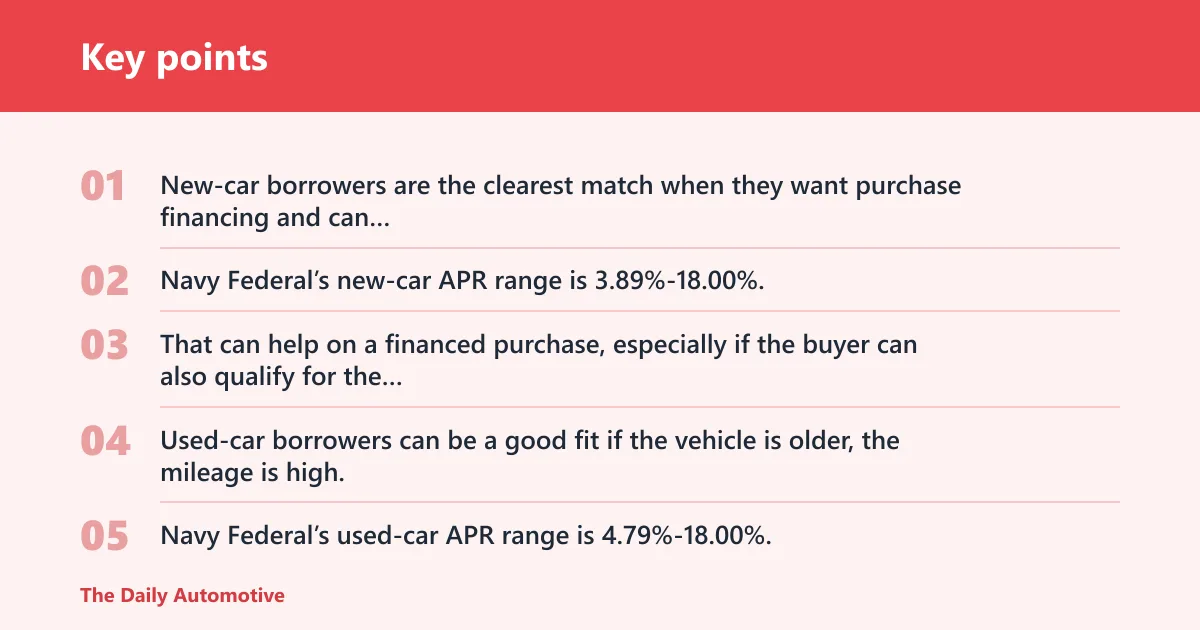
New-car borrowers are the clearest match when they want purchase financing and can document income and membership early. Navy Federal’s new-car APR range is 3.89%-18.00%, and the lender does not charge an origination or processing fee. That can help on a financed purchase, especially if the buyer can also qualify for the .25% military rate discount.
Used-car buyers
Used-car borrowers can be a good fit if the vehicle is older, the mileage is high, or the deal is coming from a private seller. Navy Federal’s used-car APR range is 4.79%-18.00%, and the loan amount can run from $250 to $500,000. The lender also allows co-signers and co-borrowers, which can help when a buyer’s credit file is thin.
Refinance and private-party borrowers
Refinance borrowers often benefit most when they already have a car loan and want a cleaner payment or a lower rate. Navy Federal’s refinance APR range is 3.89%-18.00%, it can refinance vehicles up to 20 years old, and it does not impose a maximum mileage restriction on those loans. Private-party buyers also benefit from the credit union’s flexible purchase options when the seller is not a dealer.
When Navy Federal is the right auto loan

Navy Federal is the right fit when the borrower’s situation matches one of the lender’s flexible use cases and the added review steps do not threaten the timeline. If the deal depends on instant funding, a soft-pull quote, or a lender with looser title rules, this may be a tougher fit.
| Borrower scenario | Recommended product type | Likely friction point | Document or eligibility issue to check before applying |
|---|---|---|---|
| First-time member buying new | New car purchase financing | Membership and direct deposit setup can slow the file | Confirm membership can be opened online and gather income proof |
| Used-car buyer with solid credit | Used car purchase financing | Vehicle paperwork and seller documents may delay booking | Check title status, VIN accuracy, and whether the seller can provide needed paperwork |
| Refinance borrower with equity | Auto loan refinancing | Title-transfer timing can hold up funding | Confirm the title can be transferred and the payoff amount is current |
| Private-party purchase | Private party financing | Seller coordination can create delays | Verify the seller can complete title and bill-of-sale paperwork on time |
| Military member seeking the rate discount | New, used, or refinance loan | Discount depends on military status documentation | Prepare proof of active-duty or retired military status |
| Borrower needing a large loan amount | New car, used car, or refinance loan | Loan size must still fit income and collateral review | Check whether the request stays inside the $250 minimum and $500,000 maximum |
Picture a buyer trying to finance a $9,000 used car from a private seller. Navy Federal can fit that deal, but only if the title and seller paperwork are ready and the borrower has membership in place before the vehicle changes hands. A missing signature can push the file into review without warning.
Suppose a borrower wants to refinance a 19-year-old SUV with 130,000 miles. Navy Federal may still be open to it because the lender says there is no maximum mileage restriction and that it can refinance vehicles up to 20 years old. The title-transfer step still matters, so a delay there can slow funding even when the borrower looks otherwise ready.
What do Navy Federal application statuses mean?
“Under review,” “pending approval,” and “conditional approval” are not the same thing, and each one signals a different stage in underwriting. Under review usually means the file is still being checked. Pending approval generally means a decision is close but not final. Conditional approval means the lender may approve the loan if specific items are verified or corrected.
Under review
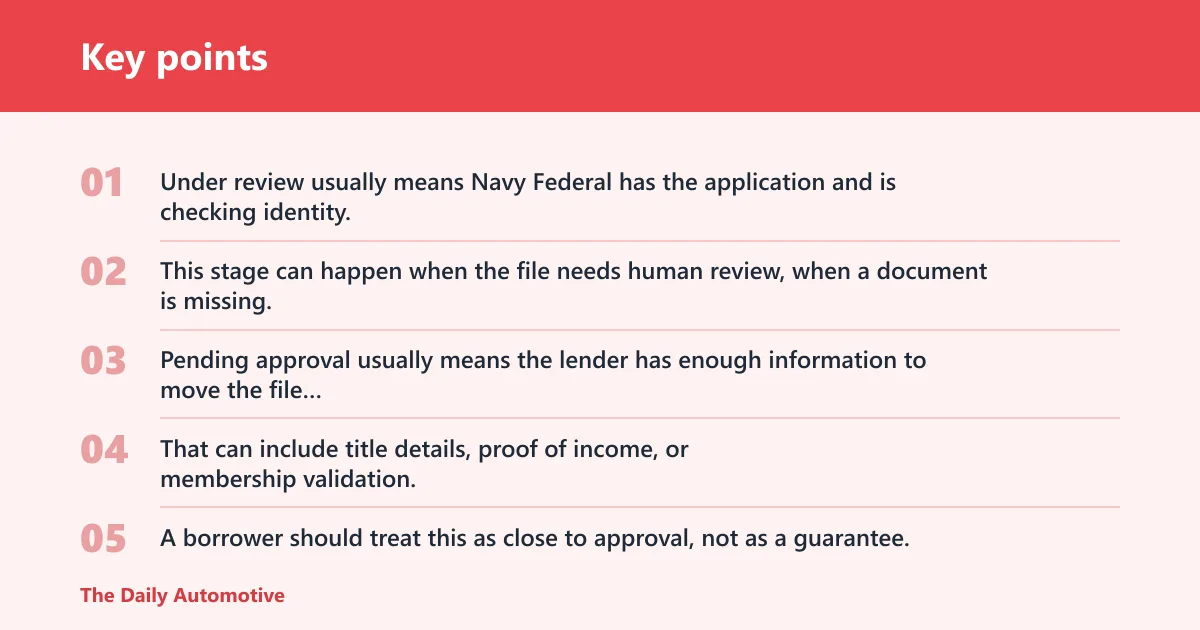
Under review usually means Navy Federal has the application and is checking identity, credit, income, membership, or vehicle details. This stage can happen when the file needs human review, when a document is missing, or when the vehicle information does not match the application. It does not mean denial.
Pending approval
Pending approval usually means the lender has enough information to move the file forward but still needs a final check. That can include title details, proof of income, or membership validation. A borrower should treat this as close to approval, not as a guarantee.
Conditional approval
Conditional approval means the loan may be approved if the borrower meets the listed conditions. Those conditions often involve updated documents, direct deposit setup, insurance evidence, or vehicle paperwork. If the condition is not satisfied quickly, the file can stall.
Document request and next steps
If Navy Federal asks for documents, respond quickly and upload exactly what was requested. The lender offers 24-hour member service, but that does not remove the need for accurate paperwork. Missing pay stubs, unreadable title documents, or an outdated payoff letter are common reasons a file sits longer than expected.
How does Navy Federal auto loan membership work?
Membership is required to apply, and it can often be set up on the website and is reported to be available in all states. That makes Navy Federal easier to access than some credit unions that limit membership by region, but you still need to qualify before the auto-loan application can move cleanly.
Who may qualify?
Navy Federal’s membership path is the gatekeeper for the loan itself. The lender does not disclose a minimum credit score, so the application outcome depends on more than a single number. Military members, eligible family members, and other qualified applicants can use the membership route if they meet the credit union’s rules.
What to confirm before applying
Before applying, confirm that membership can be opened, direct deposit can be arranged, and the loan type matches the vehicle. If you are military-adjacent but not currently serving, membership eligibility matters just as much as rate shopping. A good rate means little if the application cannot be completed.
- Confirm membership eligibility on the website.
- Gather proof of income and identity.
- Check whether the car is new, used, private party, or a refinance target.
- For refinances, verify the title can be transferred.
- Set up direct deposit if the lender requests it.
- Ask for the exact document list before you submit.
What are Navy Federal auto loan rates and terms?
Navy Federal’s rates can be competitive, but the range is wide enough that the borrower’s credit profile, loan size, term length, and vehicle type still matter a lot. The lender’s best pricing is not automatic. It depends on qualification, and the military rate discount can improve the number for active-duty and retired members.
APR ranges for new and refinance loans
New-car and refinance loans both carry an estimated APR range of 3.89%-18.00%. That span is broad enough to include strong-credit pricing and much higher-risk pricing. The lower end is only useful if the rest of the file is clean and the borrower meets membership and underwriting rules.
APR ranges for used-car loans
Used-car loans have an estimated APR range of 4.79%-18.00%. That starting point is higher than the new and refinance floor, which is common in auto lending because used vehicles carry more collateral risk. Even so, Navy Federal’s used-car terms can work well when the car is older, the mileage is high, or the buyer needs a larger flexibility window.
Loan amounts, fees, and direct deposit requirement
Loan amounts run from $250 to $500,000, which covers small refinances and high-dollar purchases alike. Navy Federal does not charge an origination or processing fee, allows both co-signers and co-borrowers, and requires direct deposit. Active-duty and retired military members may receive a .25% rate discount.
What does pending review mean on a Navy Federal auto loan application?
Pending review usually means the lender is still checking something before a final decision is issued. That may be a title issue, income verification, membership confirmation, or a vehicle detail that needs a manual look. It is a waiting status, not a final answer.
What matters most is whether the delay is caused by the borrower or by the vehicle. If the lender needs proof of income, respond quickly. If the issue is the title, the seller or payoff lender may need to act first.
Navy federal auto loan table
This decision table is the fastest way to match borrower type to the right loan path. It also shows where Navy Federal tends to slow down files, so you can fix the common hangups before the application goes in.
| Borrower scenario | Recommended product type | Likely friction point | Document or eligibility check |
|---|---|---|---|
| Buying a new sedan with stable income | New car purchase financing | Final rate depends on underwriting | Verify membership and income documents |
| Buying a 9-year-old crossover from a dealer | Used car purchase financing | Vehicle valuation and paperwork review | Check VIN, title status, and seller documents |
| Refinancing a loan with a clean payment history | Auto loan refinancing | Title-transfer timing | Confirm the title can be transferred |
| Buying from a private seller | Private party financing | Seller coordination | Make sure the seller can complete transfer paperwork |
| Active-duty service member seeking lower pricing | Any eligible auto loan type | Discount proof | Prepare military status documentation |
| Borrower with a large purchase or refinance amount | New, used, or refinance loan | Loan amount and affordability review | Stay inside the $250 to $500,000 range and verify direct deposit |
Pros and cons
Navy Federal has a lot to like for eligible borrowers, but the membership gate and review flow matter more here than at many direct auto lenders. That is where the real tradeoff sits.
Pros
- New, used, refinance, and private-party financing options
- Membership can be set up on the website
- 24-hour member service
- No origination or processing fee
- Co-signers and co-borrowers allowed
- Used-car refinances can go up to 20 years old with no maximum mileage restriction
- $200 bonus on refinance loans of $5,000 or more
- .25% rate discount for active-duty and retired military members
Cons
- Membership is required before you can apply
- No soft-pull pre-qualification is advertised
- No minimum credit score is disclosed
- Direct deposit is required
- Under review and conditional statuses can slow the process
- Refinance files can wait on title transfer
Frequently asked questions
Is Navy Federal good for auto loans?
Navy Federal is good for auto loans if you qualify for membership, want a broad set of loan uses, and can handle a more detailed review process. It is especially useful for buyers who value no origination fee, refinance flexibility, and the chance to get a military rate discount. It is less useful if you need instant approval.
Why is my Navy Federal auto loan under review?
Your file is usually under review because Navy Federal still needs to verify something, such as income, membership, title details, or vehicle information. This status is common and does not equal denial. The fastest way to move it forward is to answer document requests quickly and make sure every form matches the application.
How does Navy Federal auto loan membership work: membership is required?
Membership is required to apply, and Navy Federal says it can be set up on the website. Because the credit union is available in all states, location is not the barrier; eligibility is. Confirm membership first so you do not submit a loan application that cannot move forward.
What are Navy Federal auto loan rates and terms: navy Federal’s estimated APR ranges?
Navy Federal’s estimated APR ranges are 3.89%-18.00% for new and refinance loans and 4.79%-18.00% for used-car loans. Loan amounts run from $250 to $500,000. The lender also advertises a .25% rate discount for active-duty and retired military members and does not charge an origination or processing fee.
Does Navy Federal offer auto loan pre-qualification?
No soft-pull pre-qualification is advertised, so borrowers should not assume they can shop rates without a full application step. That means you should be ready for a hard inquiry and the lender’s review process before you apply. If you want a quick estimate only, this lender is not the easiest place to start.
Can I refinance my car with Navy Federal?
Yes. There is no maximum mileage restriction, and refinancing can begin as soon as the title can be transferred.
Is Navy Federal good for used car loans?
It can be, especially if you want used-car financing with a wide vehicle range and no origination fee. Navy Federal’s used-car APR range is 4.79%-18.00%, and the lender accepts both co-signers and co-borrowers. It is less appealing if you need a soft-pull quote or a very fast final decision.
What does pending review mean on a Navy Federal auto loan application: pending review means the lender?
Pending review means the lender is still checking part of the file and has not issued a final answer yet. It often points to membership verification, income documents, or vehicle and title information. If it stays pending, ask exactly which item is missing or incomplete and send it immediately.
Products related to this article
Sponsored / affiliate links. As an Amazon Associate I earn from qualifying purchases. I may earn additional commission from eligible campaigns.