What Is an Engine Block Heater and Do You Need One?
An engine block heater warms the coolant or engine oil before startup, and you usually need one only if you park outside in sustained subfreezing weather, especially near 0°F or below. Skip it in milder cold, and you can face harder starts, thicker oil, more battery strain, and extra engine wear. Here’s what it does, which drivers benefit, and how to tell whether your vehicle already has one installed.
This guide is part of our Winter Car Care: The Complete Cold-Weather Guide series.
How block heaters warm thickened oil


A block heater is an electrical device that warms the engine and/or motor oil before you start the vehicle. That preheat makes the engine easier to turn over and can reduce the strain that cold-weather starts put on the battery and starter. (Thedrive)
Cold motor oil thickens as temperatures fall. Thicker oil takes more effort to move through the engine, which is one reason a cold engine cranks slower and starts harder. The benefit is greatest when the car sits long enough for the engine, oil, and coolant to get very cold.
Most heaters plug into household power through a cord that comes out from under the hood, the grille, or another access point on the vehicle. The exact location varies by model, so the owner’s manual and service manual matter.
Why cold oil matters
Oil viscosity changes with temperature. In cold weather, the oil resists movement more than it does at normal operating temperature, so the starter has to work harder and the engine may fire more slowly. That is the main reason a block heater helps, even with modern vehicles.
That said, a block heater is not a cure-all. A strong battery, the right oil grade, engine size, and the manufacturer’s cold-weather guidance all affect whether you will notice a meaningful benefit.
📊 The Drive recommends turning the heater on about 3-4 hours before driving in deep freezes. Source: Thedrive.
Do you need one?
Need depends on climate, parking, and vehicle type. The Drive says vehicles may need help when temperatures drop below 10 degrees Fahrenheit, but that is a general use case, not a universal cutoff. If your car starts reliably in the cold you actually face, a heater may be optional rather than necessary.
Cold climate vs. occasional freeze
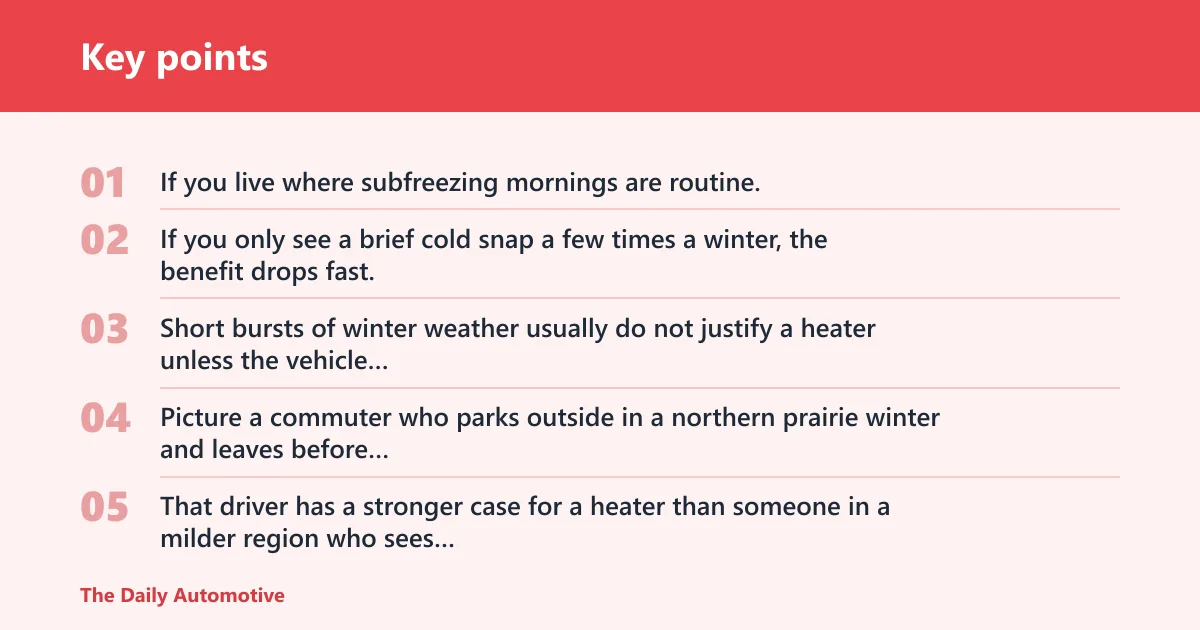
If you live where subfreezing mornings are routine, a block heater is more likely to pay off. If you only see a brief cold snap a few times a winter, the benefit drops fast. Short bursts of winter weather usually do not justify a heater unless the vehicle already struggles to start.
Picture a commuter who parks outside in a northern prairie winter and leaves before sunrise most days. That driver has a stronger case for a heater than someone in a milder region who sees freezing weather only a handful of mornings each season.
Garage parking vs. outside parking
Inside parking changes the answer. A garage, even if unheated, can keep the engine and oil warmer than open air, which can reduce the need for a heater. Outside parking exposes the powertrain to the full overnight temperature, so the heater matters more there.
Gas, diesel, hybrid, and EV-adjacent use cases
Gasoline engines in very cold climates may benefit from easier cranking and better oil flow. Diesel engines often have an even stronger case because cold fuel and combustion conditions can make starting harder. Hybrids still rely on an engine that has to start cold, so they can benefit too if they sit outside in severe cold.
EVs generally do not use engine block heaters. Plug-in hybrids are different: the gasoline engine portion can still face cold-start issues, so the answer depends on how often that engine starts in your climate and whether the vehicle maker offers a heater for that model.
When synthetic oil or a strong battery changes the call
Synthetic oil can flow better in low temperatures than heavier conventional oil, and a healthy battery can reduce cranking problems. Those two factors may lower the need for a heater, but they do not erase it in deep cold. Manufacturer guidance still wins.
Remote start changes the discussion only a little. It may give the cabin some warmth, but it is not the same as preheating the engine block or oil before startup.
Block heater decision matrix
Use this table as a practical starting point, not a hard law. The same climate can call for different answers depending on whether the vehicle sleeps in a garage or outside, and whether it starts a diesel, gasoline, or hybrid engine.
| Climate severity | Vehicle type | Overnight parking | Recommendation |
|---|---|---|---|
| Mild winter, rare freeze | Gasoline sedan or SUV | Garage | Usually unnecessary |
| Mild winter, rare freeze | Gasoline sedan or SUV | Outside | Optional if starts are already slow |
| Regular subfreezing mornings | Gasoline vehicle | Outside | Recommended if cold starts are common |
| Regular subfreezing mornings | Hybrid or plug-in hybrid | Outside | Recommended if the engine runs often in the cold |
| Frequent deep freezes near 0°F or below | Diesel truck or van | Outside | Strongly recommended |
| Frequent deep freezes near 0°F or below | Any vehicle | Garage | Optional, but still useful if starts are difficult |
| Cold snaps only, not steady winter | Any vehicle with strong battery and synthetic oil | Garage or outside | Usually optional |
Which heater type fits your car?
Different heaters solve the same cold-start problem in different ways. The right one depends on where the maker designed it to mount, how much installation work you want to take on, and whether your vehicle already has a place for one.
Core, frost, or freeze plug heater
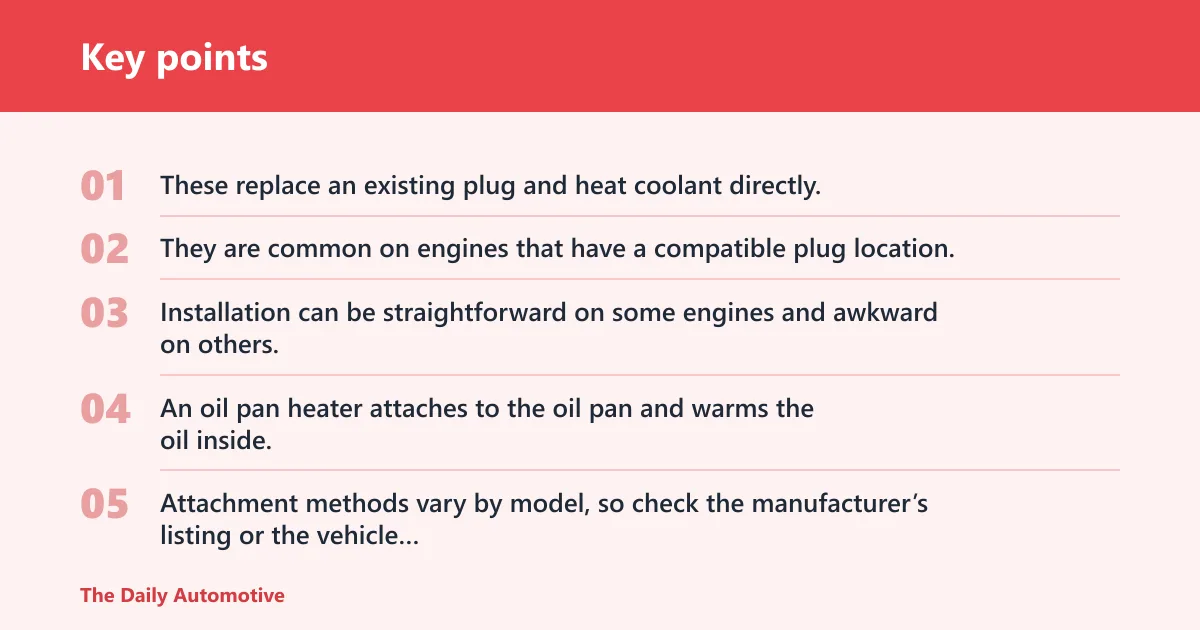
These replace an existing plug and heat coolant directly. They are common on engines that have a compatible plug location, but you need the service manual to find that location and confirm whether your model accepts this type. Installation can be straightforward on some engines and awkward on others.
Oil pan heater
An oil pan heater attaches to the oil pan and warms the oil inside. Attachment methods vary by model, so check the manufacturer’s listing or the vehicle manual before assuming a magnetic or bonded design will fit your car.
Inline heater
Inline heaters are spliced into a coolant hose. Some are circulating designs and some are non-circulating, and installation is usually more involved than with a plug-in pan heater or blanket. Fitment depends on hose routing and space under the hood.
Engine-warming blanket
An engine-warming blanket is placed on top of the engine or under the hood. It disperses heat across the engine area rather than heating one point directly. This can be useful when the vehicle and heater design allow for it, but it still depends on model-specific fitment.
Dipstick heater
A dipstick heater replaces the dipstick with a long heating element that warms the oil. It is a direct way to heat the oil supply, but compatibility and installation details vary, so the product listing and manual matter here too.
How do you tell if your car already has one?
Check the owner’s manual and service manual first. Many used vehicles already have a heater installed, but the cord may be missing, tucked away, or routed to a spot you have not noticed. The manual helps you confirm the type and the intended plug location.
- Look through the owner’s manual and service manual for any block-heater note.
- Open the hood and look for a power cord, usually with a standard household-style plug end.
- Trace the cord to see whether it leads to a freeze plug, oil pan, coolant hose, or blanket-style setup.
- Check for underhood hardware that looks like a heater element, wiring, or a factory-installed lead.
- If the cord is missing or inaccessible, match the engine code and VIN to the manufacturer listing or dealer parts catalog.
A common first-timer mistake is assuming a used truck has no heater because the plug is not obvious. Sometimes the cord is tied back near the grille, hidden behind trim, or routed to a spot the previous owner used only in winter.
If you cannot identify the heater type, stop there and use the manual. Fuel, coolant, and electrical work need ventilation, no sparks, and the battery disconnected when the manual calls for it.
How long should you plug it in?
Do not leave a block heater plugged in all night unless the manufacturer says to do that for your model. A timer is often the better default because it can cut wasted electricity and still gives the engine time to warm before departure.
Using a timer
The Drive recommends turning the heater on about 3-4 hours before driving in deep freezes. That is a practical starting point, not a rule for every vehicle. A timer keeps the heater from running longer than necessary while still giving the engine and oil time to warm.
When overnight power is unnecessary
A block heater is a preheat tool, not a parking accessory. If you only need a cold-start assist for the morning commute, overnight power is usually wasted. Idling for 5-10 minutes does not replace a block heater, because it does not warm the oil and engine the same way before startup.
Can you add one to a car?
Yes, often you can add one, but compatibility varies by model. The engine design, available mounting points, and coolant or oil routing determine what fits. That is why the service manual matters before you buy anything.
Some vehicles accept a core, frost, or freeze plug heater. Others have room for an oil pan heater or an inline heater, and some are better suited to a blanket or dipstick style. If the engine does not have a compatible location, forced fitment is the wrong move.
Check the vehicle manual and the heater maker’s listing for your exact engine code. If you are unsure, a dealer parts department or a shop familiar with your platform can verify whether the heater is offered for that model.
Frequently asked questions
What’s an engine block heater?
An engine block heater is an electrical device that warms the engine and/or motor oil before startup. It makes the engine easier to turn over in cold weather and helps reduce the strain that thick oil puts on cranking and starting.
Can you add an engine block heater to a car?
Often yes, but only if your engine has a compatible mounting or hose location for the right style of heater. Check the owner’s manual, service manual, and manufacturer listing before buying one, because fitment and install difficulty vary by model.
When do you need a block heater?
A block heater is usually most useful when you park outside in sustained subfreezing weather, especially near 0°F or below. If you have a garage, strong battery, and easy cold starts, it may be optional rather than necessary. Climate and vehicle setup both matter.
Is an engine block heater worth it?
It is usually worth it for drivers who face repeated deep freezes and outdoor parking, especially with diesel engines or vehicles that crank slowly in the cold. For mild winters or garage-kept cars, the payoff is smaller and often not worth the hassle.
How do you use an engine block heater?
Plug it into a household outlet before you drive, ideally on a timer. The practical starting point is about 3-4 hours in deep cold. Follow the vehicle and product manual for placement, cord routing, and any model-specific limits.
Do modern cars need block heaters?
Some modern cars still benefit from them in extreme cold, even with better batteries and tighter engine management. Others do fine without one. The answer depends on temperature, oil grade, parking, and the maker’s guidance for your specific model.
Products related to this article
Sponsored / affiliate links. As an Amazon Associate I earn from qualifying purchases. I may earn additional commission from eligible campaigns.