Why Won’t My Car Start in Cold Weather? Quick Checks
If your car won’t start in cold weather, match the symptom in under two minutes: no crank usually means battery or connections, rapid clicks point to low battery, slow crank suggests weak battery or thick oil, and a crank-with-no-start often means fuel or ignition. Pick the wrong symptom, and you can buy parts you do not need while the car still sits there. This guide gives quick, safe checks for sound, dash lights, and one simple test to narrow the cause fast.
This guide is part of our Winter Car Care: The Complete Cold-Weather Guide series.
Cold-start triage table

Start with the exact sound and dash behavior. Then do one quick check. That keeps you from guessing at the battery, starter, or fuel system before the car gives you a clearer clue.
| Symptom | Most likely cause | One quick check | What the result means |
|---|---|---|---|
| No lights or only dim dash lights | Dead or very weak 12-volt battery, loose terminals, or bad ground | Turn on headlights and interior lights | If they are weak or dead, battery output is likely too low; inspect terminals and try a safe jump only if the battery is not frozen. |
| Rapid clicking | Low battery voltage or high resistance at the terminals | Look for white or green corrosion and loose clamps | Clean, tight terminals matter before any deeper diagnosis. If corrosion is heavy, current may not reach the starter. |
| One heavy click | Starter motor fault, or battery voltage too low to engage it | Watch the dash lights during the key turn | If the lights stay bright but the engine only gives one solid click, the starter is a stronger suspect. |
| Slow crank | Weak battery, thick oil, or poor cable connection | Check battery voltage if you have a meter | A healthy resting battery is around 12.6V. 12.2V is weak, and 12.0V or lower often explains a cold no-start. |
| Cranks but won’t fire | Fuel, ignition, or sensor problem | Listen for fuel pump prime and scan coolant temperature data | If the scan tool shows a cold-engine reading that is far from outside temperature, the coolant temperature sensor may be lying to the computer. |
| Starts after a jump but dies later | Weak charging system, often alternator trouble | Let the engine run and watch for a warning light | A jump can mask a charging problem. If the car dies again after the jump pack is removed, charging output may be weak. |
📊 Cold can reduce battery capacity by about half at 0 F. Source: Familyhandyman.
Why cold weather changes starting behavior
Cold weather exposes weak parts fast. A 12-volt battery loses output in low temperatures, and at 0 F cold can reduce battery capacity by about half. Lower temperatures also make motor oil thicker and harder to push through the engine, so the starter must work harder just to turn the crankshaft.
Battery output drops first
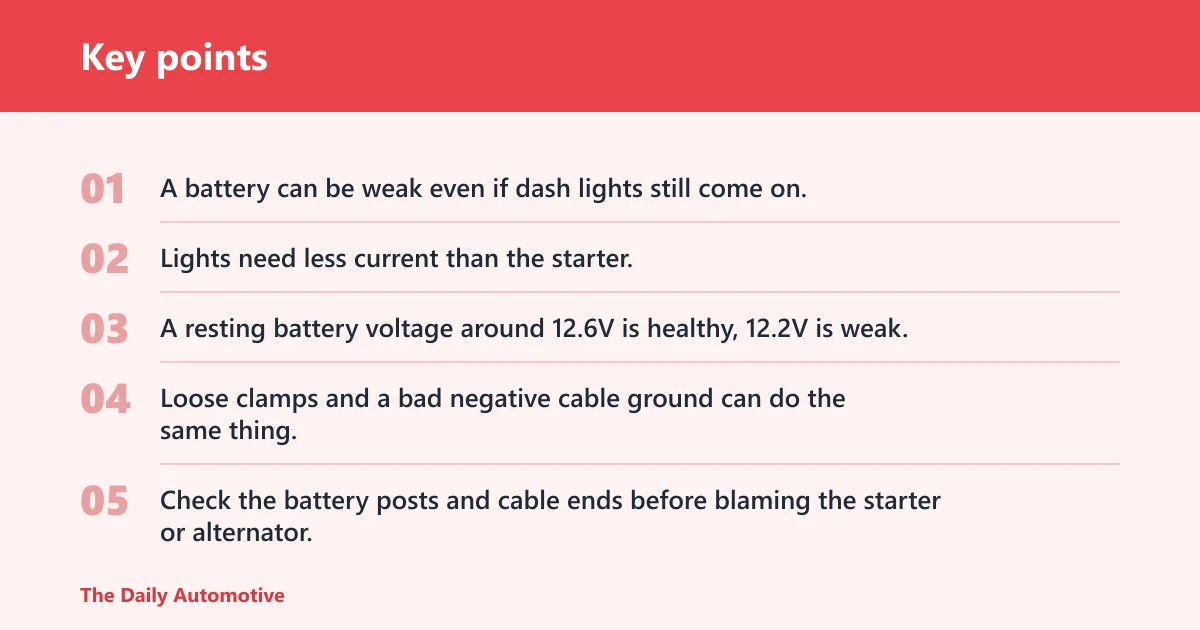
A battery can be weak even if dash lights still come on. Lights need less current than the starter, so a battery that looks “alive” may still fall apart under load. A resting battery voltage around 12.6V is healthy, 12.2V is weak, and 12.0V or lower often explains why a car won’t start in cold weather.
Terminal condition matters too. White or green corrosion can block current. Loose clamps and a bad negative cable ground can do the same thing. Check the battery posts and cable ends before blaming the starter or alternator.
Oil and fuel change the load
Lower temperatures make motor oil thicker and harder to push through the engine. SAE 5W-30 and SAE 10W-30 are common winter viscosities, and the lower winter number flows better at low temperatures. That can reduce cranking resistance on a cold morning.
Fuel matters as well. Cold lowers gasoline vaporization, so the engine may need extra help to light off. Water in the fuel system can freeze below 32 F. Older carbureted vehicles can also suffer carburetor icing, which can block airflow and fuel flow.
What quick checks should you do first?
Start with the battery terminals, the dash lights, and one safe jump-start attempt. Turn off rear defrosters, seat heaters, blower fans, and headlights before starting. That cuts electrical load while you sort out the fault. If the battery appears frozen, stop there. Never attempt to jump-start a frozen battery.
Check the battery terminals and ground
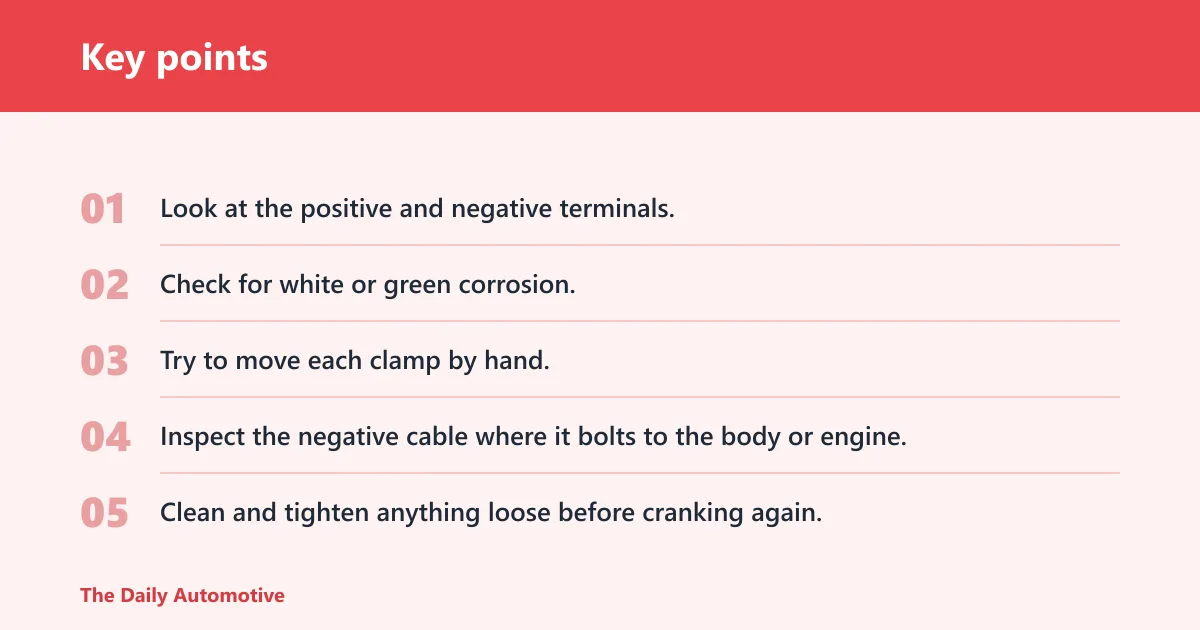
- Look at the positive and negative terminals.
- Check for white or green corrosion.
- Try to move each clamp by hand.
- Inspect the negative cable where it bolts to the body or engine.
- Clean and tighten anything loose before cranking again.
If the clamps move or the ground connection looks dirty, you may have found the issue. A battery can be good and still fail to start the car if current cannot travel through the cables cleanly.
Look for dash-light clues
Bright dash lights do not prove the battery is healthy. They only mean the battery can supply some power. A starter motor can fail to engage even when the dash stays bright, and a weak battery can still light the cabin while collapsing under starter load.
Suppose the dash is bright, the radio works, and you hear one hard click. That pattern leans away from a dead battery and toward a starter or high-resistance connection problem. If the dash goes nearly dark, battery voltage is more likely the issue.
Try one safe jump-start attempt
Use a portable jump starter or jumper cables only as a first-step check when the battery seems weak. Make one short attempt. Do not keep cranking. Repeated cranking overheats the starter and can turn a simple diagnosis into a bigger repair.
If the engine starts with the jump, let it run and see what happens next. A start that only happens with outside power may mean the battery is weak, the connections are poor, or the charging system is not keeping up.
How do I tell if it’s the battery or starter when the car won’t start?
Use the sound pattern and the dash lights together. Rapid clicking usually means the battery voltage is too low or the terminals are resisting current. One heavy click with bright dash lights often points to the starter motor. If the engine cranks slowly, think weak battery, thick oil, or poor cable connection.
What bright dash lights can still hide
Bright lights can hide a weak battery because the starter demands far more current than the dashboard. That is why a car may appear normal inside and still fail to turn the engine. Cold weather makes that gap more obvious because battery capacity falls and cable resistance rises.
How a starter fault sounds
A starter issue often sounds like a single solid click with no crank, or a moment where the engine barely moves and stops. Cold weather can expose pre-existing wear in the starter motor, solenoid, or internal contacts. If the battery is known good and the connections are clean, the starter moves up the list fast.
Why a jump-start then stall points to alternator trouble
The alternator recharges the battery while the engine runs. If the car starts after a jump but dies again later, the charging system may be weak. That pattern is different from a one-off cold soak. It often means the battery was not being replenished during normal driving.
Picture a sedan that starts with a jump in the driveway, idles for a few minutes, then dies when the cables come off. That is not a simple battery-only story. It can point to alternator trouble, a bad belt drive, or a battery that was drained and never recovered.
Could fuel, oil, or a sensor be the cause?
Yes. If the engine cranks normally but will not fire, move past the battery. Thick oil can slow cranking, frozen moisture can block fuel flow, and a bad coolant temperature sensor can stop the computer from adding enough fuel for a cold start.
Oil viscosity and cold cranking
Thicker oil increases cranking resistance in cold weather. That is why winter viscosity matters. A lower winter number flows better at low temperatures, so the starter does not have to fight as much drag. If the engine cranks slower only on very cold mornings, oil choice belongs on the list.
Fuel vaporization and frozen moisture
Cold lowers gasoline vaporization, which makes starting harder until the intake and fuel system warm slightly. Water condensation in the tank can freeze below 32 F and block fuel delivery. On older carbureted vehicles, carburetor icing can create a no-start or stall even when the battery is fine.
Coolant temperature sensor checks with an OBD2 scan
A bad coolant temperature sensor can fool the engine computer into skipping the enrichment it needs on a cold start. An OBD2 scan can often show a coolant reading that is close to outside temperature on a cold engine. Implausible readings, such as an unusually high value or a stuck-at-low reading like -40, can point to failure.
A common first-timer mistake is to replace a battery when the real issue is a sensor that is feeding the wrong temperature to the engine computer. A quick scan can separate a fuel-control problem from a simple power problem.
When should you stop troubleshooting?
Stop if the battery may be frozen, if repeated cranking has gone nowhere, or if the symptom pattern points strongly to charging, starter, or sensor trouble. A frozen battery should not be jump-started. If basic checks do not change anything, roadside assistance or a mechanic is the better next move.
Limits on repeated cranking
Do not keep trying in long bursts. Repeated cranking overheats the starter and drains what little battery power remains. Use short attempts only, then pause. If the symptom does not change after terminal checks and one safe jump try, more cranking usually adds wear without adding information.
When roadside help makes more sense
If the car only clicks, if it starts and dies again, or if you see corrosion plus a weak battery reading, the problem may need testing that goes beyond the driveway. A battery test can confirm whether the battery has enough reserve, but the pattern may still point to the alternator or starter.
Frequently asked questions
Why won’t my car start when it’s cold outside?
Cold weather cuts battery output, thickens oil, and can expose weak cables, starters, fuel delivery, or sensors. Match the symptom first. No crank, rapid clicking, slow crank, and crank-with-no-start usually point to different causes, so the exact sound matters more than the calendar.
What quick checks can I do if my car won’t start in cold weather?
Check the battery terminals for corrosion and looseness, look at the dash lights, and try one safe jump-start attempt if the battery is not frozen. Turn off unnecessary electrical devices first. If the engine starts only with outside help, test the battery and charging system next.
Can a weak battery still make dashboard lights come on?
Yes. Dashboard lights can come on even when the battery is too weak to turn the starter. The lights need far less current than the engine does. That is why a battery that looks fine on the dash can still be weak at 12.2V or lower and fail in the cold.
Is it safe to jump-start a car in freezing weather?
It can be safe if the battery is not frozen and the jump is done carefully. Never attempt to jump-start a frozen battery. Make one short try, not repeated long cranking, and stop if nothing changes. If the car starts only with the jump, the charging system still needs attention.
Why does my car click but not start when it’s cold?
Rapid clicking usually means low battery voltage or poor terminal contact. One heavy click with bright lights points more toward the starter motor. Cold weather makes both faults more obvious because battery capacity falls and resistance rises. Clean the terminals first, then decide whether a jump or a starter test makes sense.
Products related to this article
Sponsored / affiliate links. As an Amazon Associate I earn from qualifying purchases. I may earn additional commission from eligible campaigns.