AGM vs Lithium Car Battery
AGM is the safer choice for most stock cars and trucks, while lithium batteries make sense mainly for weight savings, deep cycling, or competition use if the charging system matches. Pick the wrong one and you can get short battery life, warning lights, weak starts, or a battery that never charges correctly. This guide compares starting, audio loads, short trips, storage, and factory charging systems, and it also gives a basic compatibility check: confirm the vehicle’s charging voltage is suitable for the battery, confirm the battery’s low-temperature charge protection matches your climate, and make sure the battery is being used as a starter battery rather than a deep-cycle battery.
| Factor | AGM | Lithium Car Battery | Winner |
|---|---|---|---|
| Stock charging-system fit | AGM batteries are often compatible with factory alternators and typical charging targets. | Can sometimes need a charging profile that the vehicle may not provide. | AGM |
| Energy density | About 30-40 Wh/kg | Often over 150 Wh/kg | Lithium Car Battery |
| Cold-weather risk | More tolerant for winter starting and charging | Charging can be limited in cold conditions | AGM |
| Accessory load and audio use | Handles stock and moderate extra loads well | Works best with the right support hardware and use pattern | AGM |
| Weight sensitivity | Heavier | Lighter | Lithium Car Battery |
| Expected lifespan | 3-5 years | 10 years or more | Lithium Car Battery |
| Depth of discharge | Typically 50-60% | Typically 80-100% | Lithium Car Battery |
| Upfront cost | Usually lower | Usually higher | AGM |
What changes in a real car
AGM batteries are not lithium batteries; AGM uses absorbent glass mat lead-acid construction, while lithium batteries use a different chemistry and usually a battery management system. That difference matters in a car because the battery must match the alternator, the charging profile, and the way the vehicle is actually driven.
A starter battery is not the same job as a deep-cycle battery. If the car is expected to crank the engine, recover after short trips, and sit through cold mornings, the choice is usually about compatibility first and performance second.
Say your sedan makes short 8-minute trips, uses heated seats, and sits outside overnight in winter. AGM is usually the simpler fit because it accepts typical factory charging better and is less likely to create cold-weather charging problems.
AGM and lithium comparison table
| Criteria | AGM | Lithium Car Battery | Winner |
|---|---|---|---|
| Energy density | About 30-40 Wh/kg | Often over 150 Wh/kg | Lithium Car Battery |
| Weight | Heavier | Lighter | Lithium Car Battery |
| Charge time | 5-12 hours | 1-5 hours | Lithium Car Battery |
| Lifespan | 3-5 years | 10 years or more | Lithium Car Battery |
| Depth of discharge | Typically 50-60% | Typically 80-100% | Lithium Car Battery |
| Temperature tolerance | More forgiving in winter starts | Can be limited by cold-charge rules | AGM |
| BMS and monitoring needs | No lithium-style BMS requirement | Needs a battery management system and compatible charging | AGM |
Energy density and weight
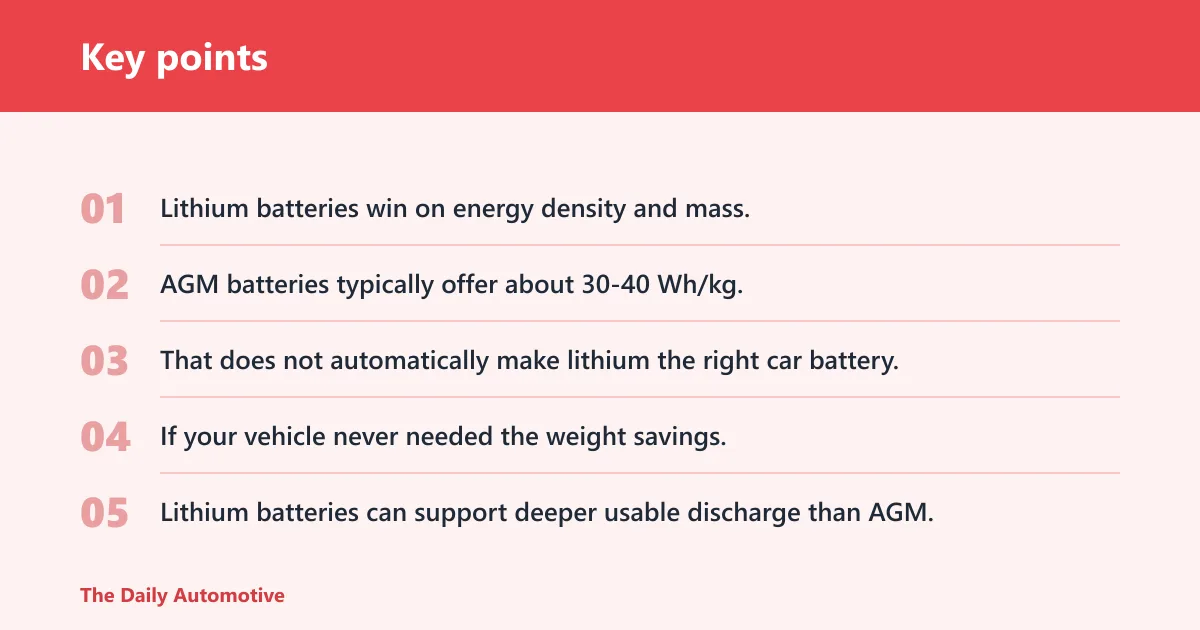
Lithium batteries win on energy density and mass. AGM batteries typically offer about 30-40 Wh/kg, while lithium batteries often provide over 150 Wh/kg, which can cut a lot of weight in racing or any build where pounds matter.
That does not automatically make lithium the right car battery. If your vehicle never needed the weight savings, the extra cost may buy less real-world value than a well-matched AGM.
Depth of discharge and recovery
Lithium batteries can support deeper usable discharge than AGM, but that figure depends heavily on the battery’s chemistry and whether it is a starter battery or a deep-cycle battery. AGM typically allows 50-60%. That matters when the battery must run accessories, audio equipment, or parked electrical loads without being drained too far.
AGM is more forgiving in routine starter-battery use because it fits the normal pattern of drive, recharge, and repeat. Lithium can deliver more usable capacity, but only if the system is set up to recharge it properly.
Charge time and lifespan
Charge time varies with battery size, alternator output, state of charge, and charging method, so there is no single universal number for either type. Lithium batteries can recharge quickly in favorable conditions, while AGM batteries often need more time to recover after repeated cranking or heavy accessory use.
Lithium can also last longer in some applications, but automotive starter-battery life varies widely with chemistry, climate, and charging system compatibility. That said, a longer life only helps if the battery is compatible with the vehicle and gets the right charging profile.
Temperature and BMS needs
Cold weather is where the split becomes obvious. AGM is often the safer choice for winter starting and cold storage because it is generally less sensitive to charging limits, while lithium may reduce charging when temperatures drop.
Lithium also needs a battery management system to monitor cells and protect the pack. If the vehicle’s alternator voltage, regulator behavior, or charging pattern does not match the lithium battery’s needs, the battery may not charge correctly or may wear out early.
Which battery works better in stock cars?
AGM is the better fit for most stock cars because factory alternators and voltage targets were designed around lead-acid behavior. Lithium batteries can work, but only when the charging system and the battery’s management requirements line up with the vehicle’s electrical design.
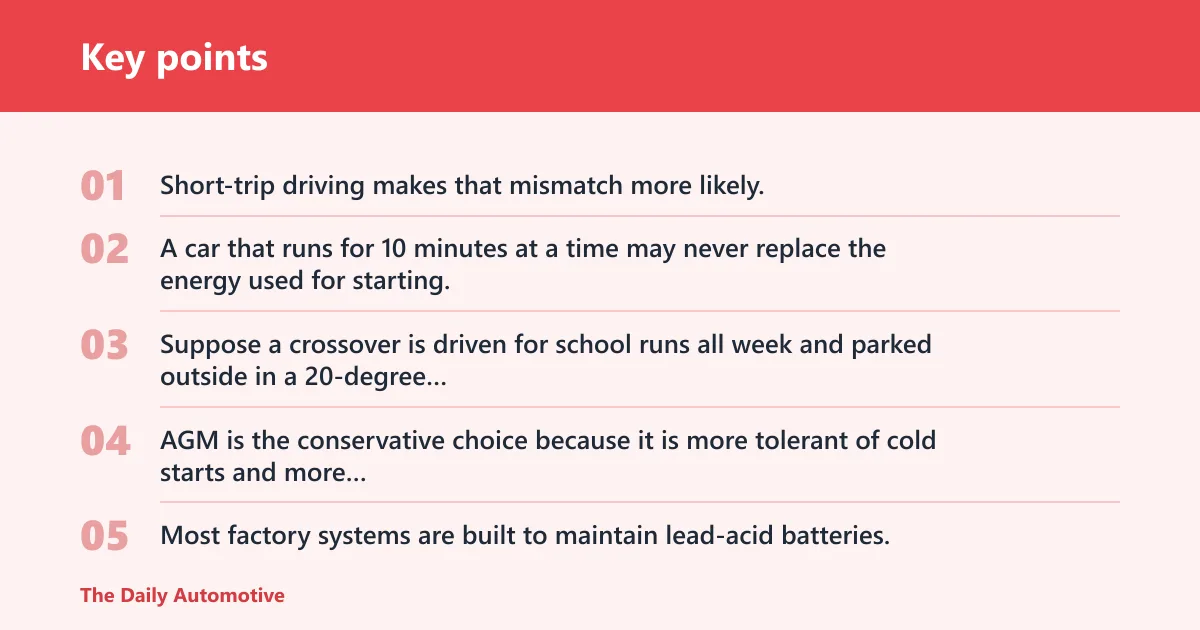
Short-trip driving makes that mismatch more likely. A car that runs for 10 minutes at a time may never replace the energy used for starting, infotainment, and cabin loads, which means the battery lives in a partial-charge state far more often than owners expect.
Suppose a crossover is driven for school runs all week and parked outside in a 20-degree morning. AGM is the conservative choice because it is more tolerant of cold starts and more likely to recover on a stock charging system.
Factory alternators and charging targets
Most factory systems are built to maintain lead-acid batteries, not to optimize lithium charging. That is why a lithium swap can be a bad fit even when the battery physically installs without issue.
If the alternator voltage, regulator strategy, or smart-charging logic is not suited to lithium, you may end up with undercharging, warning lights, or a battery that never reaches the state of charge it needs for long life.
When lithium needs extra hardware
Some lithium setups need more than a drop-in replacement. Depending on the vehicle, that can mean a compatible charger, a different regulator strategy, or extra monitoring to keep the battery within safe charging limits.
Without that support, lithium batteries can look strong on paper and still underperform in a normal commuter car.
What changes with car audio and high accessory loads?
AGM often fits better for car audio and accessory-heavy builds that still rely on a conventional charging system. Lithium Car Battery can be the stronger choice for serious high-load systems, but only when the electrical system is designed around it.
The key issue is voltage stability under load. Audio amplifiers, winches, and repeated engine-off use can pull the battery into deep discharge patterns, and the battery must recover quickly without upsetting the rest of the vehicle.
Why AGM is often the safer audio fit
AGM handles moderate accessory loads well and is easier to integrate with stock charging hardware. For daily-driven vehicles with upgraded stereos, that combination often matters more than sheer energy density.
AGM also tolerates the stop-start rhythm of parked listening and short recovery drives without demanding a battery management setup that the car never had.
When lithium makes sense for audio
Lithium batteries can work well when the audio load is large, the vehicle is built for it, and the charging system is designed around that use. Its deeper usable capacity and lighter weight can help in competition or show builds.
The mistake is assuming a lithium battery alone will fix voltage sag. If the alternator output and wiring are not sized for the load, the battery type is only part of the problem.
How do cold weather and heat affect each battery?
Cold weather usually favors AGM, especially for starting. Lithium batteries are lighter and more energy-dense, but cold charging limits can make them the weaker choice for winter commuters and vehicles that live outdoors.
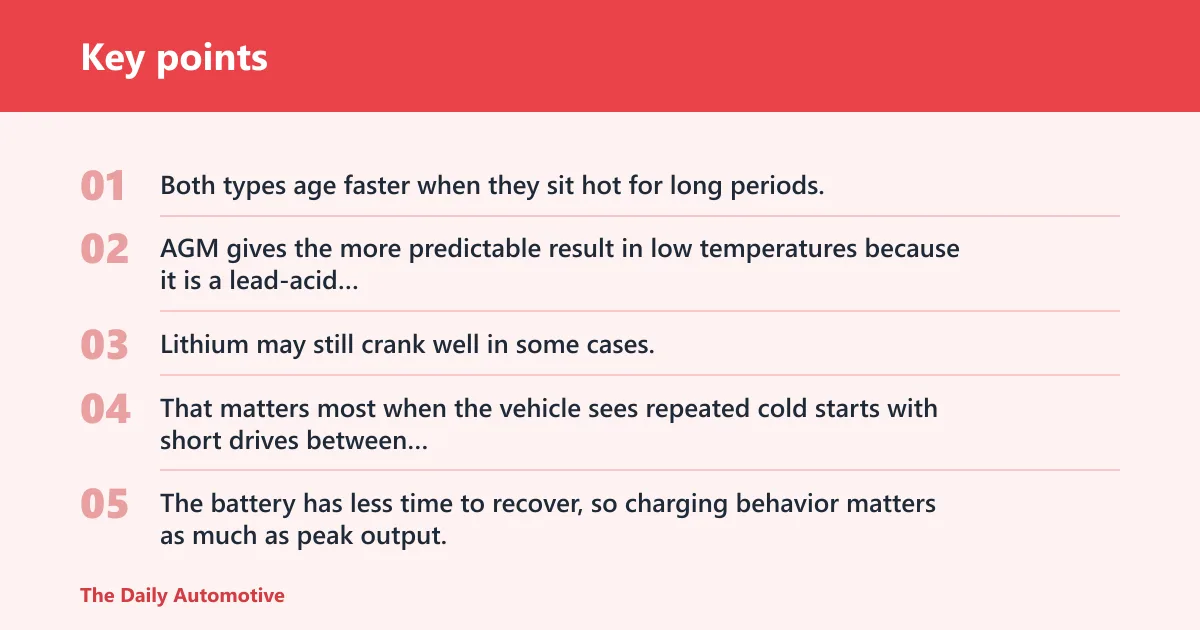
Heat is also important. Both types age faster when they sit hot for long periods, but a lithium pack’s service life still depends on the battery management system and the quality of the charging setup.
Winter starting
AGM gives the more predictable result in low temperatures because it is a lead-acid battery type built for starting duty. Lithium may still crank well in some cases, but cold charging restrictions can limit recovery after the engine starts.
That matters most when the vehicle sees repeated cold starts with short drives between them. The battery has less time to recover, so charging behavior matters as much as peak output.
Storage and long-term wear
Both battery types dislike neglect, but lithium’s longer lifespan can make sense if the car sits for long periods and the battery management system keeps it in a safe range. AGM is usually easier to keep alive in a simple garage or driveway setup.
A common first-timer mistake is buying the lightest battery available for a daily truck with a stock alternator, then expecting the rest of the charging system to adapt. The reverse mistake is choosing AGM for a race build where weight and deep cycling are the main targets.
AGM battery decision matrix
| Vehicle type | Alternator/charging-system compatibility | Cold-weather risk | Accessory load | Weight sensitivity | Expected lifespan | Recommended battery type |
|---|---|---|---|---|---|---|
| Daily commuter with factory electrical system | High for AGM, uncertain for lithium | Moderate to high | Low to moderate | Low | 3-5 years for AGM, 10 years or more for lithium | AGM |
| Truck with heated seats, towing, and short trips | High for AGM | High | Moderate to high | Low | 3-5 years for AGM | AGM |
| Audio build with upgraded charging hardware | Moderate to high if matched correctly | Moderate | High | Moderate | Depends on use and setup | Lithium Car Battery |
| Track car or weight-focused project | High only if charging is set up for lithium | Low to moderate | Low to moderate | High | 10 years or more for lithium in the right system | Lithium Car Battery |
| Motorcycle with compact packaging needs | Varies by regulator and battery spec | Moderate | Low | High | Usually favors longer-life lithium when compatible | Lithium Car Battery |
Simple cost-per-year estimate
| Battery type | Example purchase price | Expected service life | Estimated cost per year |
|---|---|---|---|
| AGM | $200 | 4 years | $50/year |
| Lithium Car Battery | $600 | 10 years | $60/year |
Choose AGM if… / Choose Lithium Car Battery if…
Choose AGM if your car uses a stock charging system, you drive in cold weather, you make short trips, or you want a safer match for a normal starter-battery role. AGM also makes sense when you want a maintenance-free, strong battery that is easier to fit into factory charging behavior.
Choose Lithium Car Battery if you need weight savings, deep cycling, or a performance build with the right charging support. It can also make sense when the higher upfront cost is acceptable because you plan to keep the vehicle long enough to benefit from the longer lifespan.
For the question of agm vs lithium car battery, the right answer is not universal. AGM wins for most daily drivers, winter use, and stock electrical systems; lithium batteries win when the build, the charge profile, and the use case are already aligned.
Frequently asked questions
What is the difference between AGM and lithium batteries?
AGM is a lead-acid battery type with absorbent glass mat construction, while lithium batteries use a different chemistry and usually a battery management system. AGM is typically easier to match to factory charging. Lithium is lighter, can charge faster, and offers more usable capacity.
Which is better lithium or AGM battery?
Lithium is better for weight-sensitive, deep-cycle, or performance setups with the right charging support. AGM is better for most stock vehicles, cold-weather use, and simple replacement jobs. The better choice depends on the vehicle’s alternator behavior and how the battery will be used.
AGM battery vs lithium: which lasts longer?
Lithium usually lasts longer in some applications, but automotive starter-battery life depends on chemistry, climate, and charging system compatibility. AGM batteries generally last around 3-5 years. That advantage only matters if the lithium battery is charged correctly and kept within its safe operating range.
Is AGM a lithium battery?
No. AGM batteries are not lithium batteries; they are lead-acid batteries. That difference affects charging behavior, weight, depth of discharge, and how well the battery matches a stock charging system.
Are lithium car batteries worth the extra cost?
They can be, but only in the right vehicle. The extra cost makes the most sense when you need weight savings, higher usable capacity, or long service life and your charging system is compatible. For a stock commuter, AGM is usually the better value.
What battery type is better for car audio, AGM or lithium?
AGM is usually the safer fit for stock or lightly modified audio setups because it integrates more easily with factory charging. Lithium batteries can be the better choice for serious audio builds with the right charging hardware, deeper discharge use, and battery management in place.
Products related to this article
Sponsored / affiliate links. As an Amazon Associate I earn from qualifying purchases. I may earn additional commission from eligible campaigns.