Best Battery Chargers for Car Storage (2026): Research Shows
For car storage, pick a battery maintainer for weeks to a few months, a smart charger for a low but healthy battery, and a recovery charger only when voltage is already deeply low. Choose wrong and you can return to a dead battery, sulfation, or a charger that works too hard on a weak battery. This guide matches charger type to storage length, battery condition, and safe connection setup.
Quick comparison
| Product | Badge | Best for | Price | ||
|---|---|---|---|---|---|
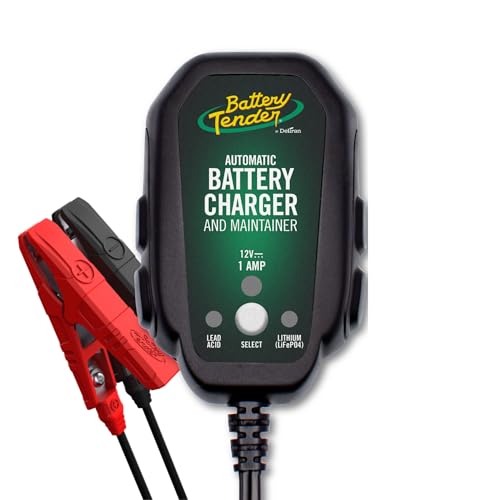 |
Battery Tender Junior 12V, 800mA Battery Charger andBattery Tender | Our pick | 12V · 800mA · Maintainer | $42.49
Price as of 1 Nov 2026
|
View |
 |
NOCO GENIUS1 1A 6/12V Smart Battery Charger, TrickleNOCO | Also great | 6/12V · 1A · Smart charger | $29.95
Price as of 1 Nov 2026
|
View |
 |
CTEK – 40-206 MXS 5.0 Fully Automatic 4.3 amp BatteryCTEK | Upgrade pick | 12V · 4.3A · Automatic charger | $99.00
Price as of 1 Nov 2026
|
View |
For a healthy 12V battery that sits for weeks, a simple maintainer is the right tool. If the battery starts low, or your garage holds both 6V and 12V gear, a smart charger with recovery support fits better.
How we chose
We compared manufacturer specs, listing details, and published buyer feedback for voltage support, maintenance mode, recovery ability, and safety features such as reverse-polarity protection.
For storage use, the differences that matter most are whether the charger can stay connected safely, whether it supports your battery chemistry, and whether it can wake a battery that is already too low for a normal maintainer.
Battery Tender Junior 12V charger and maintainer: best for simple 12V storage
This is the cleanest pick for a healthy 12V car battery that needs long-term maintenance more than recovery. It is 12V only, so it fits basic storage jobs well if your garage car, project car, or powersports battery does not need 6V support.
Its strongest appeal is simplicity. The smart charging sequence adjusts automatically, it is spark-proof with reverse-polarity detection, and the five-year warranty is a useful sign for a budget-focused maintainer.
The drawback is plain: Battery Tender Junior can maintain charge but not charge from dead. If the battery has already fallen too low, this is not the charger to wake it up.
NOCO Genius5 fully-automatic smart charger: best for mixed garages
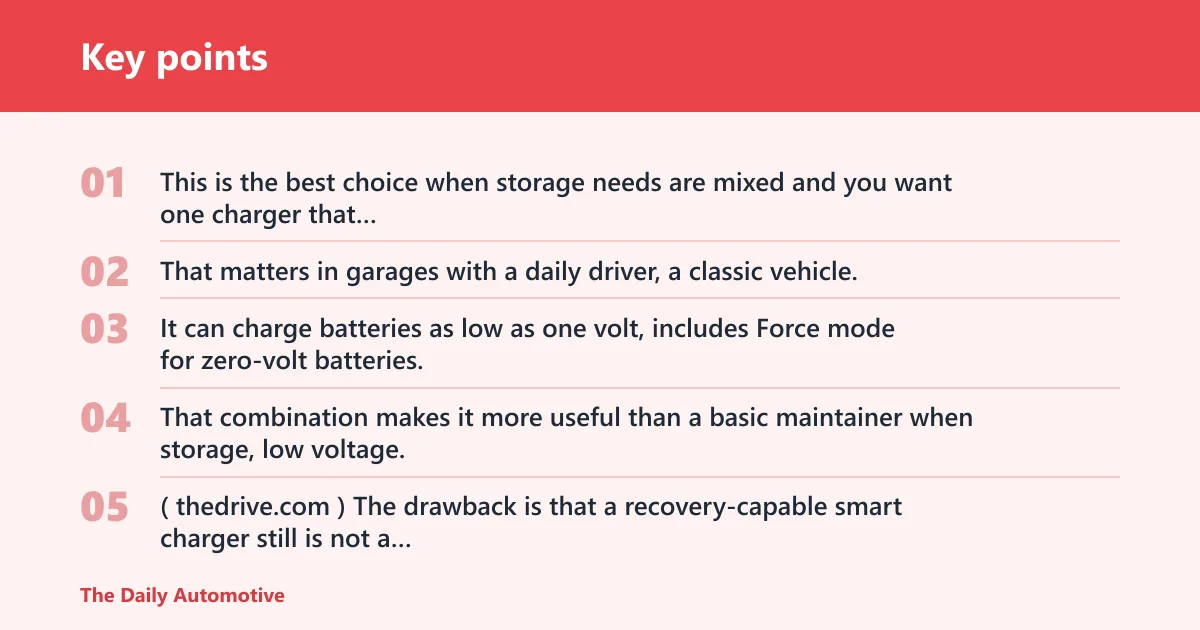
This is the best choice when storage needs are mixed and you want one charger that handles both 6V and 12V batteries. That matters in garages with a daily driver, a classic vehicle, or powersports equipment on different battery voltages.
It can charge batteries as low as one volt, includes Force mode for zero-volt batteries, and adds an advanced battery repair mode. That combination makes it more useful than a basic maintainer when storage, low voltage, and recovery all show up in the same garage. (Thedrive)
The drawback is that a recovery-capable smart charger still is not a guarantee. A deeply damaged battery may not come back, and lithium compatibility should still be checked against the exact battery and charger listing before use.
CTEK MXS 5.0 battery charger: best for 12V lead-acid care
This is the strongest match for 12V lead-acid storage care when you want an automatic charger with recondition support. It works on all 12V lead-acid batteries, charges at up to 4.3 amps, and includes a battery recondition mode.
That makes it a solid choice for flooded, AGM, and other 12V lead-acid setups where long storage can leave the battery less healthy than it should be. The float and pulse behavior also fits long-term storage better than a basic charger that does not stay in a maintenance pattern.
The drawback is the obvious one: it is 12V lead-acid focused, so mixed-voltage garages need to verify compatibility before buying. If you also keep 6V equipment or lithium batteries, this may not cover everything you own.
Which one should you buy?
If you want the cheapest answer for a healthy 12V car that sits for weeks, start with Battery Tender Junior. It covers the storage basics without extra complexity, but it is not a recovery tool.
If your garage includes 6V and 12V batteries, or the car battery is already low, the NOCO Genius5 is the safer all-around choice. It gives you more headroom for mixed storage situations and low-voltage wake-up work.
If the battery is deeply discharged and you need a more recovery-oriented tool, choose the NOCO over a plain maintainer. If the battery is healthy but you want 12V lead-acid care with recondition mode, the CTEK MXS 5.0 is the better fit.
A common first-timer mistake is buying a maintainer for a battery that is already too low. In that case, the charger may sit there harmlessly, but it will not do the job you actually need.
Storage-length decision table
| Storage length | Battery condition | Climate | Right charger type | Why this fits |
|---|---|---|---|---|
| 2 weeks | Healthy 12V lead-acid battery | Mild garage or covered storage | Maintainer | Keeps the battery topped off against self-discharge and normal parasitic draw without constant attention. |
| 2 weeks | Healthy but older battery | Cold garage | Smart charger with maintenance mode | Cold storage raises the risk of a weak battery showing problems after sitting, so a smarter charging profile helps. |
| 1-3 months | Healthy 12V AGM, flooded, gel, or deep-cycle | Any climate | Smart charger with float or maintenance mode | Longer storage increases the chance of gradual discharge, so automatic maintenance matters more than raw charging speed. |
| 1-3 months | Low but still serviceable battery | Cold or hot garage | Smart charger with low-voltage recovery | A maintainer may not wake it, while a charger with recovery mode can get it back to a usable level. |
| 3+ months | Healthy battery | Stable, dry storage | Maintainer plus monthly checks | For long storage, maintenance mode is usually better than letting the battery drift down and hoping for a restart later. |
| 3+ months | Deeply discharged or sulfated battery | Any climate | Recovery charger first, then maintainer | Long storage can worsen sulfation, and a dead battery may need a repair or recovery mode before normal maintenance can work. |
What battery condition changes
A healthy battery can often be kept alive with a maintainer, but a battery that is already deeply discharged needs more than maintenance. Self-discharge happens on its own, and parasitic draw from the vehicle can drain it faster than expected during storage.
That is why a charger with float mode, automatic charging stages, and reverse-polarity protection is the safer default. A recovery mode can help in some cases, but it cannot fix every battery that has sat too long.
How climate changes the choice
Cold storage makes a weak battery more likely to show trouble. Heat also shortens battery life, so an unattended car in a warm garage can still need a maintainer if the vehicle electronics keep drawing power.
If the storage space swings hot and cold, choose a smart charger with temperature-aware charging if the listing supports it. For mixed garages, 6V support and lithium-ion compatibility can matter too, but neither is universal across maintainers.
Battery chargers checklist
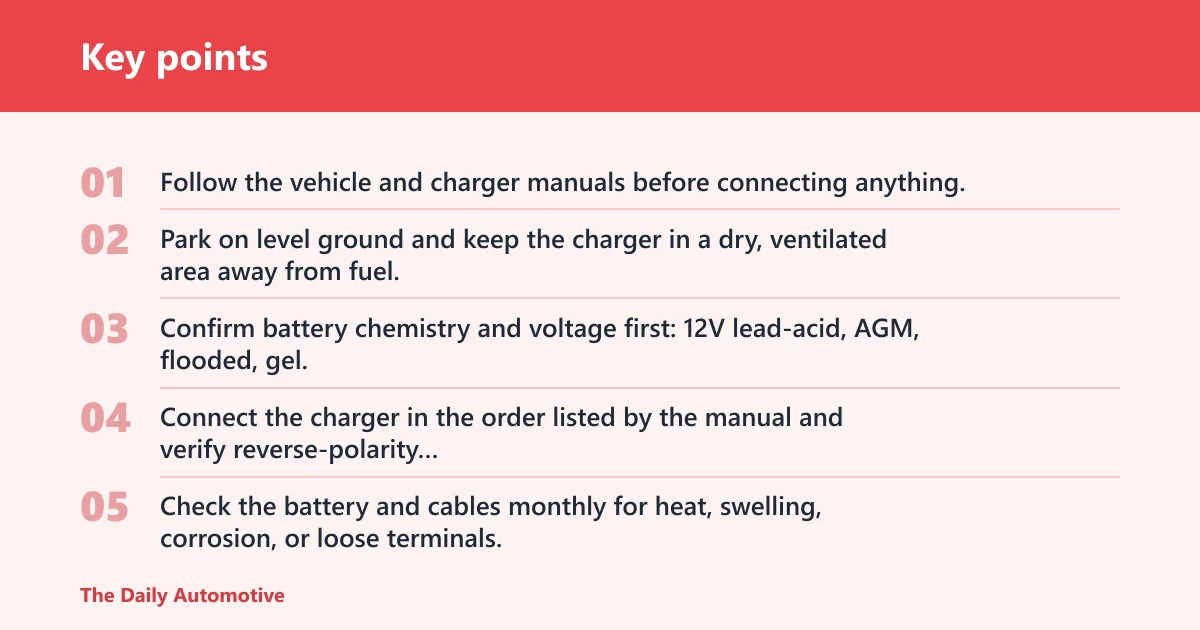
- Follow the vehicle and charger manuals before connecting anything.
- Park on level ground and keep the charger in a dry, ventilated area away from fuel, coolant, and spark sources.
- Confirm battery chemistry and voltage first: 12V lead-acid, AGM, flooded, gel, deep-cycle, 6V, or lithium-ion if supported.
- Connect the charger in the order listed by the manual and verify reverse-polarity protection is active if the charger provides it.
- Check the battery and cables monthly for heat, swelling, corrosion, or loose terminals.
- Recheck storage voltage if the charger does not remain connected full-time.
- Keep the charger where you can reach it without dragging cords across traffic paths or placing them under tires.
Where to store the battery and charger
For convenience and safety, place the charger near the battery but not where it can be knocked over, splashed, or buried under parts. A bench, shelf, or wall-adjacent spot in a dry garage is usually better than the floor, especially if the car stays parked for months.
If the battery stays in the vehicle, route the charger lead so it cannot pinch under a hood or door. If the battery is removed for storage, keep it in a cool, dry place off the concrete floor and check the charger listing for off-vehicle use.
Say your coupe sits in a cold garage for three months with a healthy AGM battery. A maintainer is the right first choice, because the battery mainly needs protection from gradual discharge, not a high-output charge cycle.
Suppose a classic truck has a 6V battery and sits most of the winter. A 12V-only maintainer will not do the job, so a smart charger with 6V support is the better pick.
What is the best battery charger for car storage?
The best charger for storage depends on battery condition and how long the vehicle sits. For a healthy 12V battery, a maintainer is usually the right answer. For mixed garages or batteries that are already low, a smart charger with 6V/12V support and recovery mode is the better choice.
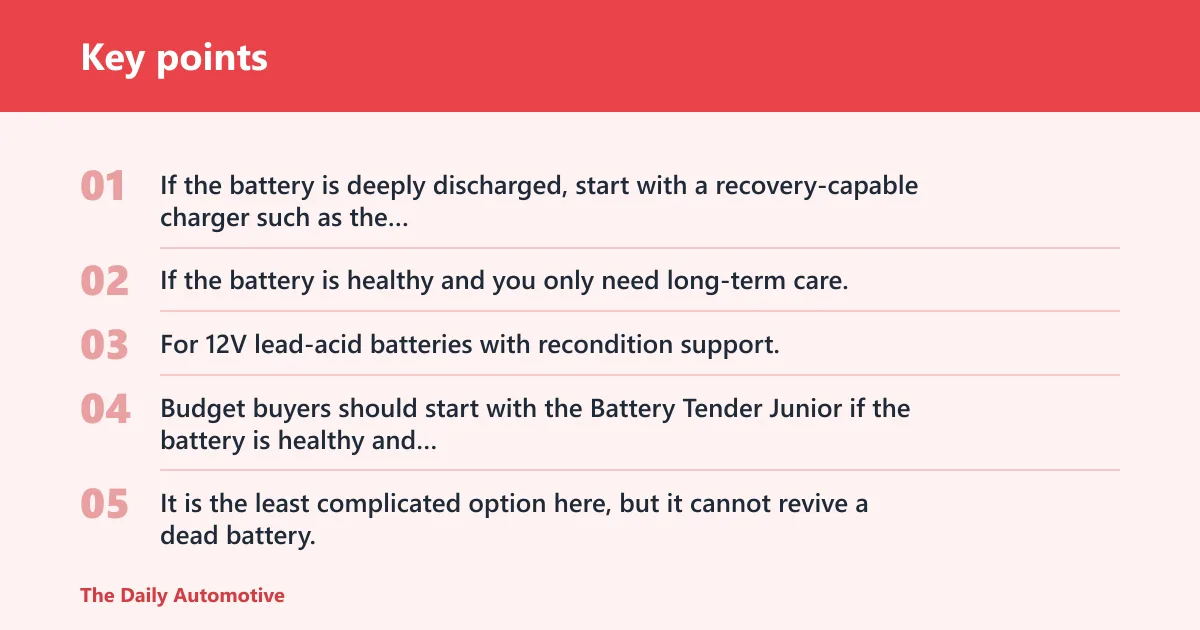
If the battery is deeply discharged, start with a recovery-capable charger such as the NOCO Genius5. If the battery is healthy and you only need long-term care, the Battery Tender Junior is the simpler budget pick. For 12V lead-acid batteries with recondition support, the CTEK MXS 5.0 is the stronger specialty option.
Best pick by budget
Budget buyers should start with the Battery Tender Junior if the battery is healthy and 12V only. It is the least complicated option here, but it cannot revive a dead battery.
Best pick by battery type
For 12V lead-acid batteries, the CTEK MXS 5.0 is the best fit when reconditioning matters. For mixed 6V and 12V garages, the NOCO Genius5 is more flexible.
Best pick by dead or weak battery
If the battery is already very low, pick the NOCO Genius5 rather than a plain maintainer. Its low-voltage charging support and Force mode make it the most useful option in this group for recovery work.
Frequently asked questions
What are the best portable car battery chargers?
For storage, the best portable charger is the one that matches battery voltage, chemistry, and condition. A maintainer is best for healthy batteries, while a smart charger with recovery mode is better for low batteries. Portability matters less than having float mode and the right battery support.
How long do portable car battery chargers last?
The charger itself should last for years if it is stored dry, used within its rating, and kept away from heat and damage. Battery life is a separate issue. A charger can help preserve a stored battery, but it cannot undo age, sulfation, or a battery that is already failing.
Are car battery chargers worth it?
Yes, if the car sits long enough for self-discharge and parasitic draw to matter. A charger can be cheaper than replacing a battery that died during storage. It is especially worthwhile for seasonal vehicles, classic cars, and anything parked for more than a few weeks.
Where should I store my car battery?
Store it in a cool, dry, ventilated place, preferably off the floor and away from sparks, fuel, and direct sun. If it stays in the car, keep the charger setup neat and accessible. If you remove it, follow the battery maker’s storage instructions and keep it on a stable surface.
Should I use a trickle charger for long-term storage?
Use a true maintainer or smart charger with float mode instead of relying on an old constant-output trickle charger. For long-term storage, automatic shutoff and maintenance stages are safer because they reduce the chance of overcharging a healthy battery while it sits.
Can a battery maintainer keep a stored car battery healthy?
Yes, if the battery starts healthy and the maintainer matches the battery type and voltage. It helps offset self-discharge and normal parasitic draw. It is not a rescue tool, though, so a battery that is already deeply discharged may need a recovery charger first.
What battery type works best in storage?
Healthy 12V lead-acid batteries, including AGM and flooded types, are the easiest to manage in storage when paired with the right maintainer. Gel and deep-cycle batteries also need compatible charging profiles. Lithium-ion support exists on some chargers, but it is not universal, so check the listing first.
Products related to this article
Sponsored / affiliate links. As an Amazon Associate I earn from qualifying purchases. I may earn additional commission from eligible campaigns.