Spare Car Key Cost: What You’ll Really Pay
A basic spare key can cost about $25 to $100, a transponder key often about $75 to $250, and a smart fob about $150 to $600; if you have no working key, programming and towing can push the bill much higher. Pick the wrong route and a $60 backup can become a $400 emergency. Here’s what sets the price, when online buying makes sense, and when it wastes money.
Car key types and price breakdown


There is no single car key price. Your quote depends on year, make, and model, plus whether you need only cutting or also chip programming, immobilizer pairing, remote functions, or towing. A plain metal duplicate costs the least. A smart fob costs the most.
Mechanical car key
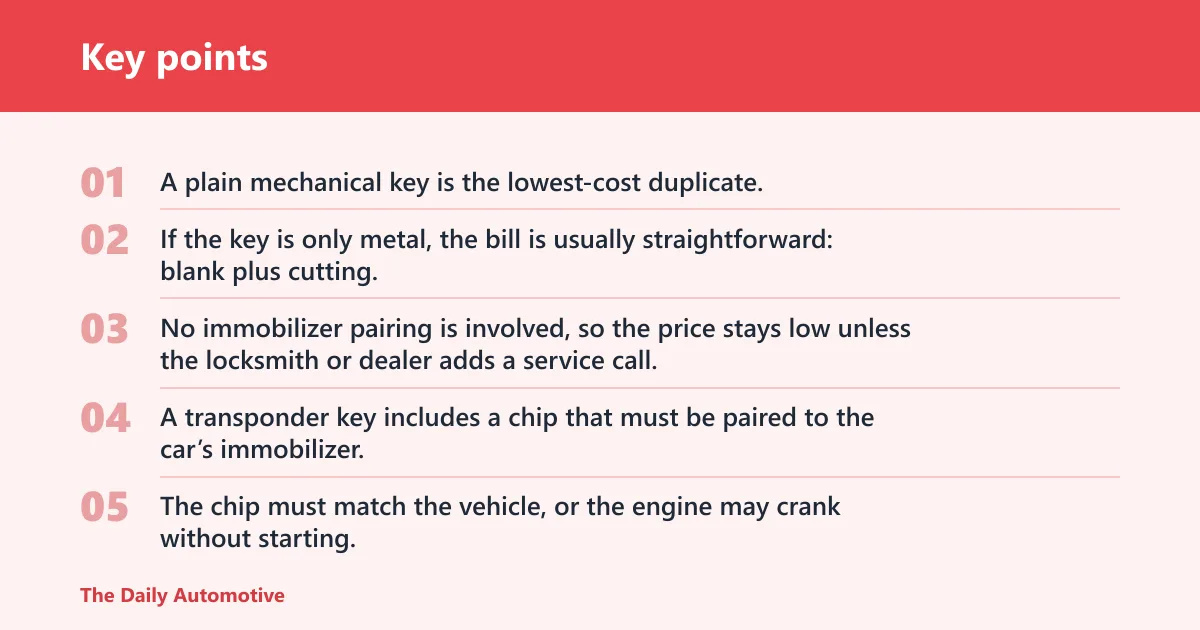
A plain mechanical key is the lowest-cost duplicate. Basic mechanical keys often cost $10 to $30 to cut and duplicate, and a standard metal key can cost $5 to $15 to cut at a hardware store. These are common on older vehicles and on doors or ignitions that do not use a transponder chip.
If the key is only metal, the bill is usually straightforward: blank plus cutting. No immobilizer pairing is involved, so the price stays low unless the locksmith or dealer adds a service call.
Transponder key
A transponder key includes a chip that must be paired to the car’s immobilizer. Transponder keys typically run $50 to $200 including programming, and transponder keys in San Jose are about $120 to $300. The chip must match the vehicle, or the engine may crank without starting.
That pairing step separates a simple duplicate from a programmed replacement. A transponder key blank can run $50 to $200 before cutting and programming are added.
Remote head key and flip key
Remote head keys and flip keys combine the blade and the buttons in one housing. Remote head or flip keys usually land around $90 to $250, and in San Jose they are about $150 to $350. These keys often need cutting plus programming, which puts them above a basic transponder spare.
They also leave more room for mismatch. The button layout, blade style, chip type, and remote frequency all need to match the vehicle.
Smart key and proximity fob
Smart keys and proximity fobs are the highest-cost common category. Smart or proximity fobs commonly run $200 to $500 or more, and push-to-start proximity smart keys in San Jose are about $200 to $500 or more. Luxury or rare-model smart keys can exceed $500.
These systems are tied closely to the immobilizer and vehicle electronics. Smart key fob hardware can cost $150 to $400 before service, and programming is usually part of the job rather than an optional extra.
Suppose a 2018 sedan needs a transponder spare and the owner still has one working key. The price is usually far lower than a lost-all-keys call because the locksmith can copy and pair the new key without forcing a reset. The same car with no working key can become a towing and reprogramming job.
What changes the final quote
The final bill changes most when the vehicle needs more than a cut key. Programming, immobilizer pairing, mobile service, towing, and part-number matching all change the total. Year, make, and model matter because key technology varies by platform, even within the same brand.
Programming and immobilizer pairing
Car immobilizers validate the chip before the car starts. That pairing step adds labor and equipment time, and it is why two keys that look alike can have very different prices. If the chip is wrong, the key may open the door but still fail to start the vehicle.
Service fee, mobile visit, or towing
Dealer pricing often runs higher than locksmith pricing, and the service model differs too. A dealer may require towing if the car cannot be driven in. A mobile locksmith can often come to the vehicle, which may reduce inconvenience even if the service fee is separate.
Parts source and part-number match
Cheap online blanks can backfire when the chip, frequency, or part number does not match the vehicle. That mistake turns a low-cost purchase into wasted money and a second round of programming or replacement. For a quote that holds, the seller must match the exact key family, not only the shape.
- Gather vehicle details. Write down the year, make, model, and trim, then note whether you have one working key, a remote head key, or a smart fob. Those details are the fastest way to separate a simple duplicate from a more complex replacement.
- Check the key type. Look for a chip, buttons, or push-to-start operation. If the key has a transponder or remote functions, do not price it as a plain metal duplicate because programming is part of the job.
- Ask for the full total. Request separate numbers for the blank, cutting, programming, travel fee, and any towing. An all-in quote is the only useful quote when the final bill can change by category.
Picture a push-to-start crossover with one lost fob and one damaged spare. The spare may still cut the bill down, but the remaining key must be confirmed by the immobilizer before a new one is ordered. That check can keep a buyer from paying for the wrong frequency or the wrong button layout.
Car key cost matrix
This matrix shows where the money goes. The line items are different for each scenario, and the total rises when programming, mobile service, or towing enters the job. The numbers below are price bands, not universal quotes.
| Scenario | Parts | Cutting | Programming | Service fee | Likely total price band |
|---|---|---|---|---|---|
| Basic mechanical duplicate | $5 to $15 | $10 to $30 | $0 | $0 to $40 | $10 to $75 |
| Transponder spare with working key | $50 to $200 | $10 to $30 | $50 to $150 | $0 to $75 | $75 to $250 |
| Remote or smart fob spare | $90 to $400 | $10 to $30 | $50 to $200 | $0 to $100 | $150 to $600 or more |
| All-keys-lost replacement | $50 to $400 | $10 to $30 | $100 to $300 | $75 to $200 plus possible towing | $200 to $800 or more |
The last row is where many budgets break. All-keys-lost situations add cost for extra onsite time and programming, and they may require immobilizer reset work that a spare-key job avoids.
Should you use a dealer or locksmith?
For many drivers, a locksmith is the lower-cost and faster route for a spare, while a dealer is safer when the vehicle uses proprietary equipment or when the locksmith cannot source the correct part. The best choice depends on the key type, your location, and whether the car can be driven.
When a locksmith can do the job
A locksmith can often handle mechanical keys, many transponder keys, and many remote head or flip keys. Mobile service helps when the car is stuck at home or at work, because the locksmith can cut and program at the vehicle rather than requiring a tow.
Ask whether the locksmith programs the exact vehicle, not just the blank. Some shops can cut a key but cannot pair every immobilizer or smart-fob system.
When the dealer is the safer option
The dealer is often the safer choice for newer smart keys, proprietary systems, or rare models where the part number must be exact. Dealership replacement often costs $200 to $500, and that higher price can buy better parts matching and fewer guesswork problems.
If the car has no working key and the immobilizer setup is complex, dealer support may be the only realistic path. Towing can add to the cost, so the total should be compared, not the sticker price alone.
How mobile service changes the total
Mobile service can cut downtime, but it can also add a travel fee. That fee may still be worth it if it avoids towing or a second trip. For a spare, mobile service often keeps the job simple because the technician can verify the working key on site.
A common mistake is asking only for the cut price and forgetting the programmed remote or chip cost. The true comparison is blank, cutting, programming, and travel combined.
Why a working spare cuts the bill
A working spare keeps the replacement in the cheaper lane. One working key usually means duplication and programming from an active key, while all-keys-lost work often requires extra time, more equipment, and sometimes immobilizer reset work. That gap is the main reason a spare pays for itself.
One working key versus all-keys-lost
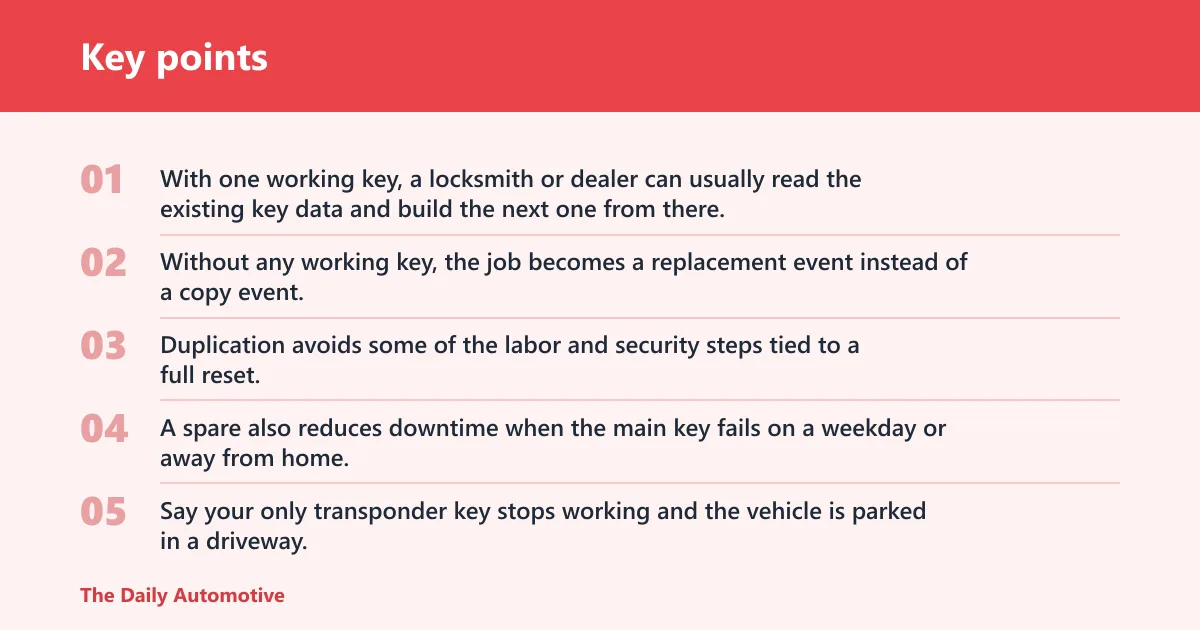
With one working key, a locksmith or dealer can usually read the existing key data and build the next one from there. Without any working key, the job becomes a replacement event instead of a copy event. That is why the bill rises sharply.
Why duplication is cheaper than reset work
Duplication avoids some of the labor and security steps tied to a full reset. The technician does not have to fight a locked-out immobilizer in the same way, and the car is easier to verify once the new key is cut and paired.
How a spare reduces downtime
A spare also reduces downtime when the main key fails on a weekday or away from home. Instead of waiting for towing and a reflash appointment, the car can usually stay in service while the spare is made or programmed.
Say your only transponder key stops working and the vehicle is parked in a driveway. If a working spare exists, the fix is usually a planned duplicate. If no working key exists, the job often becomes an emergency visit with more labor and a higher total.
How to buy the right key online
Buying online can save money when the blank is correct and the seller matches the vehicle exactly. It can backfire when the chip type, frequency, or blade style is wrong. Online buying works best for informed buyers who already know the exact part number and programming path.
- Check chip type and frequency. Confirm the immobilizer chip and remote frequency before ordering. A similar-looking fob with the wrong electronics may not pair, even if the blade fits.
- Match the blade and part number. Compare the blade profile, button count, and part number against the vehicle’s required key family. A match on shape alone is not enough for modern keys.
- Confirm programming support. Make sure the seller states whether the key can be programmed by the vehicle, a locksmith, or only through special equipment. That step determines whether the online bargain stays a bargain.
When online buying helps
Online buying helps most when the owner already has a working key, knows the exact part number, and only needs a spare. In that case, the savings usually come from lower parts cost, while local cutting and programming still complete the job.
When online buying backfires
It backfires when the seller ships the wrong chip, the wrong frequency, or a nonmatching shell. A cheap blank that cannot pair is no bargain. The repair path then doubles back to a locksmith or dealer, and the original purchase becomes wasted money.
What to ask before you book
Before booking, ask for all-in pricing, not a teaser rate. You want to know whether cutting, programming, travel, and warranty terms are included. A clear quote prevents bait pricing and makes dealer and locksmith offers easier to compare.
- Ask for all-in pricing. Request the total for parts, cutting, programming, and any service fee. If the answer is only a base price, ask what can still be added later.
- Confirm what is included. Ask whether the quote covers the blank, the cut, and the programming session. Some shops price those separately, and the gap can be large on smart keys.
- Ask about travel and warranty. Mobile service can be worth it, but only if the travel fee is known in advance. Also ask what happens if the key fails to pair or stops working soon after the visit.
One useful rule: if the quote does not name the key type, the price is not finished. The category is the bill.
Frequently asked questions
How much does a car key cost?
Year, make, model, and programming needs change the total.
How much is a car key?
That depends on the key type and the vehicle’s immobilizer system. A plain metal key is the cheapest, while smart or proximity fobs are the most expensive. Dealer pricing often runs higher than locksmith pricing, especially when the job needs towing or special programming.
How much for a replacement car key?
A replacement car key often costs more than a spare because the vehicle may need programming and verification. If you have no working key, the bill can rise further for onsite service, extra labor, or towing. All-keys-lost work is usually the highest-cost scenario.
How much does a spare key cost?
A spare key can be inexpensive when you still have one working key. Mechanical duplicates are the cheapest, transponder spares sit in the middle, and smart fobs cost the most. The price usually rises when programming is required or when the key must be sourced from a dealer.
Where to purchase spare car key?
You can purchase a spare car key from a dealer, a locksmith, a hardware store for some mechanical keys, or an online seller for the correct blank or fob. The best source depends on whether the key needs only cutting or also immobilizer pairing and remote programming.
Products related to this article
Sponsored / affiliate links. As an Amazon Associate I earn from qualifying purchases. I may earn additional commission from eligible campaigns.