
Head Gasket Repair Cost: What a Fair Quote Includes
Head gasket repair often costs roughly $1,500 to $4,000, but a warped head, cracked block, or overheating damage can raise the bill, and replacement may make more sense once the estimate approaches the car’s value. Ignore it or approve a sloppy repair, and you can end up with repeat overheating, coolant loss, and an engine that fails again. This guide breaks down a head gasket quote line by line so you can spot labor, parts, machining, and hidden add-ons, then judge repair versus replacement with confidence.
Typical cost range
Typical national price range
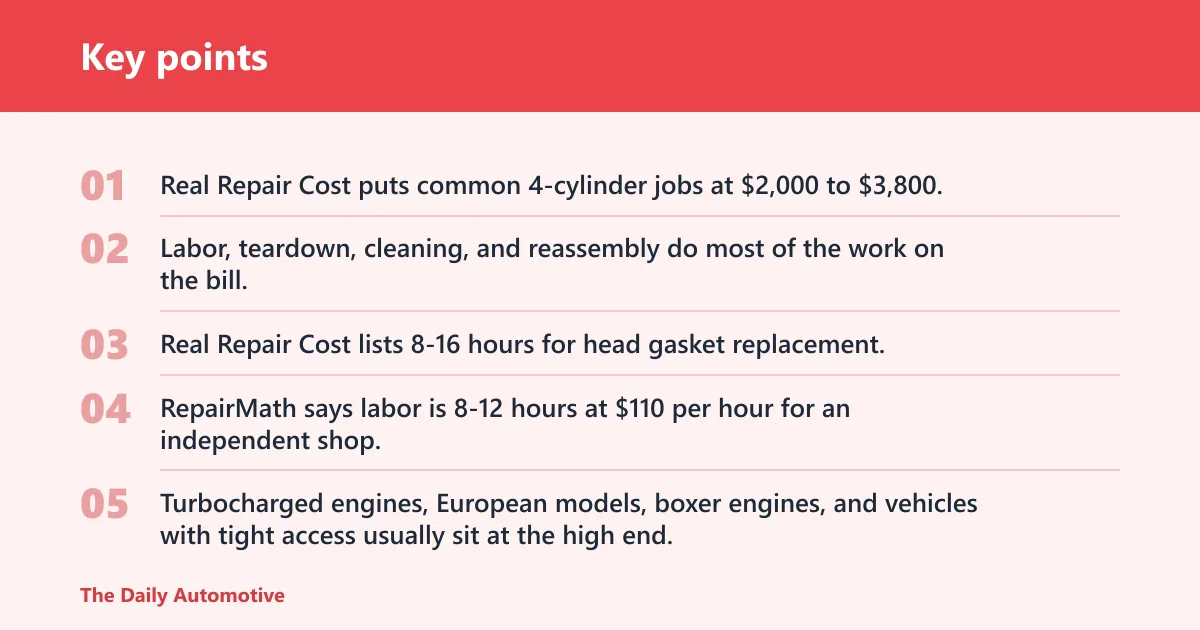
ConsumerAffairs says replacement typically costs around $2,000 or more, while the average cost of repairing a head gasket is $1,500-$2,000. Other industry ranges run wider: RepairMath lists $1,130 to $3,260 per job, and U Pull It puts shop repair at $1,000 to $3,000. Real Repair Cost puts common 4-cylinder jobs at $2,000 to $3,800.
That spread exists because the gasket itself is usually a small part of the total. Labor, teardown, cleaning, and reassembly do most of the work on the bill.
Why labor drives most of the bill
Replacing a head gasket typically takes at least 8 hours of labor, and the job can take 12 hours or more including cleaning and machining. The same source lists 8-16 hours for head gasket replacement. RepairMath says labor is 8-12 hours at $110 per hour for an independent shop. Those hours are the main cost driver.
Turbocharged engines, European models, boxer engines, and vehicles with tight access usually sit at the high end. Some engines have two heads, which means more teardown and more reassembly time.
When the quote starts to climb fast
The bill rises quickly when the head is warped, cracked, or needs pressure testing and resurfacing. It also climbs when the estimate includes timing parts, a water pump, or extra teardown time that was not obvious at first.
Head gasket failure can mix coolant and oil, so a quote that skips flushing, oil service, or cooling-system work can be incomplete even if the bottom line looks low.
Why head gasket repairs cost so much
Head gasket repairs are expensive because the job reaches deep into the engine. The part itself is relatively cheap, but replacement usually requires engine teardown, gasket-set installation, head bolt replacement on many engines, and a careful rebuild. If the head or block has damage, machine work or replacement adds more time and cost.
Engine teardown and reassembly
A proper repair often means removing intake and exhaust components, timing components, valve cover parts, and the cylinder head itself. That is why labor hours dominate the total bill.
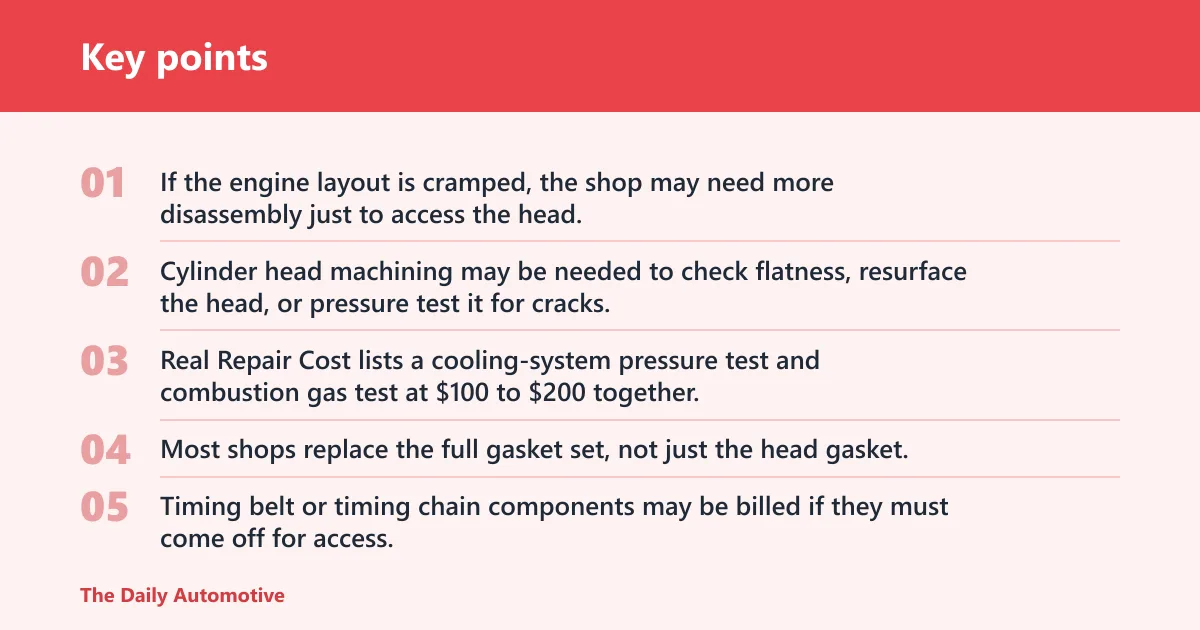
If the engine layout is cramped, the shop may need more disassembly just to access the head. That is common on V6 and V8 engines, and especially on boxer layouts where access is tighter.
Machine work and inspection
Cylinder head machining may be needed to check flatness, resurface the head, or pressure test it for cracks. Those services often add to the repair bill, and a cracked head can force replacement instead of resurfacing.
The same source lists a cooling-system pressure test and combustion gas test at $100 to $200 together. That is money well spent before the job is approved, because a bad diagnosis can turn into a four-figure mistake.
Parts often replaced at the same time
Most shops replace the full gasket set, not just the head gasket. They also often install new head bolts because many modern engines use one-time-use stretch or torque-to-yield bolts.
Related parts often include coolant, oil, and a filter, plus a thermostat or water pump if the cooling system is already open. Timing belt or timing chain components may be billed if they must come off for access.
Head gasket quote decoder table
This is the line-by-line view most estimates skip. Use it to separate a fair repair from a quote that is incomplete, padded, or light on detail.
| Line item | Typical range | When it is legitimate | Red flags |
|---|---|---|---|
| Parts | Usually modest compared with labor; often a full gasket set | When the quote includes the head gasket, intake and exhaust seals, valve cover seals, and related gaskets | Only a single gasket listed when the engine needs a full set |
| Labor hours | 8-16 hours | When the engine layout is tight, the head must come off, and reassembly includes torque sequence and timing work | A flat labor charge with no hours, or a low hour count that ignores teardown |
| Machining | Varies with resurfacing and pressure testing | When the head needs inspection for flatness or cracks, or the engine overheated | No machining on an overheated engine, or a charge with no explanation of what was measured |
| Head bolts | Usually a modest add-on | When the engine uses torque-to-yield or other one-time-use bolts | Reusing stretch bolts on an engine that calls for replacement |
| Fluids | Coolant, oil, and filter are common | When coolant and oil were contaminated or the engine must be refilled after teardown | No fresh fluids listed after coolant-oil mixing |
| Timing components | Can add a meaningful amount | When timing belt or chain parts must come off to reach the head, or service is due | Timing parts added with no explanation of access or service interval |
| Diagnostic tests | $100 to $200 for pressure and combustion gas testing together | Before repair approval, to confirm head gasket failure and rule out another cause | A large repair approved without test results |
What changes the price on your car?
Engine layout, access, and the shop you choose can move the price by thousands. An inline 4-cylinder usually costs less than a V6, V8, boxer, or dual-head engine, and dealer labor rates are usually higher than independent-shop rates. Estimates should be itemized so you can see why one quote is higher.
Engine layout and access
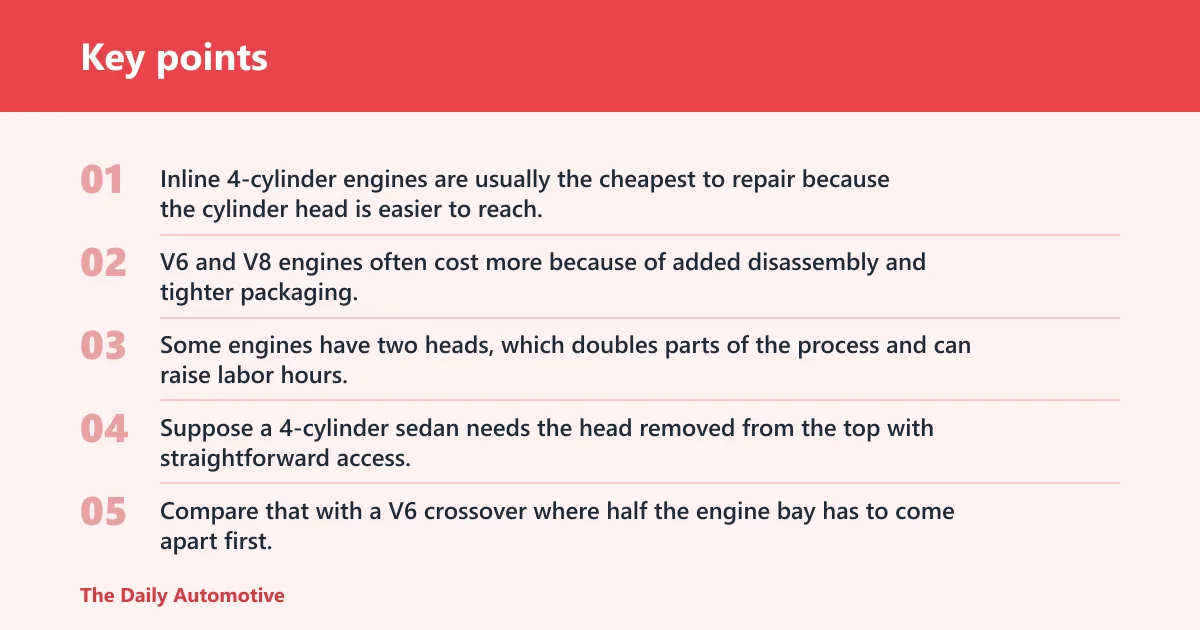
Inline 4-cylinder engines are usually the cheapest to repair because the cylinder head is easier to reach. V6 and V8 engines often cost more because of added disassembly and tighter packaging. Some engines have two heads, which doubles parts of the process and can raise labor hours.
Suppose a 4-cylinder sedan needs the head removed from the top with straightforward access. Compare that with a V6 crossover where half the engine bay has to come apart first. The repair is the same job on paper, but the labor is not the same in the shop.
Turbocharged, European, and dual-head engines
Turbocharged engines often need more labor because extra plumbing and heat shields must come off. European models can be pricier because access is tighter and repair time is longer. The same source lists a BMW 3 Series at $3,700 to $5,700, while a Toyota Camry runs $2,800 to $3,750.
Those numbers are not guarantees, but they show how layout and packaging can change the quote even when the failure is the same.
Independent shop versus dealer pricing
Dealer estimates usually come in higher because dealer labor rates are usually higher. An independent shop may still be the better fit if it itemizes labor hours, machining, bolts, fluids, and diagnostics clearly.
Ask for a written estimate that separates parts, labor, and any inspection fees. If the shop will not split those items, it is harder to tell whether the price is fair.
How do you know it is really the head gasket?
Diagnosis should come before approval, not after the quote is written. A block test or combustion gas test, cooling-system pressure test, compression test, and leak-down test can support the diagnosis and help rule out a cracked hose, radiator fault, or another engine problem.
-
Confirm combustion gas in coolant.
A block test or combustion gas test checks whether exhaust gases are entering the cooling system. That is one of the clearest signs the gasket has failed.
-
Check cooling-system pressure.
A pressure test can show whether the system loses pressure, which helps separate a gasket failure from a leak at a hose, cap, or radiator seam. The same source lists the pressure test and combustion gas test together at $100 to $200.
-
Measure cylinder sealing.
Compression and leak-down tests show whether one cylinder is losing sealing ability. That matters when the engine is misfiring or running rough but the coolant leak is not obvious yet.
-
Match the symptoms.
White exhaust smoke, milky oil, coolant loss, overheating, bubbles in the coolant reservoir, and rough running or misfires all point toward gasket trouble. Any one symptom can have another cause, but several together raise the odds sharply.
Picture a car that overheats on the highway, then starts misfiring at idle and drops coolant with no obvious puddle under it. That pattern fits head gasket failure far better than a simple thermostat issue, especially if the oil turns milky.
What should be included in the repair estimate?
A fair estimate should spell out the parts, the hours, the machining, and any extra work needed to restore the engine. If the quote only lists “head gasket replacement” as one lump sum, ask for a breakdown before you approve it.
Head bolts, fluids, and filters
New head bolts are often legitimate because many modern engines use one-time-use stretch or torque-to-yield bolts. Fresh coolant, oil, and an oil filter are also common after coolant and oil contamination.
If the quote includes oil service without explaining why, ask whether the engine showed signs of cross-contamination. That should be easy for the shop to document.
Thermostat, water pump, and timing parts
Thermostat and water pump replacement can be legitimate if the cooling system is already apart or if overheating likely damaged those parts. Timing belt or chain components may also be included when access requires removal.
Those items are not automatic add-ons. They should be tied to access, service interval, or visible wear.
Machining, head replacement, and extra teardown time
Machining charges are legitimate when the head needs resurfacing or pressure testing. If the head is cracked, replacement may be the only safe option, and that can change the estimate dramatically.
Extra teardown time is legitimate when corrosion, broken fasteners, or a stuck component adds labor. It is not legitimate when the quote grows without a clear explanation of what was found.
Is it worth fixing or should you sell the car?
A common rule of thumb is the 50% of vehicle value rule: if the repair approaches or exceeds half the car’s value, the math starts to weaken. Mileage, age, and the chance of hidden damage after teardown matter too. Older high-mileage cars are more likely to become poor repair candidates.
The 50% of vehicle value rule
If the repair is $3,500 and the car is worth $5,000, the decision is not simple. A car with a strong body, decent service history, and no transmission problems may still be worth fixing. A car with several other major needs usually is not.
Mileage, age, and reliability after repair
Even after a successful repair, the engine may have suffered from overheating. The heads may need machining, the cooling system may need more parts, and a timing service may be overdue. Those added costs can tilt the decision toward selling or replacing the car.
When hidden damage changes the answer
A torn-down engine can reveal a cracked head, damaged valve train parts, or a warped block. That is why the final bill may rise after disassembly even when the first estimate looked reasonable.
Say your sedan is worth $4,000 and the first quote is $2,300. If teardown reveals a cracked head and the revised estimate jumps to $4,800, the repair no longer fits the car’s value. At that point, selling or replacing the vehicle may make more sense.
Can I drive with a blown head gasket?
Driving with a blown head gasket is risky because the engine can overheat again, lose coolant, and suffer more internal damage. Short trips may seem possible if the car still runs, but the condition can worsen fast and turn a repair into an engine-replacement decision.
If the temperature gauge climbs, stop driving. Do not keep adding coolant and hoping the problem disappears, because repeated overheating can crack the head or damage the block.
Frequently asked questions
How much does a head gasket repair cost?
Labor is the biggest driver, and engine layout can move the price well above that range.
How much does head gasket replacement cost?
A quote should show labor hours, machining, bolts, fluids, and related parts separately.
Is it worth fixing the head gasket?
It can be worth fixing if the repair stays well below the car’s value and the rest of the vehicle is solid. If the estimate nears 50% of the vehicle’s value, or teardown reveals a cracked head or other major damage, selling may be the better move.
Why are head gasket repairs so expensive?
The gasket itself is relatively cheap. The cost comes from 8-16 hours of labor, teardown and reassembly, possible machining, new bolts, fluids, and any timing or cooling parts that must come off first. A proper diagnosis also takes time and money.
What makes head gasket repair cost more on some cars?
Engine layout and access matter most. Inline 4-cylinder engines usually cost less, while V6, V8, boxer, turbocharged, and dual-head engines often cost more. Dealer rates also tend to be higher than independent-shop rates, and some cars need more machine work after teardown.
Products related to this article
Sponsored / affiliate links. As an Amazon Associate I earn from qualifying purchases. I may earn additional commission from eligible campaigns.