How Much Does a Car Alternator Cost?
A car alternator usually costs $150 to $500 for the part alone, and a full replacement often lands between $300 and $900 once labor, diagnostics, and shop fees are included. Skip a failing alternator and you can end up with a dead battery, a no-start, or extra towing and diagnostic charges. This guide breaks down parts, labor, testing, core charges, and add-on costs so you can estimate the real bill before you call a shop.
What an alternator replacement really costs


The bill has three parts: the alternator, the labor to install it, and any diagnostic or add-on charges. The part may be cheap on one car and expensive on another, while labor shifts with access, shop rate, and whether the charging system needs extra testing.
Car Talk says alternator replacement can run from around $600 to $1,500, which fits the higher end of harder jobs and dealer pricing. OnlyMechanic lists new alternators at $100 to $600, remanufactured alternators at $50 to $300, labor costs at $100 to $300, and total replacement cost at $200 to $900.
Parts cost vs installed cost
The parts-only number is what you pay for the alternator assembly itself. Installed cost adds labor, and sometimes a diagnostic fee, shop supplies, tax, and a core charge if the old unit must be returned. That is why a quote for the same symptom can differ by several hundred dollars.
A low quote may leave out a battery test, charging-system scan, or tax. A high quote may include OEM pricing, a longer labor book time, or extra work if the belt and tensioner are worn.
What changes the total bill
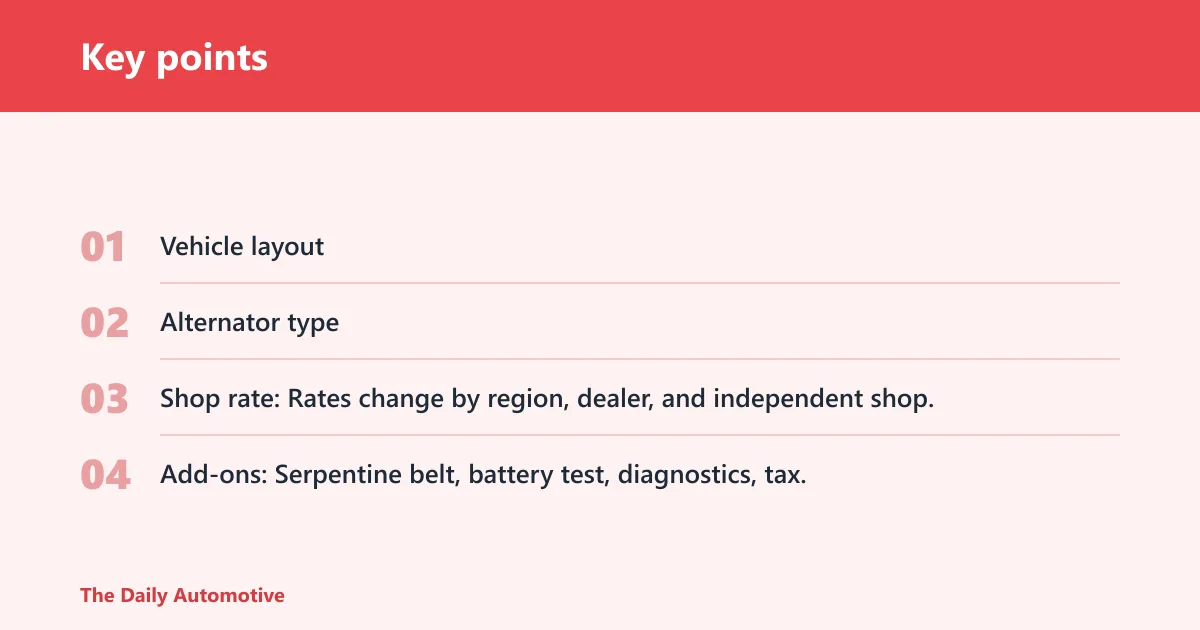
- Vehicle layout: Some alternators sit in plain view. Others sit under intake parts or near the firewall.
- Alternator type: New, remanufactured, OEM, and aftermarket parts carry different prices and warranties.
- Shop rate: Rates change by region, dealer, and independent shop.
- Add-ons: Serpentine belt, battery test, diagnostics, tax, and core charge can all appear on the invoice.
When a quote is too low or too high
If a quote sits far below the common parts-and-labor range, read the line items closely. It may leave out diagnostics, the belt, tax, or a core charge. If it is far above the range, the car may have hard access, a higher-end OEM part, or a charging-system issue that needs more than a simple swap.
Say your compact sedan shows a battery light and dim headlights, but the battery is only a year old. A shop that quotes a diagnostic test plus replacement is giving you more useful information than one that jumps straight to an alternator without checking charging voltage first.
Why does alternator pricing vary so much?
Pricing changes because the same symptom can mean very different work from one vehicle to another. Some cars use a simple front-mounted alternator. Others bury it behind brackets, splash shields, or intake parts, which adds labor time and raises the bill.
Vehicle make, model, and engine layout
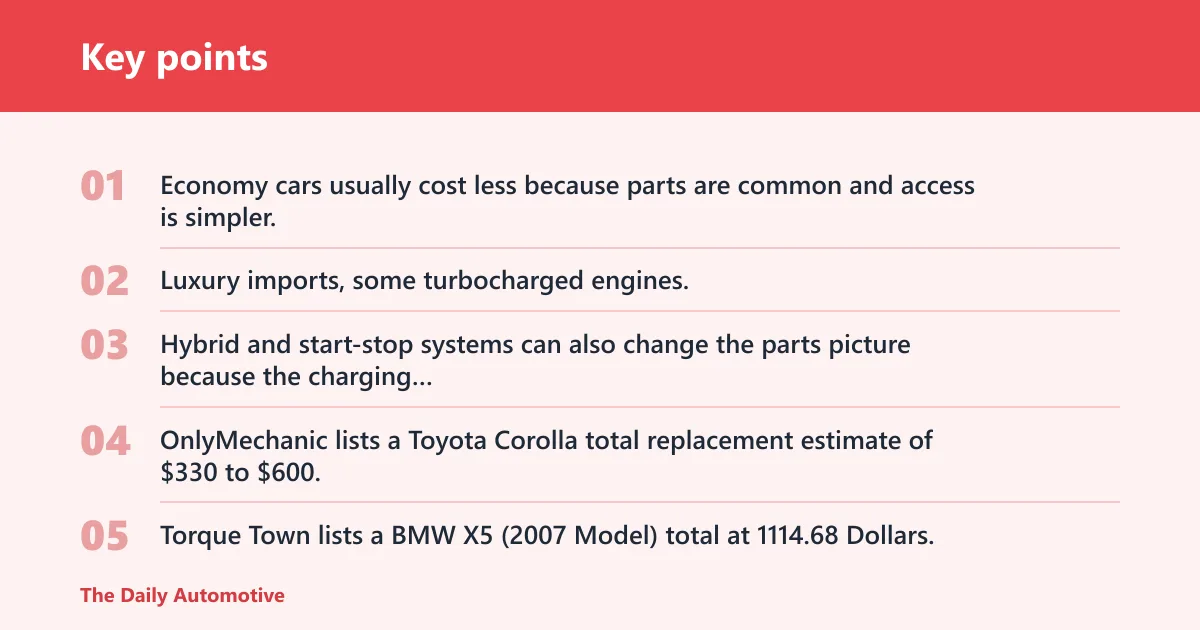
Economy cars usually cost less because parts are common and access is simpler. Luxury imports, some turbocharged engines, and vehicles with cramped engine bays usually cost more. Hybrid and start-stop systems can also change the parts picture because the charging setup may be different from a standard belt-driven alternator.
The same source lists a Toyota Corolla total replacement estimate of $330 to $600, a Honda Civic total replacement estimate of $330 to $600, and a BMW 3 Series total replacement estimate of $650 to $1,100. Torque Town lists a BMW X5 (2007 Model) total at 1114.68 Dollars.
Access difficulty and labor time
Labor cost rises when the alternator is hard to reach. A simple job may take about an hour or less. A buried one can take several hours, especially if the belt drive, intake ducting, or cooling components must come off first. The labor line can be the difference between a $350 repair and a $900 repair.
Dealer, independent shop, and mobile repair rates
Dealers often charge more for labor and may prefer OEM parts. Independent shops usually charge less and may offer remanufactured or aftermarket options. Mobile repair can reduce tow costs, but access and diagnostic limits still matter. The same source says labor is calculated on the basis of 130 Dollars per hour, which is a useful reference point when you compare quotes.
Alternator cost calculator
Use this table to estimate a real installed price before you request a quote. The subtotal combines the part and labor only. Add-ons sit outside the subtotal so you can see what pushes the final invoice higher.
| Vehicle type | Alternator type | Estimated parts cost | Labor hours | Labor rate | Subtotal | Add-ons |
|---|---|---|---|---|---|---|
| Economy sedan | Aftermarket | $120 | 1.5 | $130/hour | $315 | Belt $35, battery test $25, diagnostics $0-$100, tax, core charge |
| SUV | Remanufactured | $220 | 2.5 | $130/hour | $545 | Belt $45, battery test $25, diagnostics $0-$125, tax, core charge |
| Luxury import | OEM new | $480 | 3.0 | $130/hour | $870 | Belt $60, battery test $25, diagnostics $100-$150, tax, core charge |
Example: economy sedan
An economy sedan often sits at the lower end because the alternator is easier to reach and parts supply is broad. If the part is $120 and labor is 1.5 hours at $130 per hour, the subtotal is $315 before add-ons. Once you add a belt, tax, and possible diagnostics, the out-the-door price can climb into the common replacement range.
Example: SUV
SUVs often sit in the middle because access can be tighter and the alternator may be larger. A remanufactured part can keep the bill down, but labor time still matters. If the belt is also worn, replacing it at the same visit is usually smarter than paying the labor twice.
Example: luxury import
Luxury imports can cost much more when the alternator is buried or the charging system uses higher-spec components. OEM parts also tend to cost more than aftermarket or remanufactured units. A $480 part plus three labor hours already pushes the subtotal near $900 before tax and extras.
How to use the line items in your own quote
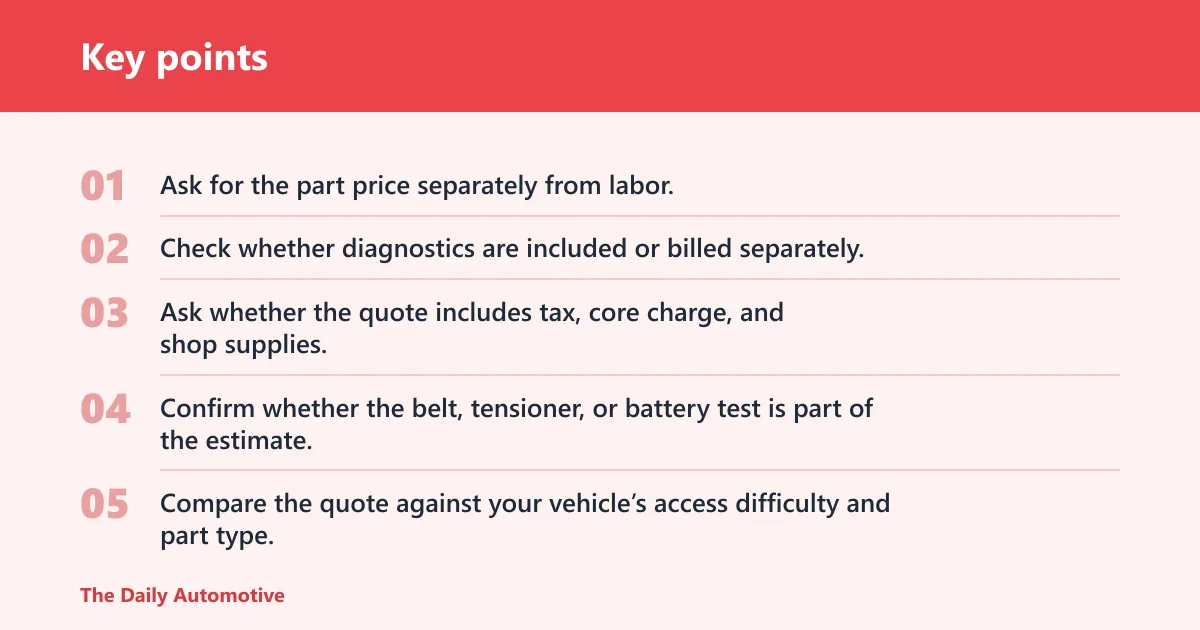
- Ask for the part price separately from labor.
- Check whether diagnostics are included or billed separately.
- Ask whether the quote includes tax, core charge, and shop supplies.
- Confirm whether the belt, tensioner, or battery test is part of the estimate.
- Compare the quote against your vehicle’s access difficulty and part type.
New, remanufactured, OEM, or aftermarket?
New alternators usually cost more than remanufactured units. OEM parts usually cost more than aftermarket parts. The right choice depends on budget, warranty expectations, and how long you want to keep the car.
Price differences
A remanufactured alternator can be a solid value for an older daily driver. A new aftermarket part can split the difference between cost and peace of mind. OEM is often the priciest option, but it can be the best fit when the vehicle is newer or has a sensitive electrical system.
Warranty differences
Warranties vary by brand and seller. In general, longer coverage can make a more expensive part easier to justify. If the vehicle still has extended warranty coverage, check whether the charging system is included before you pay out of pocket.
When each option makes sense
- Remanufactured: Good for older cars, tight budgets, and standard applications.
- Aftermarket new: Often a practical middle ground for most drivers.
- OEM: Better when fit, electronics, or warranty support matter most.
- Dealer-supplied OEM: Usually the most expensive route.
Can you save money with DIY replacement?
Yes, but only if the car is easy to reach, the tools are on hand, and the person doing the work is comfortable with belt routing and charging-system checks. DIY can save labor, but it does not erase the cost of the part, and a mistake can turn a simple job into a tow or a second repair.
Tools and skill level required
You usually need basic hand tools, a serpentine belt tool or long breaker bar on some cars, and a way to verify charging voltage afterward. Some vehicles also need trim removal, wheel well access, or battery disconnection steps. If the alternator sits under intake parts or near the rear of the engine, the job gets less beginner-friendly.
Time savings vs risk
A DIY swap can cut labor to zero, but it can also cost more if the wrong part is ordered or the belt is routed incorrectly. A charging system that still fails after the swap may point to wiring, a fuse, or the battery rather than the alternator itself.
When professional installation is the better call
If you need a diagnostic test, if the alternator is buried, or if the car has start-stop or hybrid-related charging hardware, a shop is the safer choice. Professional installation also gives you a labor warranty and a clear paper trail if the problem comes back.
Should you replace the belt and test the battery too?
Often, yes. The alternator shares a drive system with the serpentine belt, and a worn belt can create noise, slippage, or reduced charging performance. Battery and charging-system testing matter because weak batteries and alternator failures can cause similar symptoms.
Serpentine belt wear and shared drive systems
If the belt is cracked, glazed, or contaminated, replacing it at the same time usually makes sense. The same goes for a weak tensioner or an idler pulley with noise. Paying for labor twice on a belt-driven system is rarely the cheap move.
Battery and charging-system testing
A proper diagnosis should check charging voltage, battery condition, and belt drive function. A failing alternator may produce low charging output, but a tired battery can also trigger warning lights or slow starts. If the battery is old, load testing it before or after the alternator repair helps avoid a repeat visit.
Symptoms that point to the battery instead of the alternator
Dim headlights, a battery light, electrical glitches, or stalling can come from the alternator. The same source says a failing alternator may show dimming headlights, and a dying alternator may also be indicated by a check engine light. But those signs are not proof by themselves. Corroded terminals, a weak battery, or a wiring fault can look similar.
Suppose a compact hatchback cranks slowly in the morning, then starts normally after a jump. That points more toward battery weakness or a parasitic draw than a failed alternator, especially if the charging voltage still checks out after the engine is running.
How much does an alternator cost in the UK and Australia?
Expect the same repair to cost differently in the UK or Australia because labor rates, part sourcing, and currency all change the final number. Imported parts can also shift price quickly. The key is to compare the part, labor hours, and local diagnostic fees rather than relying on a U.S. quote.
Currency and labor-rate differences
Local labor rates and taxes matter more than the headline part price. A shop may quote the alternator in pounds or Australian dollars, and the same part can land differently once labor and GST or VAT are added. Even a familiar job can move up fast on a premium vehicle.
Why local quotes still vary by vehicle
A Corolla, Civic, or similar economy car often stays relatively affordable. A BMW, Land Rover, or other hard-to-access vehicle costs more because labor takes longer and parts are pricier. Torque Town’s 130 Dollars per hour reference shows why labor quickly becomes a major part of the bill.
How to compare imported part pricing
Ask whether the quote uses an OEM part, a local aftermarket part, or an imported remanufactured unit. Then compare the warranty length and the core charge. A cheaper part is not always cheaper once shipping, exchange rates, and repeat labor are counted.
Frequently asked questions
How much does a car alternator cost to replace?
Most drivers should expect a total replacement bill somewhere in the broad $300 to $900 range, with some vehicles falling below or above that depending on access, labor rate, and part choice. The same source says alternator replacement can run from around $600 to $1,500 on the high end.
How much does a new alternator cost with labor?
A new alternator with labor often lands between the cost of the part and the full installed bill, so the final number depends heavily on labor time and the shop rate.
How much does a new alternator cost without labor?
The same source lists new alternators at $100 to $600. The lower end usually fits common applications, while the upper end is more likely for higher-output or less common units. OEM parts can sit above that aftermarket range, especially on luxury or imported vehicles.
How much does a car alternator cost to fix?
“Fix” can mean diagnose, replace, or rebuild, and those are not the same price. A diagnosis may be modest, a remanufactured replacement may be cheaper than new, and a full repair can still require labor, belt work, and tax. Ask the shop which step it is quoting.
How much does an alternator cost at AutoZone?
Store pricing varies by vehicle and part type, so there is no single answer that fits every car. What matters is whether the unit is new, remanufactured, or aftermarket, and whether a core charge applies. Compare the shelf price with the installed quote before deciding.
How much does a new alternator cost for a Toyota Corolla?
The same source lists a Toyota Corolla total replacement estimate of $330 to $600. That total includes labor, so the part alone will be lower than that figure. Corolla pricing is often lower than luxury cars because access is simpler and parts are widely available.
How much does a new alternator cost for a Honda Civic?
The same source lists a Honda Civic total replacement estimate of $330 to $600. That is a realistic middle-market example, not a universal price. Your final bill can move up if the belt is worn, the battery needs testing, or the alternator is harder to reach.
How much does a new alternator cost in the UK or Australia?
There is no single exact quote for the UK or Australia because currency, labor rates, and parts sourcing vary by city and vehicle. Use the same method as in the U.S.: separate part cost, labor hours, diagnostics, tax, and any core charge before comparing quotes.
Does a car alternator always charge?
No. An alternator should charge the battery and power the electrical system when the engine is running, but output can drop if the unit fails, the belt slips, or the wiring is damaged. Charging voltage should be checked during diagnosis rather than assumed from the warning light alone.
Is it cheaper to replace the alternator yourself or pay a mechanic?
DIY is usually cheaper on paper because it removes labor, but only if you already have the tools, the right part, and the skill to do the job safely. A mechanic costs more up front, yet you get diagnosis, faster turnaround, and a labor warranty.
How much does a car alternator cost to replace: for most cars, the installed?
For most cars, the installed replacement cost is best estimated by adding the part price, labor, diagnostics, and any add-ons. A common budget range is $300 to $900, with cheaper economy cars below that and difficult luxury or import jobs above it.
How much does a car alternator cost in usa?
In the U.S., a useful rule is to separate the part from installation before you compare quotes.
Products related to this article
Sponsored / affiliate links. As an Amazon Associate I earn from qualifying purchases. I may earn additional commission from eligible campaigns.