Car Engine Oil Filters for Synthetic Oil Up to 20K Miles
FRAM Ultra Synthetic is the clearest pick for drivers aiming at the longest realistic interval because it carries a 20,000-mile lifespan claim, dual-layer synthetic media, a silicone anti-drainback valve, and 99%+ capture of particles larger than 20 microns; skip it if your engine sees short trips, dust, towing, or other severe-duty use that makes a 20,000-mile drain interval hard to justify. Always start with the owner’s manual and OEM maintenance schedule, since those set the baseline service interval.
Top pick for 20K synthetic intervals


Synthetic oil still picks up metal flakes, soot, fuel dilution, and other contaminants. That means the filter still matters, even when the oil itself is premium. The key point is simple: synthetic oil does not require a special oil filter, but longer drain intervals do require a stronger filter spec stack and a service plan that stays within the owner’s manual and OEM schedule.
Which filters fit your mileage and duty?
Match the filter to the interval you plan to run, not the number on the box. For normal commuting, about 10,000 to 15,000 miles is often the more realistic range; for gentle highway use with extended-drain oil, some filters are marketed with 20,000-mile claims, but severe duty should pull you back toward shorter service and the owner’s manual should remain the deciding baseline.
Quick picks by use case
- 10,000 miles, mixed use: Bosch Premium FILTECH for standard intervals and value-focused service.
- 15,000 miles, extended but moderate use: Royal Purple Extended Life with 15,000-mile protection and 99% filtering effectiveness at 25 microns or greater.
- 20,000 miles, gentle duty: FRAM Ultra Synthetic or Castrol CAS7317, but only when the oil and engine duty cycle support that interval.
- 10,000 kilometers or shorter severe-duty use: WIX XP, especially when towing, dust, or colder starts push you toward a conservative interval.
Say your car sees a 24-mile highway commute, little idling, and no towing. A long-life filter can make sense if the oil is also rated for the interval. Now picture that same car in stop-and-go traffic with winter cold starts and frequent short trips. The filter claim stays the same, but the service plan should not.
FRAM Ultra Synthetic oil filter
FRAM Ultra Synthetic is aimed at long synthetic-oil intervals. Its stated 20,000-mile lifespan claim, dual-layer synthetic media, silicone anti-drainback valve, and 99%+ filtration efficiency for particles larger than 20 microns make it one of the strongest matches for drivers trying to stretch service without moving into severe-duty conditions.
Why it stands out
The SureGrip non-slip surface helps installation, but that is a convenience feature, not the reason to choose it. The real value is the media stack and dirt capacity behind the 20,000-mile claim. If the vehicle spends most of its time on the highway and the oil interval is also extended, this is the kind of filter that belongs in the conversation.
Pass on it if you are trying to force a 20,000-mile interval through short commutes, dusty roads, or heavy load use. In those cases, the oil may still be serviceable, but the filter can be a limiting factor first.
PurolatorBOSS oil filter
PurolatorBOSS is designed especially for synthetic oils and is built around SmartFUSION Technology, a silicone anti-drainback valve, and an Ethylene-acrylic PuroSEAL gasket. Its dirt-holding claim is the standout: 27 grams versus 15 grams for PurolatorONE, which points to more capacity for longer intervals.
Best use case
This is a strong extended-drain option for drivers who want more margin than a standard filter but do not necessarily need to chase the absolute longest interval on the market. It fits especially well when the oil change target is in the 10,000- to 15,000-mile range and the engine sees mostly normal service.
Check the exact vehicle application before buying. Fitment still matters more than brand name, and a capable filter is useless if it is the wrong spin-on size or thread spec.
Other filters to compare
Castrol CAS7317
Castrol CAS7317 uses synthetic media, a silicone anti-drainback valve, and metal endcaps. It is presented as a long-drain synthetic-service option, not a basic short-interval filter.
Mobil 1 M1-110 extended performance oil filter
Mobil 1 M1-110 is an extended-performance aftermarket filter for synthetic oil use. It belongs on the shortlist for drivers who want a known extended-service brand and are willing to confirm application details before purchase.
WIX XP oil filter
WIX XP is positioned for extended service, with a stated 99% filtration efficiency at 35 microns and a stated service limit of up to 10,000 kilometers. It uses a silicone back valve, metal tube and metal caps, and a nitrile sealing gasket. That spec stack makes it a conservative, durable choice when you want extended protection without pretending every engine should run 20,000 miles.
Bosch Premium FILTECH oil filter
Bosch Premium FILTECH is a standard automotive oil filter, and that is the point. It is the budget-friendly choice for typical service intervals, not the best fit for maximum drain intervals. If you change oil on a normal schedule and want a straightforward filter, this is the more sensible lane.
Royal Purple extended Life oil filter
Royal Purple Extended Life is marketed with up to 15,000 miles of protection and about 99% filtering effectiveness at 25 microns or larger. That puts it in the middle ground between standard service and the longest 20,000-mile claims, which is often the sweet spot for extended synthetic intervals.
Oil filter decision table
This is the part that separates marketing claims from realistic service life. A 20,000-mile label is only useful if the engine load, oil interval, and filter construction all point in the same direction. If any one of those three is severe, the safe interval usually drops.
| Commute type | Dust/towing/turbo/severe duty | Recommended filter spec | Realistic mileage band | Red-flag reasons to shorten the interval |
|---|---|---|---|---|
| Highway-heavy commuting | Low dust, no towing, no repeated cold starts | Extended-life synthetic media, silicone anti-drainback valve, high dirt-holding capacity | 15,000 to 20,000 miles | Oil analysis not matching the interval, long idling, or fitment uncertainty |
| Mixed city and highway use | Moderate stop-and-go, occasional short trips | Extended-service filter rated for synthetic oil, strong gasket, silicone anti-drainback valve | 10,000 to 15,000 miles | Frequent short trips, winter cold starts, or visible sludge history |
| Dusty roads or construction zones | High dust exposure | Higher-capacity media and conservative interval planning | 10,000 miles or less | Dust loading, air filter issues, or longer-than-usual idle time |
| Towing or hauling | Repeated load, heat, and extended high-rpm operation | Heavy-duty filter construction, silicone valve, strong endcaps and gasket | 7,500 to 10,000 miles | Oil temp spikes, trailer use, or manufacturer severe-service schedule |
| Turbocharged engine | Heat stress and higher contamination risk | Extended-performance filter only if the oil interval is also conservative | 10,000 to 15,000 miles | Frequent boost, short trips, or hot shutdowns |
| Cold-weather short-trip use | Repeated cold starts and fuel dilution risk | Silicone anti-drainback valve and shorter interval | 5,000 to 10,000 miles | Slow warm-up, moisture buildup, and fuel dilution |
What matters most in a long-life filter?
Media capacity and filtration efficiency matter first. A filter can only hold so much dirt before restriction rises, and a long-life filter needs enough capacity to stay useful through the interval. Anti-drainback performance comes next for cold starts, then gasket quality, endcaps, and exact fitment.
Anti-drainback valve, explained plainly
A silicone anti-drainback valve is worth paying attention to because it helps keep oil from draining back out of the filter when the engine sits. That supports cold-start protection, reduces dry-start risk, and generally handles heat better than cheaper valve materials. It is not a magic upgrade, but it is one of the more meaningful parts of a long-life design.
Filtration efficiency, in plain terms
When a brand claims 99% efficiency at 20 microns or 25 microns, that means it is capturing most particles at or above that size under the test conditions used by the maker. Smaller numbers are not automatically better in isolation; you still need dirt-holding capacity and low restriction over time.
FRAM’s 99%+ claim above 20 microns is more aggressive than a 25-micron claim on paper, while Royal Purple’s 99% effectiveness at 25 microns or greater still places it in extended-life territory. WIX XP’s 99% filtration efficiency at 35 microns is paired with a shorter stated limit, which is a reminder that efficiency alone does not define service life.
When standard OEM-style filters still win
If the vehicle follows a normal drain interval and the driving pattern is mostly gentle, a standard OEM-style filter can be the better choice. It is often the smarter answer for price, fitment certainty, and uncomplicated maintenance. Extended-life aftermarket filters earn their keep only when the interval and duty cycle actually need them.
Can an oil filter really last 20,000 miles with synthetic oil?
Yes, but only under the right conditions. A 20,000-mile claim is believable when the filter is built for extended service, the oil is also rated for that interval, and the engine sees mostly clean, steady driving. Short trips, dust, towing, turbo heat, and cold-weather use make that claim much less convincing.
When to ignore a 20,000-mile label
Ignore the label if your vehicle spends much of its life on short hops, sits in traffic, tows, or sees repeated winter cold starts. Those conditions load the oil and filter faster than a marketing sheet suggests. In those cases, 10,000 miles is often the safer cap, and 15,000 miles is already a stretch worth justifying with the actual duty cycle.
A common first-timer mistake is treating the filter’s mileage claim as the oil’s drain interval. The two are related, but they are not the same thing. If the oil is due sooner, the filter is not the limiting factor; if the filter is undersized, it can become a limiting factor before the oil is truly ready to stay in service.
Frequently asked questions
What oil filter is best for synthetic oil?
The best filter for synthetic oil is the one that matches your drain interval and driving severity. For the longest realistic intervals, FRAM Ultra Synthetic and Castrol CAS7317 are strong fits; for 15,000-mile service, Royal Purple Extended Life or PurolatorBOSS are better matches; for standard intervals, Bosch Premium FILTECH is usually enough.
Do I need a special oil filter for synthetic oil?
No. Synthetic oil does not require a special filter. What changes is the interval. If you plan longer drains, look for synthetic media or multi-layer media, a silicone anti-drainback valve, and a filter that lists a service life that matches the oil change plan.
Is a silicone anti-drainback valve worth it on a synthetic oil filter?
Usually yes, especially for cold starts and engines that sit overnight or longer. Silicone is favored because it resists heat better and helps prevent dry starts by keeping oil in the filter. It matters most in cold weather, short-trip use, and turbocharged applications.
How do I choose an oil filter for a 15,000-mile oil change interval?
Choose a filter with extended-life media, a strong anti-drainback valve, and a dirt-holding claim that fits the interval. Royal Purple Extended Life, PurolatorBOSS, and some extended-performance Mobil 1 applications are more suitable than basic standard filters. Verify exact vehicle fitment before buying.
Which oil filter has the best filtration efficiency for synthetic oil?
On the listed claims, FRAM Ultra Synthetic’s 99%+ capture of particles larger than 20 microns is one of the strongest fine-particle claims here. Royal Purple’s 99% filtering effectiveness at 25 microns or greater is also strong. The better filter is the one whose efficiency matches your required interval and capacity.
Are synthetic oil filters compatible with conventional oil too?
Yes. A synthetic-oil-capable filter can generally be used with conventional oil as long as the fitment is correct. The filter does not care which base oil is in the sump; what matters is whether the filter construction matches the service interval and the engine’s duty cycle.
Products related to this article
Sponsored / affiliate links. As an Amazon Associate I earn from qualifying purchases. I may earn additional commission from eligible campaigns.
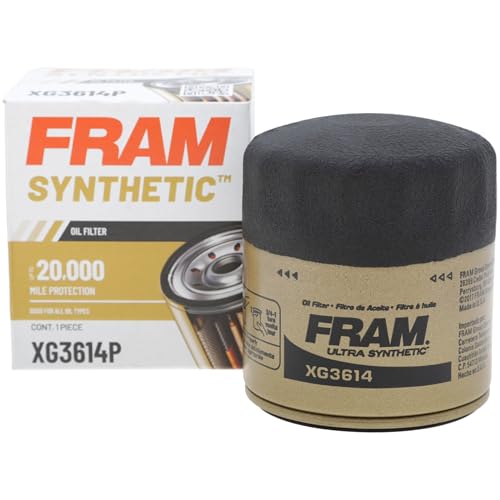 FRAM Synthetic XG3614P 20K Mile Change Automotive Replacement Engine Oil Filter for Synthetic Oil Changes, Premium Vehicle Engine Protection Oil Filter for Select Vehicle Model Years
 ECOGARD X10023 Cartridge Engine Oil Filter for Conventional Oil - Premium Replacement | Fits 2018-2023 Volkswagen Atlas 3.6L; 2020-2023 Atlas Cross Sport 3.6L