Turo Protection Plan Review: Is It Worth the Cost?
Turo protection is worth buying when the deductible is less than the amount you could pay after a scrape, theft, or total-loss claim. If not, skip it and self-insure. A bad choice can turn a cheap rental into hundreds or thousands of dollars in out-of-pocket costs. This guide compares Turo plans by deductible math, trip price, and vehicle value so you can pick the right one before booking.
This guide is part of our Car laws and compliance guide series.
What Turo protection plans actually cover
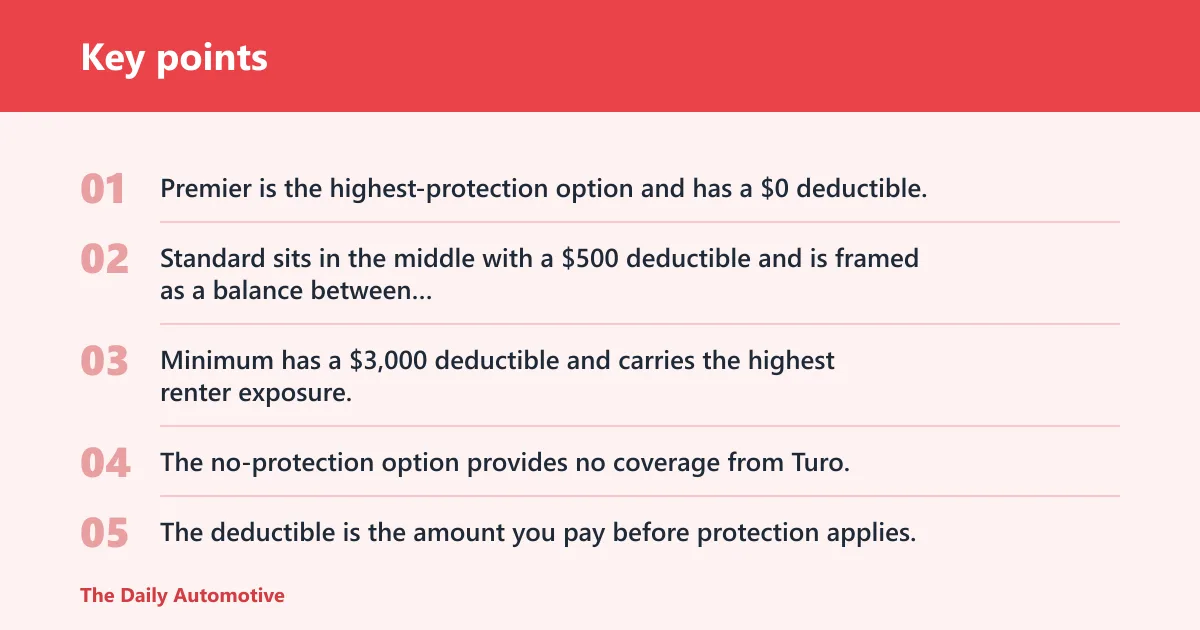
Turo offers four renter options: Premier, Standard, Minimum, or no protection. The choice comes down to how much loss you keep if something goes wrong, with deductibles of $0, $500, or $3,000, or no Turo coverage at all.
Premier, Standard, Minimum, and no protection
Premier is the highest-protection option and has a $0 deductible, so it gives you the lowest out-of-pocket risk if a covered claim occurs. Standard sits in the middle with a $500 deductible and is framed as a balance between cost and coverage. Minimum has a $3,000 deductible and carries the highest renter exposure. The no-protection option provides no coverage from Turo.
How deductibles change your exposure
The deductible is the amount you pay before protection applies. On Turo, that amount drives the decision. If a repair bill is below your deductible, you pay the full amount yourself. If the bill is above the deductible, you still pay the deductible amount.
When personal insurance becomes the backup
If you decline Turo protection, your own auto policy becomes the main backup only if it extends to peer-to-peer rentals. That is not automatic. You need to verify rental-car and peer-to-peer coverage, any exclusions for rented vehicles, and whether any card benefit applies before you rely on it.
📊 Turo had 360,000 active vehicle listings as of March 2024. Source: Turo (company).
How much does Turo protection cost in practice?
In practice, Turo protection costs are easier to judge by exposure than by sticker price. The deductible tells you how much of a claim you can absorb, while the trip price and the car’s value shape how likely that deductible is to feel reasonable.
What the deductible means for your trip budget
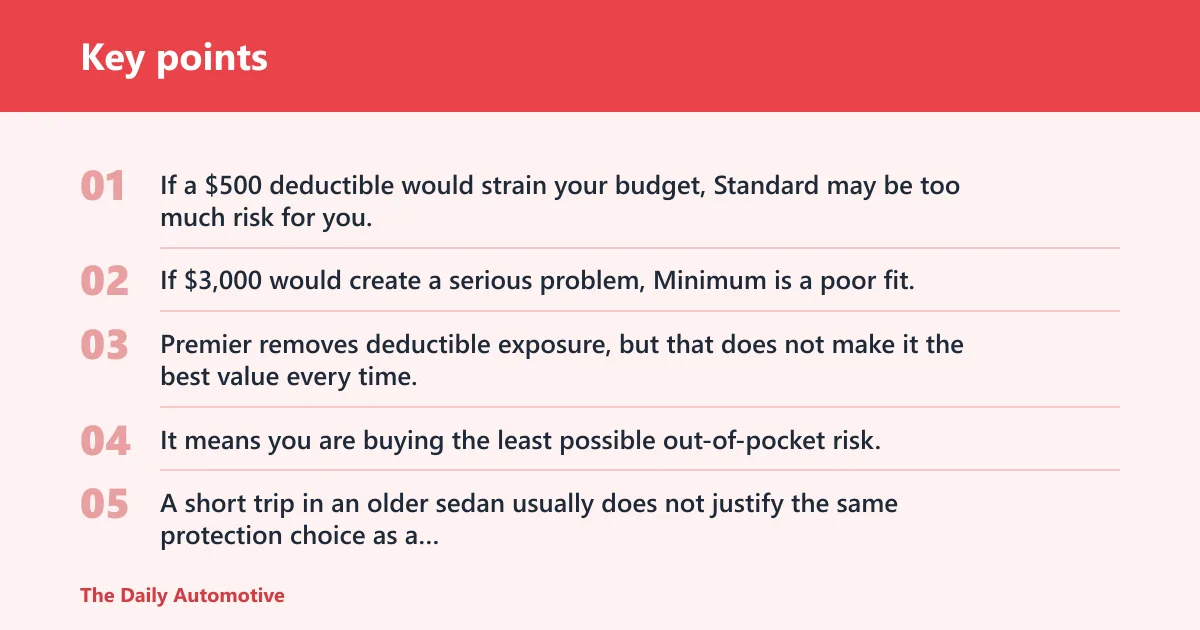
If a $500 deductible would strain your budget, Standard may be too much risk for you. If $3,000 would create a serious problem, Minimum is a poor fit. Premier removes deductible exposure, but that does not make it the best value every time. It means you are buying the least possible out-of-pocket risk.
How trip price and car value change the decision
A short trip in an older sedan usually does not justify the same protection choice as a week in a newer luxury SUV. Higher-value vehicles can mean higher repair bills, pricier parts, and a greater chance that even a minor incident becomes painful under a large deductible. Vehicle value should matter as much as trip length.
When a low deductible can still be the better deal
Say your trip costs are modest, but the car is expensive and hard to replace. A lower deductible can still be the smarter trade if one incident would create a bill you cannot easily absorb. That is especially true for renters who do not want any surprise cash call after pickup.
Premier plan: when $0 deductible makes sense
Premier makes sense when you want maximum protection and no out-of-pocket expense in a claim. With a $0 deductible, it is the clearest answer for renters who value certainty over saving a few dollars on protection terms.
Best fit for expensive or hard-to-replace vehicles
Premier is the most defensible choice for higher-value cars, specialty vehicles, and situations where even a minor incident could lead to a large repair bill. It also fits renters who would struggle to pay a deductible quickly. If a claim would disrupt your cash flow, Premier reduces that stress.
Who should pay more for lower out-of-pocket risk
First-time renters, business travelers with fixed budgets, and anyone unfamiliar with a vehicle’s condition often have good reasons to choose Premier. The extra protection is easier to justify when the downside of a claim would be hard to absorb. The goal is predictability.
Where Premier can be overkill
Premier can be excessive for a low-value car on a low-stakes trip, especially if you already have verified backup coverage and can comfortably handle a small repair bill. If you are willing to self-insure, paying for the highest protection level may cost more than it returns.
Is Turo Standard protection worth it?
Yes, Standard is usually the most practical choice because its $500 deductible splits the difference between cost and coverage. It limits exposure without pushing you into the highest-priced protection tier, which is why it works for many renters.
Why $500 is the middle-ground deductible
A $500 deductible is small enough to blunt the impact of a common repair bill, yet not so low that you pay for maximum protection on every trip. That middle position matters for everyday renters who want a reasonable cap on loss without paying for more coverage than they need.
Which renters benefit most from Standard
Standard fits most renters who can handle a manageable bill but do not want to risk a large surprise charge. It is also a better fit when the car is valuable enough that a minor dent or wheel issue could get expensive fast. For many people, that is the right fit.
When Standard is cheaper than self-insuring
If one moderate incident would cost far more than the added protection price, Standard can be cheaper in practical terms even before a claim happens. The question is not only what you pay up front. It is what a scratch, curb strike, or failed parking maneuver could cost later.
Is Turo Minimum protection worth it?
Minimum is only worth it for renters with very high risk tolerance and enough cash to absorb a $3,000 deductible. It is the highest-risk protection tier because one covered claim can still leave you with a very large bill.
What a $3,000 deductible means after a claim
A $3,000 deductible means you are still on the hook for the first $3,000 of a covered loss. For many renters, that is a major financial hit. It is large enough that even a single claim can feel like a near-total loss of any savings from choosing a lower-protection option.
Why this plan puts more risk on the renter
Minimum shifts more of the loss back to you. That may work only if you are comfortable acting as your own insurer for smaller and mid-sized damage. If not, the plan can leave you exposed to a repair bill that is larger than the entire trip budget.
Cases where Minimum only fits high risk tolerance
Minimum makes the most sense when the renter has backup savings, strong familiarity with the car, and a willingness to self-insure against smaller damage. If any of those are missing, the deductible is likely too high for the amount of risk shifted back to you.
What happens if you decline Turo protection?
If you decline Turo protection, Turo provides no coverage, and the remaining path is your own auto insurance if it applies. That makes policy verification essential before booking, because coverage for peer-to-peer rentals is not something you should assume.
How personal auto insurance fits in
Some personal auto policies may cover rental vehicles, but limits and exclusions vary. Peer-to-peer rentals can be treated differently from conventional rental cars, so you need to confirm that your policy applies to this exact type of trip. Do not treat “I have insurance” as proof of coverage.
Why you should verify rental coverage before booking
Before you book, confirm three things: whether your insurer covers Turo-style rentals, whether any deductible on your personal policy is acceptable, and whether your card benefit applies to peer-to-peer rentals. Without those answers, declining Turo protection shifts a lot of uncertainty onto you.
What full renter responsibility looks like
Without Turo protection, any covered loss may become your problem to solve through personal insurance, card benefits, or direct payment. If neither backup applies, you could be paying the full repair or loss amount yourself. That is the risk you accept by declining coverage.
Plan-by-plan cost comparison for real claim scenarios
The table below shows how deductible math changes your exposure in three common damage scenarios. It does not include the stress of waiting on a claim, but it does show the hard number that matters most: what you could owe out of pocket.
| Scenario | Estimated damage amount | Premier | Standard | Minimum | No Turo protection |
|---|---|---|---|---|---|
| Bumper damage | $1,200 | $0 | $500 | $1,200 | $1,200 or more, depending on personal coverage |
| Wheel or tire damage | $900 | $0 | $500 | $900 | $900 or more, depending on personal coverage |
| Larger body damage | $4,500 | $0 | $500 | $3,000 | $4,500 or more, depending on personal coverage |
This table shows the core tradeoff. With Premier, your exposure is $0. With Standard, it is capped at $500. With Minimum, a serious claim can still leave you with $3,000 out of pocket. Declining protection can leave you exposed to the full amount if your own policy does not respond.
Picture a compact SUV with a scraped rear quarter panel after a tight parking mistake. The bill lands at $2,400. Under Standard, the likely direct exposure is still $500. Under Minimum, it jumps to $2,400. That gap is why the deductible choice matters more than the plan name.
Which Turo protection plan should you choose?
The best plan depends on what you can absorb after a claim, not on the trip length alone. Standard is the most practical choice for most renters, but first-time renters and higher-value-car renters often benefit from more protection, while low-risk, budget-focused travelers may decide to self-insure.
First-time renter decision
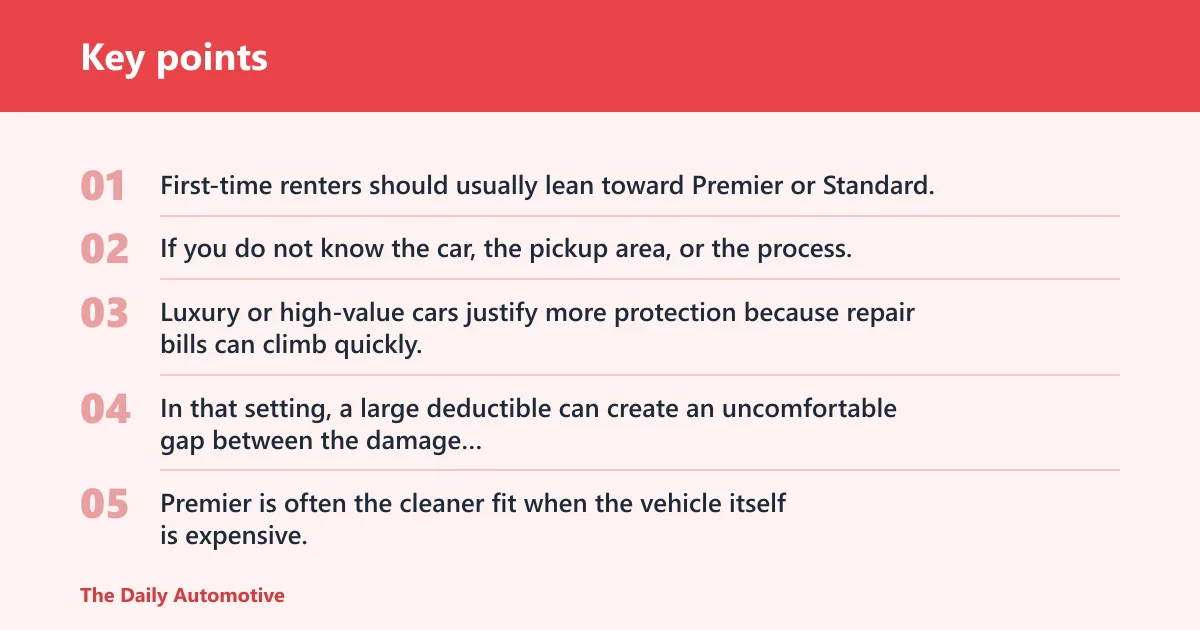
First-time renters should usually lean toward Premier or Standard, because unfamiliarity raises the chance of small mistakes and makes claims harder to manage. If you do not know the car, the pickup area, or the process, paying for lower exposure is often the safer call.
Luxury or high-value car decision
Luxury or high-value cars justify more protection because repair bills can climb quickly. In that setting, a large deductible can create an uncomfortable gap between the damage and the cash you must cover. Premier is often the cleaner fit when the vehicle itself is expensive.
Budget traveler decision
Budget travelers should compare the protection cost against the amount they could pay without strain. If the trip is inexpensive and the car is lower value, Minimum or even no protection may look tempting. But if a repair bill would wipe out the savings from the trip, Standard is the safer middle ground.
Business trip decision
Business travelers often want fewer surprises. Standard is usually the best default because it limits exposure while avoiding the highest protection cost. If the trip has tight scheduling or a late-model vehicle, Premier may be worth the extra certainty.
Frequently asked questions
What is the deductible on Turo Standard protection?
The deductible on Turo Standard protection is $500. That makes it the middle-ground choice between Premier’s $0 deductible and Minimum’s $3,000 deductible. For many renters, that is the amount that defines whether the plan feels reasonable or too risky.
Can I rely on my personal insurance with Turo?
Only if your insurer confirms that your policy covers peer-to-peer rentals and the deductible is acceptable to you. Many policies have rental limits or exclusions, so you need to verify the details before you assume you are protected. Declining Turo without checking can leave you fully exposed.
Products related to this article
Sponsored / affiliate links. As an Amazon Associate I earn from qualifying purchases. I may earn additional commission from eligible campaigns.