5 Best LED Lights for Night Driving: Based on Specs and Reviews
The best car interior LED lights for night driving are dimmable, low-glare kits with warm-white or red modes, plus a control method you can reach without digging through menus. For most drivers, a fixed 12V strip or a simple warm-white bulb swap is safer than flashy RGB effects because it cuts fumbling without throwing light onto the windshield.
Quick comparison
| Product | Badge | Best for | Price | ||
|---|---|---|---|---|---|
 |
12 Volt LED Lights BarANYPOWK | Our pick | 13.4 inch · 3000K · pack of 2 | $19.99
Price as of 10 Nov 2026
|
View |
 |
AUXITO 194 LED Bulb 6000K White 168 2825 W5W T10 WedgeAUXITO | Also great | 6000K white · 10-pack · 194/T10 | $11.04
Price as of 10 Nov 2026
|
View |
 |
Qasim 578 212-2 Led Bulb 44mm Warm White Festoon Bulb 10-SMDQasim | Also great | 44mm · warm white · 6-pack | $10.44
Price as of 10 Nov 2026
|
View |
 |
Wireless Car Interior LED Lights Remote RGB Ambient MotionNDLBYR | Upgrade pick | RGB ambient · wireless · rechargeable | $27.88
Price as of 10 Nov 2026
|
View |
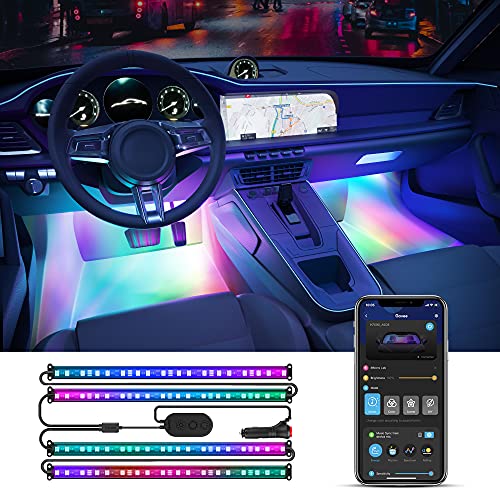 |
Govee Car LED Strip LightsGovee | Also great | RGBIC · app control · strip lights | $28.99
Price as of 10 Nov 2026
|
View |
The safest setups keep light below eye level and away from reflective trim. The tradeoff is plain: wired 12V kits are steadier for daily commuting, while wireless and app-controlled kits add flexibility but can create more distraction if you leave them bright or set to the wrong color.
Interior LED decision matrix
| Light type | Safety | Glare risk | Install difficulty | Power source | Control method | Best-use case | Avoid if |
|---|---|---|---|---|---|---|---|
| 12V LED strip lights | Good when mounted low in footwells, doors, or under dash | Medium if strips face the windshield or bright trim | Low to medium | 12V vehicle power or cigarette-lighter powered kit | Switch, remote, or app depending on kit | Daily night commuting, older vehicles, steady cabin coverage | Harsh footwell glare, adhesive peel, light aimed at glass |
| USB-powered wireless lights | Good for temporary or shared vehicles if kept dim | Low to medium | Low | USB-C rechargeable battery | Remote or onboard button, sometimes motion sensor | Short-term installs, rideshare, quick cabin cleanup | Battery anxiety, frequent charging, long overnight shifts |
| App-controlled RGB kits | Fair if you lock in a low-brightness preset | Medium to high if used in bright colors or animated modes | Medium | Usually 12V vehicle power | Smartphone control with preset scenes and brightness control | Drivers who want custom scenes and frequent changes | Phone-only control, menu digging, distraction-prone drivers |
| Wireless remote kits | Good if the remote is easy to reach | Medium if modes are overused | Low | Usually rechargeable battery or vehicle power | Wireless remote from the driver seat | Quick brightness changes without opening an app | Lost remotes, mode overload, settings that reset too easily |
| Replacement interior bulbs | Good for dome, map, and courtesy lights when kept white and dim | Low if matched to the fixture | Low to medium | Vehicle socket | Factory switch | Interior fixtures that need simple, stock-looking light | Polarity issues, wrong socket size, glare from exposed emitters |
For night driving, the safest choice is usually the one you can leave on low without thinking about it. That means fixed 12V strips or simple replacement bulbs for many commuters, while app-heavy RGB kits make more sense when color control matters more than speed.
How we chose
These picks are based on manufacturer specs, listing details, and published buyer feedback patterns. The filters were night-time glare risk, install complexity, power source, and whether the control method is easy to use from the driver seat.
Only products with clear interior use, defined power information, and a believable cabin role made the list. Kits that leaned hard into animation without a practical low-light mode were treated as weaker night-driving choices.
ANYPOWK 12V LED light bars: best for fixed cabin coverage
This kit fits drivers who want warm cabin light without a lot of setup fuss. It is a 12V-24V DC stick-on strip set with warm white 3000K output, and the listing says it is meant for RVs, vans, boats, trailers, and campers, which makes it a reasonable stand-in for many cars, trucks, and SUVs too.
The appeal is simple: 12V power, flexible strips, adhesive backing, and a light color that is less harsh than cool white at night. Placement still matters. Footwells, lower dash areas, and door pockets help visibility; mounting high on reflective trim can throw light into the windshield.
One drawback is that adhesive-backed strips can peel if the surface is dusty, textured, or constantly flexed. Another is that strip lighting can create footwell glare if the LEDs point straight up instead of toward the floor or trim edges.
Qasim 44mm warm white festoon bulbs: best for stock fixtures
This is the best fit for drivers who want a simple bulb swap inside factory dome, map, or courtesy lights. The listing describes warm white 12V DC festoon bulbs in a 6-pack, so the main advantage is staying close to the vehicle’s original lighting layout.
For night driving, replacement bulbs work well when you want usable light without adding another control layer. They are also a clean option in older vehicles where a strip kit would look out of place or require more routing. The tradeoff is that you are limited by the factory fixture, so the light spread depends on the housing and lens.
Check the socket size carefully before ordering. Festoon bulbs are not a universal fit, and a wrong length or poor contact can cause polarity or fitment problems.
AUXITO 194 LED bulbs: best for plug-and-play socket swaps
This set is for drivers who want a direct interior bulb replacement across common sockets such as dome, map, door courtesy, or trunk lighting. The listing calls out plug-and-play, non-polarity installation, which cuts the setup burden for stock-style interior fixtures.
It suits drivers who want a brighter white interior light for loading bags, finding seatbelt latches, or checking the rear seat after dark. The drawback is that 6000K white can feel harsher than warm-white options, especially if the light spills into mirrors or reflects off glossy trim.
If your priority is calm night driving, this type is usually better for short use at doors and cargo areas than for leaving on continuously. Bright white interior light can be useful, but it should still stay low enough that it does not compete with the road.
NDLBYR wireless ambient lights: best for simple install
This wireless kit is aimed at drivers who want portable mounting and fewer wires running through the cabin. The listing says it is USB-C rechargeable, has remote control, uses motion sensing, and is meant for footwell, rear cargo, truck, and SUV lighting.
Wireless lights work well in leased vehicles, shared cars, or temporary setups where drilling and routing are not worth the effort. They also suit drivers who want cabin light for entry, exit, or cargo loading without tying the system into vehicle power all the time. Published product details also point to long runtime in certain modes, which matters if you plan to leave the lights in place.
The drawback is battery management. A rechargeable light is only convenient if you remember to charge it, and long shifts or frequent use can turn battery anxiety into the main issue.
Govee smart RGBIC strip lights: best for custom scenes
This is the pick for drivers who want app control, preset scenes, and a lot of color control from a single kit. The listing calls it a DC 12V interior strip set with smart RGBIC, app control, 4 music modes, and 16 million colors in DIY mode.
It makes sense for drivers who want to tune brightness, change colors, or save a calmer scene for night commuting. The strongest use case is controlled ambient lighting, not a bright show. If you keep the app set to a dim warm or low-saturation scene, it can be practical; if you leave it in animated color cycling, it becomes more of a distraction than a help.
The main drawback is dependence on the phone for many adjustments. Phone-only control slows down changes and can pull attention away from driving, so this is best for drivers who set a scene once and leave it alone.
Which one should you buy?
If you want the safest daily-night option, start with a warm-white 12V strip or a stock-style bulb swap. Those setups cut fumbling without adding much menu hunting or color distraction.
If you drive rideshare, a wireless remote kit or a dimmable wireless rechargeable light is often the easier compromise. You can turn cabin light up for a passenger, then cut it down again fast.
If your vehicle is older and you want plug-in simplicity, choose a 12V kit with adhesive backing and a clear low-light mode. A cigarette-lighter powered setup is often the easiest path because some interior kits use a 12V car charger for power.
If mood matters more than utility, pick the app-controlled RGB kit. It gives you brightness adjustment and custom scenes, but it only works well at night if you resist the urge to run it bright.
Say your sedan has glossy black door trim and a shallow footwell. A bright blue strip pointed straight down can bounce light into the side window and mirror, which is why lower placement and softer colors matter more than raw output.
Suppose a shared SUV needs cabin light for school pickups and grocery runs. A rechargeable magnetic light can be a better fit than a hardwired strip because it mounts fast and can come off when the vehicle changes hands.
Quick picks
- Best for steady cabin coverage: ANYPOWK 12V LED light bars
- Best for stock sockets: Qasim 44mm warm white festoon bulbs
- Best for plug-and-play brightness: AUXITO 194 LED bulbs
- Best for simple wireless install: NDLBYR wireless ambient lights
- Best for app-based color control: Govee smart RGBIC strip lights
What to look for in ambient car lighting
Start with power source. A 12V vehicle-compatible kit works well in cars, trucks, and SUVs, while a USB-rechargeable light is better if you want portability and minimal wiring. If you rely on a cigarette-lighter plug, make sure the cord reaches your intended mounting spot without hanging near pedals.
Next, look at control. A wireless remote is often easier than phone control because it lets you change brightness and mode from the driver seat without opening an app. App control makes sense if you want preset scenes, color adjustment, and finer tuning, but it should not be the only practical way to turn the kit down.
For night driving, brightness should stay modest. The cabin only needs enough light to find a buckle, cup holder, or phone mount. Warm white, red, and low-saturation colors are easier on the eyes than bright blue or fast color cycling, especially in cars with shiny dashboards or reflective door trim.
Footwell and floor lighting can help passengers step in and out safely, but the beam should stay low. Light aimed at the floor is useful; light aimed at the windshield is not.
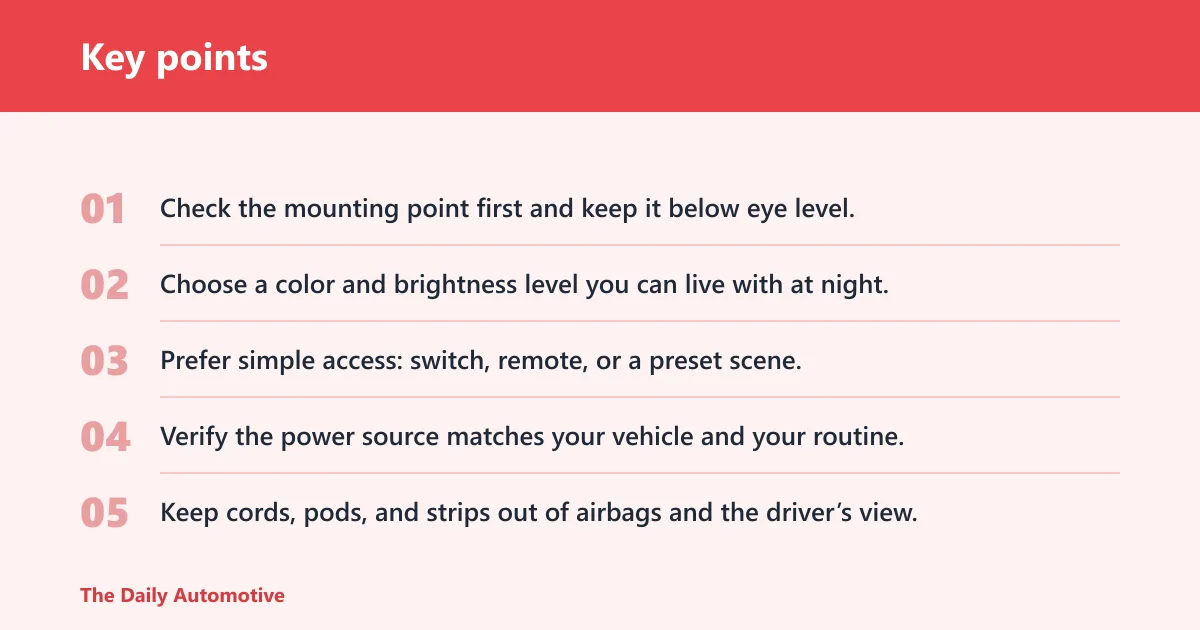
- Check the mounting point first and keep it below eye level.
- Choose a color and brightness level you can live with at night.
- Prefer simple access: switch, remote, or a preset scene.
- Verify the power source matches your vehicle and your routine.
- Keep cords, pods, and strips out of airbags and the driver’s view.
Follow the vehicle manual and the light kit instructions before installation. For any electrical work, disconnect power only as the manual directs, and keep wiring clear of pedals, steering movement, and airbag zones. Check local laws too, because cabin lighting rules can vary by state or province.
Frequently asked questions
What are the best car interior LED lights for night driving?
The best options are dimmable warm-white or low-saturation kits with a low mounting position and easy controls. For most drivers, 12V strip lights or simple replacement bulbs are safer than bright RGB effects because they reduce fumbling without turning the cabin into a distraction.
Are car interior LED lights legal and safe while driving at night?
They can be safe if kept dim, low, and out of the driver’s line of sight, but local laws differ. Keep lights away from windshield reflections, dashboard glare, and airbag zones, and check your local rules before using colored or animated modes on public roads.
Do I need app control or a remote for interior car lights?
Not always. A remote is usually easier for quick brightness changes from the driver seat, while app control is better if you want saved scenes or more color choices. If the light is meant mainly for night driving, simple controls are often the safer choice.
What is the easiest interior LED light kit to install in a car?
Wireless rechargeable lights and adhesive-backed 12V strips are usually the easiest because they avoid hard wiring. Replacement bulbs can also be simple if the socket matches. The real check is whether the kit fits your vehicle’s power setup and mounting space.
Which interior car lights work with a 12V cigarette lighter plug?
Many strip kits and some interior light bars are made for 12V vehicle power, and some are marketed for use with a cigarette-lighter plug. They are a good choice if you want a straightforward power source and do not want to hardwire into the cabin.
How bright should interior LED lights be for night driving?
Bright enough to find controls, seatbelts, and cargo, but not bright enough to light up the windshield or pull your eyes off the road. If you can see the source reflected in glass or chrome from the driver seat, the setting is probably too high.
Do music-sync car interior lights distract the driver?
They can. Sound-activated lighting and bass-reactive effects look fun when parked, but pulse-to-rhythm behavior is usually a poor match for calm night driving. If you want that feature, use it as a parked-car effect and keep a separate low-light driving mode.
Are wireless interior car lights better than wired kits?
Wireless lights are better for temporary installs, shared vehicles, and quick mounting. Wired 12V kits are usually better for daily use because they avoid battery anxiety and charging upkeep. The better choice depends on whether you want convenience now or consistency later.
What features should I look for in ambient car lighting?
Focus on brightness control, a low-glare color option, simple access from the driver seat, and a power source that fits your routine. For night driving, the best ambient lighting is the kind you can keep subtle, steady, and out of the way.
Products related to this article
Sponsored / affiliate links. As an Amazon Associate I earn from qualifying purchases. I may earn additional commission from eligible campaigns.