Griot’s Garage Ceramic 3-in-1 Wax Review
Griot’s Garage Ceramic 3-in-1 Wax is a smart buy if you want a spray wax that beads hard and you are willing to prep the paint correctly. It is built first for maintenance, second for longer wear, so the value depends on whether you treat it like a coating substitute or a better topper.
Verdict: when this spray wax is worth it
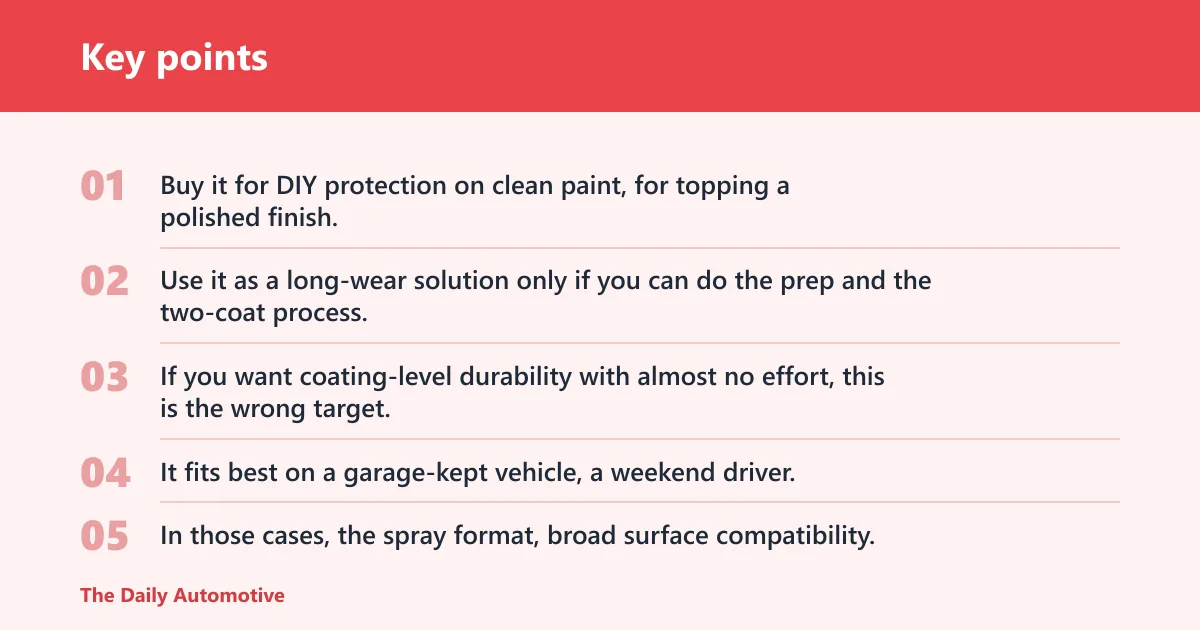

Buy it for DIY protection on clean paint, for topping a polished finish, or for fast upkeep after washing. Use it as a long-wear solution only if you can do the prep and the two-coat process. If you want coating-level durability with almost no effort, this is the wrong target.
Best use cases
It fits best on a garage-kept vehicle, a weekend driver, or a well-kept daily that gets regular washing. In those cases, the spray format, broad surface compatibility, and strong water beading can keep maintenance simple without moving to a true ceramic coating.
When it is better as a maintenance topper
If the car already has a coating, wax, or sealant underneath, this product works better as a booster than as the only layer. It can add gloss, slickness, and hydrophobic behavior, but the longevity claim depends on ideal prep and two coats, not on casual quick use.
Bottom-line value for DIY owners
The 22-ounce bottle gives this product enough volume to make sense for repeat use, especially if you have more than one vehicle or like frequent touch-ups. The value drops if you spray heavily, skip prep, or use it on dirty panels and then blame the product for streaking.
📊 The Drive tested Griot’s Best of Show Spray Wax on a 2014 GMC Acadia. Source: Thedrive.
What griot’s Garage Ceramic 3-in-1 wax actually
Griot’s Garage Ceramic 3-in-1 Wax is a spray-on ceramic wax, not a true ceramic coating. It comes in a 22-ounce bottle and is described as a blend of hydrophobic polymers, SiO2, and carnauba. That mix points to easy application with stronger gloss and water behavior.
Spray wax format and bottle size
This is a mist-and-buff product, so it fits the owner who wants quick application rather than paste-wax effort. The spray format also makes it easier to use in small sections, which matters because thin coats help avoid streaks and haze.
SiO2, polymers, and carnauba blend
The blend matters because each ingredient pushes the product toward a different job. SiO2 and hydrophobic polymers are there for water behavior and protection, while carnauba helps the finish look warmer and fuller. That mix can look excellent on maintained paint, but it still depends on surface prep.
Compatible surfaces: paint, trim, wheels, and chrome
Griot’s says it is safe for paint, wheels, trim, and chrome. That wide compatibility makes it useful as a one-bottle maintenance product, but it also means you need to control overspray and buffing residue carefully on black plastic and brightwork.
Say your SUV has black window trim and polished wheels. A light coat can work across all of it, but the same towel habits that are fine on paint can leave obvious haze on trim if the towel is damp or overloaded.
How long does Griot’s 3-in-1 ceramic wax last?
In best-case use, Griot’s says two coats can provide up to 12 months of protection. That is the number to keep in mind for a carefully prepared finish, not a promise for every climate, every wash routine, or every application method.
Best-case durability and the two-coat claim
The durability claim depends on two coats, with the second coat going on 12 to 24 hours after the first. That timing matters because layering is part of the maximum-durability setup. One thin, rushed coat on a warm, dirty panel will not act like the ideal version.
Why prep and climate change the outcome
Real-world durability shifts with wash frequency, road film, salt, sun, and how well the first layer bonded. A cool, clean, contaminant-free surface gives the product a fair shot. A dirty or warm panel can cut gloss, increase streaking, and shorten the useful life.
How often to reapply in real use
For maintenance use, many owners will reapply when water behavior starts to fade or after routine washes. For a fresh two-coat setup, the better question is not how often to spray blindly, but whether the finish still sheets and beads evenly after normal driving.
Ceramic 3-in-1 wax durability matrix
This matrix separates the product’s three application modes because they can perform differently. Wipe-on dry is generally the longest-wear route, rinse aid tends to be the middle ground, and drying-aid use is often the easiest option with less prep and less durability.
| Application method | Expected longevity | Prep required | Streak risk | Ideal owner type |
|---|---|---|---|---|
| Wipe-on dry | Best-case path toward the 12-month claim when paired with two coats | Highest: cool, clean, contaminant-free paint; small sections; thin coats; claying if needed | Moderate to high if the towel is damp or the panel is warm | DIY owner who wants the longest wear from this bottle |
| Rinse aid | Moderate; better for maintenance than maximum durability | Moderate: washed surface, but drying conditions still matter | Moderate if too much product is left behind | Owner who wants faster upkeep after washing |
| Drying aid | Shortest-lived of the three use cases, but easiest to deploy | Lower: clean rinse step, then controlled drying passes | Lower to moderate if the towel stays dry and clean | Owner who wants quick gloss and beading during drying |
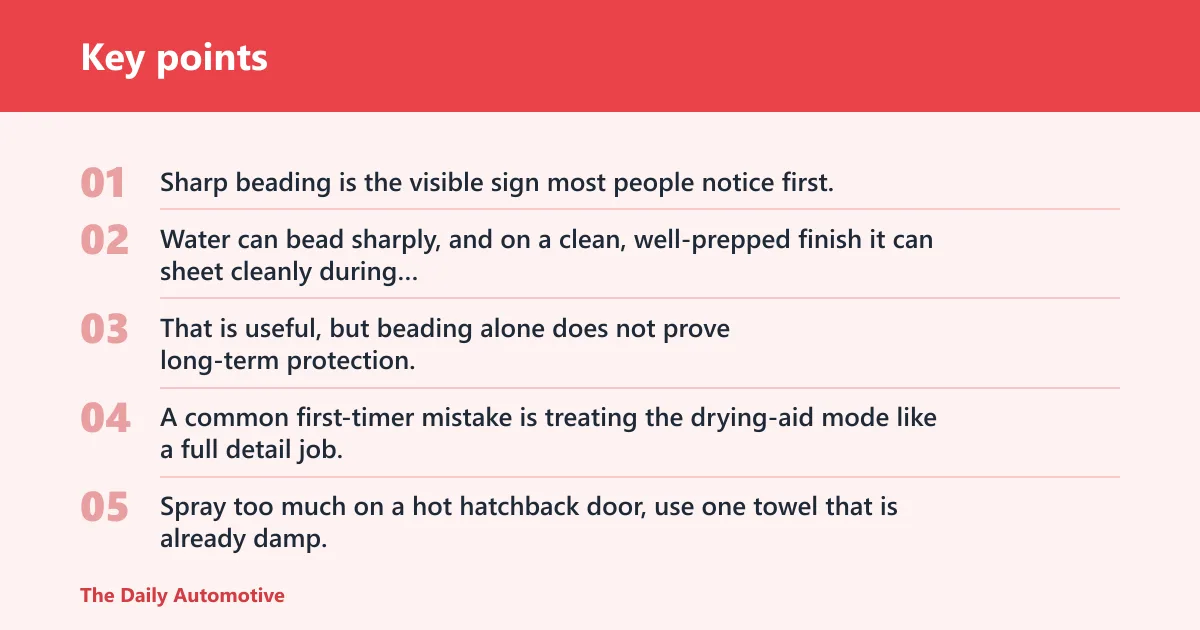
Sharp beading is the visible sign most people notice first. Water can bead sharply, and on a clean, well-prepped finish it can sheet cleanly during a rinse or rain event. That is useful, but beading alone does not prove long-term protection.
A common first-timer mistake is treating the drying-aid mode like a full detail job. Spray too much on a hot hatchback door, use one towel that is already damp, and the result can be grabby buffing, smear marks, and a finish that looks worse before it looks better.
How do you apply it without streaks?
Streak-free application starts with surface condition, not with the bottle. Use it on a cool, clean, contaminant-free panel, work in small sections, and keep the coats thin. Fresh microfiber towels matter too, because a damp towel is a common cause of haze and patchy wipe-off.
Paint prep: clean, cool, and contaminant-free
Wash the car first, let the panel cool, and remove bonded contamination if needed. If the paint feels rough after washing, claying before application gives the product a better surface to bond to. Skip that step and the finish may look uneven, especially in bright sunlight.
Why small sections and thin coats matter
Small sections keep the product manageable before it flashes or smears. Thin coats reduce residue, shorten buffing time, and lower the chance of leaving high spots. Heavy spraying does not equal better protection here; it usually means more wiping and more room for error.
Microfiber towel method
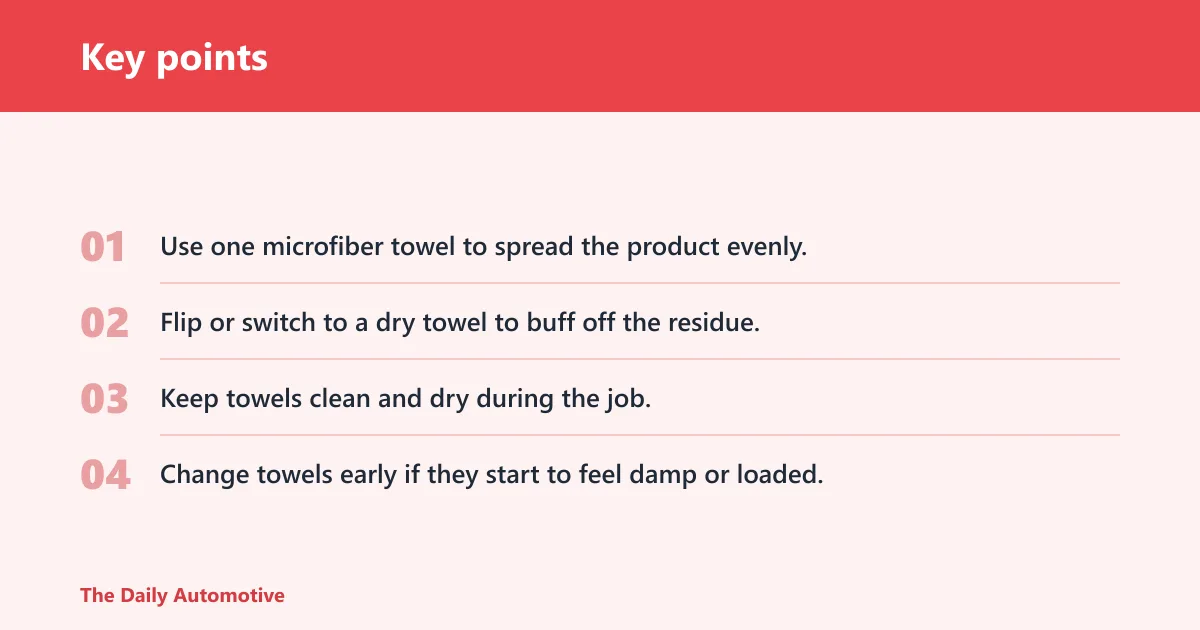
- Use one microfiber towel to spread the product evenly.
- Flip or switch to a dry towel to buff off the residue.
- Keep towels clean and dry during the job.
- Change towels early if they start to feel damp or loaded.
Fresh towels reduce streaking because they lift residue instead of smearing it. If the towel is damp, it can leave a faint haze that looks like poor product performance when the real problem is towel moisture.
How to avoid haze from damp towels
Do not keep chasing the panel with the same towel after it becomes saturated. Switch towels before the wipe turns slick and sticky. If haze shows up, a dry microfiber pass on a cool panel often clears it without adding more product.
Cost per use and bottle efficiency
The 22-ounce size gives the bottle a practical edge, but value depends on how much product you waste during application. Heavy overspray, rework from streaks, and excessive use on small panels all reduce the number of applications you get from the bottle.
| Use pattern | Approximate bottle efficiency | Value read |
|---|---|---|
| One-car use | Higher chance of getting several full applications, especially with light spray use and careful sectioning | Best if you want a dedicated maintenance bottle for one vehicle |
| Multiple-car use | More efficient per bottle because the same product supports several maintenance cycles across more than one vehicle | Best if you detail for a small household fleet or shared garage |
Where waste happens is predictable. Overspraying trim, using too much on warm paint, or buffing with an overloaded towel can burn through product faster than expected. A light mist and careful section work keep the bottle’s value closer to the advertised use case.
Pros and cons
This product has clear strengths, but they only pay off if you use it like a spray wax with prep sensitivity. The tradeoff is simple: easier than traditional waxing, more versatile than a one-note topper, but less forgiving than a true coating.
Pros
- Spray format is easier than paste waxing.
- Works on paint, wheels, plastic trim, and chrome.
- Can be used as a wipe-on product, rinse aid, or drying aid.
- Strong water beading and useful water sheeting when applied well.
- Two-coat setup offers a real path to longer wear.
Cons
- Not a true ceramic coating.
- Best durability depends on careful prep and timing.
- Streaking can happen fast with damp towels or warm panels.
- Maintenance use will not match the longest-wear claim.
- Overapplication wastes product and makes wipe-off harder.
Who should buy it?
This is a good fit for DIY owners who want a spray wax with real flexibility and are willing to spend a few extra minutes on prep. It also suits drivers who want a topper or drying aid that can be used on paint, trim, wheels, and chrome without needing to switch products.
Best for
It is best for the owner who wants easy water behavior, decent gloss, and a one-bottle maintenance routine. It also fits people who can handle a second coat window of 12 to 24 hours and who understand that the 12-month claim is a best-case result.
Not the best fit
It is not the right buy for anyone expecting coating-level durability from one quick pass. If the car lives outside, sees winter salt, or gets frequent machine washes, this works better as a regular topper than as the only line of defense.
Frequently asked questions
Is griot’s garage Ceramic 3-in-1 wax worth it?
Yes, if you want an easy spray wax with real versatility and you value water beading and gloss over true coating durability. It is a better buy for DIY maintenance than for owners who want to install protection once and forget about it for a year.
How do you apply Griot’s 3-in-1 ceramic wax without streaks?
Use it on a cool, clean, contaminant-free surface, spray lightly, and work one small section at a time. Spread with one microfiber towel, then buff with a second dry towel. If haze appears, the usual cause is towel moisture, too much product, or a hot panel.
Can Griot’s 3-in-1 ceramic wax be used as a drying aid?
Yes. That is one of its three application modes, along with wipe-on dry and rinse aid use. Drying-aid application is convenient, but it is usually the least durable path, so it makes the most sense when speed matters more than maximum longevity.
Does Griot’s 3-in-1 ceramic wax work on trim and chrome?
Yes. Griot’s says it is safe for paint, wheels, trim, and chrome. That makes it useful for one-pass maintenance, but black trim and polished metal still need careful towel control, because residue and streaks show up faster on those surfaces than on paint.
How many coats of Griot’s 3-in-1 ceramic wax do you need?
For the strongest durability claim, two coats are the target. Griot’s recommends the second coat 12 to 24 hours after the first. One coat can still improve gloss and water behavior, but the longest protection claim depends on layering.
What size bottle does Griot’s 3-in-1 ceramic wax come in?
The bottle size highlighted is 22 ounces. That amount is enough to make repeated use practical for one vehicle, and it becomes even more useful if the bottle is shared across multiple cars or used mostly as a topper.
Products related to this article
Sponsored / affiliate links. As an Amazon Associate I earn from qualifying purchases. I may earn additional commission from eligible campaigns.