5 Best Car Audio Replacements (2026): Based on Specs and Reviews
The best car audio system for a factory stereo replacement depends on the job: choose a wireless CarPlay/Android Auto head unit for connectivity, a touchscreen receiver with real pre-amp outputs for sound upgrades, or an OEM-integrated unit when the car’s factory controls must stay intact. For most drivers, a feature-rich double-DIN receiver with camera input and steering-wheel control support is the safest top pick because it covers the widest set of upgrade paths without forcing a full system rebuild.
Quick comparison
| Product | Badge | Best for | Price | ||
|---|---|---|---|---|---|
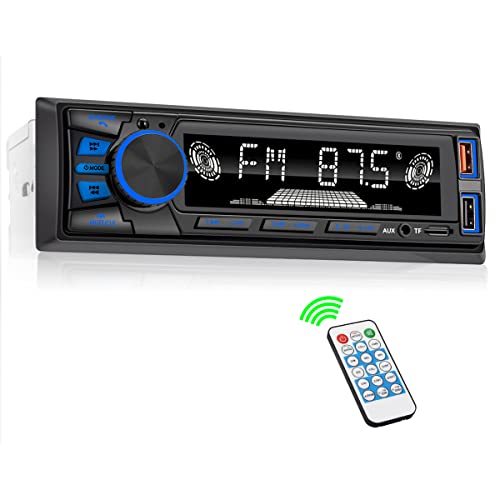 |
REAKOSOUND Car Radio Single DIN Car Stereo BluetoothREAKOSOUND | Our pick | Single DIN · Bluetooth · No CD | $19.99
Price as of 31 Oct 2026
|
View |
 |
PLZ 7" Wireless Double Din Car Stereo Apple Carplay RadioPLZ | Upgrade pick | 7" double din · CarPlay/Android Auto · touchscreen | $129.99
Price as of 31 Oct 2026
|
View |
 |
Pioneer DMH-W2770NEX 6.8" Capacitive Touchscreen Double DinPIONEER | Also great | 6.8" double din · Wireless CarPlay/Android Auto | $428.99
Price as of 31 Oct 2026
|
View |
 |
KENWOOD DMX709S eXcelon 6.95-Inch Capacitive Touch Screen,Kenwood | Also great | 6.95" double din · CarPlay/Android Auto | $399.00
Price as of 31 Oct 2026
|
View |
 |
Alpine ILX-W670-M, 7-Inch Double DIN Digital MultimediaAlpine | Our pick | $379.95
Price as of 27 Nov 2026
|
View |
This is the fast way to sort the options by fit, not by hype. The right replacement depends on dash size, phone integration, steering-wheel control retention, and whether the vehicle already uses a factory amplifier or data-bus functions.
How we chose
Selection uses manufacturer specs, listing details, and published buyer feedback about fit, use, and installation behavior. The focus stays on the features that matter in real swaps: dash compatibility, phone integration, camera support, steering-wheel control retention, pre-amp outputs, and honest power claims.
Power specs were checked carefully because peak wattage is often advertised more loudly than the output that actually drives speakers. A unit that lists stronger numbers on the box can still be a poor match if it lacks the outputs or integration features your vehicle needs.
- Fit path: single-DIN versus double-DIN, plus chassis depth and trim-kit needs.
- Integration path: steering wheel controls, backup camera support, and factory amp compatibility.
- Connectivity path: Bluetooth, Apple CarPlay, Android Auto, USB, SD, and camera inputs.
- Audio path: pre-amp outputs, RMS claims, and whether the vehicle will later need external amplification.
- Installation risk: warning chimes, retained factory amplifiers, and data-bus controlled functions.
Replacement matrix
| Common factory-stereo scenario | Dash size | CarPlay or Android Auto needed? | Steering wheel controls | Backup camera support | Pre-amp outputs needed? | Likely installation complexity |
|---|---|---|---|---|---|---|
| Older car, simple radio swap, no touchscreen required | Single-DIN | No | Usually not required | Optional | Not necessary unless adding amps later | Low to moderate |
| Daily driver with a modern dash opening and phone navigation needs | Double-DIN | Yes | Preferred | Yes | Helpful for future expansion | Moderate |
| Vehicle with factory amplifier already in place | Either, if the kit fits | Optional | Usually yes | Yes if reversing aid is desired | Yes | Moderate to high |
| Car with steering-wheel buttons and warning chimes tied to data-bus functions | Usually double-DIN, but fit depends on trim | Optional | Yes, with adapter or interface module | Often yes | Usually yes | High |
| Backup camera is being added during the swap | Double-DIN preferred | Optional | Nice to have | Yes, with rear camera input | Not required for camera alone | Moderate |
| Classic vehicle with limited dash space and simple wiring | Single-DIN | No, unless you want it | Usually not relevant | Optional | Only if future amps are planned | Low |
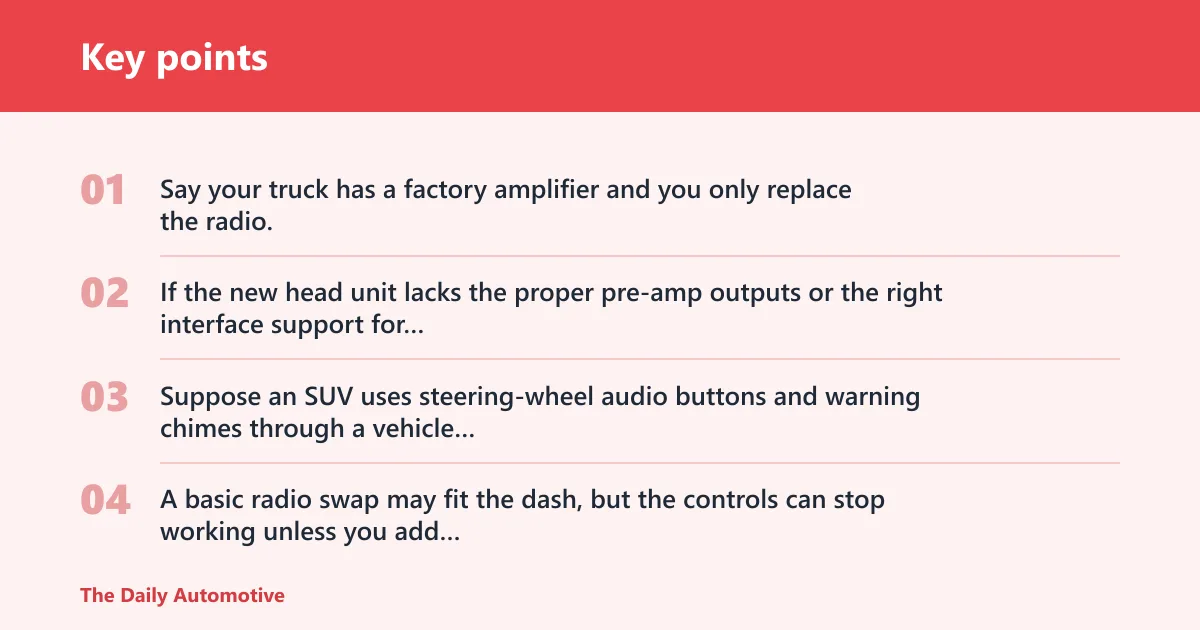
Say your truck has a factory amplifier and you only replace the radio. If the new head unit lacks the proper pre-amp outputs or the right interface support for the vehicle, the system can turn quiet, distorted, or oddly balanced even when the stereo itself powers on correctly.
Suppose an SUV uses steering-wheel audio buttons and warning chimes through a vehicle data network. A basic radio swap may fit the dash, but the controls can stop working unless you add the right interface module and confirm the listing supports that vehicle family.
What is the best car audio system for replacing a factory stereo?
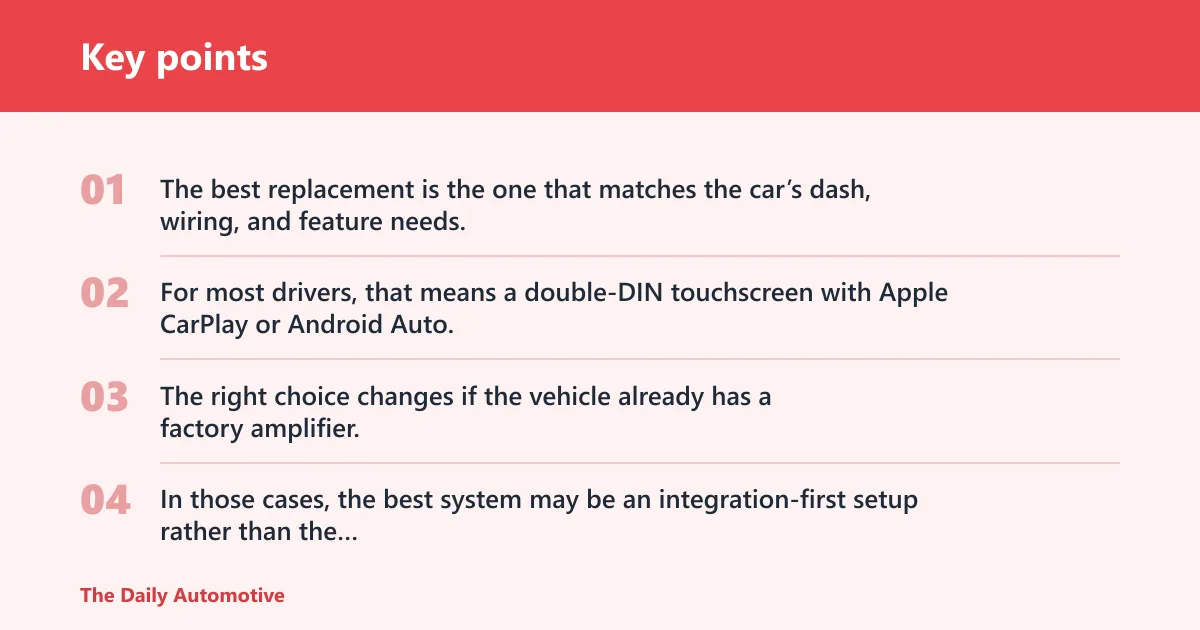

The best replacement is the one that matches the car’s dash, wiring, and feature needs. For most drivers, that means a double-DIN touchscreen with Apple CarPlay or Android Auto, Bluetooth hands-free calling, rear camera input, and steering-wheel control compatibility; for older cars, a single-DIN unit may be the right fit.
The right choice changes if the vehicle already has a factory amplifier, retained warning chimes, or data-bus controlled functions. In those cases, the best system may be an integration-first setup rather than the flashiest screen.
Best for modern connectivity
A double-DIN head unit is the best fit when your goal is smartphone integration, a larger display, and easier camera support. It typically fits many modern dash openings and usually gives more room for touch controls than a single-DIN chassis.
The strongest examples in this group add Apple CarPlay and Android Auto, Bluetooth hands-free calling, USB input, and a rear camera input. That combination covers phone navigation, streaming, and reversing help in one swap.
Pioneer DMH-W2770NEX is the cleanest match for drivers who want wireless Apple CarPlay and Android Auto in a capacitive-touch double-DIN receiver. It also adds Bluetooth and rear-view camera capability, which makes it a strong all-around replacement when the dash opening can accept it.
An honest drawback is price. At $428.99, it sits well above budget models, and the short-chassis design still requires you to check dash depth and trim-kit fit before buying.
Best for older dashboards
A single-DIN head unit still makes sense when the vehicle has a classic dash opening or limited space behind the panel. It is the safer fit choice for older cars that were never designed around a large touchscreen.
The tradeoff is clear: you usually give up screen size and some future expansion room. That does not make it a weak choice; it just means the job is different from a modern double-DIN upgrade.
REAKOSOUND Car Stereo Bluetooth Digital Media Receiver is the best fit in this group because it is a single-DIN, mechless unit with Bluetooth and no display screen. That makes it suitable for simple radio replacement in older vehicles where space is tight and the goal is basic playback plus hands-free calling.
It also includes front and rear pre-amp outputs for external amplification, which matters if the owner may add amps later. The drawback is the same thing that makes it simple: there is no screen, so there is no CarPlay, Android Auto, or camera interface to grow into.
Which head unit keeps steering wheel controls and backup camera support?
The safest answer is a head unit that explicitly supports steering-wheel control retention and includes a rear camera input. That usually means a double-DIN multimedia receiver, plus the correct adapter or interface module for the specific vehicle.
Camera support is the easier part. Steering-wheel controls are where many swaps fail, especially in vehicles that route those functions through the factory network instead of simple analog wiring.
PLZ 7" Wireless Double Din Car Stereo is built for this kind of swap because it lists steering-wheel control support, backup camera support, and wireless Apple CarPlay and Android Auto. It also includes a built-in DSP for sound tuning, which helps if the owner wants to shape the system beyond stock settings.
Its drawback is that the listing language is broad, so exact fit, wiring, and any needed adapter compatibility still have to be checked against the vehicle manual and the manufacturer’s listing for the specific trim.
Do you need Apple CarPlay or Android Auto in a factory stereo replacement?
Not every replacement needs them, but they are the main reason many buyers upgrade at all. CarPlay and Android Auto are worth paying for if the car is a daily driver and you want voice-assisted maps, calls, and music without leaning on the phone directly.
If the vehicle is a short-hop commuter, a work truck, or a classic that only needs Bluetooth and radio, a simpler head unit may be enough. Bluetooth alone remains a baseline feature, not a premium extra.
Kenwood DMX709S eXcelon is the feature-focused choice when phone integration and tuning control matter. It uses a 6.95-inch capacitive touchscreen, supports CarPlay and Android Auto, includes Bluetooth, and adds a 13-band EQ for more precise sound adjustment.
One drawback is cost. At $399.00, it is not the budget route, and buyers still need to verify camera and dash-fit details before installation.
Can you keep steering wheel controls?
Yes, in many vehicles, but usually not by wiring the radio in directly and hoping for the best. Steering-wheel control retention often requires a compatible adapter or interface module, especially in cars that use a data-bus system to handle factory functions.
The same caution applies to warning chimes and some retained accessory behavior. If those functions are integrated into the factory radio path, the replacement has to account for them or the car can lose more than just button control.
What the adapter has to solve
In a simple vehicle, the adapter may translate steering-wheel button signals to the new stereo. In a more complex vehicle, it may also preserve warning chimes, accessory behavior, or amplifier turn-on signals that the factory unit used to manage.
That is why the listing matters. A unit may advertise steering-wheel compatibility, but the vehicle-specific interface is often sold separately.
BOSS BVCP9700A is the clear value pick for buyers who want a touchscreen with phone integration and steering-wheel control compatibility. It uses a 7-inch capacitive touchscreen, supports Apple CarPlay and Android Auto, includes USB, SD, AV, and camera inputs, and is listed with 80 watts of power output.
The drawback is that it is still a mainstream budget-friendly unit, so buyers should not assume the listed power figure replaces the need for proper speaker matching or an external amplifier if the system grows later.
How much power do budget replacement stereos actually deliver?
Budget replacement stereos often advertise a large watt number, but the important detail is whether that figure is peak or RMS. Peak power is a marketing number. RMS is the more useful guide for real-world speaker matching and amplifier planning.
That distinction matters because a head unit that claims big output may still struggle to drive demanding speakers cleanly. If the car will keep its factory speakers, the head unit’s real output should be matched to speaker sensitivity and impedance rather than the loudest number on the box.
Power claims to read carefully
The BOSS BVCP9700A is listed with 80 watts of power output, which is less specific than a confirmed RMS claim. The SJoyBring unit is described with 240-watt audio output, but the buyer should still check whether the listing makes that a peak figure or a real RMS rating before planning speaker upgrades around it.
For systems that will later add amplifiers, pre-amp outputs matter more than headline wattage. A strong set of front, rear, and subwoofer outputs can make the next upgrade easier than a louder spec sheet ever will.
Best for future amplifier upgrades
The best choice here is a head unit with front and rear pre-amp outputs, because that gives you a clean path to external amplification later. This is the right move when the factory speakers will eventually be replaced, or when the car needs a subwoofer and proper channel separation.
When a system already has an amplifier, pre-amp output quality can matter more than raw wattage from the head unit itself. The radio only has to do enough to feed the amp correctly, and in OEM-amplified vehicles the right interface module and signal compatibility can matter just as much.
BOSS 616UAB is the strongest match for this path because it includes front and rear pre-amp outputs and uses a mechless design with no display screen. It also measures 7.94 inches wide overall, which is the kind of detail that helps confirm fit before ordering trim parts.
The drawback is that it is intentionally basic. With no display screen, it is not the right pick for buyers who want CarPlay, Android Auto, or a touchscreen interface.
Which replacement stereo is best for older cars or classic vehicles?
A single-DIN receiver is usually the best match for older cars or classics because it fits smaller dash openings and keeps the installation simpler. If the owner only wants Bluetooth streaming, hands-free calling, and basic media playback, there is no reason to force a large touchscreen into a dash that was never built for it.
In that setting, preserving the car’s original look often matters as much as audio features. A smaller receiver can keep the cabin tidy and avoid unnecessary trim changes.
REAKOSOUND Car Stereo Bluetooth Digital Media Receiver is the most sensible choice for that job because it is a single-DIN fit and supports MP3, WMA, and FLAC. It also has 30 radio presets, which suits a simple upgrade path for a classic or older daily driver.
Its drawback remains the same: no screen, no CarPlay, no Android Auto. That is fine if the goal is compatibility and basic convenience, but not if the goal is a modern infotainment layout.
What features matter most in a factory stereo replacement?
The features that matter most are the ones that keep the vehicle usable after the swap. Dash fit comes first, then phone integration, then camera and control retention, then audio expansion features like pre-amp outputs.
Bluetooth hands-free calling should be treated as a baseline feature. CarPlay and Android Auto are the bigger upgrade when the driver wants phone-based navigation and safer app access, while rear camera input and steering-wheel control retention protect day-to-day usability.
- Check dash size first: single-DIN or double-DIN, plus chassis depth.
- Decide whether CarPlay or Android Auto is worth the extra cost.
- Confirm rear camera input if reversing support matters.
- Verify steering-wheel control retention and any required adapter module.
- Look for front, rear, and sub pre-amp outputs if amplifiers are likely later.
- Read power claims carefully and separate RMS from peak output.
Picture a compact sedan with a double-DIN opening, factory steering-wheel buttons, and a backup camera that already works through the old radio. A replacement without the right retention support can leave the camera dark and the buttons dead even though the screen powers up.
A common first-timer mistake is choosing the biggest screen and ignoring the factory amp. If the car uses an OEM amplifier or data-bus controls, the “best” radio on paper can become the wrong fit in the car.
Which one should you buy?
- Choose the radio-only swap if the vehicle is older, the dash is single-DIN, and you only need Bluetooth, radio, and basic media playback. The REAKOSOUND unit fits that job best.
- Choose the feature-rich head unit if you want CarPlay, Android Auto, and camera support in a modern dash opening. The Pioneer DMH-W2770NEX is the strongest all-around connectivity pick, while the Kenwood DMX709S is the better call if you want a larger, more adjustment-friendly touchscreen with a stronger audio tuning toolset.
- Choose the value touchscreen if you want a lower-cost path to wireless phone integration and steering-wheel control support. The PLZ 7" unit covers that need, but exact vehicle compatibility still has to be checked against the listing.
- Choose the integration-first setup if the car has an OEM amplifier, warning chimes, or data-bus controlled functions. In that case, the stereo itself is only part of the answer, and the adapter or interface module can matter as much as the receiver.
- Check pre-amp outputs before planning future amplifiers. If the goal is only to replace a dead factory radio, that detail may not matter today, but it will matter fast if the system gets upgraded later.
Frequently asked questions
Is a double DIN stereo better than a single DIN replacement?
Double-DIN is better when the dash can accept it and you want a larger screen, phone integration, and easier camera use. Single-DIN is better for older dashboards or tighter spaces. The better choice is the one that matches the opening and the wiring plan.
Can I add a backup camera when replacing my factory stereo?
Yes, if the new head unit includes a rear camera input. Many modern double-DIN receivers support this. The camera still has to be wired correctly, and some vehicles may need extra parts depending on how the factory system handled video and reverse signals.
Products related to this article
Sponsored / affiliate links. As an Amazon Associate I earn from qualifying purchases. I may earn additional commission from eligible campaigns.