Best Car Rental Reviews for International Trips
The best car-rental reviews for international trips favor brands that are clear on documents, insurance, pickup speed, fees, and gearbox choice. Choose the company with the fewest surprise requirements and the cleanest total price. Bad choices lead to counter delays, denied pickups, and add-on costs that can dwarf the base rate. This guide compares major rental options with a destination-first rubric built for overseas travelers.
Quick picks
| Best for | Pick | Why it fits international trips | Watch-out |
|---|---|---|---|
| Most international trips | Booking.com | Clear booking rules, support in over 30 languages, and a stated 48-hour free-cancellation window on most bookings | It is a booking platform, so the final pickup rules still depend on the rental company |
| Europe-first itineraries | Sixt | Useful when you need to compare European airport and city-center pickup options carefully | Check gearbox availability and the counter’s payment rules before you book |
| Airport-heavy itineraries | Hertz | Fits trips where you want a major airport counter and a straightforward pickup flow | Airport surcharges, taxes, and one-way rules can still change the total |
| First-time overseas renters | Enterprise | Best when you want simple documents, a familiar counter process, and fewer surprises | Do not assume debit-card acceptance or automatic insurance inclusion |
For broad international flexibility, Booking.com is the strongest starting point because it surfaces booking terms up front, including payment and cancellation rules, while still letting you compare many rental companies in one place. It is not the rental company itself. That matters at pickup.
Which brand is the top pick for international trips?
Booking.com is the top pick for most international trips because it helps you compare multiple rental companies against the same overseas trip needs: documents, payment rules, cancellation terms, and destination fees. Booking.com says most bookings allow free cancellation up to 48 hours before pickup, and it offers customer support in over 30 languages.
Why it leads overall
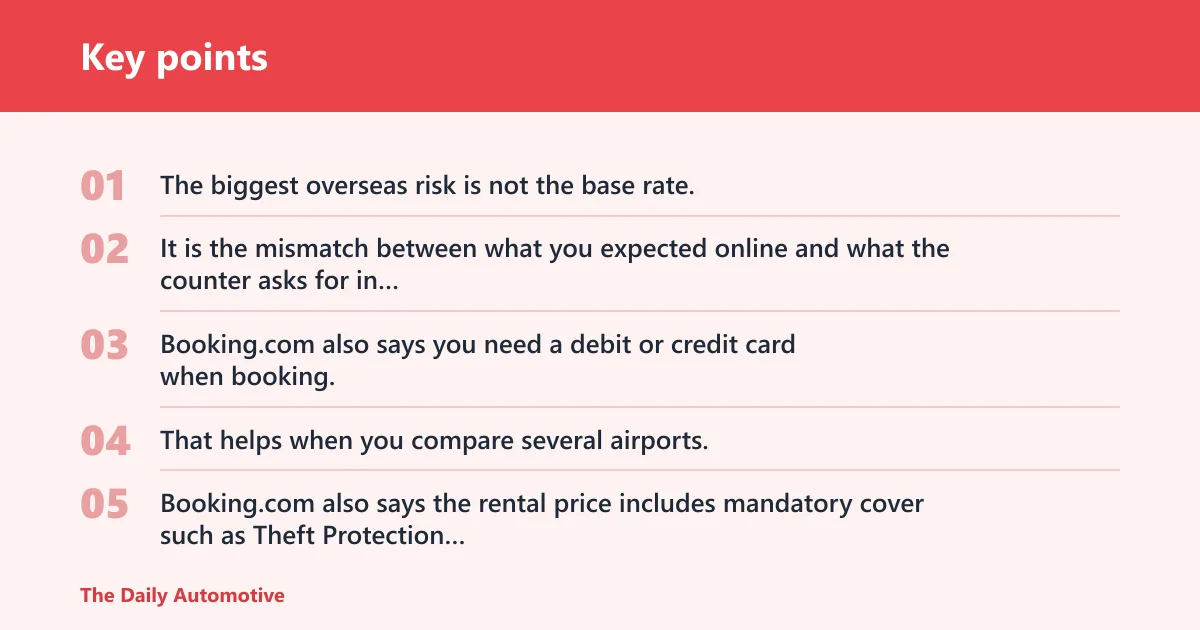
The biggest overseas risk is not the base rate. It is the mismatch between what you expected online and what the counter asks for in person. Booking.com also says you need a debit or credit card when booking, but the counter usually requires the main driver’s credit card, and many rental companies do not accept debit cards at the counter.
That helps when you compare several airports, because it forces you to check the awkward parts early. Booking.com also says the rental price includes mandatory cover such as Theft Protection and Collision Damage Waiver, but the price can still exclude one-way fees, airport surcharges, and local taxes payable at pickup.
Where it can fall short
Its weakness is simple: it is not the car supplier. The actual pickup desk still controls the deposit, the exact license check, and the border rules. CDW and Theft Protection are also not the same as full peace of mind. CDW usually covers the car’s bodywork only, deductibles can still apply, and it may not be valid in some breach scenarios.
Theft Protection typically limits your responsibility to the deductible only, but it can exclude key-in-ignition scenarios. Third-party Liability, or TPL, covers injury and property claims from others, and its limits may vary by country. The renter still has to follow the rental agreement.
Who should book it first?
Start here if you are new to international rentals, need support in your language, or want one place to compare cancellation rules before you leave. It is also a smart first stop if your itinerary includes several countries and you need to check whether the quote is missing airport fees or local taxes.
Picture a traveler landing at a busy European airport with a midnight pickup. A booking page that clearly flags the main driver’s card requirement is better than discovering that rule at the counter after a long flight. That is the kind of friction this platform helps you avoid.
Which brand works best in Europe?
Europe-first trips usually reward the brand that makes gearbox choice and pickup rules easy to verify. Sixt is a strong fit when you need to compare European airport and city-center availability, because the main question is often not price alone but whether the car matches local transmission and parking realities.
Best use case
Choose this kind of option when your route includes city streets, tight parking, and short transfers between countries. Manuals are more common in some countries, and the right choice depends on the driver’s ability. If the driver cannot handle a manual gearbox, the trip gets harder fast.
KAYAK says rental car sizes are standardized by passenger capacity, luggage space, and dimensions. It also says economy cars generally seat 4 passengers and 2 bags, and intermediate/midsize and standard often mean the same thing. That matters in Europe, where a compact car may fit your luggage better than a larger class that still has tight boot space.
Pickup and gearbox notes
For Europe, the right review should say whether the brand makes automatic availability clear at the country level, not just on a broad homepage. Manual vs automatic availability varies by country. If you need an automatic, do not assume it will be easy to substitute at pickup.
A common first-timer mistake is booking a midsize car for four people and two large suitcases without checking the luggage figure. The car may fit the passenger count but fail the luggage test, which turns the rental into a packing problem before the trip even starts.
Main watch-outs
Check whether the booking page states the license requirements for each driver and whether passport details are needed at pickup. Passport and driving licence are commonly required for international rentals, and each driver needs a valid licence. Some counters will ask for both documents.
Also check the cancellation window and the card rule. Some bookings allow free cancellation up to 48 hours before pickup, but that depends on the booking terms. If the rate looks cheap but the counter rules are strict, the savings may disappear fast.
Which brand fits airport-heavy itineraries?
Airport-heavy trips work best with a brand that keeps the pickup flow simple and does not bury the extra fees. Hertz is a practical fit when your travel plan starts and ends at major airports, because airport counters can be efficient if the paperwork is clean and the deposit terms are clear.
Best use case: use this type of option
Use this type of option when your trip is built around flight times, not city delivery. Airport pickups often make sense for business travel, family travel, or an early-morning departure where you want direct access to the terminal road network.
The more airport-centric the trip, the more important the fee list becomes. Booking.com says the price can exclude one-way fees, airport surcharges, and local taxes payable at pickup. That is exactly the kind of gap that can make a lower quoted rate look better than it really is.
Fee and counter flow notes
Check whether the company explains airport surcharges before payment and whether the counter line moves quickly after a late arrival. If reviews repeatedly mention surprise charges, the airport convenience may not be worth it.
Debit-card rules matter here too. Booking.com says you need a debit or credit card when booking, but the counter usually requires the main driver’s credit card. That is a common failure point for airport rentals, especially when a traveler assumes the booking page and the counter use the same rule.
Main watch-outs: airport desks can be strict
Airport desks can be strict about deposits, names on the card, and license checks. If more than one driver will share the car, make sure each driver’s licence is accepted under the rental agreement. Do not assume the airport desk will accept a different cardholder.
CDW and Theft Protection still deserve close reading. CDW often comes standard with most rental agreements, but it usually covers only the car’s bodywork and may carry a deductible. Theft Protection can also leave a deductible in place, so the insurance line on the quote is not the whole story.
Which brand is easiest for first-time overseas renters?

Booking.com is the easiest starting point for first-time overseas renters because it puts the most common trip blockers in one place: card rules, cancellation terms, insurance notes, and language support. It reduces the chance of a bad surprise at the counter, which is where many international rentals go wrong.
Best use case: choose this approach
Choose this approach if you are nervous about hidden fees, unsure which country rules apply, or comparing several providers in a new destination. It is especially useful when you want to filter for the right car category first, then sort out the documents and insurance second.
The rental class itself matters. Economy, compact, intermediate/midsize, standard, full-size, premium, luxury, SUV, and van classes all fit different trips. A city weekend and a mountain route do not need the same car, and a full-size car can still be the wrong choice if the pickup country favors smaller vehicles.
Documentation and payment notes
Booking.com says most companies rent to drivers aged at least 21, with some younger-driver exceptions, and drivers under 25 may have to pay a young driver fee. That can change the economics of the trip more than travelers expect, especially if more than one driver is under 25.
Passport and driving licence checks also matter more for first-timers than many guides admit. Passport is commonly required for international rentals, and each driver needs a valid licence. If a second driver plans to share the road, that person’s documents need the same level of attention.
Main watch-outs: do not rely
Do not rely on the booking confirmation alone. The quote may look complete while still leaving out one-way fees, airport surcharges, and local taxes payable at pickup. If your route crosses borders, check whether the agreement allows it before you pay.
Suppose a traveler books a compact automatic for Paris but then tries to take it into another country without checking border rules. The problem may not appear until pickup, when the rental company says the route is not allowed or requires extra permission.
International car rental scorecard
| Criterion | Weight | What a strong review should mention | Red flags to note |
|---|---|---|---|
| Documents and eligibility | 25% | Passport, driving licence, age rules, extra-driver requirements, and whether the counter asks for the main driver’s credit card | Missing passport requirement, unclear licence rules, or a card requirement that appears only at pickup |
| Insurance clarity | 20% | Whether CDW, Theft Protection, and TPL are included or optional, plus deductible and exclusions | Vague insurance language, no deductible disclosure, or breach exclusions hidden in fine print |
| Pickup and drop-off friction | 15% | Counter speed, shuttle time, queue length, and how clearly the handoff process is explained | Long delays, confusing desk changes, or unclear drop-off instructions |
| Fee transparency | 20% | Airport surcharges, one-way fees, local taxes, deposit terms, and currency conversion details | Unexpected add-ons at pickup or a quote that omits common destination charges |
| Gearbox and car-size fit | 20% | Manual or automatic availability, country-specific transmission norms, and whether the car class fits passengers and bags | Automatic not guaranteed, luggage space too small, or the wrong class for the route |
How do you choose the right rental abroad?
Choose the right rental by matching the car to the destination first, then checking documents, insurance, and fees. The best review is the one that tells you what can go wrong at pickup in that country, not the one that repeats a generic star rating. That is the practical difference.
Match the car to the destination
- Start with the route. City centers, mountain roads, and border crossings have different rental needs.
- Pick a car class that fits both passengers and luggage. Economy, compact, intermediate/midsize, and standard are not interchangeable on every trip.
- Confirm gearbox availability before payment if the driver needs automatic.
Check insurance and payment rules
- Confirm whether CDW, Theft Protection, and TPL are included or separate.
- Read the deductible wording carefully. CDW usually covers bodywork only, and deductible amounts can still apply.
- Check whether booking allows debit or credit card and whether the counter requires the main driver’s credit card.
Compare pickup terms and fees
- Check free-cancellation timing before you commit.
- Check for airport surcharges, one-way fees, and local taxes payable at pickup.
- Verify cross-border limits if the route leaves the pickup country.
What documents and fees should you check at pickup?
At pickup, check the passport, driving licence, card used for the booking, deposit rules, and the fee list before you sign. Most overseas rental problems happen when a traveler assumes the confirmation email is enough. It often is not.
Passport and driving licence
Passport is commonly required for international rentals, and each driver needs a valid licence. Some counters will ask for both documents before they release the car. If more than one driver will use the vehicle, each licence needs to be acceptable under the agreement.
Deposit and card rules
Booking.com says you need a debit or credit card when booking, but the counter usually requires the main driver’s credit card. It also says many rental companies do not accept debit cards at the counter. That is why card rules should be checked before the flight, not after landing.
Airport surcharges and local add-ons
Booking.com says the price can still exclude one-way fees, airport surcharges, and local taxes payable at pickup. These add-ons are not rare in overseas rentals. They are the difference between a believable quote and a messy final bill.
Cross-border and one-way limits
Border rules vary by company and country. Some rentals block cross-border travel altogether, and others allow it only with advance permission or extra fees. One-way border drop rules can be even stricter, so check them before you lock the itinerary.
Another common mistake is assuming a car rented in one country can be dropped in another without extra approval. A compact car may look perfect on paper, but the wrong border rule can make the trip impossible or much more expensive.
Frequently asked questions
What should I look for in car rental reviews for international trips?
Look for reviews that mention documents, insurance wording, pickup speed, fees, gearbox availability, and border rules. A useful international review says what happened at the counter, what the final charges were, and whether the company handled the destination’s rules clearly. Generic praise is not enough.
Which car rental company is best for international travel?
Booking.com is the best starting point for most international trips because it lets you compare rental terms and spot common friction points before you arrive. It is especially useful when you want clear cancellation terms, language support, and a place to compare company rules side by side.
How do I compare rental car insurance abroad?
Compare whether CDW, Theft Protection, and TPL are included, what the deductible is, and what exclusions apply. CDW usually covers bodywork only, Theft Protection usually limits you to the deductible, and TPL coverage limits vary by country. The rental agreement still controls the final outcome.
Are airport surcharges included in rental car prices?
Not always. Booking.com says the price can still exclude one-way fees, airport surcharges, and local taxes payable at pickup. Treat the quoted rate as the starting point, then check the destination-specific extras before you book, especially for airport counters and cross-border trips.
What documents do I need to rent a car overseas?
Passport and driving licence are commonly required for international rentals, and each driver needs a valid licence. Many counters also want the main driver’s credit card, even if a debit or credit card was acceptable at booking. Check age rules and extra-driver requirements before travel.
Should I book a manual or automatic car in Europe?
Book the gearbox the driver can actually use. Manuals are more common in some European markets, while automatic availability varies by country. If the driver cannot handle a manual, do not rely on a last-minute switch. Confirm the transmission on the booking before you pay.
Products related to this article
Sponsored / affiliate links. As an Amazon Associate I earn from qualifying purchases. I may earn additional commission from eligible campaigns.
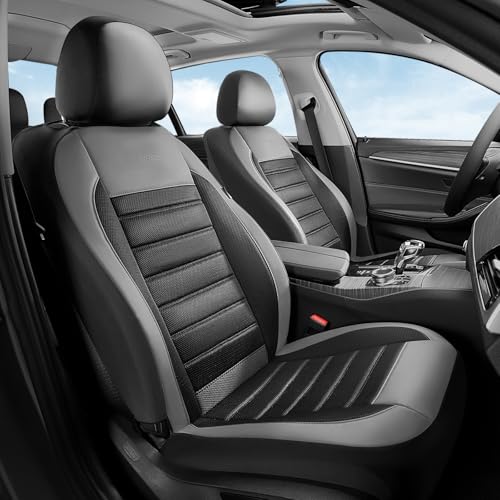 Coverado Car Seat Covers Front Seats, Luxury Leather Car Seat Covers, Automotive Mesh Seat Covers 2 Pack, Airbag-Compatible, Black Gray Seat Covers for SUV Sedan Truck
 Coverado Car Seat Covers, Front Covers for Cars, Car Seat Cover Front Seats, Automotive Seat Cover, Waterproof, Leather Car Seat Cushion, Universal Interior Covers Seat Protectors for Most Cars