Best Car Safety Features for Winter Driving Ranked
Best car safety features for winter driving are winter tires, ABS with ESC, and automatic emergency braking with pedestrian detection; those three cut the biggest crash risk first. Skip them, and stopping distances grow, traction fades on ice, and a small slide can turn into a spin, a hit, or a roadside outage. This guide ranks winter safety features by risk reduction and explains which ones matter, how they fail in snow, slush, and black ice, and what to buy first on a budget.
Which car safety features matter most for winter driving?


Winter safety starts with traction, braking control, and visibility. In real snow and ice, winter tires move to the top, then ABS and ESC, then clean sight lines from defrost, washer fluid, and working wipers. Driver-assistance systems help, but they sit below those basics because dirty sensors and missing lane markings can shut them down fast.
City commuting rewards quick stops and clear forward view. Highway winter travel adds spray, longer gaps, and more sensor blockage. Rural blizzard driving raises the stakes again, because a small mistake can leave the vehicle stranded where help is slow.
Core systems first, convenience second
Separate winter safety features into three groups. Foundational equipment changes how the vehicle grips, stops, and holds a line. Visibility equipment keeps hazards visible. Driver-assistance tech can cut workload, but it still depends on sensors and road markings.
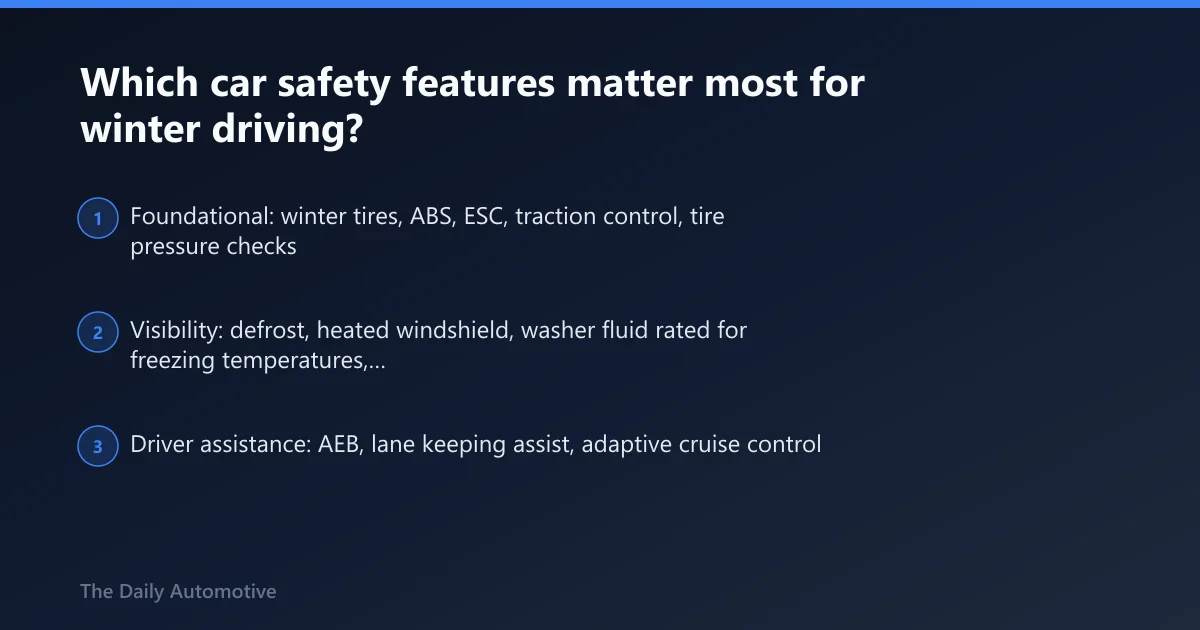
- Foundational: winter tires, ABS, ESC, traction control, tire pressure checks
- Visibility: defrost, heated windshield, washer fluid rated for freezing temperatures, wipers
- Driver assistance: AEB, lane keeping assist, adaptive cruise control
What should buy first on a budget?
If the budget is tight, winter tires come first. They usually reduce more winter crash risk than a more advanced screen of driver-assistance features because they improve every braking, steering, and acceleration move. After that, verify tire pressure, washer fluid, and defrost performance before spending on comfort items or convenience tech.
If the vehicle already has ABS, ESC, and traction control, that is good news, but it does not move winter tires off the top of the list. Those systems help more once the tires have grip to work with.
Best first purchases and checks
- Buy winter tires if the vehicle sees regular snow or ice.
- Check cold tire pressure and set it by the door placard, not by guesswork.
- Fill with windshield washer fluid rated for freezing temperatures.
- Test defrost and rear defog before the first storm.
- Confirm ABS, ESC, and traction control warning lights are off.
How much do tires and tire pressure affect winter safety?
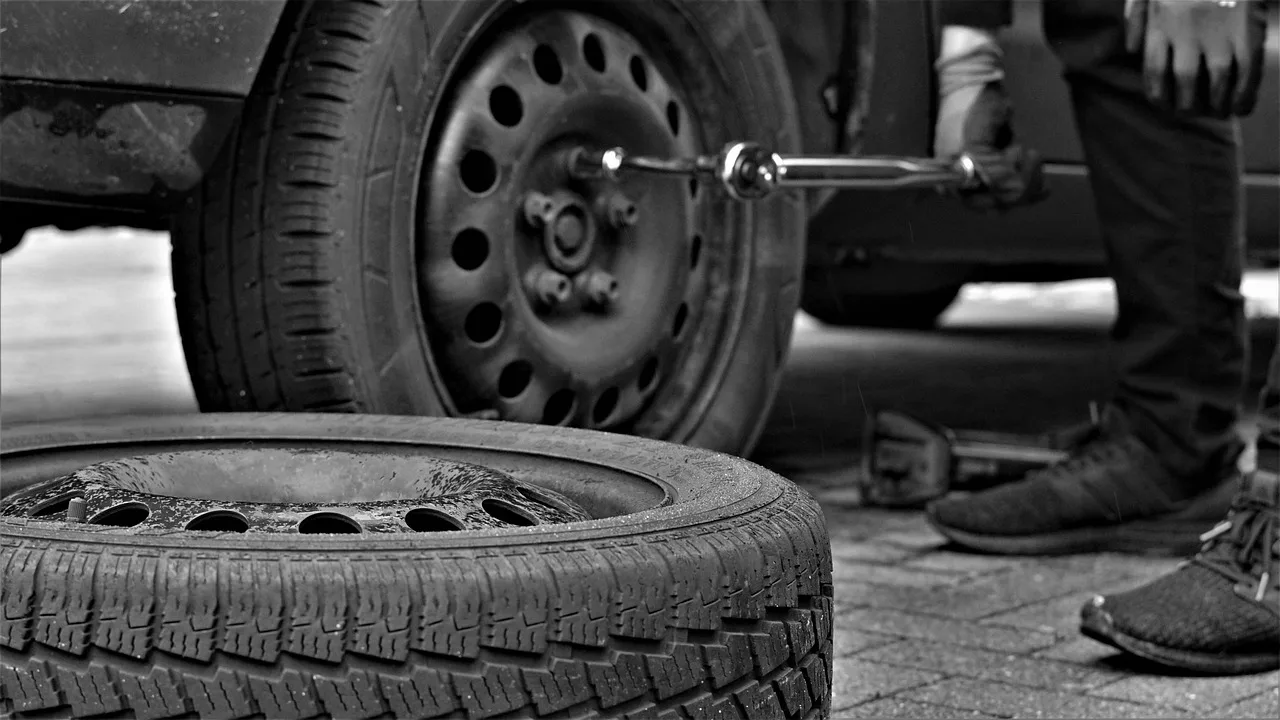
Tires matter more than most drivers expect because they are the only part of the vehicle touching the road. Winter tires use a cold-weather rubber compound and siped tread to keep working in snow and ice where all-season tires harden and lose bite. All-season tires are fine in mild cold, but they do not match winter tires once temperatures drop and roads turn slick.
Cold air also lowers tire pressure. TPMS helps by warning of a problem, but it is not a substitute for a manual check. A low tire can hurt braking, steering response, and snow traction before the warning becomes obvious.
Winter tires versus all-season tires
All-season tires are a compromise. They can handle cold pavement, but they give up a lot of grip on packed snow, polished ice, and slush. Winter tires are the better choice for drivers who face repeated freezes, hilly streets, rural roads, or early-morning commutes where the first miles are still covered in frost.
Is tire pressure monitoring enough for winter safety?
No. TPMS is a warning system, not a substitute for winter preparation. It can catch a drop after the tire is already underinflated, but it cannot tell a driver whether each tire is set correctly for a cold morning, heavy load, or long trip. Manual checks matter because pressure falls as temperatures fall.
When low pressure becomes a winter problem
Underinflation changes how the tire flexes, which can lengthen stopping distances and reduce steering precision. In snow, it can also make the tire feel vague during lane changes and braking. On black ice, there is little margin left to waste.
Why are ABS, ESC, and traction control still the foundation?
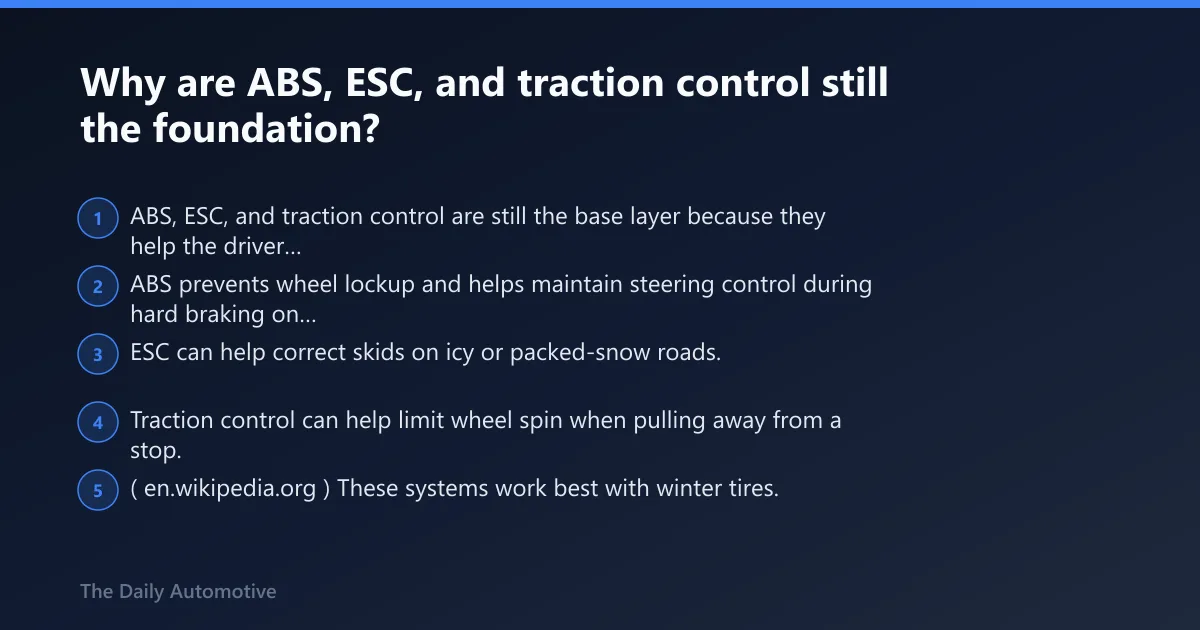
ABS, ESC, and traction control are still the base layer because they help the driver keep control after the vehicle has already started to slip. ABS prevents wheel lockup and helps maintain steering control during hard braking on slippery roads. ESC can help correct skids on icy or packed-snow roads. Traction control can help limit wheel spin when pulling away from a stop. (en.wikipedia.org)
These systems work best with winter tires. They do not create grip from nothing. They simply manage the grip the tires can find.
ABS on slippery roads
ABS keeps the wheels turning during a panic stop, which preserves steering input. That matters on an icy intersection or a downhill approach where the driver must still steer around a hazard. The system is useful, but it cannot shorten braking distance by itself if the tires have little traction.
ESC and traction control in winter
ESC is especially useful when a rear end starts to rotate on packed snow or when a front end pushes wide on a slick corner. Traction control helps when pulling away from a stop, climbing a mild grade, or leaving a plowed parking space. It can be less effective in very deep snow, where allowing some wheel spin may be needed to keep moving.
Which driver-assistance features work poorly in snow?
Driver-assistance features can help in winter, but snow, slush, and spray can cut them down fast. AEB and related driver-assist features may depend on cameras, radar, lane markings, or clean sensor windows. When those inputs are blocked, faded, or distorted, the system may reduce support or act unevenly.
AEB in snow spray and slush
Automatic emergency braking can help in low-traction stops, but snow spray and radar or camera blockage reduce its reliability. It should be treated as a backup, not a plan. The driver still needs to leave more space and be ready to brake earlier than usual.
Lane keeping assist on snow-covered roads
Lane keeping assist may struggle when lane markings are faded, covered, or hard to see in snow. On winter roads, it is best used as a supplement. If the lines disappear, the system may stop helping or start making small corrections that do not match the real road edge.
Adaptive cruise control on winter highways
Adaptive cruise control can be useful on clear winter highways, but it can become conservative or unreliable when spray, slush, or snow blocks sensors. The correct move is simple: use it cautiously, increase following distance, and be ready to take over immediately.
What safety features help most on black ice and slush?
On black ice and slush, the biggest gains come from winter tires, ABS, ESC, and a cautious driver. Black ice punishes speed and braking mistakes, while slush can pull the vehicle around and hide lane edges. Good tires and stable braking control matter more than extra convenience tech in these conditions.
Slush also throws spray that can block cameras and radar, which is why a clean windshield and cleared sensors matter. If the driver cannot see well or the car cannot see well, the risk rises quickly.
How do visibility features prevent winter accidents?
Clear visibility prevents a large share of winter mistakes because drivers cannot avoid what they cannot see. Heated windshield and defrost systems help clear frost and fog. Winter washer fluid helps remove salt and slush. A windshield cover can reduce the amount of ice and snow on the glass before the drive begins.
Heated windshield and defrost systems
A working defrost system is a safety feature, not a comfort extra. It clears frost, fog, and interior condensation that can blind the driver at the worst time. Before winter, the system should be checked with enough time to repair weak airflow, bad controls, or slow warm-up.
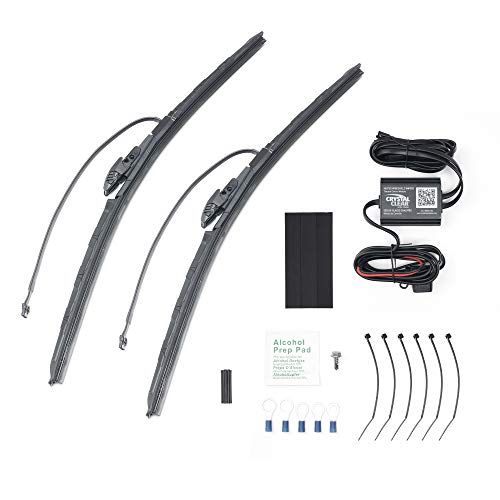
Winter washer fluid and wipers
Windshield washer fluid rated for freezing temperatures matters because road spray and salt film can coat the glass fast. In a storm, the driver may need repeated cleaning just to hold a usable view. If the fluid freezes, the whole system is dead weight when it is needed most.
Are winter car accessories considered safety features?
Some accessories support safety, but they are not equal to core equipment. A windshield cover is a practical part of a winter routine because it can keep ice and snow off the glass overnight. EcoNour’s windshield cover is made for heavy snow, frost, sleet, and blizzards, uses 600D Oxford fabric, is waterproof, measures 74 x 43 inches, fits SUV, truck, and minivan vehicle types, and includes UV protection. It comes with a one-year warranty. EcoNour also describes the fit as vehicle specific.
That said, a cover is a helper. It does not replace winter tires, a working defrost system, or clean sensors.
Winter safety feature priority table
This order reflects how much real-world risk each feature can reduce in snow, ice, slush, and poor visibility. For drivers on a tight budget, the top rows deserve attention first.
| Feature | Risk reduced | Conditions where it fails | Maintenance or check step |
|---|---|---|---|
| Winter tires | Braking, steering, and launch grip on snow and ice | Very worn tread, deep slush ruts, hard-packed glare ice | Check tread depth, age, and inflation before cold snaps |
| ABS | Wheel lockup during hard braking | Low-grip surfaces still require longer stops | Watch for warning lights and keep winter tires installed |
| ESC | Skids and loss of directional control | Can only manage available traction | Confirm system is active and fault-free |
| Traction control | Wheel spin from stops and gentle climbs | Very deep snow can need some wheel spin | Know when to use the off switch, if equipped |
| Defrost and heated windshield | Fog, frost, and ice on the glass | Weak airflow, failed element, blocked vents | Test before the season and clean cabin intakes |
| Winter washer fluid | Salt and slush buildup on the glass | Frozen lines or empty reservoir | Fill with freezing-temperature-rated fluid |
| TPMS | Low-pressure warning | Cannot prevent underinflation or find all bad set-ups | Check pressure manually in cold weather |
| AEB | Rear-end collisions and some low-speed impacts | Snow spray, blocked cameras, radar obstruction | Keep sensors clear and brake early anyway |
| Lane keeping assist | Drift reduction on marked roads | Faded, buried, or snow-covered lane lines | Use only as support, not as steering replacement |
| Adaptive cruise control | Distance management on clear highways | Heavy spray, blocked sensors, changing winter traffic | Use conservatively and stay ready to cancel it |
| Windshield cover | Startup visibility by reducing ice and snow buildup | Wrong size, poor attachment, high winds | Match size to the vehicle and secure it before storms |
Feature order for drivers on a tight budget
- Winter tires
- Cold-weather tire pressure check
- Defrost and washer fluid readiness
- ABS, ESC, and traction control verification
- Windshield cover or similar ice-blocking accessory
How should I prioritize safety features for snowy commutes?
For snowy commutes, prioritize winter tires, then pressure checks, then visibility systems, then driver-assistance features. Stop-and-go city routes reward quick braking and easy sight lines. If the commute includes hills, unplowed side streets, or early-morning ice, tire choice matters even more than a long list of high-tech options.
Drivers who spend more time on highways should pay extra attention to washer fluid, defrost, sensor cleanliness, and the limits of adaptive cruise control. The tool that helps most is often the one that keeps the glass and sensors clear.
Do I need AWD if I already have winter safety tech?
All-wheel drive can help the vehicle move more easily in snow, but it does not replace winter tires, ABS, ESC, or good judgment. AWD helps with acceleration, not with the grip needed to stop or turn. A vehicle with AWD and all-season tires can still slide badly on ice.
For winter safety, AWD is useful, but it is not a substitute for the basics. The road still decides the limit.
What should I check before driving in a blizzard?
Before a blizzard, check tires, tire pressure, washer fluid, defrost, wipers, and sensor cleanliness. Make sure the windshield, mirrors, cameras, and radar areas are clear. If the vehicle has a windshield cover, remove it fully and verify it did not leave ice around the edges or block airflow.
Also confirm that ABS, ESC, and traction control warning lights are off. Then slow down before conditions get bad, not after.
Frequently asked questions
Which driver-assistance features work poorly in snow or ice?
AEB, lane keeping assist, and adaptive cruise control are the main systems to treat carefully. Snow spray, slush, blocked cameras, and covered lane markings can reduce their usefulness fast. They can still help, but they should never be trusted to replace slower speeds, longer gaps, and active driver attention.
Products related to this article
Sponsored / affiliate links. As an Amazon Associate I earn from qualifying purchases. I may earn additional commission from eligible campaigns.