Best Car Safety Features for Families: What to Choose
The best family safety features are automatic emergency braking, rear-seat alert, reverse automatic braking, LATCH-equipped second-row seating, and teen driver controls, because they address the child-hauling mistakes and parking-lot crashes that show up most often. Leaving them out can raise crash risk, make car-seat installs harder, and allow avoidable damage when a teen or tired parent misses a hazard. This guide ranks the features by child-seat, school-run, and teen-driver use, then notes which are usually standard and which often move to higher trims.
Overall top pick: forward automatic emergency braking, because it tackles the most common front-end risk in family driving and is now standard on every winner in U.S. News’ 2026 Best Cars for Families awards, which combine safety, reliability, space, comfort, convenience, and connectivity across 116 new vehicles in 14 classes.
Top family safety features, ranked by real use cases
Backing incidents, parking-lot bumps, and child-seat loading problems should sit ahead of convenience tech in the shopping order. That is where families get hurt or spend money on repairs. The best family car is not the one with the longest option list. It is the one with the right safety hardware for the way the vehicle is used.
Why backing incidents and low-speed impacts come first
Family driving is full of low-speed risk. Driveways, school lines, grocery parking spaces, and tight garages create blind spots that big vehicles make worse. Forward automatic emergency braking helps with frontal conflict risk, while reverse automatic braking helps when backing out of spaces where a child can be hidden by the rear bodywork.
What should move to the top for infant seats, school runs, and teen drivers
Infant seat families need easy rear access, strong LATCH placement, and alerting systems that reduce forgotten-child risk. School-run families benefit most from rear-seat reminder, pedestrian-aware forward automatic emergency braking, and a clear rear camera view. Households with new drivers should rank teen driver controls above comfort upgrades, because speed limits and drive-report tools can shape habits early.
Quick picks: which safety features matter most by family need
For most shoppers, the right order is simple: automatic emergency braking first, rear-seat alert second, reverse automatic braking third, then LATCH ease and teen driver controls. Convenience features like Apple CarPlay, Android Auto, rear USB ports, and in-car Wi-Fi matter, but they do not replace crash-prevention hardware.
- Best for infant and booster-seat families: LATCH ease-of-use, rear-seat alert, wide rear-door access, and second-row space.
- Best for driveways and parking lots: forward automatic emergency braking, reverse automatic braking, and front and rear automatic braking where offered.
- Best for households with teen drivers: teen driver controls, forward automatic emergency braking, lane-keep assist, and speed/volume limits.
- Best for road trips and three-row SUVs: lane-keep assist, rear-seat USB ports, rear-seat alert, and multi-row visibility.

Why automatic emergency braking should be near the top
In my view, automatic emergency braking belongs near the top of a family shopping list because it can help reduce front-end collision risk before a driver can react. In family use, that matters around school crossings, driveways, crowded neighborhoods, and stop-and-go traffic. Every winner in the 2026 Best Cars for Families awards has forward automatic emergency braking.
Forward automatic emergency braking and pedestrian detection
Forward automatic emergency braking works when the vehicle senses a likely front-end impact and can brake on its own. Some family vehicles pair it with pedestrian detection, which can add protection near sidewalks, crosswalks, and school drop-off zones. Availability is broad across model lines, but the exact tune and standard-equipment status still vary by trim.
Front and rear automatic braking in crowded family settings
Low-speed braking aids matter most in places with small children and short sight lines. Front and rear automatic braking can cut parking-lot taps and backup mishaps. The coverage is not universal, and front and rear systems may not appear together on every model. Shoppers should check the exact trim, not the brochure headline.
Where AEB helps and where it does not
AEB is not a substitute for scanning the road or watching mirrors. It may not react to every object, every angle, or every surface condition. It also cannot fix poor child-seat loading or replace a driver who backs out too quickly. It is a backup system, not a permission slip.
Which features help most when kids are in the back seat?
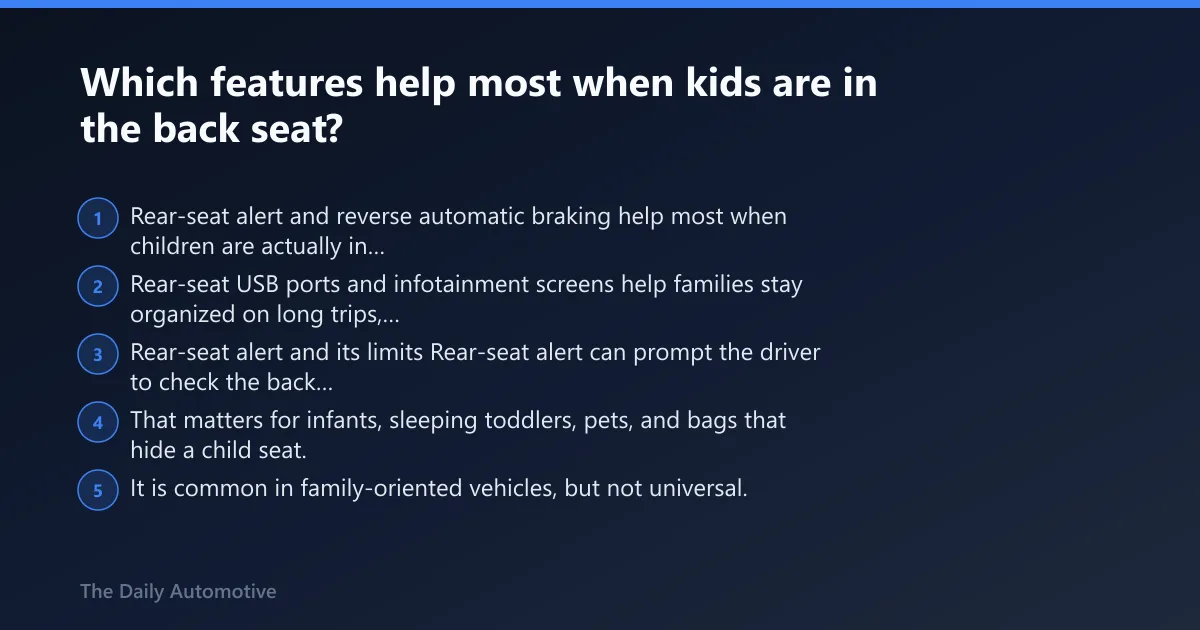
Rear-seat alert and reverse automatic braking help most when children are actually in the vehicle or near the vehicle, especially during rushed school mornings and tired end-of-day pickups. Rear-seat USB ports and infotainment screens help families stay organized on long trips, but they are convenience features, not safety features.
Rear-seat alert and its limits
Rear-seat alert can prompt the driver to check the back seat before leaving. That matters for infants, sleeping toddlers, pets, and bags that hide a child seat. It is common in family-oriented vehicles, but not universal. Some trucks and some trims may not include it, so shoppers should verify equipment carefully.
Reverse automatic emergency braking for backing out safely
Reverse automatic braking helps when backing out of driveways, garages, and parking spaces where a small child may be out of sight. It is especially useful in houses with high rear quarters, tall SUVs, or tight parking lots. The feature is available on many family models, but it is not on every model line.
Rear-seat USB ports and infotainment as convenience, not safety
USB ports in the second or third row help keep devices charged for long trips. Apple CarPlay and Android Auto make navigation and audio easier. In-car Wi-Fi can cut arguments on long drives. None of these items prevent a crash, so they belong below braking, alerting, and car-seat hardware in the buying order.
How do lane-keep assist and adaptive cruise control differ?
Lane-keep assist helps the driver stay in the lane or warns about lane departure. Adaptive cruise control controls speed and following distance. They solve different problems. Lane-keep assist is driver support, not crash avoidance. Adaptive cruise control is a spacing tool for traffic and road trips, not a substitute for lane discipline.
Lane-keep assist and lane-centering support
Lane-keep assist may nudge the vehicle back toward lane markings or help maintain lane position. Some systems add lane centering. Every winner in the 2026 family awards has lane-keep assist, but the behavior can feel different from model to model. Families should check whether the system is active only as a warning or also as steering support.
What adaptive cruise control does instead
Adaptive cruise control can keep a set gap from the vehicle ahead. It is helpful on highways, but it does not prevent lane departure by itself. A vehicle can still drift if the driver is distracted or tired. That is why lane-keep assist and adaptive cruise control should not be treated as the same feature.
When these systems help on family road trips
On long drives, lane-keep assist reduces fatigue, while adaptive cruise control smooths traffic flow. Together, they can make a three-row SUV or minivan easier to live with. Neither one should replace a rested driver, regular mirror checks, or break planning for children in the rear seats.
What safety features should a family SUV have?
A family SUV should have easy LATCH access, rear-seat alert, forward automatic emergency braking, lane-keep assist, and usable visibility from the second row. If the SUV carries children often, rear-seat access and anchor placement matter as much as the raw count of driver-assist systems.
LATCH access and car-seat fit
LATCH makes child-seat installation simpler, but ease matters more than the mere presence of anchors. Wide openings, clear lower anchors, and accessible tether points reduce mistakes. The GMC Acadia, Honda Accord, Honda Accord Hybrid, Honda Passport, Hyundai Ioniq 9, Hyundai Palisade Hybrid, and Mazda CX-90 PHEV earned high LATCH ease-of-use ratings in the family awards context.
Multi-row access, visibility, and rear-seat monitoring
Three-row SUVs need usable access to the second and third rows, plus rear-seat monitoring that helps with forgotten children and pets. Rear-seat alert is common among family winners, and all winners except the pickup trucks have it. That difference matters for buyers comparing SUVs and pickups for the same household task.
Standard versus optional equipment by trim
Safety equipment changes with trim, package, and model line. Some systems are standard on base trims, while others are buried in upgraded bundles. Every winner in the 2026 family awards has forward automatic emergency braking and lane-keep assist, but reverse automatic braking is absent on the Honda Accord and Honda Ridgeline. That sort of exception is why VIN-level verification matters.
Family safety feature priority matrix
| Family scenario | Highest-priority feature | Why it matters | Standard vs optional checklist at the dealership |
|---|---|---|---|
| Infant seat loading | LATCH ease-of-use, rear-seat alert | Supports correct installation and reduces the chance of leaving a child behind | Confirm lower anchors, top tether access, rear-seat reminder, and second-row door opening width |
| School drop-off and pickup | Forward automatic emergency braking with pedestrian detection | Helps near crosswalks, curb lanes, and distracted traffic | Check if pedestrian detection is standard or part of a package |
| Driveway reversing and parking lots | Reverse automatic emergency braking | Helps when small children or carts sit behind the vehicle | Verify rear coverage; do not assume every trim includes it |
| Teen-driver monitoring | Teen driver controls | Can limit speed, audio volume, and report on habits | Ask whether the feature is standard and whether reports are built in |
| Long trips and multi-row seating | Lane-keep assist, rear-seat alert, rear-seat USB ports | Helps with fatigue, reminders, and charging | Separate safety items from convenience items in the package list |
| Standard vs optional review | Forward automatic emergency braking, lane-keep assist | These are foundational family safety systems in the award set | Check the window sticker and order guide for the exact VIN |
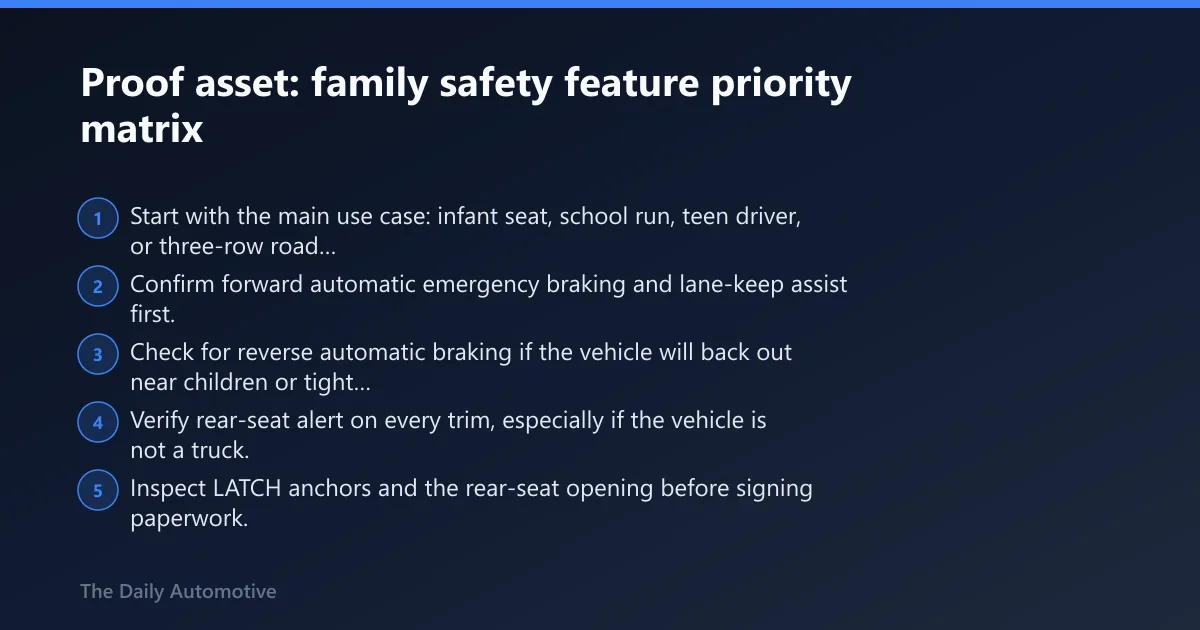
- Start with the main use case: infant seat, school run, teen driver, or three-row road trip.
- Confirm forward automatic emergency braking and lane-keep assist first.
- Check for reverse automatic braking if the vehicle will back out near children or tight objects.
- Verify rear-seat alert on every trim, especially if the vehicle is not a truck.
- Inspect LATCH anchors and the rear-seat opening before signing paperwork.
- Separate safety packages from convenience bundles that add USB ports, Wi-Fi, or infotainment extras.
How to choose the right package without overbuying
Start with the family scenario, not the trim name. A base trim with the right braking and rear-seat reminder can be smarter than a loaded trim that spends money on screens and charging ports instead of backup protection. The goal is to buy the features that match the child stage and parking environment.
Check the window sticker and order guide
Standard versus optional status varies widely by model line and trim. A family should ask the dealer for the exact window sticker, then compare it with the order guide or build sheet. Do not assume a vehicle has rear-seat alert, reverse automatic braking, or teen driver controls just because a higher trim on the same model offers them.
Avoid paying extra for convenience bundles when safety is the goal
CarPlay, Android Auto, rear USB ports, and in-car Wi-Fi are helpful, but they are not substitutes for backup braking or child reminders. If a package only adds entertainment and charging, it should not outrank a package with better safety hardware. The right spend is the one that matches the household’s daily risk.
Frequently asked questions
What car safety features are best for families?
The best family safety features are forward automatic emergency braking, rear-seat alert, reverse automatic braking, lane-keep assist, and teen driver controls. They target the mistakes families make most often: missed stop zones, backing incidents, forgotten back seats, and inexperienced drivers. LATCH ease also matters for correct child-seat installation.
Is automatic emergency braking worth it for family cars?
Yes. Automatic emergency braking is one of the first features a family should look for because it helps reduce front-end collision risk in traffic, school zones, and driveway exits. Every winner in the 2026 family awards has forward automatic emergency braking, which shows how widely it has become expected.
Do I need rear-seat alert in a family vehicle?
For many families, yes. Rear-seat alert helps prevent a child or pet from being left behind, especially during rushed routines and long days. It is common in family-focused vehicles, but not universal, and some trucks lack it. Buyers should verify the feature on the exact trim, not assume it is included.
Which safety features help with child car seats?
LATCH anchors, good tether access, easy rear-door openings, and a wide second row help most with child seats. High LATCH ease-of-use ratings are worth attention because they point to simpler installation and fewer mistakes. Rear-seat alert adds another layer for families who may be distracted by naps, bags, or errands.
What is the difference between lane-keep assist and adaptive cruise control?
Lane-keep assist helps with lane position or lane departure, while adaptive cruise control manages speed and following distance. They do different jobs. Lane-keep assist is not full crash avoidance, and adaptive cruise control does not keep the vehicle centered by itself. Families should treat them as separate tools for separate problems.
Do families need teen driver controls?
Families with new drivers should strongly consider them. Teen driver controls can limit speed or audio volume and may provide driving reports, which helps parents monitor habits without sitting in the passenger seat every trip. They do not replace supervision, but they add structure during the learning period.
What safety features are most important for minivans and SUVs?
For minivans and SUVs, the top items are forward automatic emergency braking, rear-seat alert, reverse automatic braking, lane-keep assist, and easy LATCH access. These vehicles carry children often, back into crowded spaces, and cover long trips, so their safety list should focus on real family use rather than convenience-first equipment.
Products related to this article
Sponsored / affiliate links. As an Amazon Associate I earn from qualifying purchases. I may earn additional commission from eligible campaigns.