Best Car Safety Features Under $25,000
The best car safety features under $25,000 are automatic emergency braking, blind-spot monitoring, lane keeping assist, and a rear-seat reminder, with the strongest buy being a trim that combines those features with a strong IIHS crash rating. Skip trims that include flashy tech but leave out AEB. This guide shows which features matter most, which ones are oversold, and how to compare them on budget cars.
Choosing the right safety features for your budget
What this guide covers
Budget shoppers should focus on equipment that cuts crash risk in real driving, not on the longest feature list. AEB and FCW help with frontal impacts. Blind-spot monitoring and rear cross-traffic alert matter more in traffic and parking lots. Lane keeping and adaptive cruise help, but their value depends on road markings, weather, and trim price.
Top feature mix to look for first
Start with standard AEB, FCW, a rearview camera, TPMS, and at least one lane-centering or lane-keeping feature. If the budget allows, add blind-spot monitoring and rear cross-traffic alert next. Adaptive cruise control is worth a look on commuter cars, but it usually matters more after the basics are already standard.
Why trim level matters
On sub-$25,000 cars, the model name can mislead. The base trim may include AEB and a camera, while blind-spot monitoring, rear cross-traffic alert, and adaptive cruise are locked behind a higher trim or package. Check the exact trim and VIN, not the brochure headline, before you compare prices.
Quick picks by safety need
If you want the most safety gear for the money, look for a trim that makes AEB, blind-spot monitoring, rear cross-traffic alert, and lane keeping standard. On this price range, compact sedans and some subcompact SUVs usually offer the best mix. The smartest choice is often the lowest trim that still includes the features you will actually use.
Best for city driving
Choose a small sedan or hatchback with standard AEB, FCW, blind-spot monitoring, and rear cross-traffic alert. City driving brings more lane changes, tight parking, and backing out of spaces, so those features do more work than adaptive cruise does. A rearview camera and TPMS should already be standard.
Best for highway commuting
Look for adaptive cruise control, blind-spot monitoring, and lane keeping assist. Highway commuting benefits from following-distance control and lane-change alerts, especially in stop-and-go traffic. AEB still matters, but a good adaptive cruise system can cut fatigue when it is standard rather than bundled into an expensive package.
Best for parking lot visibility
Rear cross-traffic alert is the feature to target first, followed by blind-spot monitoring and a camera with decent screen size. Parking lots and driveways are where crossing traffic is easiest to miss. If the car also has automatic high beams, night exits from dark lots become easier.
Best value on a tight budget
Start with the trim that gives you standard AEB, FCW, a rearview camera, TPMS, and lane keeping. If blind-spot monitoring is only a small step up in price, it is often the better upgrade than a larger screen, bigger wheels, or decorative trim pieces. Safety gear should come before appearance items.
Safety feature value matrix
How to read the matrix
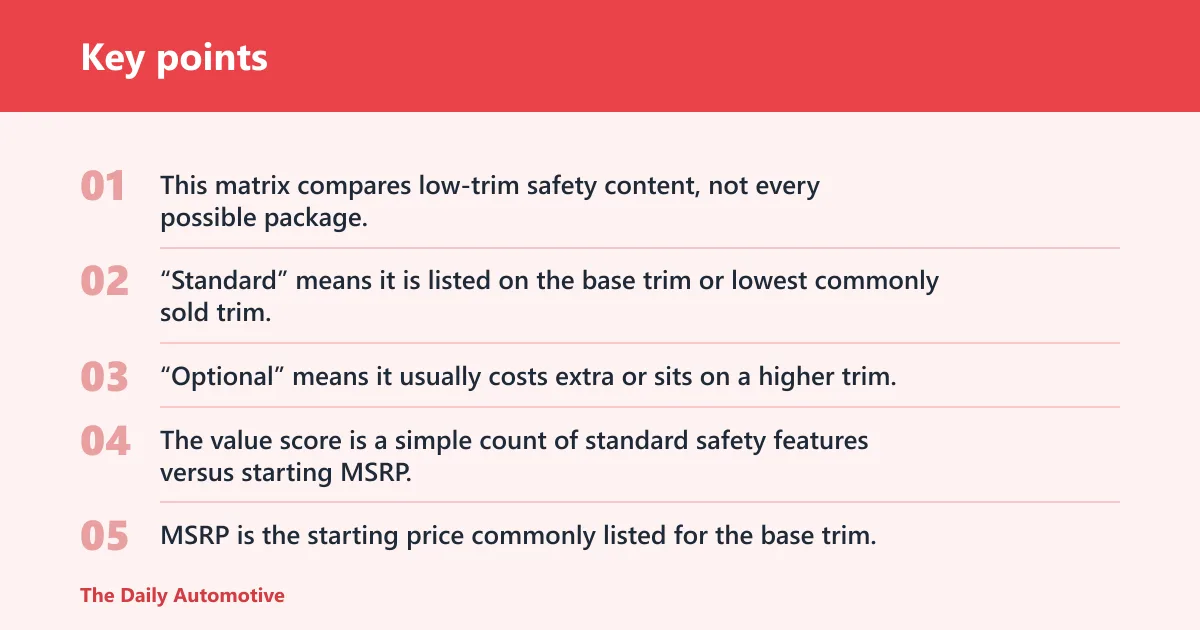
This matrix compares low-trim safety content, not every possible package. “Standard” means it is listed on the base trim or lowest commonly sold trim. “Optional” means it usually costs extra or sits on a higher trim. The value score is a simple count of standard safety features versus starting MSRP.
What each column means
MSRP is the starting price commonly listed for the base trim. The feature columns show whether the safety item is standard on that starting trim. The rating column is included so you can cross-check crash performance with equipment. The value score is a rough comparison tool, not a substitute for the actual window sticker.
| Model | MSRP | AEB | Lane keep assist | Blind spot monitoring | Rear cross traffic alert | Adaptive cruise control | IIHS / NHTSA | Value score |
|---|---|---|---|---|---|---|---|---|
| Toyota Corolla | $22,050 | Standard | Standard | Optional on higher trims | Optional on higher trims | Standard | Top Safety Pick+ / 5-star | 0.18 |
| Honda Civic | $24,250 | Standard | Standard | Optional on higher trims | Optional on higher trims | Standard | Top Safety Pick+ / 5-star | 0.16 |
| Subaru Impreza | $23,695 | Standard | Standard | Optional on higher trims | Optional on higher trims | Standard | Top Safety Pick+ / 5-star | 0.17 |
| Mazda3 | $24,150 | Standard | Standard | Optional on higher trims | Optional on higher trims | Standard | Top Safety Pick+ / 5-star | 0.16 |
| Hyundai Elantra | $22,125 | Standard | Standard | Optional on higher trims | Optional on higher trims | Standard | Top Safety Pick / 5-star | 0.18 |
| Kia Forte | $21,145 | Standard | Standard | Optional on higher trims | Optional on higher trims | Optional on higher trims | 5-star | 0.14 |
| Nissan Sentra | $21,590 | Standard | Standard | Optional on higher trims | Optional on higher trims | Optional on higher trims | 5-star | 0.14 |
| Kia Soul | $20,190 | Standard | Standard | Optional on higher trims | Optional on higher trims | Optional on higher trims | 5-star | 0.15 |
| Hyundai Venue | $20,200 | Standard | Standard | Optional on higher trims | Optional on higher trims | Optional on higher trims | 5-star | 0.15 |
| Subaru Crosstrek | $24,995 | Standard | Standard | Optional on higher trims | Optional on higher trims | Standard | Top Safety Pick+ / 5-star | 0.16 |
| Kia Seltos | $24,490 | Standard | Standard | Optional on higher trims | Optional on higher trims | Optional on higher trims | Top Safety Pick / 5-star | 0.16 |
| Toyota Corolla Cross | $24,035 | Standard | Standard | Optional on higher trims | Optional on higher trims | Standard | Top Safety Pick / 5-star | 0.17 |
How the score is built: standard feature count divided by MSRP in thousands, rounded to two decimals. That is only a comparison aid. A car with fewer standard features can still be a smarter buy if the missing items are the ones you do not need.
What are the best car safety features under $25,000?
The best safety features are AEB, FCW, blind-spot monitoring, rear cross-traffic alert, and lane keeping assist. A rearview camera and TPMS are baseline equipment, not upgrades. If the trim also includes adaptive cruise control, that is a useful bonus for commuting, but it should not replace the core protection features.
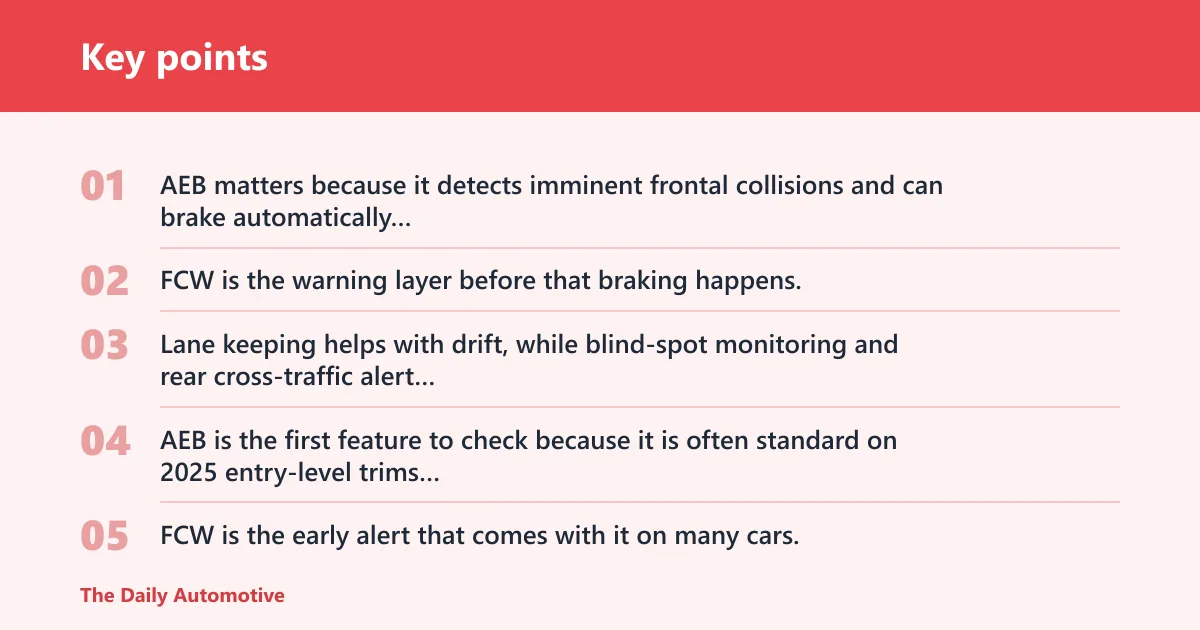
AEB matters because it detects imminent frontal collisions and can brake automatically if the driver does not react in time. FCW is the warning layer before that braking happens. Lane keeping helps with drift, while blind-spot monitoring and rear cross-traffic alert help in merges and parking maneuvers.
Start with AEB and FCW
AEB is the first feature to check because it is often standard on 2025 entry-level trims and it targets the most common type of avoidable crash: a frontal impact. FCW is the early alert that comes with it on many cars. It can cut rear-end risk, but it does not brake on its own.
Add blind spot monitoring and rear cross traffic alert
These two features pay off when lane changes, parallel parking, and driveway exits are part of your routine. Blind-spot monitoring uses radar in the rear corners to warn about a car in the next lane. Rear cross-traffic alert warns about traffic moving behind you while backing out.
Say your commute includes a crowded school pickup lane and a street with parked cars on both sides. AEB helps in stop-and-go traffic, but blind-spot monitoring and rear cross-traffic alert can catch what mirrors miss during lane changes and backing maneuvers.
Decide whether lane keeping and adaptive cruise are worth extra cost
Lane departure warning only alerts you. Lane keeping assist can gently steer the car back into the lane, but it still depends on visible lane markings and a camera that can see clearly. Rain, snow, glare, faded paint, and worn lane lines can reduce its usefulness. Adaptive cruise helps most on longer highway drives.
Suppose the lowest trim includes AEB and a camera, but the next trim adds lane keeping, blind-spot monitoring, and adaptive cruise for a modest jump in price. That upgrade is often worth it. If the next trim mainly adds bigger wheels and styling items, the safety value is weaker.
What do the lowest trims usually leave out?
Base trims often keep AEB, FCW, a camera, and TPMS, but they leave out blind-spot monitoring, rear cross-traffic alert, and adaptive cruise control. That is the most common split in this price band. Some brands also move lane keeping or automatic high beams into a package instead of the standard equipment list.
Common gaps on entry-level trims
The usual missing items are rear corner radar, rear cross-traffic alert, and more advanced lane-centering functions. Automatic high beams are also commonly packaged with other driver-assist tech. The problem is not that these features are useless. It is that the lowest trim often has them hidden behind a step-up package.
When a package is worth paying
A package makes sense when it adds several genuinely useful features at once. Blind-spot monitoring plus rear cross-traffic alert is a strong example. So is a package that adds adaptive cruise, lane keeping, and automatic high beams together. A single feature with a big price jump is harder to justify.
When a higher trim is the better buy
Choose the higher trim when it adds safety hardware you will use every week and the price gap is still smaller than the cost of adding those features one by one elsewhere. If the step up also improves headlights, braking hardware, or crash ratings, the higher trim may be the cleaner value.
How do crash ratings fit in?
Crash ratings should be part of the decision, but they do not replace feature checks. IIHS ratings tell you how well the vehicle performs in crashworthiness tests and front-crash prevention. NHTSA ratings cover frontal, side, and rollover performance. A good rating with weak equipment is still a partial win.
When to trust IIHS results
IIHS Top Safety Pick and Top Safety Pick+ are useful because they combine structure, restraint performance, and available front-crash prevention. That matters most on small cars, where crash performance can vary a lot from one model to the next. Check whether the award applies to the same trim you are buying.
How to use NHTSA ratings
NHTSA’s 5-star system is a federal benchmark and it is easy to compare across brands. It helps with big-picture crash performance, but it does not tell you which trim has blind-spot monitoring or adaptive cruise. Use it as the structural baseline, then inspect the equipment list line by line.
Why ratings do not replace feature checks
A car with good ratings can still be a poor buy if the lowest trim leaves out AEB or lane keeping. The reverse is also true: a long list of driver-assist features does not erase a weak crash test result. Use both. Ratings tell you how the shell performs. Equipment tells you what can prevent the crash in the first place.
Best safety features for different body styles
Body style changes the tradeoff. Small sedans usually give you the best mix of price and standard safety tech. Hatchbacks add easier cargo access without giving up much equipment. Subcompact SUVs can be better for visibility and seating height, but some of them charge more for the same sensor set.
Small sedan needs
For a sedan, prioritize standard AEB, FCW, lane keeping, and adaptive cruise if the price is right. Sedans often deliver strong crash ratings and decent feature content near the base trim. If blind-spot monitoring is available without forcing a big price jump, that is the best next step.
Hatchback needs
Hatchbacks are a good fit when you want city-friendly size and a low price. They often share the same safety suite as their sedan siblings. Check whether the hatch still gets the same AEB and lane-keeping system, because a trim change can alter the standard gear even when the nameplate stays familiar.
Subcompact SUV needs
Small SUVs can be easier to park and may offer better outward visibility, but the cheapest versions often strip out blind-spot monitoring and adaptive cruise. If you buy one, make sure the extra height is paired with actual sensor coverage. A taller vehicle with weak low-trim equipment is not automatically the better safety choice.
How to compare trims before you buy
Compare the exact trim, not the model name. Start with the window sticker or manufacturer spec sheet, then confirm whether AEB, lane keeping, blind-spot monitoring, rear cross-traffic alert, and adaptive cruise are standard or optional. If the answer is “available,” keep reading until you find out what trim or package it takes.
Check standard versus optional equipment
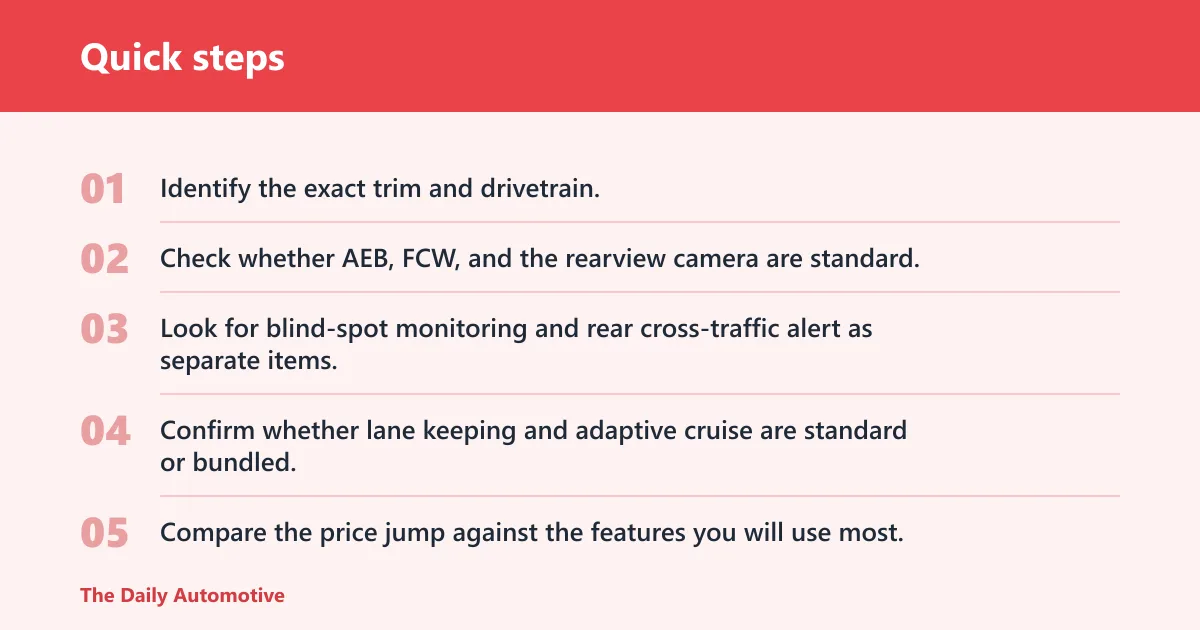
- Identify the exact trim and drivetrain.
- Check whether AEB, FCW, and the rearview camera are standard.
- Look for blind-spot monitoring and rear cross-traffic alert as separate items.
- Confirm whether lane keeping and adaptive cruise are standard or bundled.
- Compare the price jump against the features you will use most.
Ask about sensor repair costs
Radar and camera systems can raise repair bills after minor bumper damage, even when the car still drives normally. That matters on a budget vehicle because a small parking tap can affect a sensor buried in the bumper or grille. Ask whether the trim uses extra parking sensors, radar units, or camera-based systems that may cost more to replace.
Confirm availability on the exact VIN or trim
Dealer listings can blur standard equipment with optional packages, especially on low trims. Before you sign, check the build sheet or VIN-based equipment list. If the seller cannot show that blind-spot monitoring or adaptive cruise is on the car you are buying, assume it is not there.
A common first-timer mistake is buying the “safety package” version of a cheap car without checking what is actually included. One trim may add lane keeping and adaptive cruise, while another only adds cosmetic upgrades. The window sticker is the only thing that settles the question.
Frequently asked questions
Which new cars under $25,000 have the most safety features?
In this price range, compact sedans and some subcompact SUVs usually give you the most standard safety tech on the lowest trims. Look closely at models like the Toyota Corolla, Honda Civic, Subaru Impreza, Mazda3, and Hyundai Elantra. Exact equipment still depends on the trim and package.
What safety features matter most in a cheap car?
AEB matters most because it can reduce the chance of a frontal crash or lessen the impact. After that, blind-spot monitoring and rear cross-traffic alert are the most useful in daily driving. Lane keeping and adaptive cruise are valuable, but they are secondary to the core crash-avoidance features.
Can I get automatic emergency braking on a car under $25,000?
Yes. AEB is often standard on 2025 entry-level trims, even in the sub-$25,000 range. The key is to verify that it is standard on the exact trim you are buying, because some models keep it standard while others make it part of a higher package or trim step-up.
Which small cars under $25,000 have the best safety ratings?
Recent versions of the Toyota Corolla, Honda Civic, Subaru Impreza, and Mazda3 are among the stronger bets for crash ratings in this price range. Check both IIHS and NHTSA, then confirm that the trim you want still carries the same rating and the same front-crash prevention hardware.
Are blind spot monitoring and rear cross traffic alert worth paying for?
Yes, especially if you drive on multi-lane roads or back out of busy parking spaces. Blind-spot monitoring helps with lane changes and merging. Rear cross-traffic alert helps in driveways and parking lots. If they come bundled together at a modest price increase, that package is usually worthwhile.
How do I compare safety features on budget cars?
Use a simple checklist: standard AEB, FCW, camera, TPMS, lane keeping, blind-spot monitoring, rear cross-traffic alert, and adaptive cruise. Then compare the exact trim and the crash ratings. Do not compare model names alone. On budget cars, the trim often matters more than the badge on the trunk.
Products related to this article
Sponsored / affiliate links. As an Amazon Associate I earn from qualifying purchases. I may earn additional commission from eligible campaigns.