Car Repair Insurance Review: Is It Worth It?
Mechanical breakdown insurance makes sense only if your car still qualifies and the premium plus deductible stays below a repair bill you could not cover yourself. Buy the wrong plan, and you may still face exclusions, denied claims, or a policy that costs more than a repair fund. This review explains what car repair insurance is, how it differs from an extended warranty, what it usually covers, and when self-insuring is the better deal.
This guide is part of our Car care and upkeep guide series.
Verdict: is car repair insurance worth it?
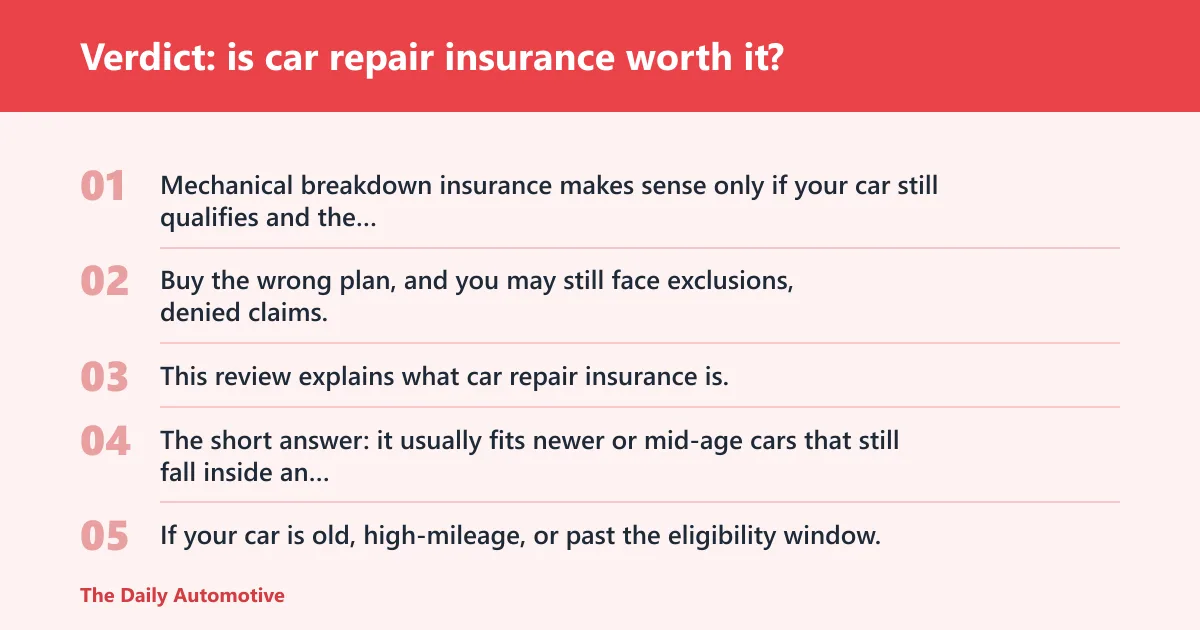
The short answer: it usually fits newer or mid-age cars that still fall inside an insurer’s age and mileage limits, especially if one engine, transmission, or electrical repair would strain your budget. If your car is old, high-mileage, or past the eligibility window, a vehicle service contract or a dedicated repair fund often works better.
Specs at a glance
MBI is not one fixed product. Eligibility, deductibles, and add-ons vary by insurer, so compare the fine print before you compare the annual quote.
| Insurer | Eligibility window | Deductible options | Notable limits or perks |
|---|---|---|---|
| GEICO MBI | Under 15 months old and under 15,000 miles | $250 | Lowest quoted annual cost in the competitor set; claims speed cited at 3.2 days |
| Progressive MBI | Up to 15 years old and under 100,000 miles | $100, $200, or $500 | Broadest eligibility window in the set |
| Allstate MBI | Under 15 months or 15,000 miles | $50, $100, or $250 | Up to 127 components across multiple tiers; trip interruption included |
| AAA MBI | Up to 12 years old or 175,000 miles | $100 or $250 | Includes engine, transmission, electrical, and roadside coverage |
Typical MBI pricing runs about $35 to $95 a year. GEICO’s quoted annual rate is $35, which gives you a low-end benchmark, but the deductible matters just as much because it shapes what you pay when a claim is approved.

Who it is for
MBI is for drivers who want protection against sudden mechanical or electrical failures and still fit an insurer’s eligibility rules. MoneyGeek says it is worth buying if a car is 2 to 12 years old, which matches the practical split: very new cars often cost less to insure for repairs, while very old cars may no longer qualify.
Good fit by ownership status
- Leased or financed vehicles: MBI can be a sensible add-on if the car still qualifies and a major repair would affect your monthly budget.
- Paid-off cars: MBI competes directly with self-insuring. Once the car is owned outright, the repair-risk choice depends more on your cash reserve than on lender rules.
- Cars near the cutoff: Eligibility comes first. If the car is too old or too far over the mileage limit, stop shopping MBI and compare service contracts instead.
What works
Car repair insurance works best when the failure is sudden, mechanical, and expensive enough to exceed the annual premium plus deductible. Covered systems often include engine components, the transmission, drivetrain, fuel system, electrical systems, power steering, brakes in sudden-failure cases, and heating and cooling.
That scope matters. A failed alternator, starter, water pump, or transmission solenoid may be the kind of bill MBI is meant to soften, while ordinary service items are not.
How it works in practice
- Check the vehicle’s age and mileage first.
- Compare deductible tiers and annual price.
- Read the covered-system list and exclusions.
- Confirm whether claims require an approved repair shop or prior authorization.
- Compare the total yearly cost against the repair risk you are trying to avoid.
A common first-timer mistake is choosing a car repair insurance plan based only on the monthly price and ignoring the deductible, claim limits, and approved repair shop network. A $35 policy with a $500 deductible can still leave you paying most of a mid-size repair yourself.
How the numbers usually pencil out
Car repair insurance costs $35 to $95 a year. The premium is only part of the bill, because the deductible shifts part of each covered repair back to you. MoneyGeek also uses a $2,000 repair as a budget-strain test, which is a sensible threshold: if a $2,000 hit would force you to borrow, MBI becomes more appealing.
What does not
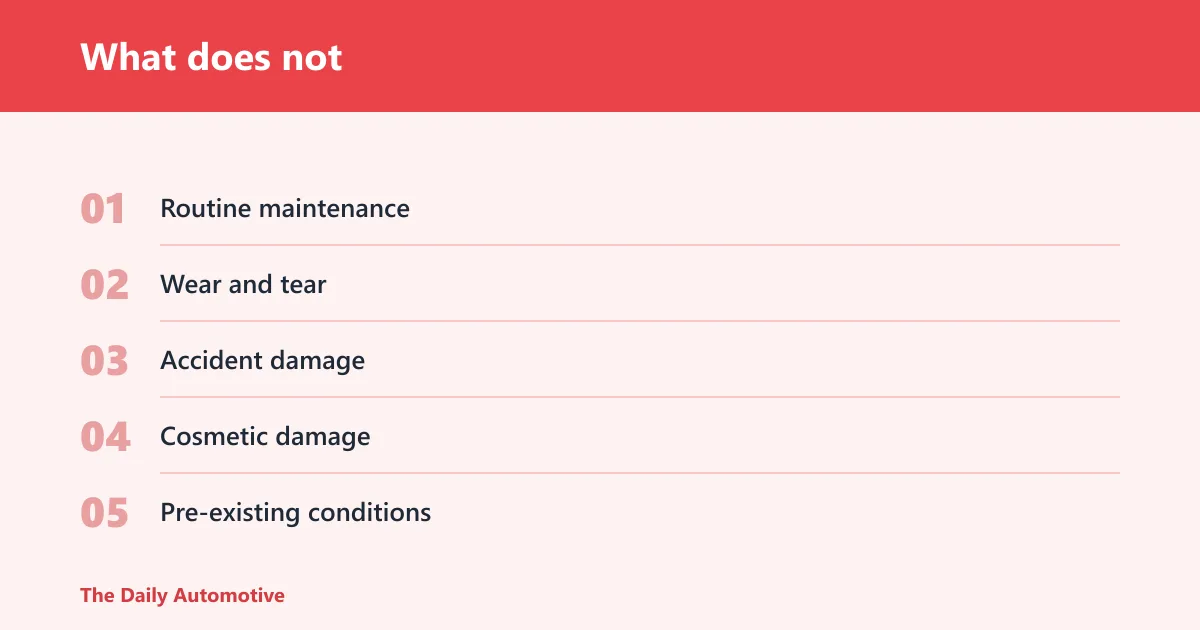
MBI does not pay for routine maintenance, wear and tear, accident damage, cosmetic damage, pre-existing conditions, or deferred-maintenance failures. MoneyGeek specifically notes that routine maintenance is not covered, and that distinction is the heart of the product.
That means a timing belt due by mileage, worn brake pads, a cracked bumper, hail damage, or an engine that fails after obvious neglect is usually outside the contract. If the problem developed slowly and predictably, expect pushback.
Coverage exclusions to watch
- Routine maintenance
- Wear and tear
- Accident damage
- Cosmetic damage
- Pre-existing conditions
- Deferred maintenance failures
What is car repair insurance?
Car repair insurance is another name for mechanical breakdown insurance, usually sold as an add-on to an auto policy rather than a standalone replacement for standard coverage. It is designed for sudden mechanical or electrical failures, not for collision losses or the ordinary costs of keeping a car on the road.
Mechanical breakdown insurance versus standard auto insurance
Standard auto insurance covers losses tied to driving events such as collision, theft, vandalism, or liability claims, depending on the coverage you buy. MBI is different: it helps with internal failures in the car itself. If the engine or transmission failed because of normal wear, MBI is the more relevant policy type, not your regular auto policy.
Why eligibility comes before price shopping
Eligibility is the first filter because a cheap quote means little if the car is too old or has too many miles. GEICO’s cutoff is under 15 months old and under 15,000 miles. Progressive goes much wider, up to 15 years old and under 100,000 miles. AAA and Allstate sit in between with their own limits.
Decision table: which option fits your car?
The best choice depends on age, mileage, and ownership status. In many cases, the right answer is not “buy or do not buy,” but “buy the right product for the car you actually have.”
| Vehicle profile | Typical repair exposure | Most logical option | Why |
|---|---|---|---|
| Newer, low-mileage car | Lower odds of a major failure, but one repair can still be expensive | MBI | Still likely to fit strict eligibility windows; premium is usually modest |
| Mid-age car with moderate mileage | Higher chance of electrical, cooling, or drivetrain issues | Compare MBI and vehicle service contracts | MBI may still fit, but service contracts can become the fallback if eligibility tightens |
| Older or high-mileage car | Greater risk of wear-related failures and more exclusions | Extended warranty or self-insurance | MBI eligibility often ends; self-funding may beat paying for limited coverage |
| Paid-off car with strong repair savings | Owner can absorb a large bill without borrowing | Self-insurance | A dedicated repair fund can outperform a policy with a deductible and exclusions |
| Financed car with tight monthly cash flow | One sudden failure could disrupt payments | MBI if eligible | Protection may be worth the premium if it prevents a debt spiral after a large repair |
Sample out-of-pocket scenarios: with a $1,500 repair, a $250 deductible leaves you paying $250 if the claim is covered, plus the yearly premium. At $3,500, the policy helps more, but your deductible still applies. At $6,000, the value gap widens further if the failure is covered and approved.
Which company has the best fit?
The “best” insurer depends on the car you own, not just the brand name. GEICO looks cheapest for near-new cars, Progressive has the widest eligibility window, Allstate adds broader component coverage and trip interruption, and AAA reaches older vehicles that no longer fit stricter cutoffs.
GEICO MBI
GEICO is the low-cost benchmark here, with a quoted annual rate of $35. Its eligibility is narrow at under 15 months old and under 15,000 miles, and the $250 deductible means small claims do not produce much value. It fits near-new vehicles that need basic protection without a large upfront price.
Progressive MBI
Progressive has the broadest eligibility window in the set, at up to 15 years old and under 100,000 miles. It also offers $100, $200, or $500 deductibles, which gives you more control over the monthly-versus-claim tradeoff. That makes it the most flexible option for drivers who are no longer shopping for a new car.
Allstate MBI
Allstate is a premium short-new-car option, with coverage under 15 months or 15,000 miles. Its tiers cover up to 127 components, and it includes trip interruption. The lower deductible choices, including $50, can help if you want more protection on a new vehicle and are willing to pay for it.
AAA MBI
AAA is the older-car option once tighter programs stop fitting. Its eligibility runs up to 12 years old or 175,000 miles, and its coverage includes engine, transmission, electrical, and roadside benefits. For vehicles past GEICO’s or Allstate’s cutoff, that wider window can be the deciding factor.

- Delivers 7000A peak current for broad compatibility
- Includes a forced start button for fully drained batteries
- Equipped with heavy-duty metal clamps and safety protections
Sharmeal Car Jump Starter 7000A is not repair coverage, but it is a practical backup if you want to avoid a tow for a dead battery. Based on the spec sheet and reviews, the drawback is clear: it helps with start-up emergencies, not engine, transmission, or cooling failures, so it is a complement, not a substitute.

- Includes a lightweight and compact tire inflator
- Comes with reinforced jumper cables
- Stowed inside a high quality bag for the trunk
AUTODECO Car Emergency Roadside Assistance Kit fits drivers who want basic trunk-ready support while comparing MBI or a service contract. The drawback is the same one most kits have: jumper cables and a tire inflator can help with roadside incidents, but they do not pay repair bills for internal mechanical failures.
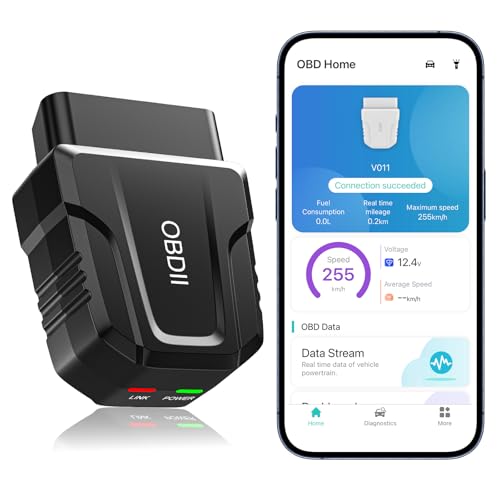
- Provides a complete diagnostic solution
- Supports over 96% of car makes and models
- Features advanced Bluetooth 5.4 connectivity
UMEIJA OBD2 Scanner Diagnostic Tool can help you confirm a check-engine code before you call for service, which is useful when deciding whether a failure looks covered or looks like routine maintenance. The drawback is that a scanner diagnoses symptoms; it does not decide coverage, and it cannot turn a wear issue into a claim.
Should you buy it
Buy MBI if your car still fits the age and mileage limits, the premium and deductible are small next to your repair risk, and one covered failure would strain your budget. If the car is older, high-mileage, or already past the eligibility window, an extended warranty or self-insurance usually makes more sense.
Choose MBI if…
- Your car is still inside the insurer’s age and mileage cutoff.
- You want protection against sudden engine, transmission, electrical, or cooling failures.
- A $2,000 repair would be a real budget problem.
- You want lower-cost coverage on a newer vehicle rather than a broader service contract.
Choose an extended warranty if…
- MBI eligibility has ended because the car is too old or too far over mileage.
- You are comparing dealer-backed vehicle service contracts against insurer MBI.
- You want a product that is often sold for older vehicles beyond 12 years or 175,000 miles.
Choose self-insurance if…
- You can pay a $1,500, $3,500, or even $6,000 repair without borrowing.
- The deductible and annual premium would eat too much of the benefit.
- Your car has enough age or mileage that exclusions are likely to matter.
Frequently asked questions
what’s the best car repair insurance
There is no single best option for every driver. GEICO is the low-cost choice for near-new cars, Progressive has the broadest eligibility window, Allstate adds more component coverage and trip interruption, and AAA fits older vehicles that no longer qualify elsewhere. The best fit depends on age, mileage, and deductible tolerance.
which car insurance company has best reviews
Reviews are not enough on their own for MBI. What matters more is whether the insurer will accept your car, what deductible it offers, and which failures it covers. A company can look good on satisfaction and still be the wrong choice if your vehicle falls outside its eligibility window.
is car repair insurance worth it
It can be, but only when the car still qualifies and the expected repair risk is high enough. MoneyGeek’s 2 to 12 year range and $2,000 strain test are useful guides. If the premium plus deductible is close to the repair fund you already have, self-insuring may be smarter.
what is the most reliable car insurance company
Reliability depends on the claim type, not just the brand. For MBI, the most useful question is which insurer has the clearest eligibility rules, the deductible you can live with, and the shortest claim friction. GEICO’s cited 3.2-day claims speed is one benchmark, but it still needs to fit your car.
how does car repair insurance work
It works like add-on protection for sudden mechanical or electrical failures. You pay a yearly premium, then a deductible when a covered repair is approved. It does not cover routine maintenance, wear and tear, accident damage, cosmetic issues, pre-existing conditions, or deferred-maintenance failures.
should i use my insurance to fix my car
Usually not for engine or transmission failure unless the damage came from a covered accident or another covered event under your standard auto policy. Mechanical breakdown issues belong under MBI or a vehicle service contract, not collision coverage or liability coverage. Using the wrong policy can lead to a denial.
Products related to this article
Sponsored / affiliate links. As an Amazon Associate I earn from qualifying purchases. I may earn additional commission from eligible campaigns.