Best Car Speakers for Clarity (2026): Based on Specs and Reviews
For factory head units, a common rule of thumb is to pick 88–92 dB sensitivity, 4-ohm speakers, and smooth tweeter voicing. With a mild amp, put lower distortion and better cone control ahead of big watt ratings. Choose poorly, and vocals sound thin, cymbals turn harsh, and road noise buries detail. This guide maps speaker specs to stock radios, amp-ready setups, and highway-noise listening.
Quick comparison
| Product | Badge | Best for | Price | ||
|---|---|---|---|---|---|
 |
NVX® XSP65KIT 6.5" Car Speakers, 600W Max, 200W RMS, 2-WayNVX | Our pick | 6.5" · 600W · Component System | $169.99
Price as of 22 Oct 2026
|
View |
 |
Kenwood KFC-1666S Car Stereo Speaker 6-1/2" 2-Way SpeakersKenwood | Budget pick | 6.5" · 300W · 2-Way Speakers | $31.00
Price as of 22 Oct 2026
|
View |
Use this as a fit-first filter, not a beauty contest. The same speaker can sound clear in one car and dull in another if sensitivity, depth, and crossover behavior do not match the system.
How we chose
The shortlist centers on three things that affect clarity in real use: how much output a speaker can make from factory power, whether it will physically fit the door or dash opening, and how its tweeter and crossover design shape vocals and upper harmonics.
We also separated speakers by use case. A stock head unit favors easier-to-drive designs. A mild amp opens the door to cleaner headroom and better control. Highway commuting needs a speaker that stays composed when road noise rises.
Factory speakers are the main cause of flat sound. That makes replacement worthwhile, but only if the new speaker matches the car’s limits instead of fighting them.
Clarity fitment matrix
| Scenario | Speaker type | Sensitivity | Impedance | Mounting depth | Ideal use case |
|---|---|---|---|---|---|
| Factory head unit | Coaxial or easy-fit 2-way component | 88–92 dB | 4 ohms | Shallow if the door has a shallow basket or window clearance issue | Clearer vocals, podcasts, and day-to-day commuting without an amplifier |
| Mild amp | 2-way component with a well-matched crossover | Moderate sensitivity with better control and lower distortion | 4 ohms, or 3.2 ohms if the amp supports it | Check depth before ordering, especially in late-model doors | Cleaner mids, firmer vocal placement, and less strain at higher volume |
| Sound-quality build | Component system with tuning control and stronger imaging | Not the only factor; tuning matters more here | Match to the amplifier’s stable load | Depth and mounting-hole diameter must both clear the car’s door or dash | Front-stage clarity, better separation, and less harshness at highway speed |
Say your car has a stock radio and you mainly stream podcasts on the highway. A shallow 6.5-inch coaxial with decent sensitivity will usually be a safer clarity upgrade than a power-hungry component set that never gets enough clean voltage.
Suppose your door accepts 6.5-inch speakers but has limited depth behind the panel. A deeper basket can hit the window glass or inner door brace even when the size looks right on paper, which turns a good speaker into a bad fit.
Which car speaker type is clearest?
Component speakers usually win on clarity because they split the woofer and tweeter and use an external crossover to divide frequencies. That gives more control over where vocals, cymbals, and upper harmonics play, which helps staging and imaging. Coaxials are simpler and often easier to fit, but they give up some placement control.
Coaxial vs component
Coaxial speakers combine a woofer and tweeter into one unit. That keeps installation straightforward and makes them a strong choice for factory locations where you want better clarity without extra hardware. Component speakers use an external crossover to split frequencies, which usually gives cleaner front-stage placement and more tuning control.
When 2-way, 3-way, and 4-way designs make sense
A 2-way design splits duties between a woofer and tweeter. That is the most common clarity-first setup because it can keep vocals focused without adding complexity. A 3-way or 4-way design adds more frequency division, which can help when the system is tuned well, but it also raises install and integration demands.
More drivers do not automatically mean better clarity. Extra cones can add complexity without fixing a poor crossover choice or bad tweeter placement. For many drivers, a good 2-way component or coaxial is the cleaner path.
What sensitivity should you look for?
For a factory head unit, sensitivity matters because the radio has limited power. A speaker that is easier to drive will sound fuller at normal volume, while a low-sensitivity model may seem weak, flat, or muffled until you add an amplifier. SRIKO also notes sensitivity as important for factory head units or modest amps.
Stock radio priorities
With no external amp, prioritize speakers that make useful output from limited power. That is why the 88–92 dB range is a practical target for clarity-focused upgrades on factory power. It helps vocals stand out without forcing the radio into strain.
A high sensitivity rating is not a promise of better sound by itself. Door seal quality, speaker placement, and crossover voicing still matter. But if the radio is weak, sensitivity often decides whether the upgrade feels obvious or underwhelming.
What changes with an amp
Once you add a mild amplifier, you can give up some sensitivity and focus more on distortion control, cone control, and thermal handling. That is where RMS power handling becomes more important than the marketing number on the box. The speaker needs to stay composed when the amp is working harder.
That is also why an amp-ready speaker can sound calmer at the same listening level. The system is no longer asking the head unit to do all the work.
Best car speakers for clarity
NVX XSP65KIT: best for mild amplifiers
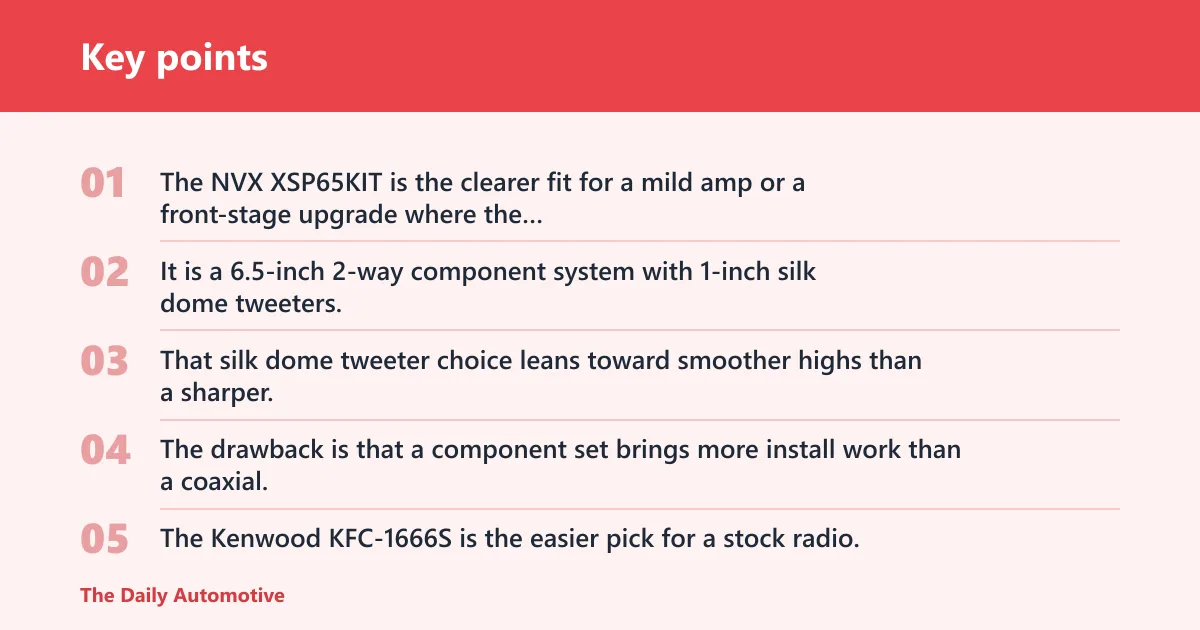
The NVX XSP65KIT is the clearer fit for a mild amp or a front-stage upgrade where the goal is stronger vocal control and better separation. It is a 6.5-inch 2-way component system with 1-inch silk dome tweeters, and the published specs list 200W RMS per speaker.
That silk dome tweeter choice leans toward smoother highs than a sharper, more aggressive voicing, which can help with long listening sessions and highway fatigue. The drawback is that a component set brings more install work than a coaxial, and it makes the most sense when the crossover can be mounted and the tweeters can be positioned well.
Kenwood KFC-1666S: best for factory head units
The Kenwood KFC-1666S is the easier pick for a stock radio, especially if you want cleaner vocals without reworking the whole front stage. It is a 6-1/2-inch 2-way coaxial speaker, and the published details list 300 watts peak power along with grilles for easier installation and protection.
As a coaxial drop-in approach, it is the simpler path for drivers who want clarity without a separate crossover network. The tradeoff is staging control: a coaxial usually cannot image quite like a well-installed component set, and the published specs do not signal the same premium tweeter and crossover control as the NVX set.
Which one should you buy?
If your car still runs the factory head unit, start with the Kenwood. It is the simpler clarity upgrade, and a coaxial is easier to fit in common factory locations. If you already have a mild amplifier or plan to add one soon, the NVX set makes more sense because the component layout and silk dome tweeters support cleaner front-stage tuning.
If your main complaint is highway noise, the decision depends on the rest of the system. With no amp, lean toward the easier-to-drive option. With an amp and a proper install, the component set is the better route for keeping vocals intelligible over tire and wind noise.
Budget matters too. The Kenwood is the lower-cost path, while the NVX asks for more money and more installation effort. A buyer chasing bass-first output should not use this guide as a subwoofer substitute. These are clarity upgrades, not low-end replacement parts.
What matters before you buy?
Impedance, RMS power, depth, size, tweeter material, and crossover design all decide whether a speaker will sound clean in your car. The wrong mix can leave you with weak output, harsh highs, or a speaker that will not physically fit the opening.
Impedance and RMS power
Impedance is the electrical load the speaker presents to the amplifier. Four-ohm speakers are the safest match for many factory radios and aftermarket amps. The Audiocircle Stuttgart Line, for example, is listed with a 3.2-ohm impedance, which can change output and amp loading compared with a standard 4-ohm design.
RMS power means continuous power handling, not a brief peak number. That is the figure that matters when matching a speaker to an amplifier. The Image Dynamics CXS64 V2 is listed at 125W RMS per speaker, while the NVX XSP65KIT is listed at 200W RMS per speaker. Peak wattage can be useful for context, but it should not drive the buying decision.
Mounting depth and speaker size
SRIKO says mounting depth should be checked before ordering, and that advice matters because door clearance is often the hidden fitment problem. A 6.5-inch speaker may still fail if the basket is too deep or the magnet hits the window track. Late-model vehicles can be especially tight behind the panel.
Which speaker size is easiest to fit in most cars? In practice, 6.5-inch speakers are often the most flexible because many vehicles use them in the doors and there are many adapter options. 6×8-inch speakers can fit well in some domestic and Ford applications, but they are less universal than 6.5-inch replacements.
Tweeter material and crossover control
PEI dome tweeters tend to sound brighter and more forward. Silk dome tweeters are usually smoother and can reduce listening fatigue on long drives. That matters more than many shoppers expect, because a bright tweeter can sound detailed for five minutes and tiring after an hour.
Crossover design matters even more in component systems. The crossover splits frequencies so the woofer and tweeter are not fighting the same band. That affects imaging, treble smoothness, and how stable vocals sound from the driver’s seat.
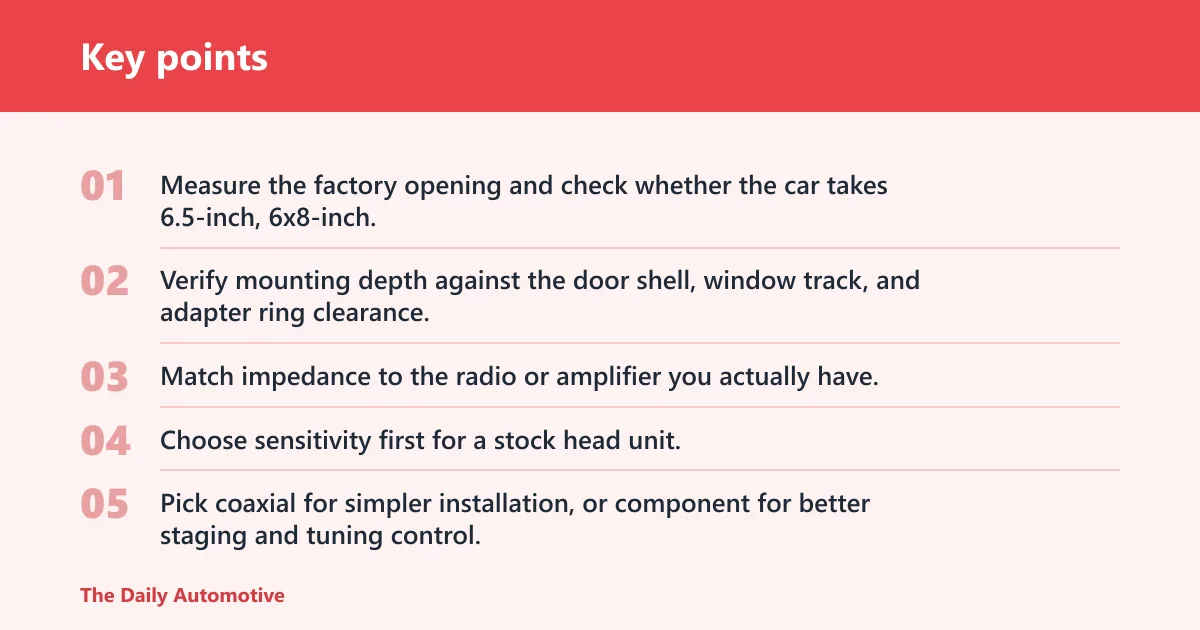
- Measure the factory opening and check whether the car takes 6.5-inch, 6×8-inch, or another size.
- Verify mounting depth against the door shell, window track, and adapter ring clearance.
- Match impedance to the radio or amplifier you actually have, not the one you plan to buy later.
- Choose sensitivity first for a stock head unit, then look at RMS power if an amp is part of the plan.
- Pick coaxial for simpler installation, or component for better staging and tuning control.
- Prefer silk dome tweeters if you want smoother highs, or a more forward tweeter if your cabin sounds dull and you are not already treble-heavy.
A common first-timer mistake is buying a speaker because the top-end number looks impressive, then discovering the door cannot clear the magnet. Another is pairing a low-sensitivity speaker with a factory radio and expecting loud, clean vocals without adding power. The spec sheet has to match the car.
Frequently asked questions
What are the best car speakers for clarity?
The best car speakers for clarity are usually 2-way component systems for the front stage or well-voiced coaxials for easier installs. Clear-sounding speakers emphasize clean midrange, controlled highs, and a crossover or tweeter design that avoids harshness. Fitment and power matching still matter just as much as brand.
Do component speakers sound clearer than coaxial speakers?
Usually, yes, because component speakers place the woofer and tweeter separately and use an external crossover. That gives better imaging and more precise staging when installed correctly. Coaxials can still sound very clear, especially in factory locations or when the system is running from a stock head unit.
What speaker sensitivity is best for a factory head unit?
A practical target is 88–92 dB sensitivity for a factory head unit. That range helps the radio make enough output without strain, which matters for vocal clarity and podcast playback. Sensitivity is only part of the picture, though. Install quality, impedance, and tweeter voicing still shape the result.
How important is mounting depth when choosing car speakers?
Very important. A speaker can match the diameter on paper and still fail in the car if the basket is too deep for the door cavity. Depth limits can interfere with the window track, braces, or factory grille. Always check depth before buying, especially on late-model vehicles.
What does RMS power mean on car speakers?
RMS power is the speaker’s continuous power handling, which is the number to use when matching it to an amplifier. It tells you much more than peak wattage does. Peak power is a short-term figure and is less useful for real-world clarity, heat management, and amp matching.
Can car speakers improve clarity without adding an amplifier?
Yes. A good coaxial or efficient component set can improve clarity on a factory radio, especially if the stock speakers are the weak point. The best results come from a sensitivity-friendly design, proper fitment, and tweeter voicing that does not become harsh at limited power.
What frequency response should I look for in clear-sounding car speakers?
Look for usable extension at both ends, but do not chase the widest number blindly. Low-end extension affects fullness, while high-frequency extension affects perceived detail. A broad response only helps if the speaker is controlled enough to stay clean in the door and the tweeter is not overly bright.
Products related to this article
Sponsored / affiliate links. As an Amazon Associate I earn from qualifying purchases. I may earn additional commission from eligible campaigns.