Best Generators for Electric Cars (2026): We Compared
For EV backup charging, the best generator choice is usually a large battery power station for short, quiet top-ups. Choose a dual-fuel generator only if you need longer runtime or higher charging output. A bad match can leave your EV stranded with too little energy to reach a charger. This guide compares both options for outage use.
Quick comparison
| Product | Badge | Best for | Price | ||
|---|---|---|---|---|---|
 |
EF ECOFLOW Portable Power Station DELTA 2 Max 2048Wh, 2400WEF ECOFLOW | Our pick | 2048Wh · 2400W · LFP | $1,049.00
Price as of 24 Oct 2026
|
View |
 |
Jackery Explorer 1000 v2 Portable PowerJackery | Also great | $499.00
Price as of 24 Oct 2026
|
View | |
 |
Westinghouse 4000 Peak Watt Super Quiet Dual Fuel PortableWestinghouse | Also great | 4000 Peak Watt · Dual Fuel · Quiet | $749.99
Price as of 24 Oct 2026
|
View |
 |
Champion 4500-Watt Electric Start Dual Fuel PortableChampion Power Equipment | Also great | $988.62
Price as of 24 Oct 2026
|
View |
The comparison comes down to charging output, runtime, and EVSE compatibility. A power station is the cleaner, quieter option for light emergency charging. A dual-fuel inverter generator is the better path when you need longer outage coverage or any real chance at 240V charging.
Use the table above to filter by charge type, then check the failure cases before you buy. The wrong outlet, weak running watts, or an EVSE that rejects the setup can turn a good spec sheet into a dead end.
How we chose
We compared each option on four points that matter during an outage: sustained running watts, 120V versus 240V support, noise and fuel burden, and safety features such as CO shutdown or bonded-neutral configuration.
Running watts matter more than surge watts for EV charging. Charging is a steady load, so surge capacity helps only briefly and does not fix an underpowered output stage.
We also separated emergency top-ups from real charging. That difference matters more than brand names, because Level 1 at 120V and Level 2 at 240V have very different power demands and compatibility rules.
Finally, we looked at home-backup fit. If you plan to use a transfer switch or feed critical loads, the generator must support the right voltage, outlet format, and installation path.
EF ECOFLOW DELTA 2 Max: best for quiet top-ups
The EF ECOFLOW DELTA 2 Max is the better fit if you want silent, emission-free backup power for short EV top-ups and other household essentials. Its 2048Wh LiFePO4 storage and 2400W AC output make it more capable than many small stations, and the quiet operation starting at 30 dB helps in apartments, garages, and shared parking areas.
Based on the published specs, this is a practical emergency backup tool, not a fast charger. A 2048Wh battery can support limited charging time, but it cannot turn an EV into a long-range refill source. Once the battery is depleted, you need grid power, a generator, or a fuel source.
The drawback is simple: battery capacity is finite. Even with expandable capacity up to 6kWh, the AC output limit still defines what the EVSE will accept, and a full overnight EV session is often beyond what a single portable station can comfortably provide.
Jackery Explorer 1000 v2: best for compact backup
The Jackery Explorer 1000 v2 is best for compact, short-duration backup where portability matters more than total energy. At 1070Wh with 1500W output, it suits emergency phone charging, lighting, router backup, and very modest EV top-up use through a compatible low-power charging path.
This is the most portable option in the group, and that matters when you need to move it quickly or store it in a small space. It is also a sensible fit for lower-demand use cases where silent operation and LiFePO4 chemistry matter more than raw output.
The drawback is its limit. 1500W is not enough for serious EV charging, and the 1070Wh battery size keeps it in the “move a few miles” category rather than the “rebuild range overnight” category. For an EV owner, that is a backup convenience tool, not a primary charging solution.
Westinghouse 4000 peak watt dual fuel inverter: best for long outages
The Westinghouse 4000 peak watt dual fuel inverter generator is the stronger fit when you need longer outage runtime and a better shot at supporting actual EV charging. Dual-fuel operation gives you gasoline or propane flexibility, and the RV-ready inverter format is a better match for sensitive electronics than a basic open-frame generator.
This is the product in the group most aligned with sustained backup planning. Dual-fuel matters because fuel availability changes during outages, and propane storage can be easier in some homes than gasoline. The inverter design also helps with power quality, which matters when an EVSE or household electronics are part of the load.
The drawback is still real: it is fuel-burning, so you must deal with noise, exhaust, outdoor placement, and maintenance. It is also not a guaranteed Level 2 solution unless the EVSE, voltage, and outlet setup line up correctly.
Champion 4500-watt dual fuel inverter: best for flexible backup
The Champion 4500-Watt Electric Start Dual Fuel Portable Inverter Generator is a good middle-ground option for buyers who want electric start, dual-fuel flexibility, and a bit more output headroom than a small power station can provide. It is better suited to home backup planning than casual emergency-only use.
Its strength is practical flexibility. Electric start reduces hassle during an outage, and the dual-fuel design gives you options when one fuel is hard to find. That makes it a reasonable candidate for longer backup windows, especially if you expect to run other household loads alongside EV charging.
The drawback is that the product data supplied here does not give the exact running-watt and outlet details needed to treat it as a guaranteed EV charging pick. For EV use, that missing information matters. You still need to verify voltage support, neutral configuration, and the actual charger draw.
EV charging decision matrix
This is the part most buying guides skip. A backup source that can move a few miles is not the same thing as one that can support overnight charging, and that gap is where many generator purchases fail.
| Use case | Minimum watts | Outlet type | Fuel/runtime implications | Noise | Fail-safe warning |
|---|---|---|---|---|---|
| Emergency trickle charge | About 1,500W or more for a modest 120V EVSE path | NEMA 5-15 or 5-20 on the EVSE side, if the charger supports it | Portable power station or small inverter generator; runtime is limited by battery Wh or fuel tank size | Power station is silent; generator noise still matters outdoors | If the EVSE refuses the source or the output sags, stop and switch to lower draw |
| Level 1 overnight top-up | Running watts should comfortably exceed the EVSE draw plus household basics | NEMA 5-15/5-20, 120V charging | Best with a power station for brief use or a fuel generator for longer runtime | Silent with battery backup; lower drone with inverter models | Do not expect meaningful range recovery if the battery bank is too small |
| Limited Level 2 backup | Higher running watts are needed; surge watts are not the main number | Often NEMA 14-50 or another 240V path, depending on EVSE and setup | Fuel-burning inverter generator is usually the practical choice; runtime becomes a fuel question | Noticeably louder than a power station | Without bonded-neutral or a compatible transfer-switch setup, the EVSE may refuse to charge |
| Whole-home-plus-EV outage support | Substantial continuous output, often beyond small portable units | 120V/240V support through a transfer switch | Fuel use rises fast when home loads and EV charging run together | Outdoor generator noise is unavoidable | Use a proper transfer switch and electrician-approved setup; improvised backfeeding is unsafe |
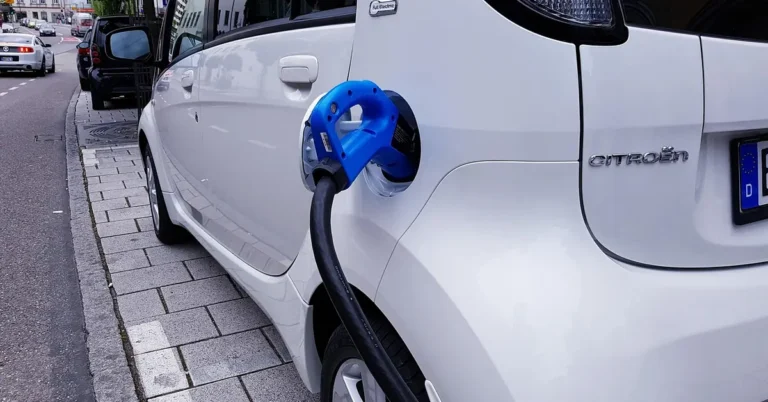
Say your EV has 120V charging only and you need enough range to reach a public charger the next morning. A smaller power station or inverter generator can help, but only if the EVSE accepts the source and the battery or fuel runtime covers the actual charging window.
Suppose you are trying to keep a car, refrigerator, and internet gear alive during a two-day outage. That shifts the problem from quiet top-up to sustained load, and a dual-fuel inverter generator with enough running watts becomes the more realistic path.
Can a power station charge an EV?
A power station can charge an EV in limited situations, but only as a short, low-output backup. The key limits are its AC output and battery capacity. A LiFePO4 station is quiet and emission-free, which is valuable indoors nearby or in dense housing, but it is not a full replacement for grid power.
What a LiFePO4 power station can realistically do
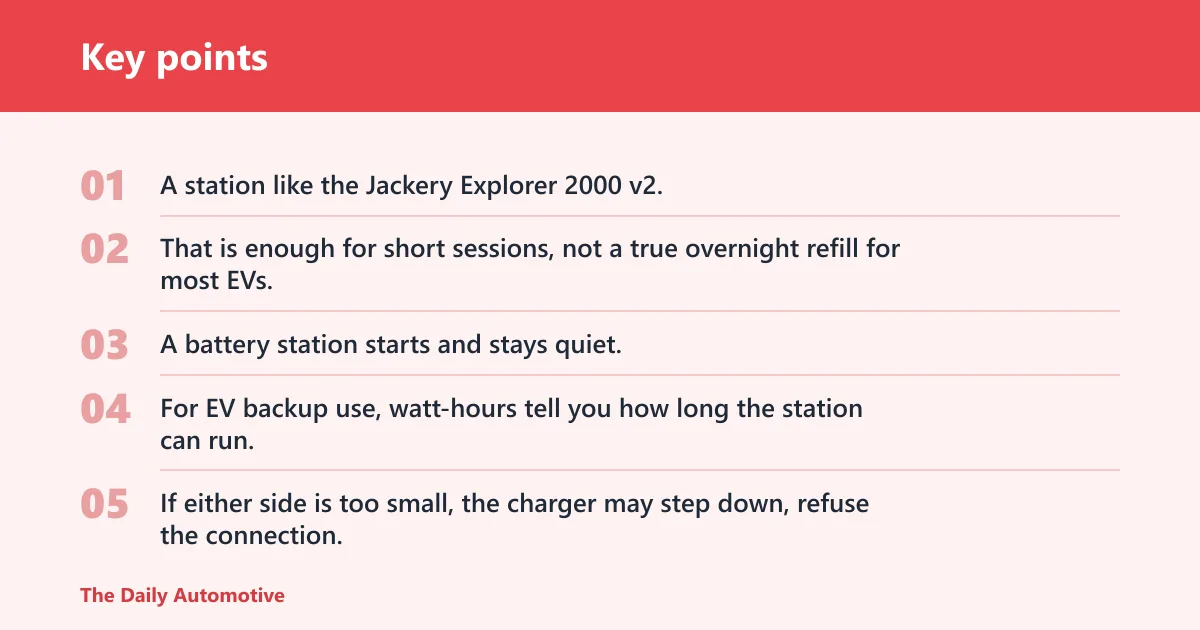
A station like the Jackery Explorer 2000 v2, with 2042Wh LiFePO4 storage and 2200W total AC output, can support emergency charging in a careful, limited way. That is enough for short sessions, not a true overnight refill for most EVs.
The main advantage is noise. A battery station starts and stays quiet, so it can be better than a fuel generator in an apartment building, a shared driveway, or any place where exhaust and sound are a problem.
Why AC output and watt-hours set the limit
For EV backup use, watt-hours tell you how long the station can run, while AC output tells you what the EVSE can draw at once. If either side is too small, the charger may step down, refuse the connection, or stop early.
That is why power stations are better for emergency top-ups than for meaningful replenishment. They can be the right answer for a few miles of range. They are usually the wrong answer for a serious overnight recovery.
Where silent operation helps
Silent operation matters when the outage is local, the weather is mild, and the goal is to buy time. It also helps when you need to run electronics after dark without making the whole block listen to a generator.
But silence is not free. You are paying for stored energy, and once that energy is gone, the station needs a wall outlet, solar input, or a generator of its own.
Dual-fuel generator: best for outage charging
A dual-fuel inverter generator is usually the better choice when your outage window is long enough that battery storage would run out too soon. Gasoline and propane give you flexibility, and the inverter design is friendlier to electronics than a basic contractor-style unit.
Why dual-fuel matters in long outages
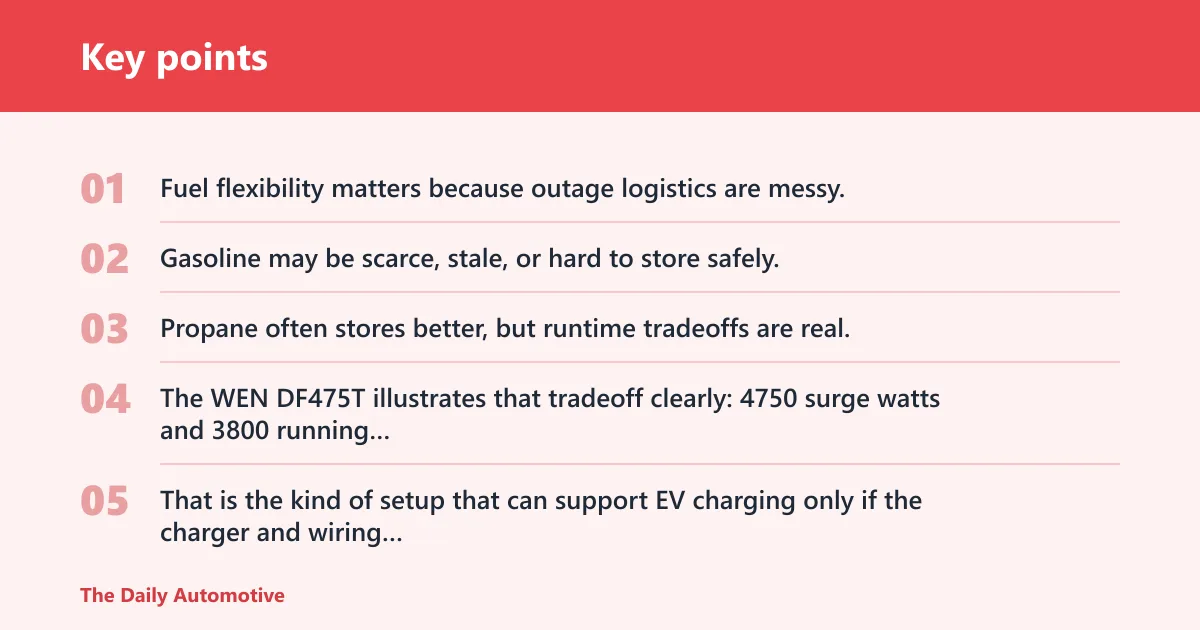
Fuel flexibility matters because outage logistics are messy. Gasoline may be scarce, stale, or hard to store safely. Propane often stores better, but runtime tradeoffs are real, and output is often lower on propane than on gasoline.
The WEN DF475T illustrates that tradeoff clearly: 4750 surge watts and 3800 running watts on gasoline, versus 4350 surge watts and 3500 running watts on propane, with 120V/240V output switching. That is the kind of setup that can support EV charging only if the charger and wiring match the available output.
What Level 1 and limited Level 2 charging need
Level 1 charging uses 120V and is slow by design. It is the most realistic low-watt backup path, especially if your goal is only to gain enough range to escape the outage zone.
Level 2 charging is 240V and usually needs higher running watts. It often uses a NEMA 14-50 outlet or a transfer-switch-backed installation, and the EVSE may require a bonded-neutral or another compatible setup before it will allow charging.
Where bonded-neutral and outlet compatibility matter
This is where many owners get stuck. A generator can have enough watts on paper and still fail because the outlet, neutral bond, or transfer-switch arrangement does not match the EVSE’s expectations.
That is also why a 14-50 outlet is not universally compatible. It is a common 50A 125/250V receptacle for EV and RV use, but the wiring, enclosure, and generator configuration still have to be correct.
A common first-timer mistake is assuming surge watts will carry the day. They will not. EV charging is a sustained load, so the running-watts figure is the one that decides whether the setup keeps charging or drops out.
Which one should you buy?
Buy the battery power station if your goal is quiet, short emergency charging and low hassle. Buy the dual-fuel inverter generator if you need longer runtime, better odds of supporting Level 1 overnight use, or a path toward limited Level 2 and home backup.
Apartment or condo backup
Start with a power station if you need silent operation and have no safe place for a fuel generator outdoors. The Jackery Explorer 1000 v2 fits compact, low-demand backup better than any fuel-burning option here, but it is still only a modest EV helper.
Garage owner with transfer switch plans
Choose the dual-fuel inverter generator if you already plan to add a transfer switch or want one system that can support critical loads and possible EV charging. The Westinghouse 4000 peak watt model is the better match here because it is built around fuel flexibility and inverter output.
Camping or occasional emergency use
Go with the quieter battery option when your charging need is occasional and portability matters most. The EF ECOFLOW DELTA 2 Max has the most useful balance of output, storage, and quiet operation among the battery choices listed here.
Long outage planning on a budget
Pick the dual-fuel route if runtime matters more than silence. That is where a gasoline/propane setup pays off, because you can keep running when a battery station would already be empty. Just budget for fuel, maintenance, and outdoor operation.
Frequently asked questions
What size generator do I need to charge an electric car?
For Level 1 charging, you need enough running watts to cover the EVSE and any other loads on the same circuit or generator. For limited Level 2 use, you usually need a much larger inverter generator with 240V output and the right neutral setup. Running watts matter more than surge watts.
Can a portable generator charge an EV battery?
Yes, but only if the generator output matches the EVSE’s requirements and the setup is electrically compatible. A portable generator is more realistic for slow 120V charging than for true fast charging. If the EVSE rejects the source, the battery will not charge at all.
Do I need 240V to charge an electric car from a generator?
Not always. Level 1 charging uses 120V and is the easiest path for a backup generator or power station. Level 2 uses 240V and is faster, but it usually needs higher running watts and a compatible outlet or transfer-switch arrangement before the EVSE will allow it.
Is a dual-fuel generator better for EV charging?
Usually yes, if you need longer runtime or expect fuel shortages. Dual-fuel models give you gasoline and propane options, which helps during outages. The tradeoff is output, since propane often reduces available watts, and the generator still has to meet the charger’s sustained load.
Can a power station charge an electric car during an outage?
Yes, for short emergency top-ups. A LiFePO4 power station is quiet and emission-free, but its AC output and watt-hour capacity limit how much range it can add. It is a good stopgap, not a replacement for overnight charging or serious range recovery.
What safety features should I look for in an EV charging generator?
Look for CO watchdog shutdown protection, outdoor-only operation, and a generator or setup that matches your charging voltage. For home backup, a transfer switch is the safer path, but installation requirements vary. If the setup involves 240V, bonded-neutral compatibility matters too.
Products related to this article
Sponsored / affiliate links. As an Amazon Associate I earn from qualifying purchases. I may earn additional commission from eligible campaigns.