Best Engine Mounts for a Smooth Daily Driver: We Compared
For a smooth daily driver, start with OE-style hydraulic or fluid-filled engine mounts. If you want the quietest cabin, stay with stock-durometer replacements and skip performance mounts unless wheel hop or drivetrain lash matters more than idle vibration. Choose too firm a mount and you get more idle shake, more cabin buzz, and quicker wear in exhaust flex joints and nearby brackets. This guide ranks the best mount types by comfort, fitment, and durability, then explains when firmer mounts make sense.
Quick comparison
| Product | Badge | Best for | Price | ||
|---|---|---|---|---|---|
 |
Anchor Right Engine Torque Strut Mount compatible with FordSixity Auto | Our pick | Right · Direct-fit OE replacement · Ford Taurus | $30.30
Price as of 12 Nov 2026
|
View |
 |
Hydraulic Engine & Trans Mount Assy Replacement for MercedesNEWZQ | Pair with it | Front left/right + rear · Replacement set · Mercedes | $60.99
Price as of 12 Nov 2026
|
View |
 |
DEA Products DEA A2906 Front Engine MountAED | Budget pick | Front · OEM hydraulic · A2906 | $33.90
Price as of 12 Nov 2026
|
View |
 |
ACDelco GM Genuine Parts 25828247 Engine MountGM GENUINE PARTS | Also great | Engine mount · OE replacement · GM Genuine Parts | $133.77
Price as of 12 Nov 2026
|
View |
 |
Mopar 68258599AA Engine Mount (Rear) Fiat 500X Jeep RenegadeMopar | Also great | Rear · Direct replacement · Fiat 500X/Jeep Renegade | $56.45
Price as of 12 Nov 2026
|
View |
Use this table to match the mount type to how the car is used, not the brand name on the box. The right answer starts with OEM fitment, side-specific orientation, and the amount of torque control you actually need.
The catalog context also matters: engine mounts sit under Engines and parts, alongside a broader Transmission & Drivetrain Mounts category and Bodywork, mounts and accessories; the shopping page offers Select brand and Select category filters, advertises 5M+ parts sold, and mentions a 90-day warranty on selected parts.
How we chose
These picks are ordered by daily-driver priority: lowest cabin vibration first, then OE-like geometry, then expected durability, with firmer options only when torque control matters more than quiet.
- Manufacturer listing details: direct-fit language, OE replacement claims, and whether the mount is hydraulic, rubber, or torque-strut style.
- Vehicle fitment and geometry: side-specific application, engine orientation, and whether the listing points to vehicle-specific part numbers.
- Published buyer feedback: signs that the part fits cleanly and avoids the common mistake of adding vibration or bracket interference.
- Comfort-first priority: daily-driver picks rank higher when they are more likely to keep idle smooth and control NVH without adding harshness.
Hydraulic engine mount: best for comfort
AED DEA A2906 Front Engine Mount is the best fit here for a smooth commuter because it uses an OEM hydraulic design and is aimed at direct fitment. Hydraulic mounts are fluid-filled, so they usually do the best job of isolating engine vibration at idle and at low speeds, which is exactly where daily-driver complaints start.
This is the pick for stock commuters, older cars where cabin buzz has become noticeable, and drivers who want the least change in refinement. The honest drawback is simple: hydraulic mounts can leak or collapse with age, so they are comfort-first parts, not the longest-lasting answer in every high-mileage case.
When the engine rocks at idle in gear, a hydraulic mount is often the first type to consider. It is also the right starting point when you want OE-like engine height and NVH control rather than a firmer feel.
Rubber engine mount: best OEM-style fit
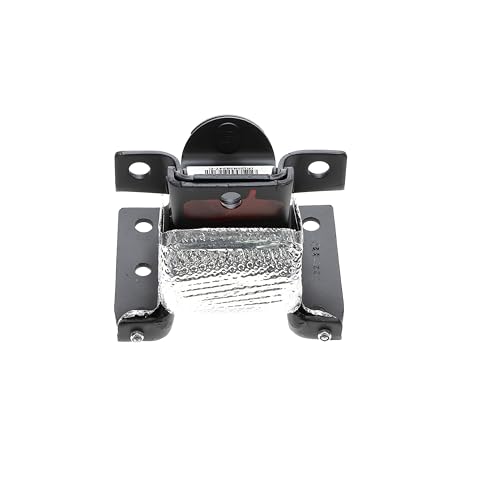
ACDelco GM Genuine Parts 25828247 Engine Mount is the most straightforward OEM-style answer in this group, and that matters when you want the original geometry back. Rubber mounts remain the common daily-driver choice because they usually balance isolation and durability better than softer, worn-out mounts that have already lost their shape.
This is the best fit for stock cars, factory-engineered setups, and drivers replacing a failed original mount who want the closest feel to the car’s intended behavior. The drawback is that rubber still wears, and once it softens or cracks, idle shake and clunking can return even if the part is technically still in place.
Use this type when the priority is staying close to OEM fitment, preserving engine height, and avoiding surprise NVH changes. It is also the safer general pick when you do not want to trade comfort for extra drivetrain control.
Polyurethane engine mount: best for tighter torque control
Sixity Auto Anchor Right Engine Torque Strut Mount compatible with Ford Taurus 2000-07 is the firmer choice here, and it fits the daily-driver use case only when torque control matters more than absolute quiet. Polyurethane mounts reduce drivetrain movement, which can help with throttle response feel and limit engine roll under load, but they usually transfer more vibration than stock rubber or hydraulic designs.
This is the better fit for mild modifications, a worn torque-strut location, or a driver who notices excess movement when getting on and off the throttle. The drawback is the tradeoff itself: more control usually means more cabin buzz, especially at idle and during low-speed cruising.
This listing is also side-specific. That matters because the driver-side mount and torque-strut position often see heavy load under engine torque, so the bracket design and vehicle orientation must match before you order anything.
Solid motor mount: best for maximum drivetrain control
Mopar 68258599AA Engine Mount (Rear) Fiat 500X Jeep Renegade is included as the firmest end of the spectrum among the available options, but it is not the comfort-first answer. Solid-style mounts maximize drivetrain control and keep movement down, yet they are the least friendly choice for a smooth daily driver because vibration moves into the cabin more easily.
That makes this type most suitable when control is the priority and comfort is secondary. The honest drawback is the biggest one in this guide: if the goal is low idle vibration and quiet cruising, a solid mount is usually the wrong direction.
Use this category only when the vehicle’s original setup, torque demands, or modification level make extra stiffness worth the NVH penalty. For most commuters, it is too harsh for everyday use.
Replacement set: best for mixed mount wear
NEWZQ Hydraulic Engine & Trans Mount Assy Replacement for Mercedes C350 S550 AWD is the best fit when several mounts are worn and you want to address the whole system in one pass. This replacement set includes front left and front right mounts plus a rear transmission mount, so it is aimed at correcting multiple points of movement rather than one isolated bad piece.
It suits high-mileage cars where one failed mount usually means the others are not far behind, and labor overlap makes a full set more sensible. The drawback is fitment specificity: this is a vehicle-focused replacement set, so you must verify the exact OE numbers and the drivetrain layout before ordering.
This is also the clearest reminder that engine vibration complaints do not always come from the engine mounts alone. A worn transmission mount can mimic a bad engine mount, which is why a full-system inspection matters before you buy parts.
Engine mount decision table
| Use case | Best mount type | Comfort | Vibration transfer | Expected durability | Best-fit scenario | Key fitment note |
|---|---|---|---|---|---|---|
| Stock car | Hydraulic or OEM-style rubber | Highest | Lowest | Good, but age-sensitive | Quiet commuter, factory power level, idle smoothness first | Match OE geometry and vehicle-specific part numbers |
| Mild mods | Polyurethane | Moderate | Moderate to high | Often better shape retention than soft rubber | Light performance changes, less drivetrain movement, response over quiet | Check side-specific mount location and bracket orientation |
| High-mileage commuter | Hydraulic or OEM-style rubber, sometimes full set | Highest practical comfort | Lowest practical transfer | Depends on age and heat exposure | Idle shake, clunking, and excess movement with a worn original set | Inspect engine mounts and transmission mounts together |
| Maximum control, least comfort | Solid | Lowest | Highest | Can be durable, but harsh | Performance use where drivetrain movement matters more than cabin quiet | Not the right pick for a smooth daily driver |
How do you know if your mount is bad?
A bad engine mount usually shows up as idle vibration, clunking on throttle or lift-off, or visible engine movement when the powertrain shifts under load. Those are the classic symptoms, but they are not the only causes of shake, so you should also check for exhaust contact, worn transmission mounts, and bracket interference.
One common clue is that the vibration gets worse in gear than it is in park or neutral. Another is a change in feel when you move from acceleration to deceleration, which points to excess engine movement rather than a problem with the engine itself.
A common first-timer mistake is to assume every cabin vibration comes from the exhaust instead of worn engine mounts. A loose exhaust hanger can tap the body, and a tired transmission mount can feel a lot like a failed engine mount at idle.
What to inspect before replacing parts
- Look for cracked rubber, collapsed fluid-filled sections, or leaked fluid around a hydraulic mount.
- Check whether the engine sits unevenly or shifts too much when loaded.
- Inspect nearby exhaust contact points, heat shields, and brackets.
- Compare the passenger-side and driver-side mounts if the vehicle uses a side-specific design.
Should you replace one mount or all of them?
Replace the failed mount first if the rest are clean, dry, and not showing movement or cracking. Replace more than one when the car is high mileage, the labor overlaps, or the remaining mounts are the same age and likely near the same wear point.
That decision is less about symmetry and more about cost of ownership. If access requires the same disassembly, paying the labor twice can make a “one-at-a-time” plan more expensive than it looks on paper.
Suppose the driver-side mount is torn and the passenger-side mount already looks collapsed. Replacing only the visible failure may restore some comfort, but the remaining weak mount can keep vibration in the cabin and bring the car back into the bay sooner.
Why labor overlap changes the math
- Mount access often requires supporting the engine and removing brackets or shields.
- Once those parts are off, the second mount may add little extra labor.
- Related hardware may also be one-time-use on some vehicles, so reuse should follow the manual and the listing.
- Inspect the transmission mount at the same time, because it can carry similar wear and cause similar symptoms.
Which one should you buy?
If cabin quiet matters most, start with the hydraulic or OEM-style rubber pick. If you want the closest thing to factory behavior, choose the rubber/OE replacement that matches your vehicle’s original geometry and part number. If torque control matters more than refinement, the firmer polyurethane option is the better fit, but expect more NVH.
For the broadest daily-driver answer, the hydraulic mount is the safest first choice. For a high-mileage replacement where the car is already apart, the replacement set can make more sense if the remaining mounts are also worn.
What to verify before ordering
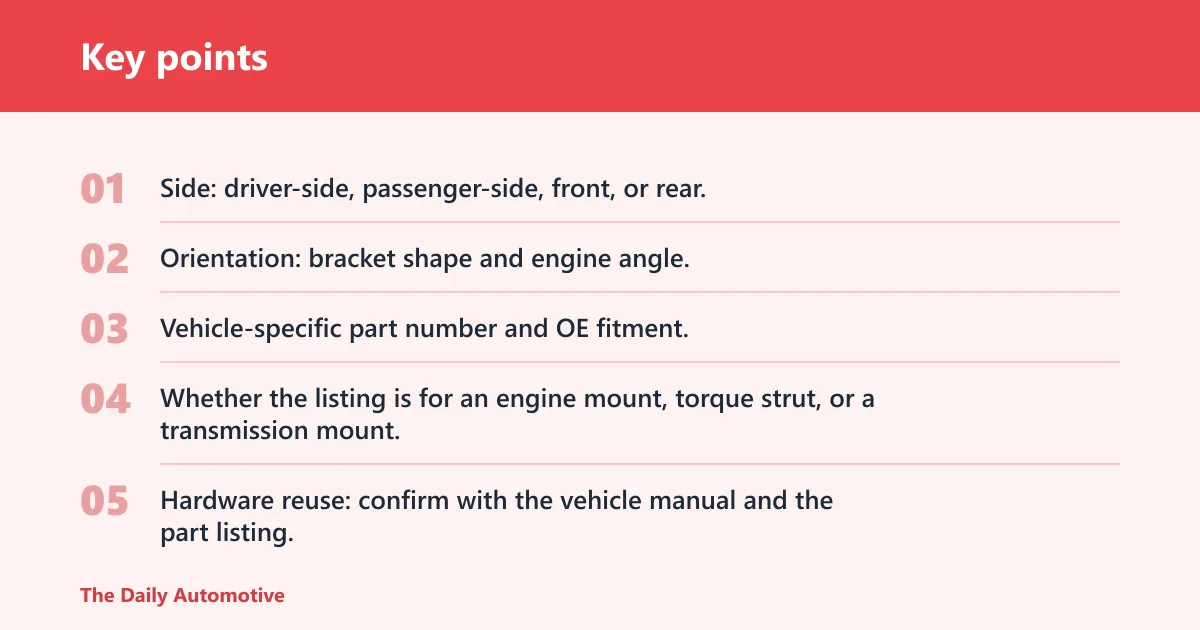
- Side: driver-side, passenger-side, front, or rear.
- Orientation: bracket shape and engine angle.
- Vehicle-specific part number and OE fitment.
- Whether the listing is for an engine mount, torque strut, or a transmission mount.
- Hardware reuse: confirm with the vehicle manual and the part listing.
Picture a sedan with 120,000 miles, a steady idle shake in drive, and a clunk when backing out of a driveway. A hydraulic or rubber replacement is usually the first move; if the transmission mount is also soft, a single engine mount may not solve the whole problem.
Say your car has mild intake and exhaust changes, and you feel drivetrain rock when you roll on the throttle in second gear. In that case, a firmer polyurethane mount can make sense, but the price is more vibration at stoplights and a busier cabin at cruise.
Frequently asked questions
What is the best mount?
The best mount for a smooth daily driver is usually an OE-style hydraulic or fluid-filled engine mount, followed closely by a quality rubber OEM-style replacement. Those options keep vibration transfer low and preserve factory-style geometry. If torque control matters more than quiet, a firmer mount can fit a different goal.
What are the best engine mounts for a smooth daily driver?
For a smooth daily driver, hydraulic mounts are the best starting point because they usually control NVH better than firmer designs. Rubber OEM-style mounts are the next choice if you want close-to-stock behavior and an easy fit. Polyurethane and solid mounts are usually too harsh for comfort-first commuting.
Which motor mount is best for reducing vibration at idle?
Hydraulic engine mounts are usually the best choice for idle vibration because fluid-filled construction helps isolate low-speed shake. Rubber mounts can also work well if the original geometry is correct and the part is not overly stiff. If the car still shakes, inspect transmission mounts and exhaust contact too.
Should I replace one engine mount or all of them?
Replace only the failed mount if the others are clean and still support the engine correctly. Replace more than one when mileage is high, wear is similar across the set, or labor overlap makes the second part nearly free to install. Always inspect the transmission mount during the same job.
How do I know if my engine mount is bad?
Common signs include idle vibration, clunking on acceleration or lift-off, and visible engine movement under throttle. A bad mount can also let the engine touch brackets or exhaust parts, which creates noise that feels like mount failure. Check for cracks, leaks, and uneven engine height before ordering parts.
Are aftermarket engine mounts worse for comfort than OEM mounts?
Not always. A well-made aftermarket hydraulic or rubber mount can be close to OEM comfort, but the wrong material or geometry can add vibration quickly. The key is vehicle-specific fitment and side-specific application, not brand hype. Confirm the exact part number and mount location before you buy.
Products related to this article
Sponsored / affiliate links. As an Amazon Associate I earn from qualifying purchases. I may earn additional commission from eligible campaigns.