Roadside Assistance Review for Car Owners
Choose roadside assistance by the failure you are most likely to face: battery, tire, lockout, fuel, tow, or EV charging. Then buy the plan that covers that event without mileage surprises or vehicle-type limits. Pick the wrong membership and you can pay for a tow, learn the truck cannot handle your car, or wait long enough to miss a shift. This roadside assistance review for car owners compares major memberships by breakdown scenario, coverage limits, response rules, and exclusions.
This guide is part of our Car care and upkeep guide series.
Roadside assistance: AAA vs better World Club
The main trade-off is broad access versus tighter plan design. AAA gives you roadside help across the U.S. and Canada, digital request by name and ZIP code, and common services that cover most everyday breakdowns. Better World Club is more tiered: four plans, prices from $24.95 to $119.95 per year, and towing that ranges from 5 to 100 miles depending on tier.
That difference matters because a membership only helps when the plan fits the breakdown in front of you. A dead battery is not the same as a 72-mile tow from a rural highway, and a lockout is not the same as a car with no safe spare tire to install.
What this comparison covers
This review looks at failure mode first: what happens at the curb, on the shoulder, or in your driveway when the car will not move. It also separates emergency coverage from convenience perks so you can see whether a plan adds real protection or simply repeats benefits you may already have through auto insurance, a credit card, or a warranty plan.
The main trade-off
AAA is the simpler fit if you want broad everyday coverage and a faster digital request flow. Better World Club can make more sense if you want to buy by towing tier and compare lower entry pricing against longer tow options, but you need to watch the approval rules and location limits more closely.
📊 AAA says its roadside assistance fleet has more than 63,000 trucks. Source: AAA.
Which roadside plan fits your breakdown risk?
Match the plan to your most likely failure mode, not the cheapest annual fee. Commuters and daily drivers usually need battery, tire, and lockout help first. Older-car owners need tow coverage and on-site repairs that do not depend on parts. EV owners should focus on towing distance and battery-related service availability. Low-mileage drivers may need less frequent protection, but a single long tow can still make the membership pay for itself.
Commuters and daily drivers
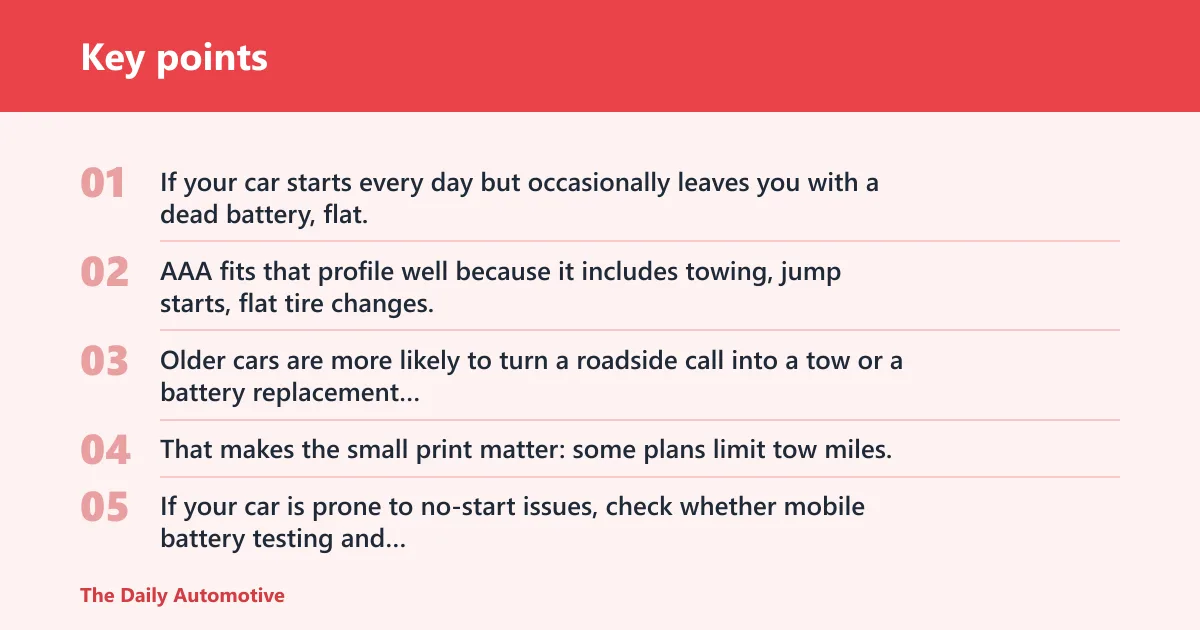
If your car starts every day but occasionally leaves you with a dead battery, flat, or locked-in keys, look for the cleanest request process and the strongest coverage for fast, routine failures. AAA fits that profile well because it includes towing, jump starts, flat tire changes, fuel delivery, locksmith help, and minor auto repairs without parts when possible.
Older-car owners
Older cars are more likely to turn a roadside call into a tow or a battery replacement request. That makes the small print matter: some plans limit tow miles, require approval for the destination, or only cover repairs at approved facilities. If your car is prone to no-start issues, check whether mobile battery testing and replacement are actually available in your area before buying.
EV owners
EV owners should compare towing distance, truck access, and whether the plan gives a meaningful member discount. Better World Club advertises an EV discount, while AAA gives broad U.S. and Canada coverage. The key is whether the tow allowance handles your car’s real radius from home or work, because a short tow may not be enough if you need a specific charging-capable facility.
Low-mileage drivers
If you drive rarely, roadside assistance can still be worth it when one failure would strand you far from home. Better World Club’s lower-priced tiers may fit here, but check whether the tow allowance is enough for your area and whether trip interruption coverage appears on the tier you are considering. Low mileage does not remove lockouts, dead batteries, or empty tanks.
Say your sedan dies in a grocery-store lot with the hood shut and the battery too weak to crank. A plan with jump-start coverage and mobile battery testing helps more than a plan that mainly advertises a cheap annual rate.
Suppose your crossover gets a flat on a rural road and the spare is cracked or underinflated. The useful plan is the one that explains what happens next: spare installation if safe, tow fallback if it is not, and any shop restrictions before the truck rolls.
Roadside assistance decision table
This table shows several common breakdown scenarios and the coverage issues that tend to matter most. Use it to compare what a plan usually handles versus the limits that can turn a covered event into an out-of-pocket bill.
| Breakdown scenario | Typical coverage | What to verify | Watch-outs |
|---|---|---|---|
| Dead battery | Jump-start; AAA also offers mobile battery testing and replacement | Whether battery testing is offered at your location and whether replacement can be done roadside | Availability varies by location; a jump-start may not solve a failed battery |
| Flat tire | Spare installation or tire change | Whether the spare is considered safe to install and whether the plan helps if no usable spare is present | Unsafe spare exceptions; some plans do not cover tire replacement itself |
| Lockout | Vehicle unlock help; AAA also lists locksmith help | Whether entry attempts have a fallback tow if the car cannot be opened | Some vehicles need specialized entry methods; success is not guaranteed |
| Empty tank | Fuel delivery; some plans include free gallons | Whether fuel quantity is capped and whether diesel is available in all locations | Diesel may not be available everywhere; free fuel amounts can be limited |
| Tow | Tow to a repair facility or destination within plan limits | Miles included per plan, policy limit, tow-to-destination rules, and approved facility restrictions | Denied small tows can happen if the call falls outside the mileage or shop rules |
What does each plan cover?
Coverage only helps when the service matches the failure and the limits fit the distance to safety. AAA lists towing, winching, jump starts, flat tire changes, fuel delivery, locksmith help, and minor auto repairs without parts when possible. Better World Club splits benefits across four plans and ties towing distance to the tier you buy.
Towing and mileage limits
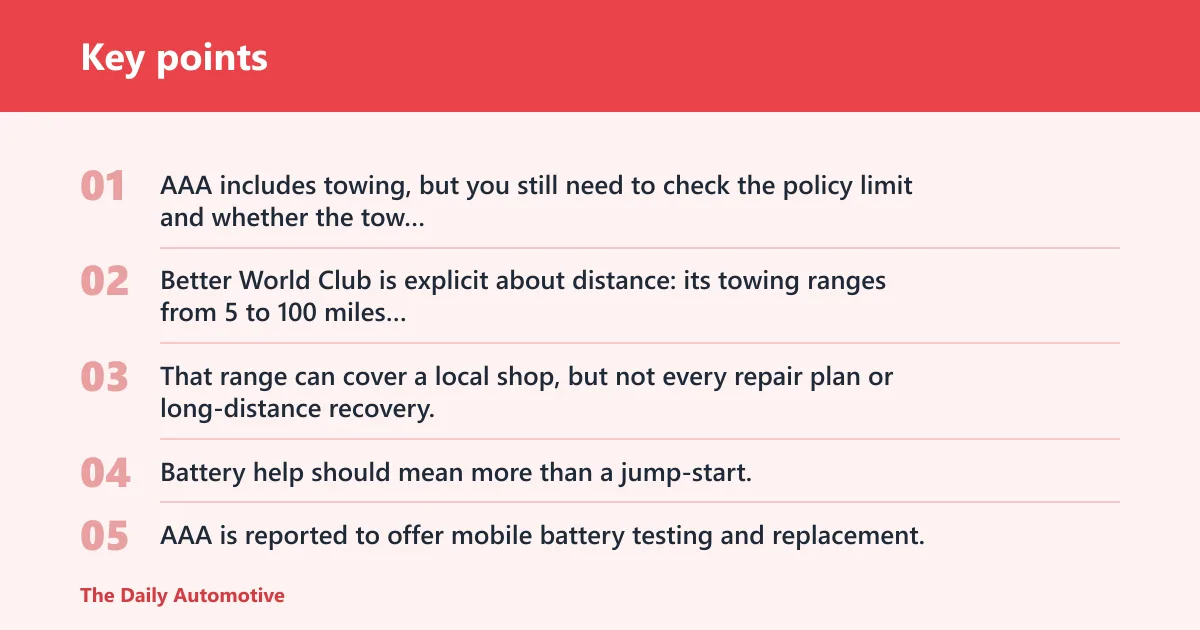
AAA includes towing, but you still need to check the policy limit and whether the tow must end at an approved facility. Better World Club is explicit about distance: its towing ranges from 5 to 100 miles depending on tier. That range can cover a local shop, but not every repair plan or long-distance recovery.
Battery service
Battery help should mean more than a jump-start. AAA is reported to offer mobile battery testing and replacement, which can matter when a weak battery keeps coming back after a start. Better World Club members should verify whether the local provider can do more than restart the car, because location-dependent availability can change the value of the membership.
Flat tire service
A tire call can end quickly or turn messy. The cleanest outcome is a spare installation, but the plan should also explain what happens if the spare is unsafe or missing. Do not assume roadside help means tire replacement; many memberships stop at mounting the spare and leave the rest to a shop.
Fuel delivery
Fuel delivery is one of the simplest benefits and one of the easiest to read wrong. AAA includes fuel delivery, but you should still check whether there is a gallon limit. Better World Club may include free gallons on some plans, yet diesel may not be available in all locations, which matters for diesel owners and some light trucks.
Lockout assistance
Lockout coverage should be judged by the fallback, not the promise. AAA lists locksmith help, and many plans attempt a vehicle unlock first. If that fails, tow support becomes the next question, especially for newer vehicles with tight security systems or broken keyless entry hardware.
Trip interruption coverage
Trip interruption is a useful extra on some plans, but it should not drive the whole decision unless you travel far from home. Better World Club includes it on some plans with dollar limits by tier, so the real question is whether the reimbursement cap is enough to matter after a true breakdown away from home.
How much do roadside assistance plans cost?
Price matters, but it is only one part of the buy decision. Better World Club lists four plans from $24.95 to $119.95 per year, and it also offers a 30-day refund policy. AAA pricing varies by market and membership level, so check the exact annual fee in your region rather than assuming one national rate.
AAA pricing signals to check
For AAA, the more important number is not a posted sticker price but the value of what it includes. Compare the local annual fee against towing distance, battery service, and whether your household can request help for any car across the U.S. and Canada. A slightly higher fee can be worthwhile if it avoids one denied tow.
Better World Club tier prices
Better World Club is easier to compare on paper because the company gives a clear range. The lower tiers may fit drivers who mainly want basic coverage, while the higher tiers are aimed at people who need longer towing allowances and more trip support. The EV discount can also tilt the math for electric-car owners.
When a higher tier is worth it
Pay for the higher tier when your likely failure mode is expensive to solve outside the plan: a long tow, repeated dead-battery calls, or a trip far from home. If you mainly want lockout help around town and already have tow benefits through insurance or a credit card, the cheaper tier may be enough.
Roadside request methods and service access
Request method matters because a breakdown is a bad time to hunt for account numbers. AAA says members can request service using name and ZIP code, and its digital roadside request can be completed in four steps. Better World Club is said to use phone-only requests, which may be fine if a human call is preferred but less convenient when the phone battery is low. (AAA)
AAA digital request by name and ZIP code
AAA’s request flow is built for speed at the roadside. The company says members can request service using name and ZIP code, and the digital process can be completed in four steps. That reduces friction when you are cold, wet, or standing next to a disabled car with traffic moving past.
Better World Club phone-only request
Phone-only request is not a flaw by itself, but it is a real difference. If your phone signal is weak or your battery is dying, a phone call can be harder than tapping through an app. On the other hand, some drivers prefer talking through the exact location and failure mode with a dispatcher.
Why request method matters in a breakdown
Request method affects more than convenience. It can decide how quickly the provider understands the vehicle type, the road condition, and whether the car is at a garage, apartment lot, or shoulder. That matters because tow rules and approved-facility restrictions are easier to honor when the request is precise from the start.
Choose AAA if… / Choose Better World Club if…
Choose AAA if you want broader access, simpler request handling, and a plan built around common roadside failures rather than tier-by-tier tradeoffs. Choose Better World Club if you want to shop by towing distance, care about an EV discount, and are willing to check the limits more carefully before buying.
Choose AAA if you want broader access and app-based convenience
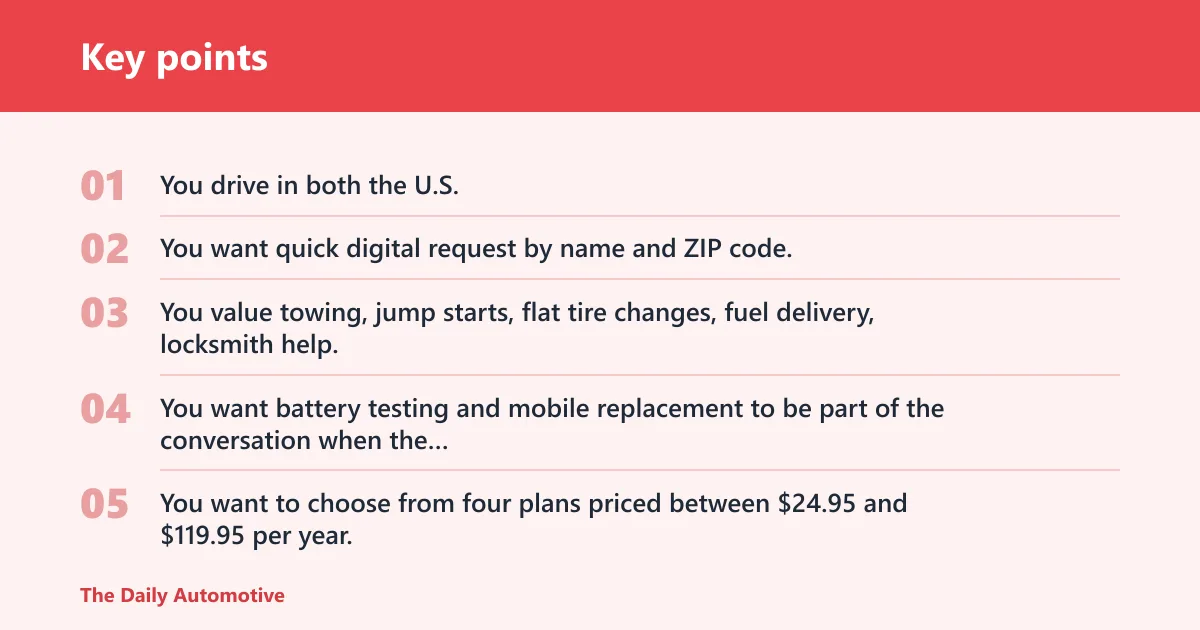
- You drive in both the U.S. and Canada and want one membership for either side of the border.
- You want quick digital request by name and ZIP code.
- You value towing, jump starts, flat tire changes, fuel delivery, locksmith help, and minor repairs in one package.
- You want battery testing and mobile replacement to be part of the conversation when the car will not start.
Choose Better World Club if you want tiered towing and an EV discount
- You want to choose from four plans priced between $24.95 and $119.95 per year.
- You need towing that scales from 5 to 100 miles depending on tier.
- You are comfortable with phone-only request and can confirm coverage details before buying.
- You drive an EV and want the discount to offset a higher tier.
When neither membership may add much
If your auto insurance already includes towing, lockout, and fuel delivery with generous limits, or your credit card and warranty plan already duplicate the same benefits, a separate membership may add little. The point is not to buy more help. It is to buy the help that fills the gap your current coverage leaves open.
Frequently asked questions
Do I have roadside assistance?
You may already have it through auto insurance, a premium credit card, a new-car warranty, or a manufacturer app. Check the exact towing miles, lockout limits, fuel quantity, and whether the benefit applies to any vehicle or only the cardholder’s car before you buy anything else.
Is roadside assistance worth it?
It is worth it when one stranded event would cost more than the annual fee, especially a tow, battery replacement, or long lockout delay. It is less useful if your other policies already cover the same failure modes with enough miles, enough fuel, and no hard approval hurdles.
Aaa vs roadside assistance
AAA is one roadside assistance option, not a separate category. The real question is whether AAA’s U.S. and Canada coverage, digital request flow, and service list fit your likely breakdown better than another plan’s towing mileage, fuel rules, or phone-only request process.
What does roadside assistance cover?
Most memberships commonly cover towing, jump starts, flat tire help, fuel delivery, and lockout service. Stronger plans may add battery testing, battery replacement, winching, locksmith help, minor repairs, or trip interruption coverage. The limits matter more than the headline service names.
How much does roadside assistance cost?
Cost ranges widely by provider and tier. The same source lists four plans from $24.95 to $119.95 per year, while AAA pricing depends on local membership structure. Compare price against tow miles, fuel limits, and whether the request method is easy to use during a real breakdown.
Which roadside assistance plan is best for my car?
The best plan depends on the failure you are most likely to face. Commuters often need jump-start and lockout help, older cars need stronger tow and battery support, EV owners need towing distance and charging-related flexibility, and low-mileage drivers may care most about one long tow being fully covered.
Products related to this article
Sponsored / affiliate links. As an Amazon Associate I earn from qualifying purchases. I may earn additional commission from eligible campaigns.