Duralast Gold Battery Review: Is It Worth It?
Duralast Gold is a solid value pick for conventional cars when you want a mid-tier battery with a better warranty than basic house brands, but it is not the right upgrade if your vehicle calls for AGM. Buy the wrong type, and you can waste money, shorten battery life, or leave cold-weather starting weak. This guide separates the cases where Duralast Gold makes sense from the cases where AGM is the better buy.
What duralast Gold
Duralast Gold is a flooded-cell lead-acid starting battery aimed at conventional vehicles with higher power demands. It includes a free-replacement warranty, uses polypropylene construction to help reduce vibration damage, and is meant to meet or exceed original-equipment CCA and reserve capacity.
That last point matters. CCA is the starting-power number, while reserve capacity shows how long the battery can support the vehicle if the charging system fails. If either one comes in below the vehicle requirement, the battery may fit the tray and still be a poor match.
What to verify in the listing before you buy
Check the manufacturer listing for your exact vehicle, engine, and trim before you buy. Confirm group size, CCA, reserve capacity, and whether the battery is listed for your engine and electrical load. Also confirm whether your vehicle needs a conventional flooded battery, an EFB battery, or AGM.
- Match the group size, such as 94R (H7), Group 75, or Group 78.
- Match or exceed the vehicle’s OE CCA requirement.
- Match or exceed the OE reserve capacity requirement.
- Verify whether the vehicle calls for flooded, EFB, or AGM construction.
- Check installation orientation and maintenance needs before you pay.
A common mistake is buying the correct battery size for your truck but overlooking the cold-cranking amps needed for dependable starts. A Group 75 battery can still be the wrong buy if the vehicle is a start-stop model that needs EFB or AGM support.
📊 Consumer Reports lists the DieHard Gold 94RH7 weight at 43.3 lbs. Source: DieHard Gold 94RH7 Car Battery Review.
Duralast gold vs platinum
Gold is the simpler battery. Platinum AGM is sealed, better for vehicles with extra onboard electronics, and said to have twice the cycle life of conventional batteries. Platinum EFB is the better fit for start-stop vehicles, with faster recharge rates, and may offer more engine starts than standard flooded batteries, along with a full replacement warranty.
That means the upgrade pays off when the vehicle needs it. If the car has start-stop operation, heavy electronics, or a harsh duty cycle, the more advanced battery can be the cheaper choice over time because the wrong battery may cycle out sooner.
Gold versus Platinum AGM for electronics-heavy vehicles
Choose Platinum AGM when the vehicle has extra accessories, frequent accessory use with the engine off, or a manual that specifically calls for AGM. AGM is sealed and maintenance-free by comparison, so it removes the water-top-off concern that comes with flooded batteries.
Gold can still work in some conventional vehicles, but it is not the safer default when electronics load is high or the climate is severe. Platinum AGM also has stronger extreme-temperature performance and better vibration resistance.
Gold versus Platinum EFB for start-stop vehicles
Choose Platinum EFB for a start-stop vehicle unless the manual and listing clearly support another type. EFB is built for repeated engine restarts and faster recharge. A standard flooded battery can struggle in this role, especially when the engine shuts off at lights and the electrical load stays on.
Gold is a poor default for start-stop use. The battery may fit physically, but the recharge pattern and cycle demands are different enough that the wrong chemistry can shorten service life.
When the upgrade is worth the extra cost
Pay more for Platinum when the vehicle’s usage pattern is hard on batteries. That includes lots of short trips, heavy accessory use, stop-start operation, and rough-road service where vibration is a problem. In those cases, the extra cost can buy better match quality instead of just a fancier label.
Battery decision matrix
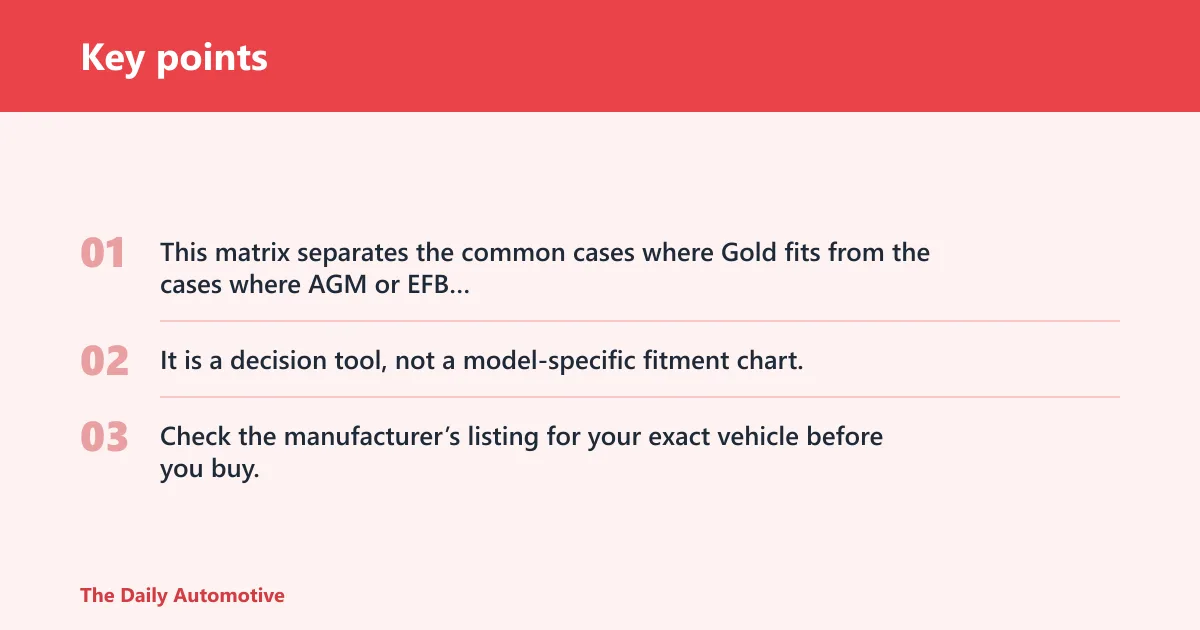
This matrix separates the common cases where Gold fits from the cases where AGM or EFB is the safer buy. It is a decision tool, not a model-specific fitment chart. Check the manufacturer’s listing for your exact vehicle before you buy.
| Scenario | Recommended Duralast tier | Why it fits | Prioritize this spec | Red-flag checklist |
|---|---|---|---|---|
| Standard commuter | Gold | Conventional vehicle, normal electrical load, regular highway or mixed driving | CCA and reserve capacity at or above OE; 3-year free replacement warranty | Start-stop system; warning label calling for AGM; weak charging system |
| Hot-climate commuter | Gold only if the listing fits cleanly; Platinum AGM if heat is severe | Heat shortens flooded-battery life faster, so the better match may be the sealed option | Reserve capacity and warranty; heat tolerance matters more than bare minimum CCA | Repeated hot soak starts; battery near exhaust heat; frequent short trips |
| Winter commuter | Gold if CCA meets OE; Platinum AGM if cold starts are consistently harsh | Cold-weather starting depends on strong CCA and a healthy charging system | CCA first, then reserve capacity | Battery near end of life; slow cranking; undercharged battery after short drives |
| Stop-start car | Platinum EFB, or AGM if the manual calls for it | Stop-start cycling needs faster recharge and more cycle life than a standard flooded battery | Cycle-life support and recharge rate | Basic flooded battery installed in a stop-start vehicle |
| Accessory-heavy SUV | Platinum AGM | Extra electronics and accessory drain favor sealed AGM and stronger reserve support | Reserve capacity and maintenance-free design | Large aftermarket audio, power inverters, camping loads, or frequent engine-off accessory use |
| Off-road or light truck | Gold for mild use; Platinum AGM for rough roads and heavier vibration | Gold has impact-resistant polypropylene construction, but AGM brings stronger vibration resistance | Vibration resistance and reserve capacity | Repeated washboard roads, tow duty, poor tray support, or loose hold-downs |
Are Duralast Gold batteries good for daily driving?
Yes, for the right daily driver. Duralast Gold works well for conventional cars that see regular commuting, moderate accessory use, and a charging system in good shape. It is a reasonable value pick when the vehicle does not need AGM or EFB and the listed CCA and reserve capacity match OE.
Best-fit daily-driver traits
Gold makes the most sense for a standard commuter with a normal alternator load, no start-stop system, and no major aftermarket electrical draw. It is also a fit when you want a better warranty than a plain house-brand battery without stepping all the way up to AGM.
Suppose your sedan has a Group 75 battery and no start-stop system. If the listing shows the right group size and OE-level CCA, Gold is the kind of battery that can make sense without paying for technology the car does not need.
Where Gold makes sense versus where AGM is smarter
Gold makes sense when the car is conventional, the climate is moderate, and maintenance is acceptable. AGM is smarter when the vehicle sits in heat, carries extra electronics, or needs a sealed battery because of placement or service access. AGM is also the safer choice when the manual asks for it.
Specs to prioritize: CCA, RC, and maintenance
For daily driving, CCA should clear the vehicle’s requirement first. Reserve capacity is the next filter if the car idles with accessories on or sees short trips that leave the battery undercharged. If you do not want to top off water or check battery condition regularly, AGM is usually the easier ownership choice.
How long does it last?
Duralast Gold can last a normal service interval in a vehicle with healthy charging, moderate climate, and enough driving to keep the battery charged. Heat, short trips, and parasitic draw can shorten that life. The 3-year free replacement warranty helps with early failure, but it does not prevent wear.
Why climate and trip length matter
High heat dries out flooded batteries faster and can speed internal wear. Short trips create another problem: the alternator may not replace the energy used to start the car, so the battery stays partly discharged. That weakens starting performance and can cut service life.
How heat, short trips, and parasitic draw shorten life
Parasitic draw matters when a vehicle sits for days or has an electrical fault that keeps pulling current after shutdown. In that case, even a new battery can act weak because it is being drained in the background. That is why a bad battery diagnosis should include a charging-system check before replacement.
Picture a commuter that runs five-minute trips all week, then sits outside in summer heat. The battery can look fine one day and then crank slowly the next, not because it is “bad” in isolation, but because the use pattern never lets it recover.
What the 3-year warranty does and does not cover
The 3-year free replacement warranty helps if the battery fails early under normal use, but it is not a cure for vehicle problems. If the alternator is weak, the charging system is off, or the battery is under-sized for the car, a replacement may fail the same way.
What specs matter most?
For Duralast Gold, the most useful spec order is simple: group size for fit, CCA for starting, reserve capacity for backup power, and then construction and warranty. Vibration resistance matters more if the vehicle sees rough roads or off-road use, because loose mounting and shock loads can damage a flooded battery sooner.
Cold-cranking amps for starting power
CCA is the number that matters most for morning starts and cold weather. Use it as a match-to-vehicle number, not a bragging number. Consumer Reports lists an example battery, the DieHard Gold 94RH7, with 800 A claimed CCA and places it in Group 94R (H7). (Consumerreports)
Reserve capacity for accessory load and backup power
Reserve capacity matters when the car runs lights, audio, HVAC fan, or accessories with limited charging support. It also matters if the charging system fails, because reserve capacity shows how long the battery can keep the vehicle alive long enough to get to a repair.
The same source says reserve capacity is how long a battery can power a car if the charging system fails. That is a useful lens for SUVs and trucks with accessory load, and it is one reason RC should not be ignored in a value battery decision.
Group size, fitment, and vibration resistance
Group size tells you whether the battery fits the tray and terminal layout. Group 94R (H7), Group 75, and Group 78 are common examples, but the exact model still depends on the vehicle. Gold’s impact-resistant polypropylene construction helps with vibration, while Platinum places more emphasis on vibration resistance.
Battery warning signs
A battery may be failing if the engine cranks slowly, the lights dim at idle, accessories reset after startup, or the battery warning light stays on. Corrosion, swelling, and repeated jump-starts are also warning signs. Before you buy a battery, test the charging system so you do not replace a healthy battery for an alternator problem.
How to tell the battery may be failing
Look for slow cranking after the car sits overnight, a click instead of a start, or headlights that fade when the engine is off. Repeated low-voltage complaints after short drives are another clue, especially in hot weather or after the battery has already aged a few years.
When the alternator or charging system is the real problem
If a battery keeps going flat soon after replacement, the cause may be charging-system output, a parasitic draw, or poor connections. That is why replacement should not come before diagnosis. The battery can be the symptom, not the cause.
Simple checks before replacement
Use a multimeter, a battery load test, or a charging-system check at a parts counter or repair shop. Confirm the battery is fully charged before calling it bad. Also inspect the terminals, hold-down, and tray, because poor connections can imitate a weak battery.
- Check the terminals for looseness and corrosion.
- Confirm the battery is mounted upright if the battery type requires it.
- Test charging voltage with the engine running.
- Check for parasitic draw if the battery keeps dying after parking.
- Replace the battery only if the test results support it.
Frequently asked questions
How good is a duralast gold battery
Duralast Gold is good for conventional vehicles that need a value-oriented flooded battery with a stronger warranty than a basic replacement. It is less attractive when the car needs AGM or EFB, or when the climate, accessory load, or start-stop system calls for a more advanced battery type.
Is duralast gold battery worth it?
Yes, if your vehicle is a normal commuter, your climate is moderate, and the listing shows the right group size, CCA, and reserve capacity. It is not worth it when the vehicle calls for AGM or EFB, because the cheaper battery can become the expensive one after early failure.
How long does a duralast gold battery last?
Its life depends on heat, trip length, charging quality, and how much the vehicle sits. A healthy charging system and regular driving help a lot. Short trips, parasitic draw, and hot weather can cut that life down well before the warranty period ends.
What is the warranty on a Duralast Gold battery?
Duralast Gold carries a 3-year free replacement warranty. That helps if the battery fails early under normal use, but it does not solve charging-system faults, parasitic draw, or a mismatch between the battery type and the vehicle’s requirements.
Should I choose duralast Gold or duralast Platinum?
Choose Gold for a conventional vehicle with normal electrical demand and no start-stop system. Choose Platinum AGM for extra electronics or severe climates, and Platinum EFB for start-stop vehicles. The better battery is the one that matches the vehicle’s actual demand, not the one with the higher label.
What signs mean my Duralast battery is bad?
Slow cranking, dim lights, repeated jump-starts, swelling, corrosion, and a battery that dies again soon after charging are the main signs. If the problem returns after replacement, test the alternator and look for parasitic draw before you assume the battery itself was the only issue.
Products related to this article
Sponsored / affiliate links. As an Amazon Associate I earn from qualifying purchases. I may earn additional commission from eligible campaigns.