Best Oil Stop Leaks for Minor Seepage (2026): We Compared
Use a seal-conditioning engine oil stop leak only for minor seepage from aging seals or gaskets; skip it for active drips, bearing noise, or coolant contamination. Using the wrong additive can waste money, hide a larger fault, or worsen sludge and oil-control problems. This guide matches the right product to leak source, oil type, and side-effect risk.
Quick comparison
| Product | Badge | Best for | Price | ||
|---|---|---|---|---|---|
 |
Lucas Oil 10278 Engine Oil Stop LeakLucas Oil | Our pick | 1 quart · stop leak · additive | $11.98
Price as of 8 Nov 2026
|
View |
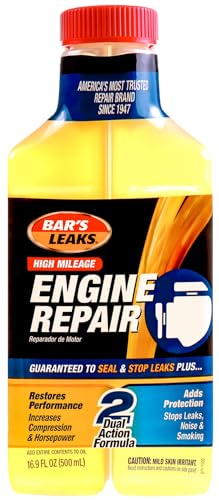 |
Bar’s Leaks 1000 High Mileage Engine RepairBar’s Leaks | Also great | 16.9 oz · high-mileage · repair | $14.18
Price as of 8 Nov 2026
|
View |
 |
AT-205 ATP Re-Seal Leak Stopper 8 Ounce – 4 Packatp automotive | Upgrade pick | 8 oz · resealer · 4 pack | $68.25
Price as of 8 Nov 2026
|
View |
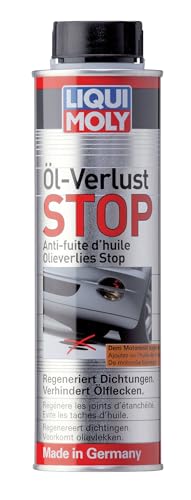 |
LM 1005 Oil Leak Stop 300 mlLiqui Moly | Pair with it | 300 ml · oil leak stop · additive | $21.00
Price as of 8 Nov 2026
|
View |
Use this section to sort a slow weep from a repair-now leak before you buy anything. The right bottle depends on where the oil is escaping, what oil is already in the engine, and whether the leak points to a seal, gasket, or cracked part.
How we chose
This comparison is based on manufacturer specs, listing details, and published buyer feedback. The filter was narrow: only products aimed at oil leaks, only products with clear compatibility or treat-size details, and only products that fit minor seepage rather than major damage.
What was left out matters just as much. Products without enough listing detail, products that blur engine treatment with other systems, and products that do not clearly fit gasoline, diesel, conventional, or synthetic use were excluded from the recommendation path.
The guiding rule is simple. If the engine is losing oil from a worn seal, a seal conditioner may be worth a try. If the source is a cracked housing, torn gasket, or a heavy rear main seal leak, the bottle is a detour, not a fix.
ATP Automotive AT-205 Re-Seal: best for fast seal conditioning
Best for a quick try on minor seepage from dried or hardened seals, especially when you want a treatment described as working within a few hours. ATP Automotive AT-205 is sold as an 8-ounce bottle, treats up to a 6-quart capacity, and is described as compatible with conventional and synthetic oils.
What stands out is the narrow seal-conditioning angle. The product is described as rejuvenating rubber seals, and ATP says it works with gasoline and diesel engines. That makes it the strongest fit here for a vehicle that is otherwise healthy but leaves a small wet edge at a seal or gasket.
Watch-outs are practical. It is not a repair for cracked housings, torn gaskets, or a leak that is actively dripping onto the ground. If the engine is smoking badly, using oil quickly, or making bearing noise, skip the bottle and inspect the failure directly.
Liqui Moly Oil Leak Stop / LM 1005: best for mixed-fleet compatibility
Best for drivers who want a compatibility-first option. Liqui Moly LM 1005 comes in a 300 ml bottle, treats up to 5 liters of motor oil, and is described as compatible with all commercially available motor oils.
What stands out is its broad oil compatibility and its stated use with diesel particulate filters and turbochargers. That makes it easier to place in a mixed-fleet garage or in a vehicle that already has emissions hardware and forced induction.
Watch-outs are practical, not dramatic. The bottle size is built for a single treatment window, so you should match it to the oil capacity before pouring. Like any seal conditioner, it is aimed at seepage from aging seals, not a broken gasket, cracked pan, or damaged housing.
Lucas Oil 10278 Engine Oil Stop Leak: best for full synthetic oil
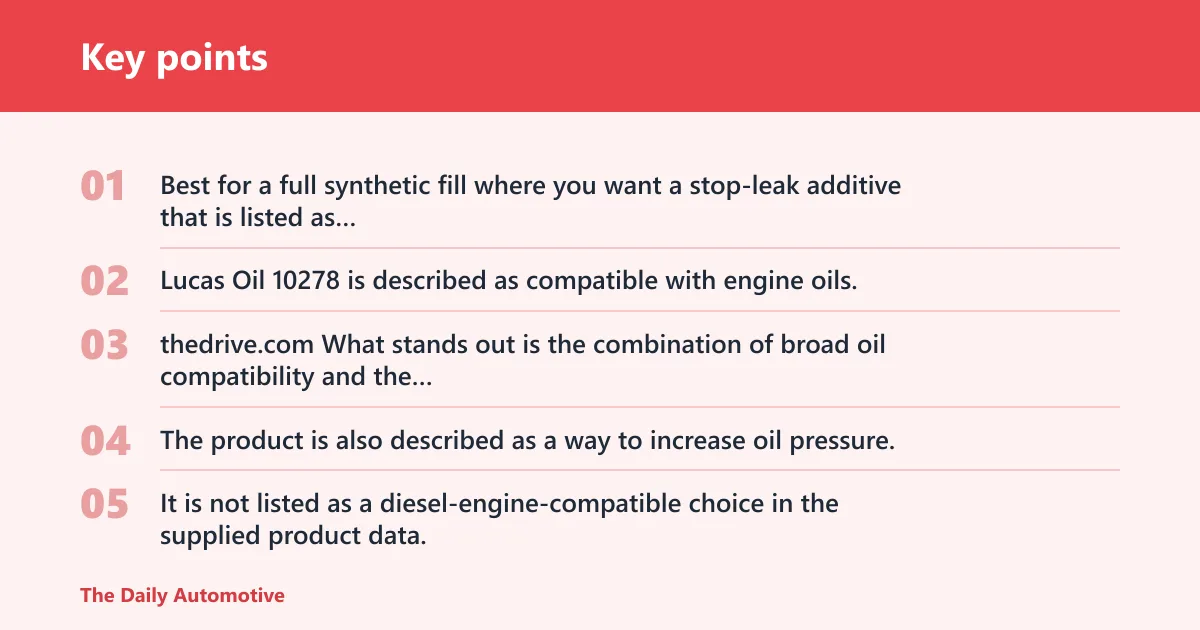
Best for a full synthetic fill where you want a stop-leak additive that is listed as compatible with full synthetic oils. Lucas Oil 10278 is described as compatible with engine oils, including full synthetic oils, and the listing says it does not contain harmful solvent. thedrive.com
What stands out is the combination of broad oil compatibility and the solvent claim. The product is also described as a way to increase oil pressure, which may appeal to drivers seeing a light seep and an older seal that has gone hard. It is not listed as a diesel-engine-compatible choice in the supplied product data.
Watch-outs matter here. The listing says it is not compatible with diesel engines, so do not assume it is a universal choice across the fleet. As with the others, it is for minor seepage, not a blown seal, a cracked cover, or a pan gasket that is actively dumping oil.
Start by confirming the leak source before adding anything. Clean the engine, check the oil level, look for the highest wet point, and separate a seal seep from a drip, a cracked housing, or an overfill issue. If the source is a worn seal or gasket and the loss is minor, a compatible stop-leak additive can be a temporary step.
Bar’s Leaks Oil Seal: best value for wear-and-tear seepage
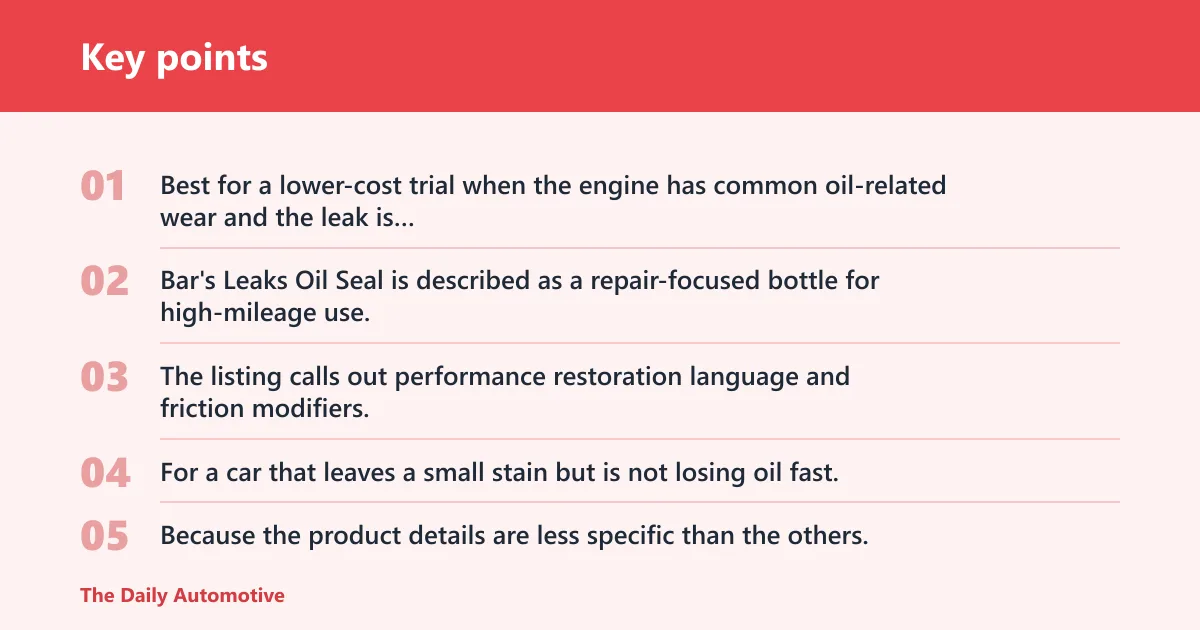
Best for a lower-cost trial when the engine has common oil-related wear and the leak is still in the seepage stage. Bar’s Leaks Oil Seal is described as a repair-focused bottle for high-mileage use, and the product details say it can be added at oil change or when topping off.
What stands out is the value angle. The listing calls out performance restoration language and friction modifiers, which puts it closer to a general engine-repair additive than a pure seal conditioner. For a car that leaves a small stain but is not losing oil fast, that can be enough to justify a first try.
Watch-outs are straightforward. Because the product details are less specific than the others, treat it as a trial option rather than a precise fit. If the leak source is a rear main seal failure, cracked housing, or a damaged gasket surface, skip additives and repair the part.
Oil leak decision matrix
| Leak source | Severity | Oil type / engine type | Safest additive choice | Verdict |
|---|---|---|---|---|
| Valve cover gasket or cam seal with a damp edge | Minor seepage, no drip | Conventional or synthetic oil; gasoline engine | ATP Automotive AT-205 Re-Seal | Buy |
| Shaft seal or valve stem seal with light oil film and no smoke spike | Minor seepage | Conventional or synthetic oil; engine not overheating | Liqui Moly LM 1005 or AT-205 | Buy |
| High-mileage seepage with broad oil compatibility needs | Slow weep only | Mixed-fleet use; follow the bottle limits | Bar’s Leaks Oil Seal | Monitor |
| Rear main seal with visible drops on the ground | Active dripping | Any oil type | None | Repair |
| Oil pan gasket with wet pan edge and recurring spots | Persistent leak | Any oil type | None | Repair |
| Cracked housing, damaged cover, or torn gasket surface | Major leak or sudden loss | Any engine | None | Repair |
| PCV issue, overfill, or sludge-related oil control problem | Leak-like symptom, source not confirmed | Any oil type | None until diagnosis is confirmed | Monitor |
A practical threshold helps here. If the engine leaves a damp stain, loses only a small amount over time, and still has a single known seep point, a conditioner may be worth trying. If it drips onto the driveway, needs frequent top-offs, or wets multiple surfaces, the problem has moved beyond a bottle.
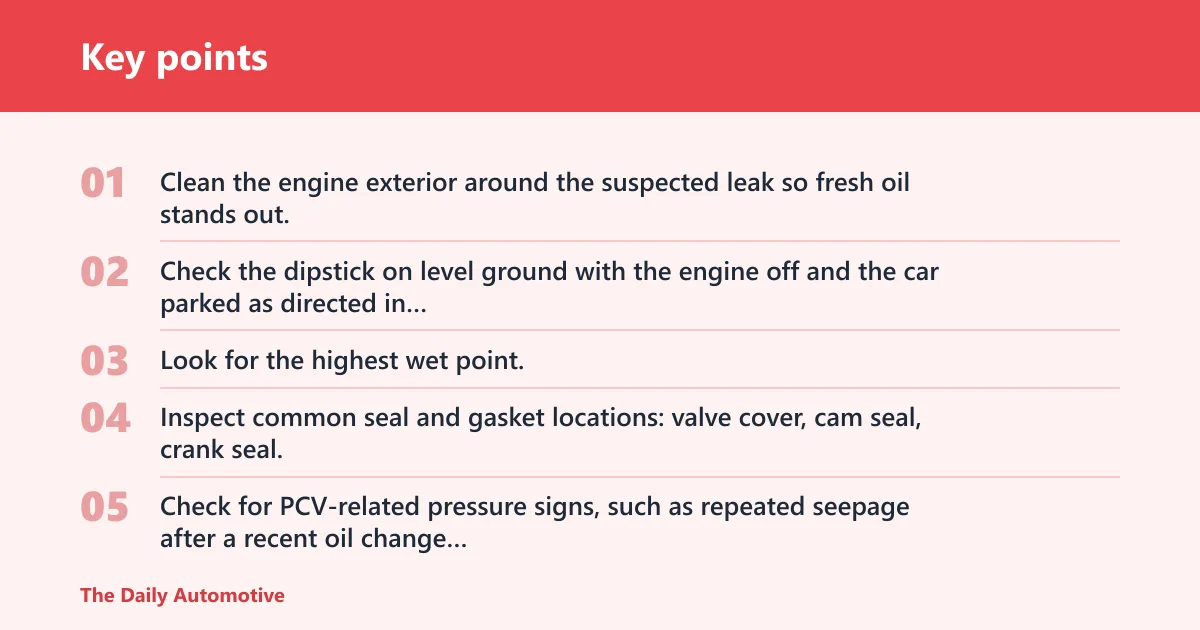
- Clean the engine exterior around the suspected leak so fresh oil stands out.
- Check the dipstick on level ground with the engine off and the car parked as directed in the owner’s manual.
- Look for the highest wet point. Oil runs downward, so the lowest drip is not usually the source.
- Inspect common seal and gasket locations: valve cover, cam seal, crank seal, oil pan edge, filter area, and drain plug.
- Check for PCV-related pressure signs, such as repeated seepage after a recent oil change or oil mist around breather plumbing.
- Confirm the engine is not overfilled. Too much oil can mimic a leak by pushing oil past seals.
- If the source is a crack, torn gasket, or heavy drip, skip additives and plan a repair.
Say your sedan leaves a quarter-sized spot after an overnight park and the valve cover edge is damp, but the dipstick still reads close to normal. That is the kind of case where a seal conditioner can be a reasonable buy-now attempt. The same bottle makes no sense if the pan corner is dripping onto cardboard in minutes.
Suppose a turbo gasoline engine starts leaving a wet ring near a shaft seal after switching to full synthetic oil. If the leak is still seepage and the bottle lists synthetic compatibility, a conditioner can be tried before a mechanical repair. If the leak has turned into a stream or the smoke is blue on startup, move to repair instead.
How fast do these additives work?
Some products act quickly, but fast is not the same as guaranteed. ATP Automotive AT-205 is described as working within a few hours, which makes it the quickest option in this group on paper. The others are framed more as treatment additives, so expect a slower, less visible change.
No change after a short drive does not prove failure, though. If the leak source is a rear main seal, pan gasket, cracked housing, or torn gasket face, there may be nothing for a seal conditioner to revive. In that case, the absence of progress is the right clue.
For a true minor seep, watch for reduced wetness at the source, fewer fresh spots after parking, and less oil mist around the suspect area. Do not expect a bottle to rebuild damaged metal or close a hole.
Can you use stop leak with synthetic oil?
Yes, some can. That makes synthetic use possible, but only when the leak source fits.
Skip the bottle if the vehicle already has severe oil loss, a cracked housing, or a torn gasket surface. Also avoid using any additive as a substitute for a mechanical fix when the engine has oil pressure warnings, bearing noise, or contamination from coolant.
Keep an eye on how the engine behaves after treatment and stop using the additive if the leak worsens or the engine develops new symptoms.
Which one should you buy?
For the fastest seal-conditioning try, start with ATP Automotive AT-205 Re-Seal. Its listing is the most specific about quick effect, and it is described as working within a few hours while treating up to a 6-quart capacity.
For synthetic oil, Liqui Moly LM 1005 is the cleanest mixed-fleet choice because it is described as compatible with all commercially available motor oils and is also stated to work with diesel particulate filters and turbochargers. If you run full synthetic and want broad compatibility, Lucas Oil 10278 is also a fit, but not for diesel engines.
For value, Bar’s Leaks Oil Seal is the least specialized but still useful for wear-and-tear seepage when you want a lower-commitment trial. If the leak is more than a seep, or if the source is a pan gasket, rear main seal, or cracked housing, do not buy any of them. Repair the fault instead.
Cost matters because additive pricing is only part of the decision. A $10 to $25 bottle may be worth trying when the leak is a slow seep and the vehicle is otherwise healthy. A mechanical seal or gasket repair can cost far more, but it is the only sensible route when the part is physically damaged or the oil loss is active.
For a car leak, the same rule applies: find the source first. If the oil is coming from a valve cover edge, cam seal, or another aging rubber or plastic seal, a conditioner may slow the seep. If it is coming from a pan gasket, rear main seal, or broken part, the correct fix is mechanical repair.
Frequently asked questions
What is the best engine oil stop leak for minor seepage?
For minor seepage, ATP Automotive AT-205 is the strongest first try if you want the quickest seal-conditioning path. Liqui Moly LM 1005 is a strong second choice when broad motor-oil compatibility matters more, and Lucas Oil 10278 fits full synthetic use but is not listed for diesel engines.
Will oil stop leak work on a small seep or just a major leak?
These additives are meant for small seepage, not major leaks. They work best on seals and gaskets that have dried out, shrunk, or hardened. If oil is dripping quickly, the part may be too damaged for a conditioner to help, and a repair becomes the better answer.
Can stop leak additives be used with synthetic oil?
Yes, some can. Always match the bottle to the vehicle manual.
Do oil stop leak products fix valve stem seals and rubber gaskets?
They can sometimes help with rubber gaskets and other aging soft seals if the issue is wear, drying, or shrinkage. They do not fix valve stem seals as an external leak source; a failing valve stem seal usually causes oil burning and blue smoke. They are much less useful for torn gaskets, cracked housings, or badly damaged seal surfaces. Those problems need a physical repair.
When should I avoid using an oil stop leak additive?
Avoid it when the engine has active dripping, low oil pressure, bearing noise, coolant contamination, or a cracked part. Skip it if you have not confirmed the source, because an overfill, PCV problem, or sludge issue can mimic a seal leak and a bottle will not fix the real cause.
How much oil stop leak should I add to my engine?
Use the exact amount listed on the bottle and match it to the engine oil capacity. Do not guess; too much additive can create new oil-control problems.
Will an oil stop leak additive cause blue smoke or thinner oil?
If the engine is already worn, overfilled, or dirty inside, the problem may still show up after treatment. If smoke appears, oil consumption rises, or the engine already has sludge, stop using the additive and inspect the engine mechanically.
Products related to this article
Sponsored / affiliate links. As an Amazon Associate I earn from qualifying purchases. I may earn additional commission from eligible campaigns.