OEM Car Battery vs Aftermarket Battery
OEM and aftermarket batteries can be compared by matching group size, terminal layout, CCA, reserve capacity, venting, and battery-management-system requirements to the vehicle, rather than by brand alone. Pick the wrong battery, and you can end up with fitment problems, warning lights, short battery life, or a no-start in cold weather. This guide shows how to compare the specs, spot the cases where OEM matters, and buy the right replacement with confidence.
| Decision factor | Car Battery | Aftermarket Battery | Winner |
|---|---|---|---|
| Dealer compatibility and VIN lookup | Matched to factory specs through the dealer channel; usually a direct-fit option | Can match the car well, but you must verify the spec yourself | Car Battery |
| Price and buying options | Often carries a higher dealer-channel price and may include labor or registration charges | Sold through parts stores, online retailers, big-box stores, warehouse clubs, and battery specialists; usually wider price spread | Aftermarket Battery |
| Spec match when chosen correctly | Strong when the dealer part is a true factory match | Strong when group size, chemistry, CCA, RC, venting, and reset needs are matched correctly | Tie |
| Choice of chemistry and performance tier | Usually narrower selection | Budget, midrange, and premium options; flooded, AGM, and EFB choices are common | Aftermarket Battery |
| Best use case | Newer vehicles with tight fitment rules, dealer software requirements, or a need for exact factory compatibility | Older vehicles, clear spec matches, and buyers who want to control cost without giving up the needed spec | Depends on vehicle |
Car battery vs aftermarket battery basics
Dealer-sold batteries are built to factory specifications and are often the simple answer when a vehicle needs an exact match. Aftermarket batteries are sold outside the dealer channel, usually at lower cost, with more choices in chemistry and price. The right pick is the one that matches the car’s actual electrical and physical requirements.
What a car battery means here
In this context, car battery means a dealer-channel replacement matched to the vehicle’s factory spec. That usually means the part is selected by VIN lookup and is expected to fit the tray, hold-down, venting, and terminals without guesswork. The label matters less than whether the replacement matches the car’s requirement.
What counts as an aftermarket battery
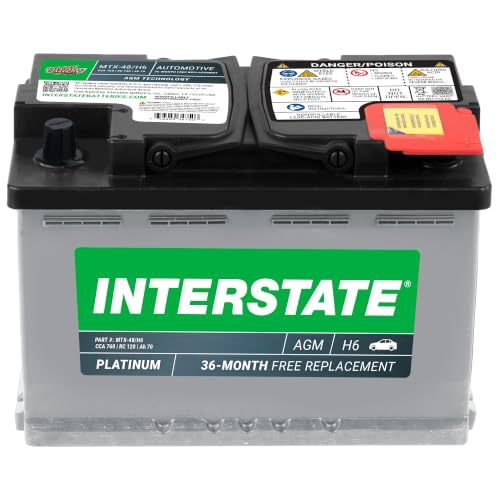
An aftermarket battery is sold outside the dealer channel. You’ll find them in parts stores, online retailers, big-box stores, warehouse clubs, and battery specialists, from budget flooded units to premium AGM models. Many are perfectly suitable, but you have to verify the spec instead of assuming the box tells the whole story.
Why the label is not the whole decision
OEM and aftermarket parts are contrasted in auto use, but performance depends more on the specs than on the branding. A premium aftermarket AGM battery may outperform a standard OEM flooded battery if the vehicle needs higher cycling tolerance or more accessory support. A poor fit, by contrast, can fail even if the brand name is respected.
Battery comparison matrix
The best way to compare these options is by the vehicle’s age, chemistry requirement, and electrical demand before price. Older basic cars can often accept a straightforward replacement. Newer models with stop-start systems, battery monitoring, or heavy accessory loads need a tighter match and may need registration or a reset after installation.
| Vehicle age | Required chemistry | Stop-start system | Climate | Electrical load | Dealer price premium | Warranty convenience | Recommended choice |
|---|---|---|---|---|---|---|---|
| Older vehicle, basic charging system | Flooded lead-acid | No | Mild | Low | High | Low need for dealer process | Aftermarket Battery |
| Older vehicle, but OEM-sized tray and venting matter | Flooded lead-acid | No | Cold | Moderate | Moderate | Medium | Car Battery |
| Mid-age vehicle with stop-start | AGM | Yes | Hot or mixed | Moderate to high | High | Medium | Aftermarket Battery |
| Newer vehicle with battery monitoring | AGM or exact factory type | Yes | Cold | High | Moderate | High if dealer handles registration | Car Battery |
| Any vehicle with a large price gap and clear spec match | Matched to spec | Any | Any | Any | Large | Low concern | Aftermarket Battery |
Vehicle age and system complexity
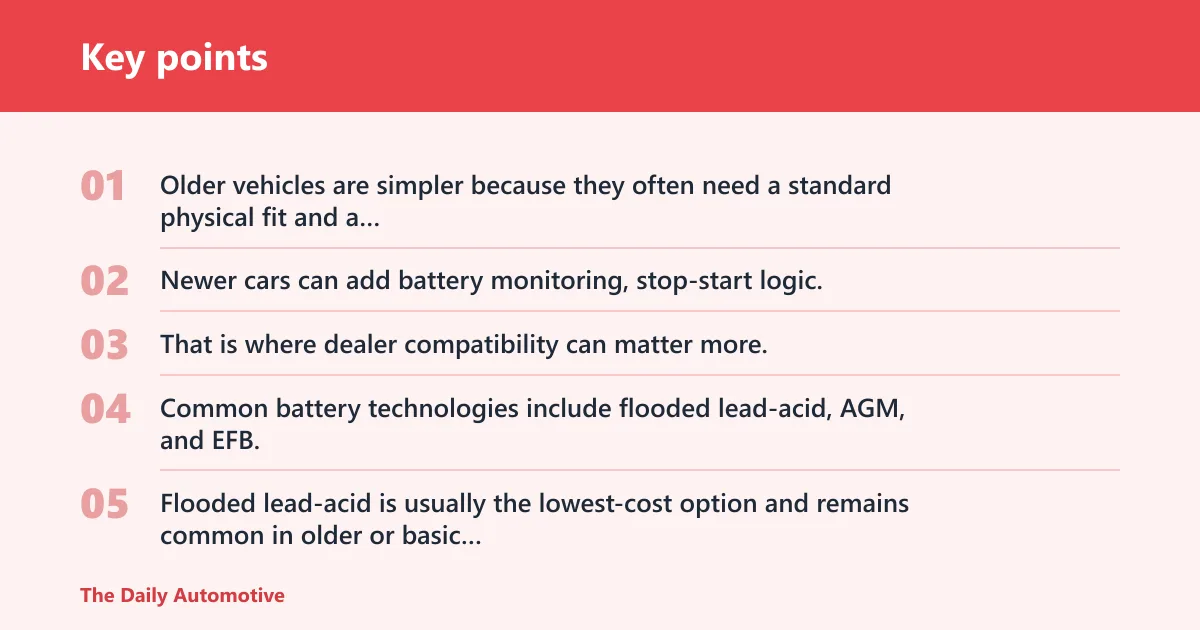
Older vehicles are simpler because they often need a standard physical fit and a conventional charging profile. Newer cars can add battery monitoring, stop-start logic, and reset procedures that change the replacement equation. That is where dealer compatibility can matter more.
Chemistry required: AGM or flooded
Common battery technologies include flooded lead-acid, AGM, and EFB. Flooded lead-acid is usually the lowest-cost option and remains common in older or basic vehicles. AGM batteries are better for stop-start systems and deeper cycling, so they fit vehicles that see more electrical cycling or more accessory use.
Stop-start, climate, and electrical load
Cold cranking amps matter a lot in cold climates because the battery has to deliver strong starting power when temperatures fall. Reserve capacity matters when accessories, short trips, or backup reserve are part of the load profile. If the car has stop-start and a heavier electrical load, AGM deserves serious attention before you chase the cheapest box on the shelf.
Dealer price premium and warranty convenience
OEM batteries are often more expensive than comparable aftermarket batteries. That premium can buy VIN lookup compatibility, dealer handling, and a simpler exchange process. It can also buy hidden convenience if the dealer registers the battery or handles system coding as part of the replacement.
How do fitment and spec checks work?
Fitment starts with group size, not the logo on the carton. A battery can be chemically correct and still be wrong if the tray, hold-down, terminal layout, or venting do not line up. For newer cars, the electronic side matters too, because battery registration or a BMS reset may be part of the job.
Group size, tray fit, and hold-downs
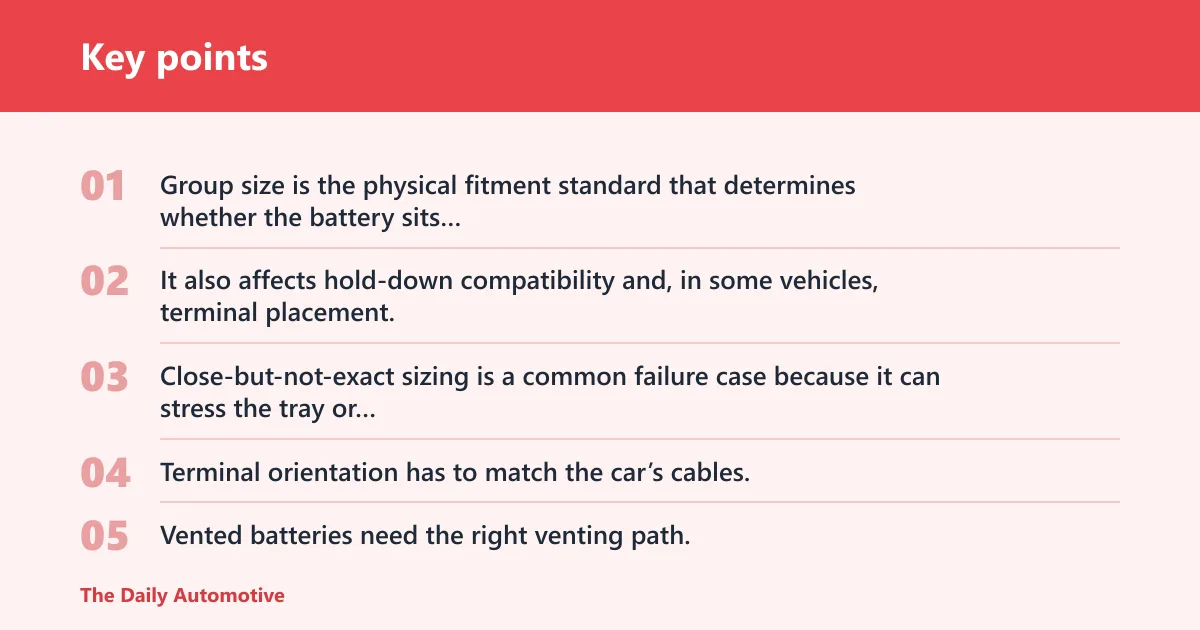
Group size is the physical fitment standard that determines whether the battery sits correctly in the tray. It also affects hold-down compatibility and, in some vehicles, terminal placement. Close-but-not-exact sizing is a common failure case because it can stress the tray or let the battery move.
Terminal layout and venting
Terminal orientation has to match the car’s cables. Vented batteries need the right venting path, especially where the battery sits inside the cabin, trunk, or another enclosed space. A mismatch here is not a small inconvenience; it can make the replacement wrong from the start.
Say your compact sedan needs a group 35 battery with a side-terminal layout and external venting. A top-terminal battery that “almost fits” can create cable stretch and a venting problem at the same time. That is not a good trade for a slightly lower price.
CCA and reserve capacity checks
Cold cranking amps tell you whether the battery can deliver the starting power the vehicle expects, especially in cold weather. Reserve capacity tells you how long it can support accessories and backup loads. Compare both numbers against the vehicle’s requirement before you compare brand names.
VIN lookup and factory match
A dealer VIN lookup can help confirm the factory battery specification, especially on vehicles with multiple options. That matters because trim level, engine choice, and electrical equipment can change the required battery. If the vehicle has a battery monitoring system, the correct part is only half the job; the reset or registration step still has to happen.
Suppose a crossover uses an AGM battery from the factory and the replacement is installed without registration. The car may still start, but the charging strategy can be off, which can shorten battery life or trigger a warning. The box can be right and the setup can still be wrong.
Is OEM always the safer choice?
No. Dealer supply adds value when the vehicle needs exact factory compatibility or dealer handling of the battery replacement. But if the aftermarket battery matches the vehicle’s actual spec and the dealer price premium is large, the safer choice for your budget may be the aftermarket part. Safety here is about fit and system compatibility, not the badge on the label.
When dealer supply adds value
Dealer-channel replacement is most useful when the vehicle has tight fitment, a specific venting setup, or a monitoring system that benefits from dealer registration support. If the dealer handles the part lookup, registration, and labor, the added cost may buy less risk and less time spent sorting out the replacement.
When the same supplier makes both versions
OEM means a component maker or original brand involved in the supply chain. In practice, the same major battery supplier may make both the dealer-sold battery and a comparable aftermarket version. That is why brand perception alone is a weak way to shop.
When price premium is hard to justify
If the aftermarket battery matches group size, chemistry, CCA, reserve capacity, venting, and reset requirements, the dealer premium may be hard to justify. The total ownership cost also matters: dealer labor, registration, and the exchange process can make the gap wider than the sticker price suggests. That is where a well-matched aftermarket battery often wins.
Is an aftermarket battery enough for your car?
Yes, if the spec match is exact and the vehicle does not need dealer-only handling. Aftermarket batteries come in budget, midrange, and premium tiers, and the better ones can meet or exceed the spec of an OEM flooded unit. The key is to buy by chemistry, size, and electrical need, not by shelf appeal.
Budget, midrange, and premium aftermarket tiers
Aftermarket batteries often offer more choices in price, performance level, and battery type. A budget flooded lead-acid battery may be fine for an older sedan with low accessory demand. A premium AGM battery makes more sense when the vehicle cycles the battery harder or needs more reserve.
When an AGM aftermarket battery makes sense
An AGM battery is the better fit when stop-start is in play, when the vehicle sees deeper cycling, or when accessories draw more from the battery between starts. It also helps in vehicles that see vibration or repeated short trips. In those cases, the aftermarket AGM can be the stronger buy.
When a flooded lead-acid battery is still appropriate
A flooded lead-acid battery remains appropriate for older, basic vehicles that do not need stop-start support or extra cycling tolerance. It is usually the lowest-cost path when the car’s electrical demand is modest. If the spec calls for flooded and the climate is not punishing, there is no need to pay for chemistry you will not use.
Choose Car Battery if… / Choose Aftermarket Battery if…
Choose Car Battery if the vehicle needs exact dealer compatibility, factory-matched fitment, or dealer support for registration or reset procedures. Choose Aftermarket Battery if the spec match is clear, the price gap is large, and you can verify group size, chemistry, CCA, reserve capacity, venting, and terminal layout before buying.
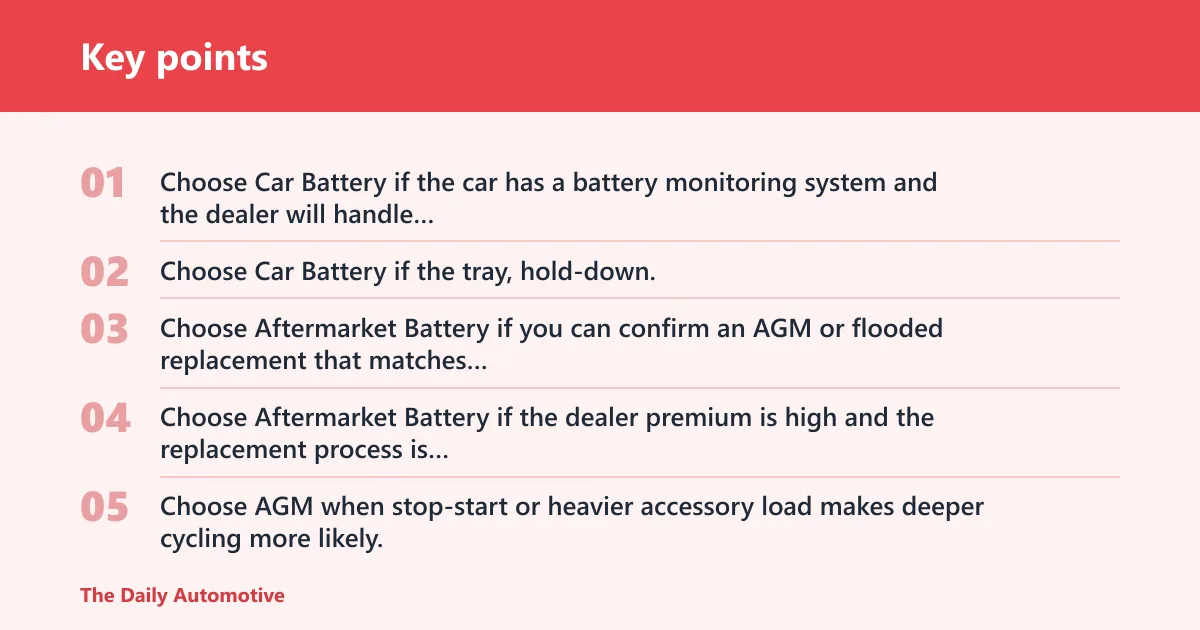
- Choose Car Battery if the car has a battery monitoring system and the dealer will handle registration or coding.
- Choose Car Battery if the tray, hold-down, or venting setup is vehicle-specific and you want a VIN-verified match.
- Choose Aftermarket Battery if you can confirm an AGM or flooded replacement that matches the factory spec.
- Choose Aftermarket Battery if the dealer premium is high and the replacement process is straightforward.
- Choose AGM when stop-start or heavier accessory load makes deeper cycling more likely.
Red flags for wrong fitment and reset issues
- Wrong group size or tray fit
- Hold-down that does not secure the case correctly
- Terminal layout that strains the cables
- Venting mismatch on a battery that needs it
- CCA lower than the vehicle requires
- Reserve capacity that is too low for the load profile
- Skipped battery registration, BMS reset, or coding on a newer vehicle
- Check the factory battery spec by VIN or owner documentation.
- Match group size, terminal layout, and venting first.
- Compare CCA and reserve capacity, not just the brand name.
- Confirm whether the car needs AGM, flooded lead-acid, or another approved chemistry.
- Ask whether registration, reset, or coding is required after installation.
- Compare the total cost, including dealer labor and warranty exchange convenience.
Frequently asked questions
How does it compare to oem batteries?
Compare it on fitment and spec first. OEM batteries are sold through the dealer channel and matched to factory specs, while aftermarket batteries are sold outside the dealer channel and may offer more price and chemistry choices. If the aftermarket match is exact, performance can be comparable.
What is an aftermarket battery?
An aftermarket battery is a replacement sold outside the dealer channel. It can come from parts stores, online retailers, warehouse clubs, or battery specialists. Options range from budget flooded lead-acid units to premium AGM models, so the label alone does not tell you whether it is the right fit.
What is a oem battery?
An OEM battery is a dealer-channel replacement matched to the vehicle’s factory specification. It is often a direct-fit match for the tray, hold-down, venting, and terminals. In many cases, a VIN lookup is used to confirm the correct part.
Are car batteries the same?
No. Batteries differ by group size, chemistry, CCA, reserve capacity, terminal layout, and venting needs. Two batteries can look similar and still be wrong for the same car. Newer vehicles may also need registration or a BMS reset after replacement.
Why are auto batteries so expensive?
Price reflects chemistry, case design, starting power, reserve capacity, and the cost of matching tighter vehicle requirements. Dealer batteries often add channel markup, labor, and convenience. On newer vehicles, registration or coding can add to the total replacement cost as well.
Harley davidson battery vs aftermarket
The same rule applies: match the motorcycle’s required size, chemistry, terminal layout, and starting performance first. An aftermarket battery can be the better buy if it fits the tray and meets the electrical spec. If the model has special charging or fitment needs, verify them before buying the cheaper option.
Products related to this article
Sponsored / affiliate links. As an Amazon Associate I earn from qualifying purchases. I may earn additional commission from eligible campaigns.