Best Snow Socks for Occasional Use (2026): Research Shows
For occasional winter use, choose snow socks only if your vehicle has exact fitment coverage, the wheel well has enough room, and you need a short-term traction aid for light snow or ice. Pick the wrong size or rely on them in deep snow, and you can damage the fabric, lose grip, or spend money on a fix that fails when you need it. This guide explains when snow socks make sense, what to check before buying, and which features matter most for low-cost, occasional use.
Quick comparison
| Product | Badge | Best for | Price | ||
|---|---|---|---|---|---|
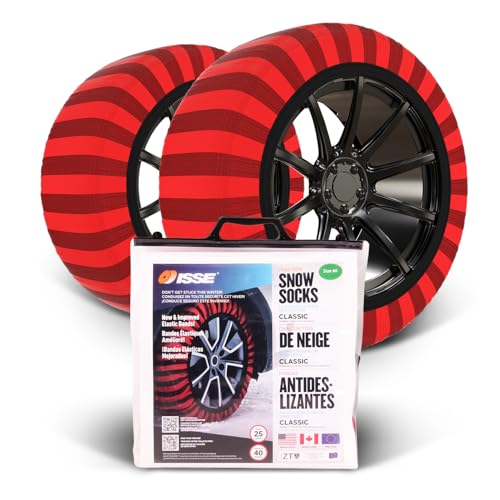 |
ISSE Classic Snow Socks for Tires. Designed for All TireISSE | Our pick | Size 70 · textile snow socks · multi-season use | $115.43
Price as of 1 Nov 2026
|
View |
 |
AutoSock for Passenger Vehicles HP697, Snow Socks forAUTOSOCK | Pair with it | HP697 · snow socks · 2-pack | $120.95
Price as of 1 Nov 2026
|
View |
 |
MICHELIN SOS Grip Evolution 3 Textile Snow Socks, EmergencyMICHELIN | Also great | Evolution 3 · textile snow socks · emergency use | $109.73
Price as of 1 Nov 2026
|
View |
 |
Canchiing 2 Pack Automotive Snow Socks for Tire, TractionCanchiing | Budget pick | XL · tire snow socks · emergency kit | $29.99
Price as of 1 Nov 2026
|
View |
This comparison is for drivers who want a temporary traction aid, not a season-long winter setup. If your winters are routine, deep, or legally chain-controlled, the better answer is usually chains or winter tires.
How we chose
The picks below are based on manufacturer specifications, listing details, and published buyer feedback about fitment, installation, and wear themes. No product was scored with invented numbers, and no hands-on claim is made here.
Fitment coverage comes first. Clear installation notes, included accessories, and honest use-case limits come next. Price only helps when the size and clearance requirements already fit your vehicle.
ISSE Classic Snow Socks: best for easy fit
This is the pick for drivers who want a straightforward, trunk-friendly emergency aid and have confirmed the listed size matches their tires. ISSE lists Size 70, easy 3-minute install, reusable tear-resistant fabric, and compact storage, which suits occasional use better than a bulky chain kit.
Its main strength is convenience. The drawback is the same one that applies to most textile traction aids: if your tire size is wrong or your wheel well is tight, the sock may not seat properly and can wear fast on pavement.
Fit snow socks by matching the exact tire size, preparing a dry install surface, and centering the fabric before you move the car. The job is usually easier than chain installation, but the sock still has to sit squarely on the tread and clear the wheel arch.
Tools and setup
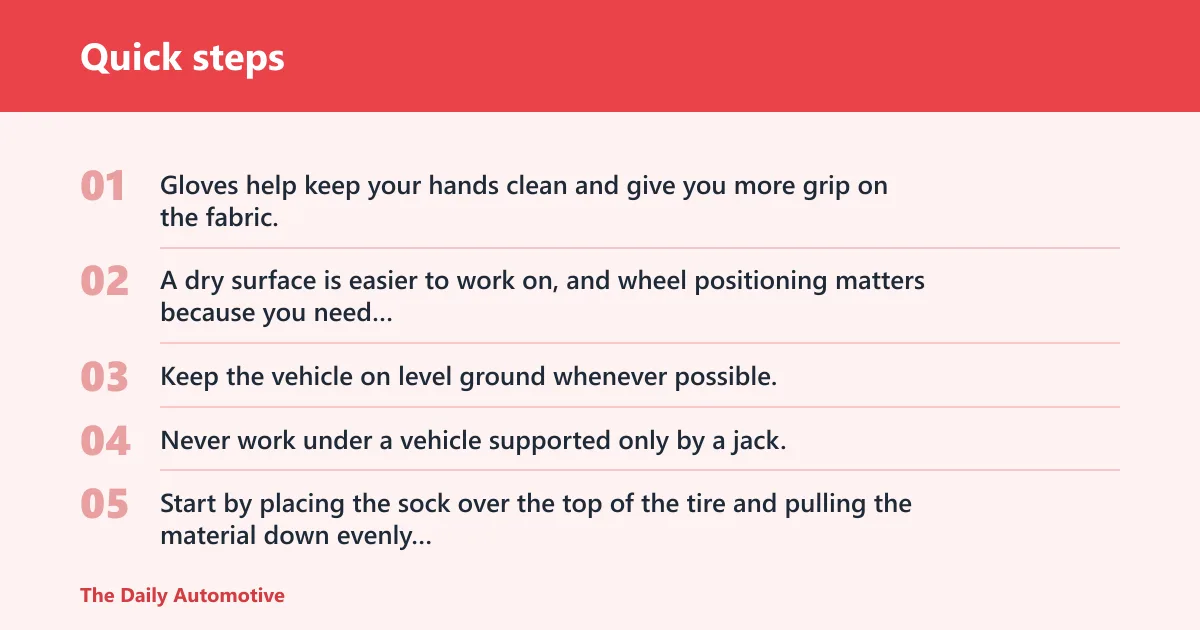
Gloves help keep your hands clean and give you more grip on the fabric. A dry surface is easier to work on, and wheel positioning matters because you need access to the top section of the tire before the sock is pulled around it.
Keep the vehicle on level ground whenever possible. Never work under a vehicle supported only by a jack; use jack stands on level ground if lifting is required, and follow the vehicle manual.
Install in order
Start by placing the sock over the top of the tire and pulling the material down evenly on both sides. Then move the vehicle forward or backward only as instructed by the product manual so the remaining portion can be fitted without twisting the fabric.
Once installed, check that the sock sits centered and does not contact the brake area, liner, or suspension. If the product manual calls for a speed limit, keep that limit in view before you start driving.
If the sock slips
If a sock slips, stop before it gets tangled. Reset it, confirm the size again, and look for a clearance problem that is forcing the fabric out of position. If it still will not stay centered, do not keep driving on it.
If it touches the wheel arch, remove it. That usually means the vehicle is too tight for that specific sock or the fitment is not right for the wheel well.
AutoSock for passenger vehicles: best for tight wheel wells
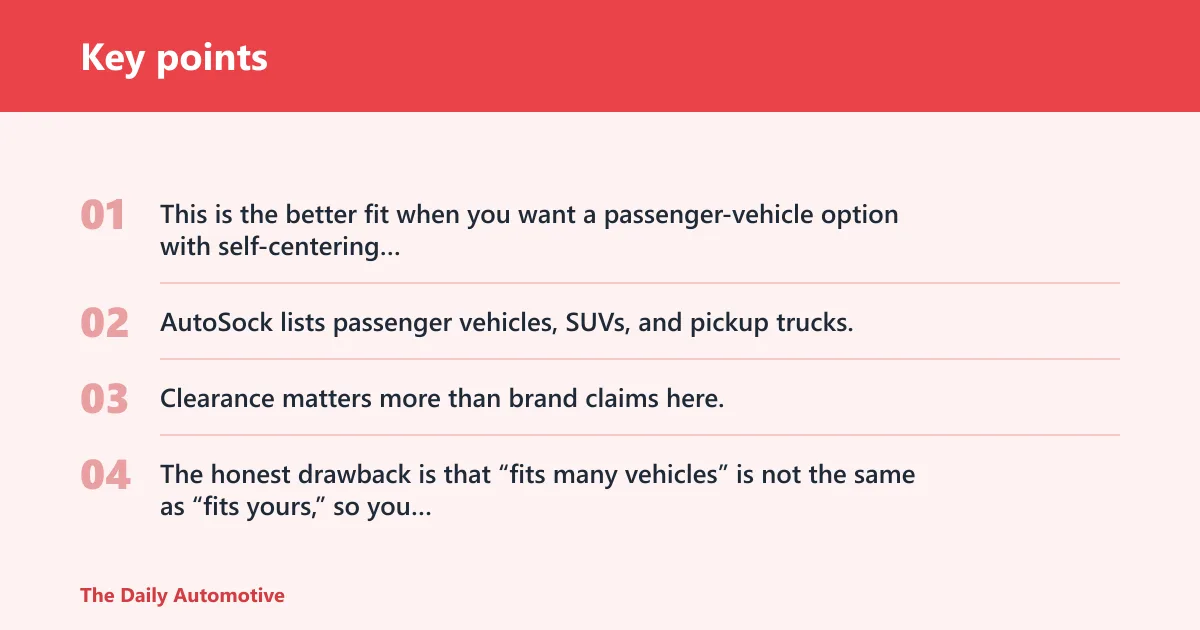

This is the better fit when you want a passenger-vehicle option with self-centering webbing and a kit that includes gloves and instructions. AutoSock lists passenger vehicles, SUVs, and pickup trucks, which makes it a practical shortlist candidate when fitment needs to be checked carefully by tire size.
Clearance matters more than brand claims here. The honest drawback is that “fits many vehicles” is not the same as “fits yours,” so you still need the exact tire size and enough space around the fender, suspension, and brakes.
MICHELIN SOS Grip Evolution 3: best for short emergency trips
This is the strongest emergency-trip choice for drivers who want a fast-on, fast-off aid and a simple install sequence. MICHELIN lists quick 4-step assembly and compatibility with ESP and ABS, which is useful for light snow, brief recovery moves, and low-speed travel where a temporary aid is enough.
The drawback is scope. It is still a temporary textile traction device, so it should not be treated as a substitute for winter tires, and it should not be pushed into deep snow or long bare-pavement driving.
Canchiing 2 Pack Automotive Snow Socks: best for low-cost backup
This is the budget backup when you want a low-cost emergency kit and understand that the tradeoff is less confidence about long-term wear than on the higher-priced options. Canchiing lists quick-fit installation, an ice scraper, and gloves, which makes it appealing for rare use and trunk storage.
The drawback is that a low price usually means more reason to verify your exact tire size, inspect the fabric more often, and avoid stretching the product beyond short, low-speed use on snow or ice.
Which one should you buy?
Choose snow socks if you need a temporary aid, your exact tire size is listed, and the clearance around the tire is enough for the sock to stay off the fender liner, suspension, and brake hardware. Choose chains if the route has deeper snow, steeper grades, or a local chain law requires metal traction devices.
Choose winter tires if winter driving is routine. Studless winter tires are the common all-season winter answer for traction and control, while studded tires may be allowed only in certain regions and conditions. If your winter exposure is rare and mild, skip both and keep moving with cautious driving and a contingency plan.
Say your sedan wears 205/55R16 tires and the front wheel well already leaves little space between the tread and the liner. In that case, a sock that is the wrong size or a sock with bulky seams can rub quickly, and the vehicle may be a poor candidate even if the brand name sounds suitable.
What snow socks are and how they work
Snow socks are textile traction aids meant for temporary grip on snow and ice. They are easier to install than metal chains, but they are not a full winter-tire replacement and they are not built for long runs on dry pavement.
Most designs rely on textile traction material that grips loose snow and packed surface film better than a bare tire. Their use is usually limited by speed, surface condition, and wear life, so manufacturer guidance matters more than habit.
Snow sock decision matrix
Use this table to decide whether snow socks, chains, winter tires, or neither makes more sense for your situation. If more than one warning applies, move down the list toward the more durable option.
| Tire size and fit | Wheel clearance | Drivetrain | Snow depth | Trip frequency | Best recommendation |
|---|---|---|---|---|---|
| Exact size match listed by the manufacturer | Clear space at fender, suspension, and brakes | FWD, RWD, or AWD with manual confirmation | Light snow or icy film | Rare trips, short distances | Snow socks |
| Exact size match listed by the manufacturer | Tight but sufficient clearance | Any drivetrain, but with traction-control sensitivity checked | Light to moderate snow | Occasional winter travel | Snow socks, if the manual allows it |
| Exact size match or approved chain size | Limited clearance | Any drivetrain | Deeper snow, steep grades, road-law requirements | Occasional or repeated winter travel | Chains |
| Common fitment problems or no exact listing | Very tight wheel wells, low-clearance sedan, or brake interference risk | Especially sensitive RWD or low-profile setups | Any meaningful winter exposure | Seasonal driving | Winter tires |
| No clear fitment, minimal snow exposure | No safe clearance margin | Any drivetrain | Rare or mild | Very occasional | Neither; plan around weather |
Fitment by tire size
Tire size is the first gate. Match the full sidewall code exactly, such as 205/55R16, not just the wheel diameter. The wrong width or sidewall profile can leave the sock too loose, too tight, or out of alignment with the tread.
If the product listing names a range, stay inside that range and check load and speed rating implications in your owner’s manual. A sock does not change the vehicle’s certified tire requirements.
Clearance and drivetrain limits
Wheel clearance includes space at the fender, suspension, brake caliper, and inner liner. Low-clearance sedans and vehicles with tightly packed wheel wells are the most common poor candidates.
Drivetrain matters because front-wheel drive, rear-wheel drive, and all-wheel drive can all behave differently under load. Rear-wheel-drive cars may spin the driven wheels more easily under throttle, so they need especially careful low-speed use and traction-control awareness.
Speed and surface limits
Most manufacturers set a low maximum speed for textile traction aids, and that limit is usually lower than normal road driving. Keep speeds down and follow the product label, because performance drops as the road turns from snow to slush to bare pavement.
Dry pavement can shred the fabric quickly. If you hit clear road for an extended distance, remove the socks as soon as conditions allow.
Snow socks checklist
Use this six-step check before you move the car. It keeps the install simple and helps avoid the most common failures.
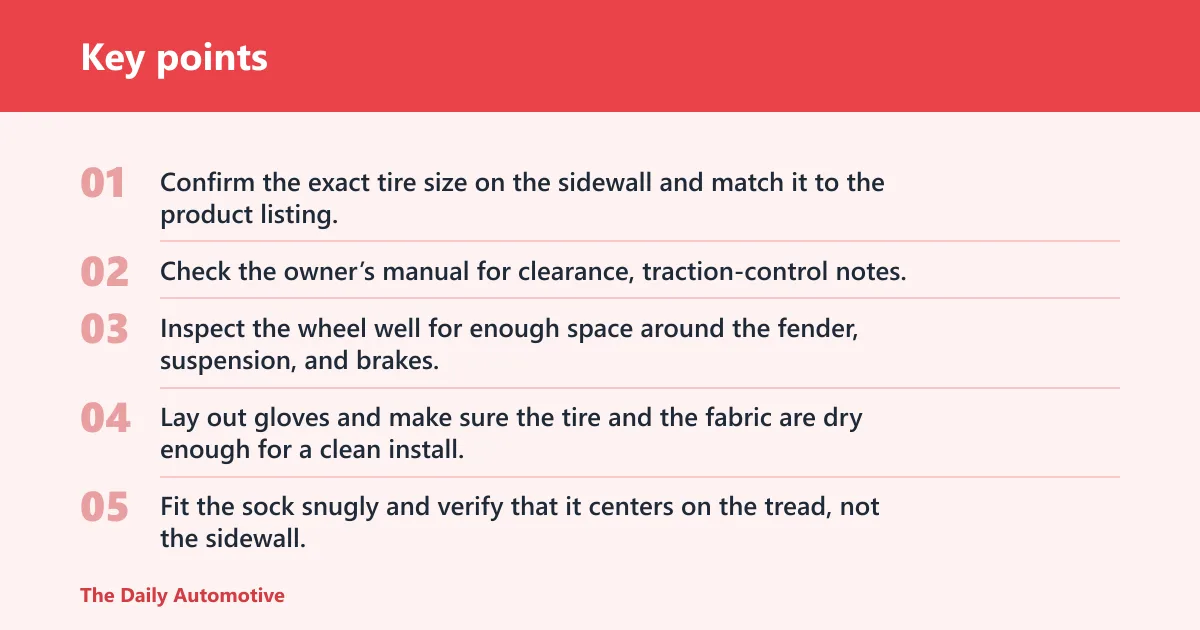
- Confirm the exact tire size on the sidewall and match it to the product listing.
- Check the owner’s manual for clearance, traction-control notes, and any chain or textile restriction.
- Inspect the wheel well for enough space around the fender, suspension, and brakes.
- Lay out gloves and make sure the tire and the fabric are dry enough for a clean install.
- Fit the sock snugly and verify that it centers on the tread, not the sidewall.
- Move off slowly, then stop and recheck for slip, rubbing, or uneven seating.
Failure cases to watch
A common first-timer mistake is to assume a sock that “almost fits” is good enough. It is not. If the fit is off, the problems below are common.
| Failure case | What it looks like | What to do |
|---|---|---|
| Slip | The sock walks off-center or gathers near one shoulder of the tire | Stop, reset the sock, and verify the size and centered placement before driving farther |
| Fender contact | You hear rubbing in the wheel arch or see contact marks | Remove the sock and confirm clearance; if the arch is too tight, choose chains, winter tires, or neither |
| Shredding | Fabric frays after brief bare-pavement use | Remove immediately and replace the sock if the material is torn or thinned |
| Bare pavement | The road clears and traction aid performance drops | Take the socks off as soon as practical to reduce wear and road noise |
| Legal limit issue | Local rules restrict textile aids or require chains in posted areas | Follow local road rules before you travel; do not assume snow socks are allowed everywhere |
Are snow socks legal for road use?
Legality varies by region, road condition, and winter-control rules. Some areas allow textile traction aids only under certain conditions, while others treat them differently from chains or require approved winter equipment in posted zones.
Check local rules before winter travel, especially if you cross state, provincial, or national borders. Do not assume a product that is legal on one road will be allowed on the next.
Will snow socks work on my car tires?
They will work only if the product size matches your exact tire dimensions and the wheel well has enough clearance. Sidewall format matters because the manufacturer sizes these by tire code, not by wheel diameter alone.
If your vehicle has a low-clearance sedan setup, a wide tire, or a tightly packed brake and suspension area, the answer may be no even if the socks look close. In that case, chains, winter tires, or neither may be the better call.
How long can you drive on snow socks?
You should drive only as long as the manufacturer guidance allows and only on the surface for which the product is intended. Snow socks are temporary aids, so the practical answer is short, low-speed travel on snow or ice, not a long highway run.
Wear life drops quickly on bare pavement. If the road clears, remove them rather than stretching the product past its intended use.
Are snow socks better than chains for occasional use?
For occasional use, snow socks are better when ease of installation matters more than maximum traction and when the route is limited to light snow or ice. Chains are the better choice when conditions are harsher, the law requires them, or you need a more aggressive bite.
Chains are also more likely to be accepted where traction-control demands are less of a concern and where legal rules are explicit. Snow socks are the lighter tool; chains are the stronger tool.
Can I use snow socks on rear wheel drive cars?
Yes, but only if the exact fitment is listed and the clearance is sufficient. Rear-wheel-drive cars can be more sensitive to throttle-induced wheelspin, so you need conservative speed, smooth input, and a manual check for any traction-control limitations.
If a rear-wheel-drive car has a tight wheel well or low-profile tires, it may be a poor candidate. In that case, winter tires are often the cleaner answer, and chains may be the more appropriate emergency tool.
Do snow socks damage tires or ABS/traction control?
They should not damage tires or ABS when used within the product and vehicle manuals, but fitment mistakes and excess speed can cause wear, rubbing, or control-system confusion. Manufacturers often note ABS or ESP compatibility, yet you still need to verify the manual for your model.
Traction control may intervene differently on snow socks than on bare tires, especially during starts and turns. If the manual warns against a certain use case, follow the manual rather than assuming the sock overrides it.
Frequently asked questions
What size snow socks do I need for my tires?
You need the size that matches your exact tire code, such as 205/55R16, or the manufacturer’s listed size range for that code. Do not size by wheel diameter alone, because sidewall format and tire width affect whether the sock seats correctly and clears the wheel well.
How do you fit snow socks for cars?
Lay the sock over the driven tire, center it on the tread, and move the car only as the manual directs so the lower section can be finished. Gloves help, a dry surface helps, and the final check is whether the sock stays clear of the fender, suspension, and brakes.
Products related to this article
Sponsored / affiliate links. As an Amazon Associate I earn from qualifying purchases. I may earn additional commission from eligible campaigns.