Best Trailer Wiring Kits for Towing (2026): We Compared
For everyday towing, choose the simplest trailer wiring kit that matches your vehicle’s connector and the trailer’s light count. For most light-duty use, the CURT 58380 Vehicle-Side and Trailer-Side 4-Pin Flat Wiring Kit is the cleanest fit because it covers basic lighting without adding extra parts. Get the match wrong and you risk dead lights, warning messages, blown fuses, or buying a second kit.
Quick comparison
| Product | Badge | Best for | Price | ||
|---|---|---|---|---|---|
 |
CURT 58380 Vehicle-Side and Trailer-Side 4-Pin Flat WiringCURT | Our pick | 4-Pin · Universal · Vehicle-side and trailer-side | $5.49
Price as of 17 Nov 2026
|
View |
 |
Oyviny Multi-Tow 7 Way RV Blade and 4 Way Flat TrailerOyviny | Pair with it | 4-Way + 7-Way · Dual output · Tundra | $44.99
Price as of 17 Nov 2026
|
View |
 |
Tekonsha 22115 Custom Tow Harness 7 Way Tow Hitch TrailerTekonsha | Upgrade pick | 7-Way · Custom tow harness · Short-circuit protection | $288.48
Price as of 17 Nov 2026
|
View |
This roundup stays practical: match the connector to the trailer you actually tow, then add pins only when you need more functions. The table below focuses on the minimum setup, installation complexity, and whether coding is typically part of the job.
How we chose
The selection is based on manufacturer specs, listing details, and published buyer feedback, with focus on fitment clarity, connector type, installation complexity, and the functions each kit supports.
CURT 58380: best for simple light towing
This is the simplest pick for everyday towing with basic lighting needs. The listing calls it a 4-Pin, Universal, vehicle-side and trailer-side kit, and the color-coded 12-inch wires and easy-grip plug design make it the least intimidating option for a small trailer, utility cart, or light carrier that only needs core trailer lighting functions.
What stands out is the low complexity. A universal kit is the right answer when you need a basic electrical connection and do not need modern vehicle-electronics integration or extra trailer functions beyond the standard lighting functions it is built to handle.
The main drawback is also its strength: it stays basic. If your towing routine needs reversing lights, a continuous power supply, or charging lines for a camper or bike carrier, a 4-pin setup is not the right end point. Check the vehicle manual and the trailer’s connector requirements before buying.
Oyviny Multi-Tow for 2007-2013 Toyota Tundra: best for a factory tow package
This kit makes sense if you drive a 2007-2013 Toyota Tundra with the factory tow package and want both 4-way and 7-way connections in one adapter. The listing says it is plug-and-play, which usually means less cutting and splicing than a universal install, and that matters when you want a quick path from a factory tow setup to trailer use.
It is the better fit when the vehicle already has the right tow package hardware and you need more than a basic flat connector. The dual-output design gives you a more flexible setup for mixed trailer use, while the dust cap and weatherproof features are useful for routine outdoor storage.
The limitation is straightforward: fitment is narrow. It is not a general answer for every car, and the listing itself says factory tow package required. If your Tundra does not match that setup, stop and verify compatibility before ordering.
Tekonsha 22115: best for full 7-way trailer functions
This is the strongest match for drivers who need a vehicle-specific 7-Way tow kit and want the installation to stay close to the factory-style route. The listing says no cutting or splicing is required, and it adds short-circuit and overload protection, which is useful when the trailer wiring needs to handle more than basic lamp power.
Choose this when your trailer setup needs a full 7-way style connection rather than only lighting. It is a better path when you need a more complete trailer interface than a simple flat connector can provide.
The drawback is cost and fitment discipline. At $288.48, it is much more expensive than a basic universal kit, and vehicle-specific kits only make sense when the model match is right. Confirm the exact vehicle listing before you buy.
Trailer wiring decision table
| Everyday towing scenario | Minimum setup | Pin count | Must-have functions | Likely install complexity | Coding typically needed? |
|---|---|---|---|---|---|
| Bike rack with lights or a light carrier | Basic universal flat kit | 4 | Indicators, brake lights, tail lights, rear fog light if required by the trailer and local rules | Low to moderate | Usually no, unless the vehicle uses encoded trailer logic |
| Small utility trailer for short trips | Vehicle-specific or universal 4-pin setup | 4 | Core trailer lighting functions | Low if plug-in; moderate if splicing is needed | Sometimes, on modern vehicles with CAN-Bus integration |
| Camper rental or trailer that needs charge lines | 13-pin kit | 13 | Lighting plus reversing lights, continuous power supply, and charging lines for caravans or bike carriers | Moderate to high | Often yes, especially with approved or encoded kits |
| Factory tow-package vehicle with mixed trailer use | Vehicle-specific adapter or tow kit | 4 or 7 | Whichever functions the vehicle and trailer both support | Low if the fitment is exact | Depends on vehicle electronics and the supplied module |
What trailer wiring kit do I need for everyday car towing?
Start with the trailer’s actual electrical needs, then match the simplest kit that supports them. If you only need the standard lighting functions, a 4-pin or basic 7-way setup may be enough.
A common first-timer mistake is choosing a kit because the plug matches the vehicle, even though it lacks the weather sealing and brake-light support needed for everyday towing. Picture a small utility trailer that only needs lights: a 13-pin kit adds complexity without much value. On the other hand, a caravan rental with fridge or battery charging needs more than a flat connector can provide.
ORIS says the wiring kit is the central interface between the vehicle and the trailer, and it identifies the 13-pin variant as the established standard for modern vehicles and trailers. That does not mean every everyday towing job needs 13 pins. It means you should buy for the trailer, not for the biggest connector on the shelf.
Match the kit to your trailer’s required lighting functions
At minimum, the trailer socket must transmit indicators, brake lights, and tail lights. If the trailer also uses reversing lights, a continuous power supply, or charge lines, the kit has to support those functions from the start. A smaller connector cannot create those features later.
Choose the least complex setup that still covers your use
If your routine is occasional and simple, buy the least complex kit that fully covers it. Vehicle-specific kits make sense when the vehicle’s electronics need a tailored solution. Universal kits make sense when the job is basic and you want broad fitment without needing advanced integration.
What is the difference between a 7-pin and 13-pin wiring kit?
A 7-pin kit usually covers the core trailer lighting job and is still common on simpler trailer setups. A 13-pin kit is the more complete modern layout and can support reversing lights, continuous power supply, and charging lines for caravans and bike carriers. Choose the connector based on the trailer’s real functions.
That difference matters most when you move beyond a basic trailer. If you tow a small utility trailer, 7-pin may be enough. If you rent a caravan or tow a bike carrier with charging needs, the 13-pin option becomes the practical choice.
When the extra pins matter
Extra pins matter when the trailer needs more than lighting. They are not an upgrade for its own sake. They only pay off when the trailer has reversing lamps, battery charging, or a continuous feed that a basic 4-pin or 7-pin setup cannot deliver.
What to verify on your vehicle and trailer
Check the vehicle’s rear socket, the trailer plug, and the owner’s manual. A 13-pin trailer with 7-pin vehicle wiring will need an adapter or a different kit. If the vehicle uses CAN-Bus integration, the trailer solution may also need a module that communicates correctly with the vehicle electronics.
What is the difference between a universal and specific wiring kit?
A universal wiring kit is flexible across many vehicles and usually gives you a basic electrical connection. A vehicle-specific kit is tailored to one vehicle model and is designed to integrate more cleanly with the vehicle’s electronics. If your car has parking sensor suppression, fault monitoring, or encoded trailer logic, vehicle-specific is usually the safer path.
Use a universal kit when the towing need is simple and the vehicle does not demand deeper integration. Use a specific kit when the listing says it matches your exact model and supports the vehicle’s network and trailer electronics more directly.
When a universal kit makes sense
Universal kits are a good fit for older vehicles, simpler wiring jobs, and light towing where the main goal is getting the lamps working. They are also useful when you want a broad-fit option and do not need modern driver-assistance support tied to the trailer connection.
Where compatibility risk is higher
Risk goes up on newer vehicles with CAN-Bus integration, parking sensors, lamp monitoring, or coded trailer functions. In those cases, the wrong kit can trigger dashboard warnings, false bulb-out messages, or non-working lights. If the vehicle listing mentions a module, do not treat the wiring as a universal fit.
Do I need vehicle coding for a trailer wiring kit?
Sometimes. Vehicle coding is often part of the job when the kit is approved or tied into the vehicle’s electronics. It can be required so the car recognizes the trailer, suppresses parking sensors, or manages lamp monitoring correctly.
If the kit is truly plug-and-play for your exact vehicle, coding may not be needed. But if the listing mentions a trailer control module or support for CAN-Bus integration, assume coding may be part of installation until the manufacturer says otherwise.
When coding is typically part of installation
Coding is most common on modern vehicles with trailer logic built into the body control system. It may also appear when the kit needs to tell the car that a trailer is attached so the vehicle can change how it monitors bulbs or parking sensors.
What to confirm in the vehicle manual or listing
Check whether the kit needs a separate module, a 12-volt power supply from the battery, or a software step after installation. If the listing does not clearly say the kit is compatible with your exact vehicle, stop there and verify fitment before ordering. That is cheaper than a second kit.
Which one should you buy?
For the average driver with occasional light towing, buy the CURT 58380 first if your trailer only needs basic lighting and you want the simplest install. If you need a full 7-way vehicle-specific kit and are willing to pay for it, the Tekonsha 22115 is the most complete pick here.
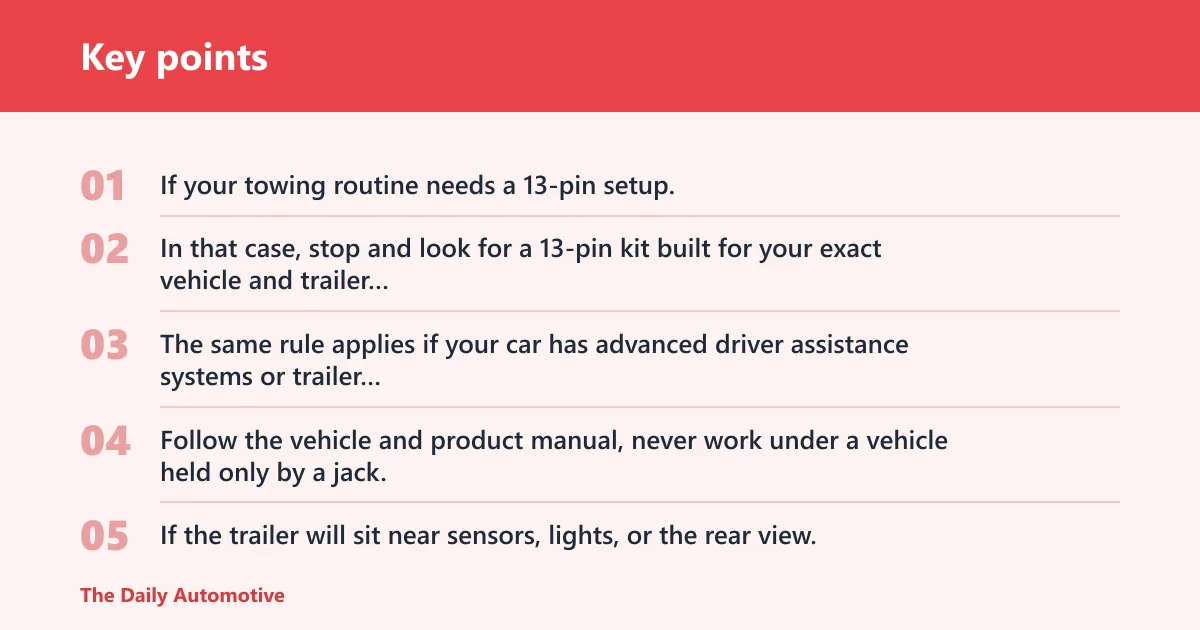
If your towing routine needs a 13-pin setup, none of these three should be forced into that role. In that case, stop and look for a 13-pin kit built for your exact vehicle and trailer combination. The same rule applies if your car has advanced driver assistance systems or trailer diagnostics that the listing does not clearly cover.
Follow the vehicle and product manual, never work under a vehicle held only by a jack, never exceed the vehicle’s rated tow limit, and check local laws before you drive. If the trailer will sit near sensors, lights, or the rear view, make sure nothing blocks the vehicle’s driver-assistance equipment or legal lighting requirements.
Suppose you tow a 6×4 utility trailer twice a month. A 4-pin universal kit is often enough, provided the trailer only needs basic lighting and the vehicle does not require coding. If the same trailer suddenly adds reverse lamps or a battery feed, the simple kit stops being enough.
Say your vehicle shows a trailer icon or fault message after installation. That points you toward fitment, coding, ground, or socket checks rather than a bad trailer bulb alone. A vehicle-specific kit with the right module usually solves that faster than adding random adapters.
Frequently asked questions
Why is my trailer socket not working after installation?
Check the basics first: pin count, plug seating, ground connection, and fuse condition. ERICH JAEGER notes that a trailer socket can fail even when connected as instructed, so the problem is not always obvious. If indicators do not work on either the car or trailer, the issue may be in the kit, socket, or coding.
Why do several fault lights appear after installing a wiring kit?
Several fault lights can appear when the vehicle does not recognize the trailer module correctly or when the kit is not matched to the car’s electronics. ERICH JAEGER specifically addresses this kind of warning pattern. Check fitment, coding, power supply to the module, and whether the vehicle needs trailer recognition enabled.
Products related to this article
Sponsored / affiliate links. As an Amazon Associate I earn from qualifying purchases. I may earn additional commission from eligible campaigns.