How Much Does a Remote Starter Cost for a Car?
A remote starter for a car usually costs about $250 to $700 all in, with basic hardware often around $80 to $300 and professional installation often adding roughly $150 to $400; push-button or security-equipped vehicles can push the total higher. Quotes often miss vehicle modules, labor time, or subscription fees, and that is how a “cheap” starter turns into a much pricier job. This guide breaks down hardware, install labor, vehicle-specific modules, and any ongoing fees so you can compare quotes accurately.
Typical cost range
Most drivers land somewhere in the $300 to $700 range for a professionally installed basic aftermarket system. Hardware, labor, and vehicle-specific parts rarely show up as one neat number, so the quote can look low at first and climb after programming, bypass modules, or extra remotes are added.
What buyers usually pay
Mid-range kits alone often fall in the $300 to $500 band, while high-end systems with smartphone control may reach $600 to $1,200 or more before installation fees.
That spread makes sense once you split the bill into parts. A simple keyed sedan needs less integration than a newer push-button car with anti-theft logic and more computer-controlled functions.
Why quotes vary so widely
Two quotes can both be honest and still look very different. One may include the kit, labor, bypass module, and programming, while another only covers hardware. Some systems also need a newer remote, a data interface, or a phone plan.
Say one sedan gets a basic 1-way kit and a two-hour install. Another gets a 2-way system with a bypass module and extra programming on a smart-key vehicle. The second quote should be higher, even if both are “remote starts.”
Remote starter cost matrix
This matrix breaks the total into hardware, labor, module or programming add-ons, and estimated total cost. Use it to see whether a quote is truly high or just incomplete.
| Install scenario | Hardware range | Labor range | Module or programming add-ons | Estimated total cost |
|---|---|---|---|---|
| Basic keyed sedan | $150 to $300 | $150 to $300 | $0 to $100 | $300 to $700 |
| Push-button compact | $200 to $500 | $225 to $450 | $50 to $200 | $475 to $1,150 |
| Truck with bypass module | $150 to $400 | $175 to $400 | $50 to $200 | $375 to $1,000 |
| Luxury vehicle | $300 to $600 | $300 to $600 | $100 to $250 | $700 to $1,450 |
| Manual-transmission case | $200 to $500 | $250 to $500 | $50 to $200 | $500 to $1,200 |
| Smartphone-enabled system with subscription note | $600 to $1,200 or more | $200 to $500 | $0 to $200 | $800 to $1,900+, plus $50 to $150 yearly |
The matrix uses common price bands, not a promise. The same vehicle can land near the bottom or top of a range depending on wiring access, security integration, and whether the system needs a cellular service plan.
What affects installation price most?
Hardware tier, vehicle wiring, and labor time drive most of the final bill. A simple install on an older keyed car may fit into a shorter labor window, while newer vehicles often need more programming and more expensive interface parts.
Hardware tier and remote type
A 1-way remote is usually the least expensive option. A 2-way remote adds confirmation feedback, so you know whether the car received the command, and that extra function usually raises the price.
Range can also change the cost. Short-range remotes are cheaper, while longer-range models and systems with a display remote or smartphone control cost more.
Vehicle wiring and programming complexity
Installation time typically ranges from 2 to 5 hours, and labor rates commonly run $75 to $150 per hour. That means labor alone can move the bill by several hundred dollars, especially on vehicles with tighter dash access or more complex security systems.
Older vehicles often cost less to install than newer complex vehicles. Modern ignition systems, body control modules, and immobilizers usually mean more wiring, more programming, and more risk of a wrong fit.
Extra modules and add-ons
Bypass modules can add $50 to $200 to the total cost. They matter because many modern vehicles will not let a remote-start signal work properly without an interface that communicates with the security system.
-
Check the vehicle layout.
Identify whether the car uses a keyed ignition, push-button start, or a manual transmission. That choice often decides whether you need a bypass module, extra safety logic, or a more complex interface. -
Ask for the labor line.
Request the shop’s hourly rate and estimated install time. With common labor rates of $75 to $150 per hour and a typical 2 to 5 hour job, you can see whether the quote matches the work. -
Separate modules from hardware.
Make the shop list the starter, remote, bypass module, and programming as separate items. That keeps the quote honest and makes comparison easier across brands and installers.
A $250 kit can be a fair deal, but it is not the same thing as a completed installation on a newer SUV with a security module.
Factory remote start or aftermarket?
Factory remote start commonly ranges from $500 to $1,200, and it can be the cleaner option when the vehicle already supports the factory package. Aftermarket systems can cost less, but the final total depends more on wiring and module needs.
Integration and convenience differences
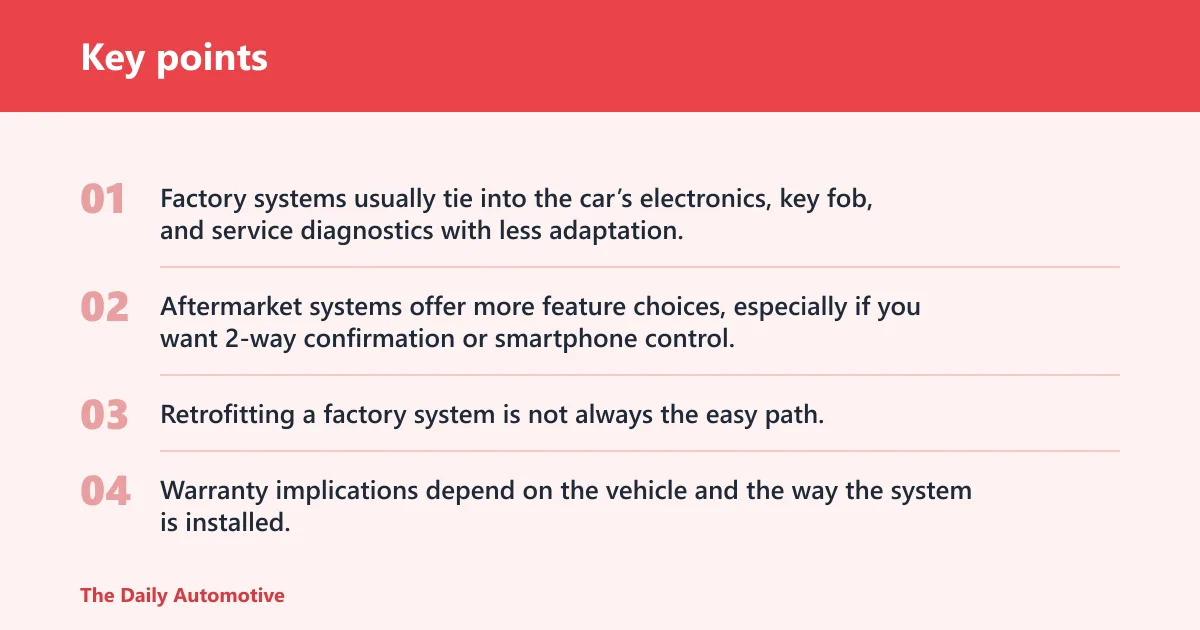
Factory systems usually tie into the car’s electronics, key fob, and service diagnostics with less adaptation. That can reduce odd behavior and make the system feel built in.
Aftermarket systems offer more feature choices, especially if you want 2-way confirmation or smartphone control. That flexibility is useful, but it can also mean extra parts and extra install time.
Retrofit complexity on older vehicles
Retrofitting a factory system is not always the easy path. On some cars, the OEM parts, wiring, coding, and dealer labor can make the retrofit expensive enough that a quality aftermarket kit is the more practical choice.
On the other hand, if the vehicle already has the needed factory hardware or a dealer package, the integration can be cleaner than piecing together aftermarket parts.
Warranty and service considerations
Warranty implications depend on the vehicle and the way the system is installed. A properly installed remote starter should not create issues by itself, but any added wiring must be done carefully and in line with the vehicle manual and product instructions.
Follow the vehicle and product manual. That matters most on newer vehicles with immobilizers, smart keys, and sensitive electrical systems.
Do manual transmission cars cost more?
Yes. Manual transmission vehicles need extra safety systems and usually cost more to remote-start. Availability is also more limited because the starter must prevent the car from starting in gear, which adds parts, programming, and install complexity.
Why safety requirements matter
A remote starter on a manual has to account for gear position and safe shutdown behavior. Installers often need extra safeguards so the car cannot lurch forward or start unexpectedly.
That extra protection is the reason many shops charge more, and some systems are simply not offered for every manual car.
When the price climbs
Manual-transmission installs often need added sensors or special logic, which pushes both hardware and labor higher. If the vehicle also has a smart key or factory immobilizer, the quote can rise again.
Do manual transmission cars cost more to remote-start? Usually yes, because the system has to verify the car is safe before it will start.
What do 2-way remotes and smartphone control add?
2-way remotes and smartphone control both add convenience, but they change the price in different ways. A 2-way remote gives confirmation feedback on a dedicated fob, while smartphone systems depend on cellular communication and often carry recurring fees.
2-way confirmation and range features
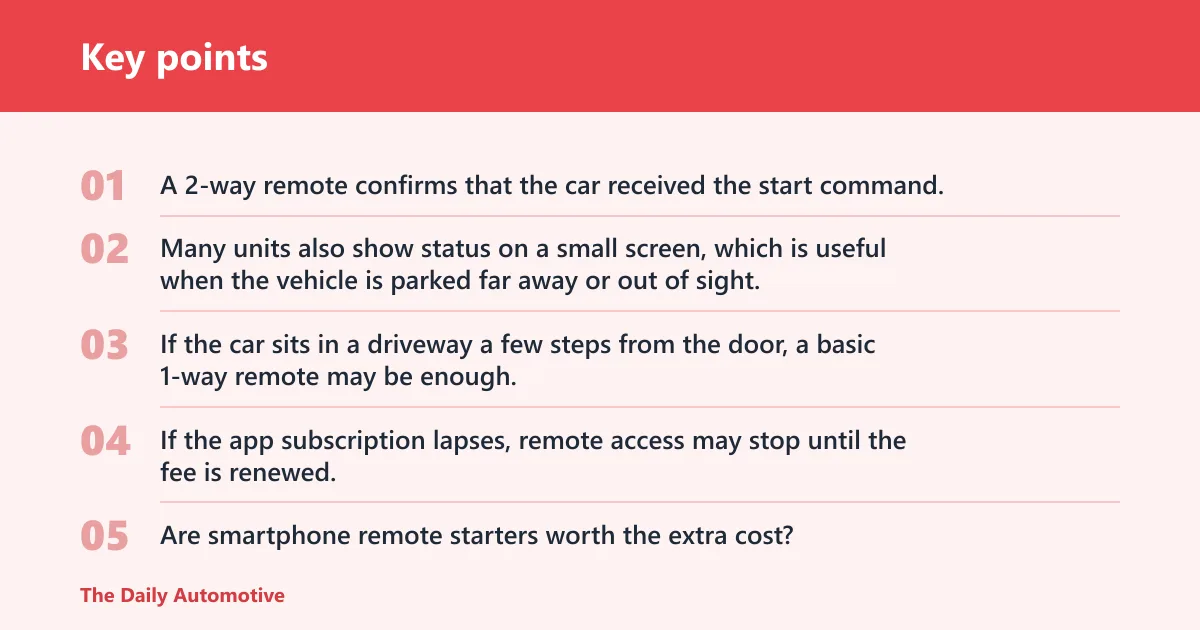
A 2-way remote confirms that the car received the start command. Many units also show status on a small screen, which is useful when the vehicle is parked far away or out of sight.
The premium is usually worth it if you park in a large lot or want a clear confirmation that the engine actually started. If the car sits in a driveway a few steps from the door, a basic 1-way remote may be enough.
Smartphone control and subscription fees
They usually rely on cellular service, so app control can work from much farther away than a standard remote.
That dependence on a phone plan is the tradeoff. If the app subscription lapses, remote access may stop until the fee is renewed.
Are smartphone remote starters worth the extra cost? They can be, if you want distant control, tracking, or multiple drivers using one app. If you only need cold-weather warm-up, a lower-cost key fob system often makes more sense.
Is a remote starter worth the money?
For many drivers, yes, especially in winter. The value comes from warm-up time, defrost convenience, and the ability to get into a cabin that is less cold when you leave. The upgrade makes the most sense when you park outside and use the car daily.
Who benefits most
Commuters, parents with early departures, and drivers in cold climates tend to get the most use out of the feature. A system that saves a few minutes every morning can feel more valuable than a higher upfront price if the car sees frequent winter use.
When a basic system is enough
If the vehicle is a simple keyed model and the car is parked close to home, a basic 1-way remote can be a smart buy. It keeps the bill lower while still delivering the main comfort benefit.
Picture a compact hatchback parked in an uncovered driveway. A basic kit plus labor may be enough. Now picture a push-button SUV with factory security and a phone app requirement; the same convenience can cost much more because the install is more involved.
Frequently asked questions
How much does a remote starter cost for a car?
A remote starter for a car usually costs $250 to $700 all in for a basic professionally installed setup. Hardware often starts around $150 to $300, while labor and any vehicle-specific module can push the total higher. Advanced systems cost more.
How much does a remote starter cost for your car?
Your car’s price depends on its key type, wiring, and security system. An older keyed car often falls near the lower end, while a push-button or manual-transmission vehicle usually needs extra parts and labor that increase the quote.
How much does a remote car starter cost to install?
Installation commonly adds $150 to $400, based on the shop’s hourly rate and the time needed. With labor rates of $75 to $150 per hour and a typical 2 to 5 hour job, complex vehicles can cost notably more.
How much does it cost to put a remote starter in a car?
Putting one in can cost $300 to $700 for a basic system, with advanced setups going higher. If the vehicle needs a bypass module, extra programming, or smartphone connectivity, the total can move well above that range.
What affects remote starter installation price the most?
The biggest price drivers are vehicle complexity, labor time, and whether the car needs a bypass module or extra programming. Push-button cars, manual transmissions, and newer security systems usually cost more than older keyed vehicles.
Is factory remote start cheaper than aftermarket?
Sometimes, but not always. Factory remote start commonly ranges from $500 to $1,200, and retrofits can be expensive. Aftermarket systems can cost less for the same basic function, though the final price depends on parts, labor, and vehicle fit.
Why do quotes for remote start vary so much?
Quotes vary because one installer may include only hardware while another includes labor, a bypass module, and programming. Vehicle differences matter too, and smartphone or 2-way systems usually cost more than a basic 1-way setup.
Products related to this article
Sponsored / affiliate links. As an Amazon Associate I earn from qualifying purchases. I may earn additional commission from eligible campaigns.