Thermacell Heated Car Seat Cover Review: Worth It?
Thermacell heated car seat covers make sense only if you want plug-in warmth for short, cold starts and you can verify the cover fits your seat shape, airbag layout, and power outlet. For most commuters, a documented alternative with clearer specs and easier fit checks is the safer value; a bad fit can slip, heat unevenly, or get in the way of seat functions.
How seat shape and cushion width affect fit and safety
Thermacell is worth a look if your commute starts with a cold cabin, your vehicle has a 12V accessory outlet, and you want a removable seat-warmer instead of a repair or retrofit. It is a weaker buy if you need exact fit on sculpted sport seats, depend on side airbags in the seatback, or want published warm-up and shutoff details before you spend.
Verdict by commute length
For a 5- to 15-minute winter drive, the value is strongest when the seat is cold at startup and the cabin heater has not had time to help. For longer highway commutes, the appeal drops unless the cover fits tightly and stays comfortable the whole way. Long runs make uneven heat easier to notice.
Verdict by climate severity
In mild winters, a heated cover often feels optional. In cold regions with repeated frosty starts, the comfort gain is easier to justify, especially if the vehicle lacks factory heated seats. In deep-cold climates, published warm-up claims matter more than general marketing, because a slow warm-up can leave the first few minutes uncomfortable.
Verdict by seat type
Simple bucket seats are the easiest fit. Wide cushions, aggressive bolsters, and seats with side airbags raise the risk of slippage or blocked features. Thick upholstery can also slow heat transfer, so the same cover may feel stronger in one vehicle and weaker in another.
Quick picks by need
For the clearest value call, choose the product that matches your commute, seat shape, and tolerance for cord management. The best answer is not the same for a short city run, a truck with a tall seatback, or a driver who wants the lowest first-year cost.
| Need | Best fit | Key detail from the listing | One drawback |
|---|---|---|---|
| Short cold starts | Thermacell heated car seat cover | 12V plug-in format is aimed at quick cabin heat on demand | Public specs in the supplied facts are limited |
| Long highway commutes | FOTN Heated Seat Cover | Uses a 12V accessory outlet and warms both the seat bottom and backrest | Cover fit still depends on seat shape and strap security |
| Trucks and SUVs | FOTN Heated Seat Cover | Backrest coverage helps on taller seats | Thicker or sculpted seats can still create fit risk |
| Lowest first-year cost | Trillium Worldwide Car Cozy 2 | Single heat level, safety timer, and 16 x 16 inches | Smaller coverage and fewer controls |
Best for short cold starts
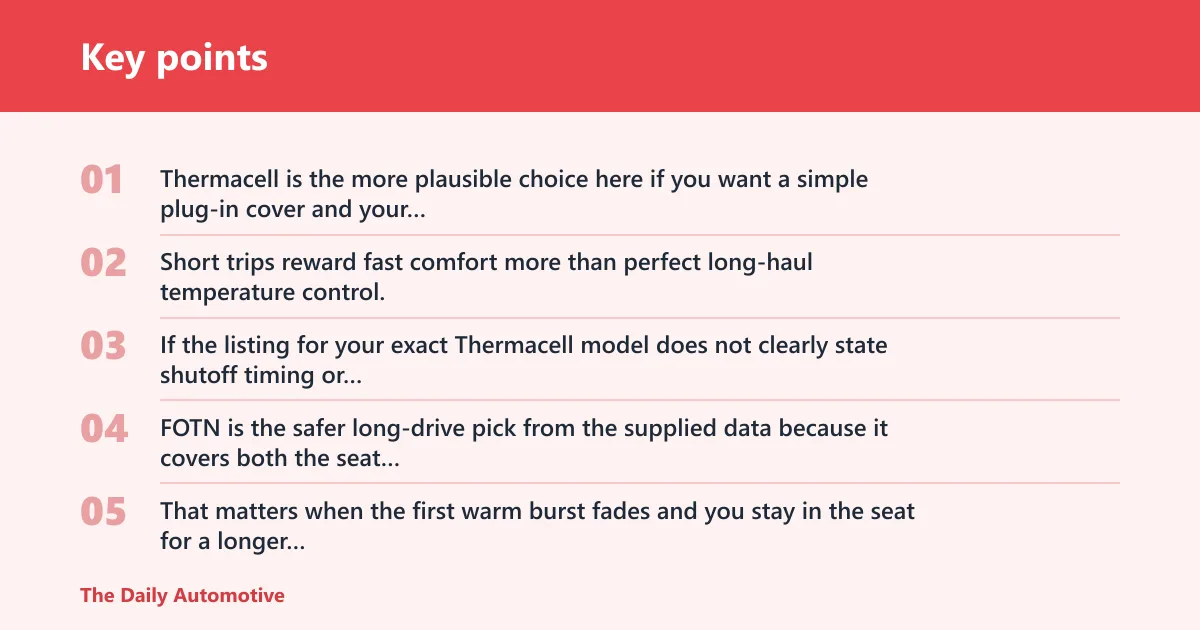
Thermacell is the more plausible choice here if you want a simple plug-in cover and your main complaint is the first few minutes after startup. Short trips reward fast comfort more than perfect long-haul temperature control. If the listing for your exact Thermacell model does not clearly state shutoff timing or fit details, the value drops fast.
Best for long highway commutes
FOTN is the safer long-drive pick from the supplied data because it covers both the seat bottom and backrest. That matters when the first warm burst fades and you stay in the seat for a longer stretch. More coverage usually beats a tiny hot spot on a two-hour commute.
Best for trucks and SUVs
FOTN again has the cleaner case because tall seatbacks benefit from full coverage. Trucks and many SUVs also have broader seats, so the mounting system and cord routing matter more than on a small sedan. A cover that reaches the backrest can feel more stable and more complete.
Best value if you want the lowest first-year cost
Trillium Worldwide Car Cozy 2 is the most restrained option in the supplied facts: one heat level, a safety timer, and a compact 16 x 16-inch size. That can suit a driver who wants basic warmth without paying for extra controls. It is less flexible, but the ownership risk is easier to understand.
What Thermacell claims to do
The supplied facts for Thermacell are thin, and that affects the buying decision. Treat the brand as a 12V plug-in heated seat cover, then confirm the exact listing details before buying. If the product page does not spell out heat settings, shutoff, and coverage area, that gap matters.
12V accessory outlet power
A heated seat cover can be a 12V warming pad for nearly any car, truck, or SUV, and the FOTN Heated Seat Cover explicitly uses a 12V accessory outlet. That makes this type of product easy to install in most vehicles with a working cabin power socket, but it also means cord placement matters every day.
Seat bottom and backrest coverage
Coverage is a major comfort divider. The FOTN cover warms both the seat bottom and backrest, while the Trillium Worldwide Car Cozy 2 measures 16 x 16 inches and is better understood as a compact pad. Thermacell should be judged the same way: check whether it covers only the sitting surface or both major contact zones.
Heat settings and shutoff
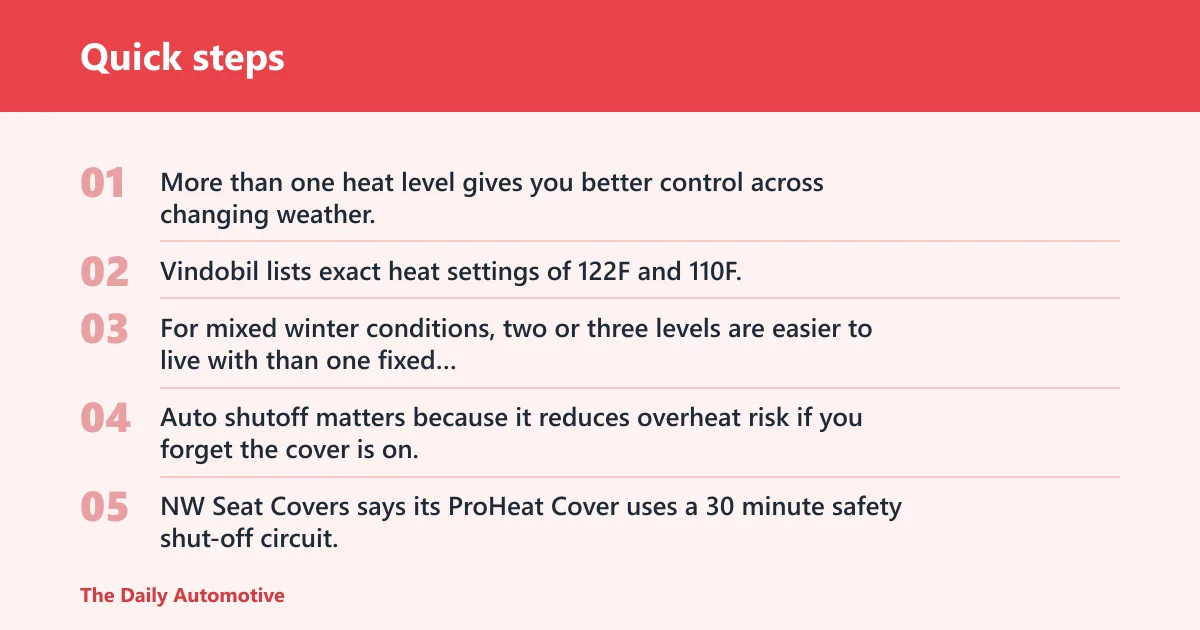
Heat settings change how usable a cover feels across a week of commuting. Vindobil publishes a one-minute warm-up claim and exact heat settings of 122F and 110F. Trillium Worldwide Car Cozy 2 has a single heat level with a safety timer, and NW Seat Covers says its ProHeat Cover uses a 30 minute safety shut-off circuit.
What the listing does not say
The supplied facts do not appear to include Thermacell’s published warm-up time, heat range, shutoff duration, or warranty. That is a problem for a purchase decision, because those details help you compare comfort, safety, and value. If the seller cannot answer them clearly, skip the purchase.
How fast does it warm up?
For winter commuting, warm-up speed is about the first minute, not the final cabin temperature. A good heated seat cover should start to feel warmer quickly, but seat material, thickness, and the size of the heating area all change how fast that warmth reaches your body.
Cold-start comfort
Short trips benefit most from quick warmth at startup. NW Seat Covers says its ProHeat Cover can be warm in about 60 seconds, while Vindobil publishes a one-minute warm-up claim. Those figures matter because the first cold minute is the one drivers feel most.
Published warm-up claims
Published claims help only when they are tied to an actual model. Thermacell does not have a supplied warm-up figure here, so you should not assume it matches the faster claims from other brands. If warm-up speed is your main buying reason, a missing number is a warning sign.
Why seat material changes the feel
Thicker upholstery can slow heat transfer, and a firm or bolstered seat can make the warm area feel smaller than the product description suggests. Say your seat has thick leather and side bolsters. The cover may still heat, but you may feel the warmth later and in a narrower zone than a flatter cloth seat.
Will it fit your seat?
Fit is the biggest day-to-day risk with plug-in heated seat covers. A snug cover stays put, keeps the cord from snagging, and is less likely to interfere with controls. A loose one can shift during entry and exit, which hurts comfort and can make the warm area feel uneven.
Strap-on mounting and cord routing
The seat cover installation system should hold the pad tight enough that it does not creep forward. Cord routing also matters because the plug should not dangle near shifters, pedals, or seat controls. If the cable crosses the driver’s path, the setup is wrong even if the heater itself works.
Airbags and seat sensors
Keep aftermarket seat accessories out of airbag zones and follow the vehicle and product manual. Child restraints and aftermarket seat accessories must be allowed by both the car-seat and vehicle manual. If your seat has side airbags or occupancy sensors, confirm compatibility before installing any heated cover.
Seat shape, bolsters, and headrest clearance
Deep bolsters, tall seatbacks, and unusual headrest shapes can reduce contact and make straps harder to secure. A common first-timer mistake is choosing a heated cover for short commutes, then finding the seat warms unevenly and the controller cord gets in the way of shifting. The result is worse warmth and more cord fuss.
Thermacell decision matrix
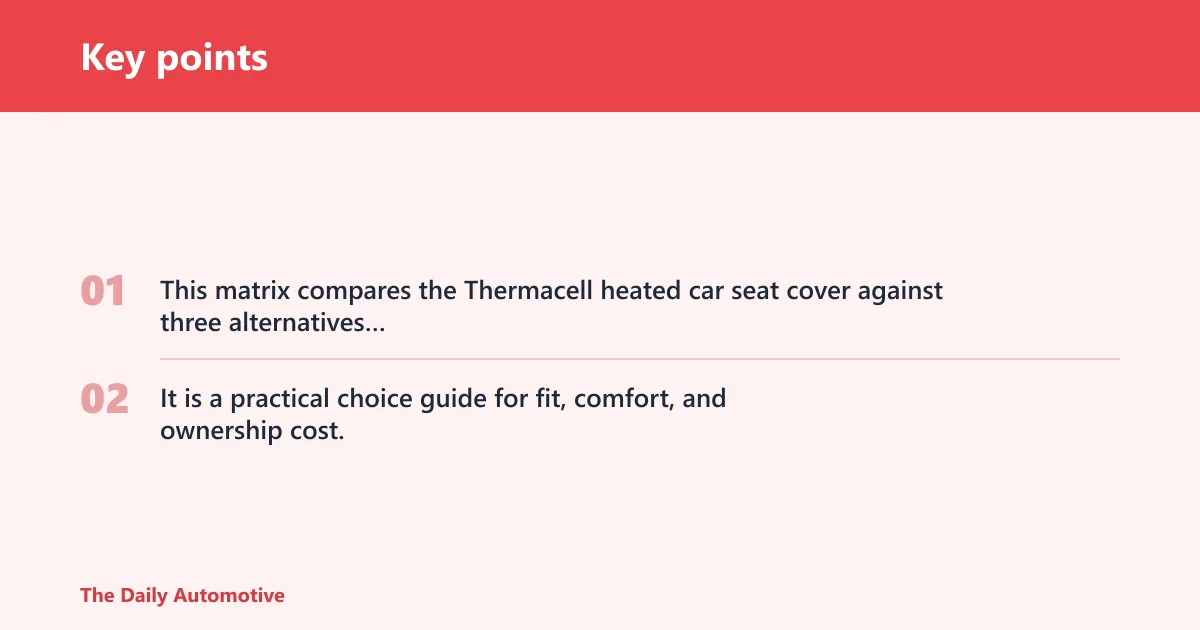
This matrix compares the Thermacell heated car seat cover against three alternatives using the same criteria you can reuse on any winter commute purchase. The point is not a score. It is a practical choice guide for fit, comfort, and ownership cost.
| Criteria | Thermacell heated car seat cover | Budget pad: Trillium Worldwide Car Cozy 2 | Premium cover: FOTN Heated Seat Cover | Retrofit: Drake Off Road Universal Seat Heater Kit |
|---|---|---|---|---|
| Warm-up time | Not published in the supplied facts | Not published here | Not published here | Installation-dependent; check the listing for your model |
| Seat and back coverage | Confirm on the listing before buying | 16 x 16 inches, so coverage is limited | Seat bottom and backrest | Two seats, but coverage depends on install |
| Safety features | Confirm shutoff details before buying | Single heat level with a safety timer | Check the listing for shutoff details | Hardwired to 12V vehicle power; follow the manual |
| Fit risk | Medium to high until seat shape is confirmed | Lower on simple seats, higher on sculpted seats | Medium, because larger coverage adds more strap points | Higher because it is a permanent-style retrofit |
| Cord hassle | Moderate; plug-in cord management matters | Moderate; short pad still needs routing | Moderate; more coverage can mean more cable management | Low after install, but the install itself is more involved |
| Winter usefulness | Best for quick cold starts if the fit is right | Best for basic warmth on a tight budget | Strong for repeated winter use and larger seats | Strongest if you want a more integrated result |
| Durability risk | Unknown from the supplied facts | Limited by simple construction | Unknown from the supplied facts | Install quality matters; hardwired systems are less removable |
| First-year cost | Depends on purchase price and fit success | Lowest likely ownership burden | Higher than a basic pad | Highest due to install effort and parts |
Start with the commute, not the marketing. A short, frosty drive rewards fast warmth and simple controls. A longer commute rewards better backrest coverage, more stable mounting, and a shutoff feature that does not need constant checking.
Heat settings and control method
More than one heat level gives you better control across changing weather. For mixed winter conditions, two or three levels are easier to live with than one fixed setting.
Auto shutoff and overheat protection
Auto shutoff matters because it reduces overheat risk if you forget the cover is on. The same source says its ProHeat Cover uses a 30 minute safety shut-off circuit. If a product does not publish a shutoff duration, treat that as a real information gap, not a minor detail.
Coverage area and material thickness
Do not assume the seat and back heat equally. A larger backrest area can feel much better on a cold morning, especially in a truck or SUV. Thick upholstery can blunt the feeling of warmth, so the better cover on paper may still feel modest on the seat you actually drive.
Plug-in power and cable length
A 12V accessory outlet is the normal power source for this category, and that makes installation simple. Simpler does not mean carefree. If the cord is too short, it can tug at the cover or interfere with the center console. If it is too long, it can become clutter.
When a retrofit makes more sense
Drake Off Road Universal Seat Heater Kit is described as hardwired to 12V vehicle power and intended for two seats. That kind of solution makes more sense if you want a more permanent setup and are willing to accept a more involved install. For leased cars or frequent seat changes, a plug-in cover is easier to undo.
Say your commute is 12 minutes, your seat is flat cloth, and you only want a warm seat bottom before the cabin heat catches up. A simple plug-in cover may be enough. Say the seat has thick leather, side airbags, and strong bolsters. Verify compatibility first, then decide whether the comfort gain is worth the fit risk.
Frequently asked questions
Is a Thermacell heated car seat cover worth it for winter commuting?
It is worth it for drivers who want fast seat warmth on short winter trips and can verify a clean fit on their exact seat. It is less compelling if the listing does not clearly state shutoff, heat levels, or coverage. In that case, a more documented alternative is easier to judge.
How fast does a heated seat cover warm up in cold weather?
Published claims in the supplied facts range from about 60 seconds to one minute for some models, but Thermacell’s figure is not supplied here. Real-world feel depends on seat thickness, upholstery, and how much of the backrest actually heats. Cold-start warmth should be judged in the first minute.
Are plug-in heated seat covers safe to leave on in a car?
Only if the product includes a shutoff feature and the installation follows the manual. An auto shutoff timer reduces overheat risk, but it does not fix a bad fit, a damaged cord, or blocked vents. Keep the cover out of airbag zones and the driver’s view, and check local laws.
What features should I look for in a heated car seat cover?
Look for a clear heat setting list, a published shutoff time, enough coverage for both seat bottom and backrest, and a mounting system that stays tight. For winter use, the best products also make cord routing easy and do not interfere with seat airbags, sensors, or controls.
Will a heated seat cover work with seat airbags and controls?
Sometimes, but only if the product and vehicle manuals allow it. Seats with side airbags, occupancy sensors, or aggressive bolsters need extra caution. Keep aftermarket seat accessories out of airbag zones and avoid anything that blocks switches, lumbar controls, or the seatbelt path.
What is the difference between a heated seat cover and a heated seat kit?
A heated seat cover is usually a removable 12V pad that straps on and plugs into the accessory outlet. A heated seat kit is more permanent and, in the supplied facts, the Drake Off Road Universal Seat Heater Kit is hardwired to 12V vehicle power and covers two seats. Kits usually fit the car less casually and cost more to install.
Products related to this article
Sponsored / affiliate links. As an Amazon Associate I earn from qualifying purchases. I may earn additional commission from eligible campaigns.
 FLORICH Leather Seat Cover, Car Seat Covers Front Set, Waterproof Car Seat Protectors, Front Seat Covers 2 Pack, Breathable Automotive Seat Covers Protector Fit for Most Cars Trucks SUV
 FH Group Car Seat Cover Front Set Striking Striped Car Seat Covers with Front Seat Covers and Rear Split Bench, Universal Fit Interior Accessories for Cars, Trucks, and SUVs – Gray