Best Tire Pressure Gauges for Everyday Cars (2026): We Compared
For everyday cars, a common choice is a simple digital or dial tire pressure gauge with about ±1 psi accuracy, a clear 0.1-psi or 1-psi display, and a chuck that seals easily on tight valve stems. Bad readings can mean underinflated tires, uneven wear, longer stopping distances, and wasted fuel. This guide compares the best gauge types, explains which accuracy and readability features matter, and tells you when an inflator-compatible model is worth the extra money.
Quick comparison
| Product | Badge | Best for | Price | ||
|---|---|---|---|---|---|
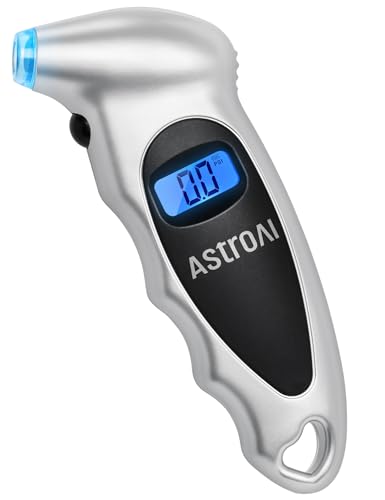 |
AstroAI Digital Tire Pressure Gauge 150PSIAstroAI | Our pick | 150PSI · ±1PSI accuracy · Backlit LCD · Silver | $7.49
Price as of 19 Nov 2026
|
View |
 |
Heavy-Duty Digital Tire Pressure Gauge with InflatorMilton | Upgrade pick | 255 PSI max · 0.1 display resolution · Pistol grip · USA assembled | $83.96
Price as of 19 Nov 2026
|
View |
 |
Digital Tire Pressure Gauge with Inflatorsmilfuy | Also great | 250 PSI · 0.1 display resolution · Quick-connect coupler · Metal & ABS build | $15.59
Price as of 19 Nov 2026
|
View |
Pick the gauge that fits how you actually check tires: fast curbside checks, a garage setup, or a glove box tool that needs no battery. The table below maps those jobs to the features that matter most.
How we chose
The picks below are based on manufacturer specs, listing details, and published buyer feedback. The focus is on everyday use: clear reading in low light, easy valve access, useful accuracy for passenger cars, and a size that can live in the glove box without becoming a nuisance.
We also gave more weight to failure modes shoppers actually run into, including dead batteries, sticky chucks, leaking valve seals, and displays that are hard to read in parking-lot light.
AstroAI digital gauge: best for glove box checks
This is the best fit for drivers who want a small, easy-to-read gauge for routine checks and quick top-offs. The AstroAI digital tire pressure gauge lists ±1 PSI accuracy, a backlit LCD, and a lighted nozzle, which helps when you are checking tires in dim light or at the edge of a parking lot.
Its main strength is convenience. A digital gauge like this gives a direct readout, and the unit switches between four settings with one button press, which is useful if you move between passenger cars, bikes, or other equipment.
The drawback is battery dependence. Digital gauges are easier to read, but if the battery dies at the wrong time, the gauge stops being useful until you replace it.
Milton 555E inflator gauge: best for compressor use
This is the strongest choice for a home garage or a driver who wants a gauge that also inflates tires. The Milton 555E combines a gauge, inflator, hose, and clip-on air chuck, and it is built around a 0.1 display and a 360-degree swivel gauge head for awkward angles.
It is the better pick when you already have, or plan to use, a compressor regularly. The integrated inflator is useful when you want to check pressure and add air without switching tools, and the swivel head helps when the valve stem is tucked behind a wheel design that is hard to reach.
The tradeoff is size and cost. It is more expensive than a basic glove-box gauge, and the hose-and-handle setup is more tool than many daily drivers need.
Smilfuy inflator gauge: best budget inflator option
This is the budget choice for buyers who want inflation capability without paying for a heavier-duty shop tool. The smilfuy gauge combines a digital display with a quick-connect coupler, a 250 PSI maximum, and a metal-and-ABS build that should suit home compressor use.
Its appeal is straightforward: one unit can measure pressure and add air, and the no-leak air chuck with automatic shutoff is aimed at cleaner, safer inflation. That makes it practical for drivers who want a simple garage setup without moving up to a pricier inflator gauge.
The downside is that this style is less compact than a plain gauge. If you mainly want something for the glove box, the hose and coupler add bulk you may not need.
Tire gauge decision table
| Use case | Gauge type | Minimum useful accuracy | Recommended PSI range | Display type | Battery dependence | Compressor compatibility worth it? |
|---|---|---|---|---|---|---|
| Daily commuter, quick monthly checks | Digital or analog | About ±1 psi | 0–75 psi is enough | Clear digital readout or easy-to-read dial | No for analog, yes for digital | No, unless you top off air often |
| Older car or mixed-fleet household | Analog or digital with broad range | About ±1 psi | 0–75 psi or 5–220 psi | Large dial or backlit digital display | No for analog, yes for digital | Maybe, if you use a home compressor |
| SUV, truck, or frequent load changes | Digital or inflator-compatible | About ±1 psi | Broader range helps if pressures vary a lot | Backlit digital display preferred | Yes for digital, no for analog | Yes, if you add air at home |
| Enthusiast or garage setup | Inflator-compatible gauge | About ±1 psi or better | 0–75 psi or wider | Digital display with strong backlight | Usually yes | Yes, if you want one tool for measure-and-fill |
What is the best tire pressure gauge for everyday cars?
The best tire pressure gauge for everyday cars is usually a compact digital or analog model with about ±1 psi accuracy, a readable display, and a chuck that attaches easily to the valve stem. For most drivers, that is enough precision to keep tires near the door-jamb sticker without paying for track-focused gear.
That choice changes if you use a compressor at home. In that case, an air inflator-compatible gauge can be worth the added size because it lets you check and fill tires with one tool.
Why the everyday-driver use case matters
Normal passenger cars do not need a race-gauge setup. What matters most is whether you can get a fast, believable reading before you leave, especially if the gauge lives in a glove box and gets used in cold weather, low light, or a crowded parking lot.
That is also where features like a backlit digital display, a swivel chuck, and a broad but sensible PSI range earn their keep. A broad range is useful if the same gauge might move between cars, SUVs, bikes, or a spare tire.
Is a digital tire pressure gauge better than an analog one?
A digital tire pressure gauge is better if you want quick readability, backlit use at night, and a clear number without squinting at a dial. An analog gauge is better if you want no batteries, a simpler mechanism, and a tool that can sit in the glove box for long periods without power concerns.
The right answer depends on where you use it. Digital wins for parking-lot checks and low light. Analog wins when you want a low-maintenance backup that still works after months of sitting in the car.
Digital gauge strengths and weak points
Digital gauges usually give a direct readout and may offer a backlit display for nighttime adjustments. That is helpful when the valve stem faces inward or you are checking pressure after sunset. The weak point is obvious: they depend on a battery, and battery failure turns a useful tool into dead weight.
Analog gauge strengths and weak points
Analog gauges avoid batteries and have only one moving part. That makes them attractive for durability and simple storage. The tradeoff is readability, since the dial can be harder to interpret in dim light, though some models use glow-in-the-dark dial markings to help.
How to choose one for everyday cars
Start with the pressure range your vehicles actually need. A typical passenger car works fine with a gauge that covers the low end cleanly, while mixed garages and larger vehicles are better served by broader coverage such as 0–75 psi or even 5–220 psi on some models.
Then decide how you read it. If you check tires at night or in a dim garage, a backlit digital display is worth paying for. If you want a low-fuss backup tool, an analog gauge with a readable dial is a sensible choice.
Finally, look at the chuck and the body shape. Swivel chucks with 360-degree rotation are useful on tight wheel designs because they let you reach awkward valve stems without fighting the tool.
-
Check the valve access.
If the wheels have deep pockets, slim spokes, or awkward stem angles, put a swivel chuck near the top of your list. A tool that seals cleanly is easier to use and less likely to leak during the reading.
-
Match the display to your routine.
Choose a backlit digital gauge if you often check tires at dusk, in a garage, or on the roadside. Pick analog if you want a battery-free tool and can live with a less obvious reading in low light.
-
Keep the accuracy target realistic.
For daily driving, about ±1 psi is the practical target. Performance-minded use can justify closer attention to calibration and a more precise display, but most commuters do not need to pay extra for numbers that are finer than their maintenance habits.
-
Decide whether inflation belongs in the tool.
If you already use a compressor at home, an inflator-compatible gauge may save time. If you only want a quick check before work, a simple gauge is lighter, cheaper, and easier to stash.
Should you keep a gauge in the glove box?
Yes. A tire pressure gauge in the glove box makes it more likely you will check pressure when it is easiest to do so, before a long drive or after noticing a slow leak. For everyday cars, convenience matters because the best gauge is the one that is actually available when the tires need attention.
Keep one there if the gauge is compact, the display or dial stays readable, and the body is sturdy enough to survive being moved around with registration papers, sunglasses, and charging cables.
What can go wrong in the glove box?
Heat, vibration, and loose storage can wear out cheap tools. Digital gauges can die from a flat battery, while analog models can become hard to read if the dial face is scratched or the chuck starts leaking at the seal.
That is why the best glove-box gauge is not merely small. It needs to be small and dependable.
Are pencil tire gauges accurate enough for regular use?
Pencil tire gauges can be accurate enough for casual regular use if they are in good condition and you are mainly trying to spot underinflation. They are not the best choice when you want easy readability, repeatable numbers, or low-light use, because the sliding scale can be awkward and hard to read.
If you choose one, treat it as a basic maintenance tool rather than a precision instrument. For most everyday cars, that is acceptable, but a digital or good analog gauge is easier to trust.
Where pencil gauges fall short
The common failure points are simple: the scale can be difficult to read, the chuck can be fiddly on recessed valves, and small variations are easy to miss. That makes them less appealing for drivers who want a fast, one-hand check in a parking space.
If a tire gauge is going to live in the car for months, better ergonomics usually matter more than the price difference.
How accurate do tire pressure gauges need to be?
For most passenger cars, a gauge that is about ±1 psi accurate is enough for routine checks. That level of accuracy supports normal maintenance, where the goal is to stay close to the manufacturer’s recommended pressure rather than to chase track-day precision.
Performance-minded drivers may want more confidence in calibration, but daily commuting does not usually justify a costly precision gauge. The bigger risk is not tiny measurement drift; it is using a hard-to-read or unreliable tool and missing a meaningful drop in pressure.
When calibration matters more
Calibration matters if the gauge is old, has been dropped, or seems inconsistent compared with another known-good gauge. If readings start to vary by more than a pound or two between checks, replace it or compare it against a trusted reference.
Manual gauges that are calibrated to ANSI B40.1 Grade A give buyers a useful benchmark. That standard is a plain way to judge whether a gauge is meant to be read with confidence rather than guessed at.
Can a tire pressure gauge also inflate or deflate tires?
Yes. Some gauges can also be compatible with a compressor, which means they measure pressure and help add air through the same setup. That is most useful for home garages, regular top-offs, and drivers who want one tool instead of a separate gauge and inflator.
For everyday cars, this is optional, not required. A simple gauge is usually enough if you only need a quick reading and plan to top off tires elsewhere.
Simple gauge versus inflator-compatible gauge
A simple gauge is smaller, cheaper, and easier to keep in the glove box. An inflator-compatible gauge is more useful if you already have a compressor and want to avoid switching between tools during maintenance.
Picture a sedan that loses a few psi between seasons. A simple gauge tells you the pressure fast. An inflator-compatible model lets you check the pressure, add air, and recheck without moving from the wheel.
When should you check tire pressure for the most accurate reading?
Check tire pressure when the tires are cold, ideally before driving. That gives the most accurate reading because driving heats the air inside the tire and can raise the number temporarily.
A short wait after parking can help, but the key point is to measure before the tires have picked up road heat. Road & Track’s guidance also says to check before driving.
Simple cold-check routine
-
Park and let tires sit.
Check pressure before driving in the morning or after the car has sat for several hours. That keeps the reading closer to the tire’s true cold pressure.
-
Remove the valve cap carefully.
Keep the cap clean and out of the dirt. A damaged or dirty valve seal can cause a slow leak or a bad seal on the gauge chuck.
-
Seat the chuck firmly.
Press the gauge straight onto the valve stem until it seals. A sticky or loose chuck can cause hiss, poor contact, and a false reading.
-
Compare to the placard.
Use the pressure listed on the vehicle door-jamb placard or owner’s manual, not the number molded on the tire sidewall. If the reading is off, adjust in small steps and recheck.
Say your compact crossover has a rear tire that looks a little low after a week of cold weather. A backlit digital gauge makes that check easier at 7 a.m., while a leaking chuck or flat battery can turn the same job into guesswork.
A common first-timer mistake is checking one front tire, seeing a good number, and assuming the others match. That misses slow leaks, especially on cars with valve stems tucked behind wheel spokes.
Which one should you buy?
If you want the simplest answer, buy the AstroAI digital gauge for a glove-box tool, the Milton 555E if you want a serious inflator-compatible garage gauge, and the smilfuy if you want a lower-cost inflator setup. For most daily drivers, a compact digital or analog gauge with about ±1 psi accuracy is the right call.
If you are choosing between a cheap basic gauge and an inflator-compatible model, decide how often you add air yourself. If the answer is “rarely,” keep it simple. If the answer is “often,” pay for the compressor-friendly setup.
For older cars, SUVs, and mixed-fleet households, a broader PSI range is useful because the same gauge may move between very different tire sizes. For a battery-free backup, analog still has the edge. For parking-lot checks in low light, digital is easier to read.
Frequently asked questions
Should I keep a tire pressure gauge in my glove box?
Yes, if it is compact and readable. A glove-box gauge gets used more often because it is always close at hand, and that makes it easier to catch underinflation before it turns into wear, comfort, or fuel-economy problems.
What should I look for in a good quality tire pressure gauge?
Look for a clear display, useful accuracy, a sealing chuck, and a range that fits your vehicles. A backlit digital display helps at night, a swivel chuck helps on awkward valve stems, and a broad PSI range is useful if you share the gauge across different vehicles.
Products related to this article
Sponsored / affiliate links. As an Amazon Associate I earn from qualifying purchases. I may earn additional commission from eligible campaigns.